Database Sharding Strategies: Horizontal Scaling Patterns for High-Traffic Production Systems
Vertical scaling — buying a bigger server — has a physical and economic ceiling. When a single PostgreSQL table hits 500 million rows, even the most powerful RDS instance starts showing query degradation on indexed lookups. Read replicas solve read throughput but cannot address write bottlenecks. Database sharding distributes both read and write load horizontally across multiple nodes, enabling virtually unlimited scale.
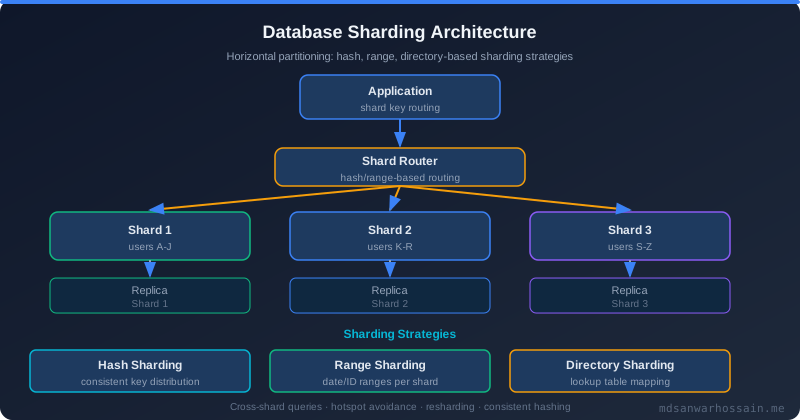
Table of Contents
The Real-World Problem: 500 Million Row Table
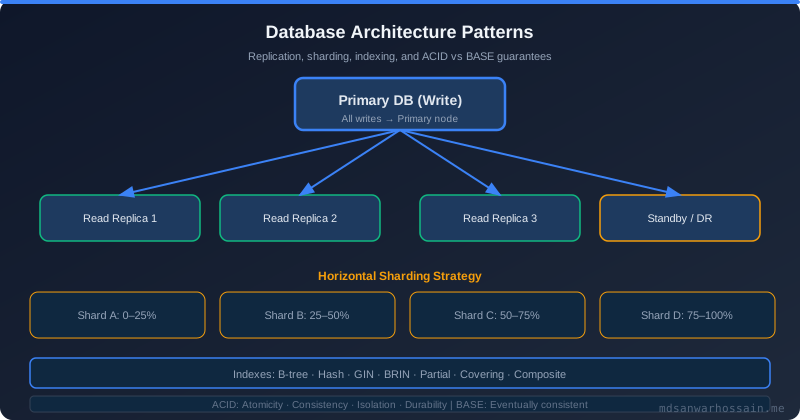
Consider an e-commerce platform that has been in production for three years. Its orders table has grown to 500 million rows. The auto-increment primary key B-tree index now occupies 8 GB of disk, consuming the majority of PostgreSQL's shared_buffers. Complex reporting queries that join orders with order items and customer records are timing out at 30 seconds under peak load. The write throughput has hit a ceiling of approximately 8,000 transactions per second — the limit of the largest available RDS instance class.
The engineering team walked through a deliberate decision tree before committing to sharding. First, they added read replicas: this solved the read load but the write bottleneck on the primary remained. Next, they implemented PostgreSQL native partitioning using PARTITION BY RANGE on the created_at column, splitting data into monthly partitions. This improved VACUUM performance and query pruning for time-bounded queries, but all writes still flowed to a single primary database server — no relief on write throughput or storage hotspots. Finally, the team evaluated managed distributed SQL options: Aurora with write forwarding (still single writer), CockroachDB (compelling but a significant operational migration with licensing cost), and Google Spanner (prohibitive cost at their scale). They chose sharding across multiple independent PostgreSQL instances as the path that preserved their existing application investment and team expertise while achieving the required write scalability.
The key insight driving this decision: at 8,000 TPS, no amount of vertical scaling would get them to their three-year target of 50,000 TPS. Only horizontal distribution of writes across independent nodes could close that gap.
Sharding Fundamentals
A shard key is the field used to route every query to the correct shard node. It is the single most critical design decision in any sharded architecture — it cannot be changed without a full data migration after the system is in production.
There are two physical configurations for shards. Physical shards are fully independent database servers with separate storage, separate compute, and separate connection pools. Logical shards are multiple schemas or databases hosted on a single physical server. Start with logical shards: create 4–8× more logical shards than you have physical nodes. When a physical node becomes a bottleneck, you migrate a logical shard to a new physical server without changing the application's shard routing logic — the logical-to-physical mapping simply updates in the routing layer.
The cardinal rule of sharded queries: every query must include the shard key in the WHERE clause. A query without the shard key requires scatter-gather execution — the routing layer fans out the query to every shard and merges results at the application layer. This is an O(n) cost that grows linearly with shard count and eliminates most of the scalability benefit of sharding. If your access patterns frequently need to query without the shard key, sharding is the wrong solution, or you have chosen the wrong shard key.
Pre-sharding is the practice of provisioning more logical shards than you need at launch. A system that starts with 64 logical shards across 4 physical nodes can scale to 64 physical nodes by moving logical shards one at a time — each move is a simple online replication + cutover. A system that starts with exactly 4 shards on 4 physical nodes must rebalance a large fraction of its data when adding a fifth server.
Range-Based Sharding
Range-based sharding assigns contiguous value ranges to shards: user_id 1–10,000,000 on Shard 1, 10,000,001–20,000,000 on Shard 2, and so on. The routing logic is a simple range lookup — fast and deterministic.
Strengths: range queries are efficient and stay on a single shard. ORDER BY user_id LIMIT 20 never needs to cross shard boundaries. Date-range sharding — assigning orders by the month they were created — aligns perfectly with time-series access patterns where the most common queries ask for "last 30 days" or "this quarter".
The write hotspot trap: if you shard on an auto-increment ID, every new insert goes to the shard that owns the highest range — the latest shard handles 100% of new writes while all other shards sit idle for inserts. Solutions include using non-sequential IDs (UUID v4 distributes inserts uniformly; Twitter Snowflake ID encodes time but adds a machine ID component that distributes writes across shards), or implementing time-based rotation where a new shard becomes the active write target each quarter.
def get_shard_id(user_id: int) -> str:
    shard_ranges = [
        (1,          10_000_000,  "shard-01"),
        (10_000_001, 20_000_000,  "shard-02"),
        (20_000_001, 30_000_000,  "shard-03"),
    ]
    for start, end, shard in shard_ranges:
        if start <= user_id <= end:
            return shard
    # Route new IDs to the currently active write shard
    return "shard-latest"
In production, the range table is typically stored in a fast in-memory data structure (a sorted array or a skip list) and loaded at application startup. Updates to shard ranges during a migration event are pushed via a configuration service like Consul or Zookeeper.
Hash-Based Sharding and the Mod-N Problem
Hash-based sharding computes shard_number = hash(shard_key) % N to assign keys to shards. A good hash function (MurmurHash3, xxHash) distributes keys with near-perfect uniformity regardless of the distribution of the underlying data values — there are no hotspots caused by skewed data ranges.
Weakness: range queries require scatter-gather. Hashing destroys the ordering of keys. A query for all orders placed by users 1 through 1,000 must be sent to all shards because hashing scatters those user IDs unpredictably. This is an acceptable trade-off for workloads that are primarily point lookups.
The deeper problem with mod-N sharding is elastic scaling. When you increase N from 4 to 5 shards, the mapping hash(key) % 4 vs hash(key) % 5 produces completely different shard assignments for approximately 4/5 of all keys. A migration from 4 to 5 shards requires moving roughly 80% of the dataset. This makes adding capacity extremely expensive.
-- Application-level shard routing using PostgreSQL's HASHTEXT function
-- The application computes this and opens a connection to the correct shard
SELECT node_dsn
FROM   shard_routing
WHERE  shard_id = ABS(HASHTEXT(order_id::text)) % 4;
Hash sharding is the right choice for write-heavy workloads where distribution uniformity matters more than range query efficiency: activity feed events, session stores, rate-limiting counters keyed by IP address, and similar use cases where point-lookup performance under high write concurrency is the primary concern.
Consistent Hashing — Solving the Mod-N Problem
Consistent hashing places both nodes and keys on a conceptual hash ring (a circular number line from 0 to 2^64). Each physical node owns multiple virtual nodes (vnodes) distributed at random positions around the ring. To route a key, hash it to find its position on the ring, then walk clockwise to the nearest vnode — that vnode's owner serves the key.
Why vnodes solve elastic scaling: when you add a new physical node, you assign it a set of vnodes distributed around the ring. Each new vnode only displaces the single clockwise neighbor that previously owned that ring segment. On average, only 1/N of the data set needs to move when a node is added or removed, regardless of the total number of keys. This is what enables Cassandra, DynamoDB, and Riak to add capacity with minimal data movement.
public class ConsistentHashRing {
    private final TreeMap<Long, String> ring = new TreeMap<>();
    private final int virtualNodes;

    public ConsistentHashRing(int virtualNodes) {
        this.virtualNodes = virtualNodes;
    }

    public void addNode(String node) {
        for (int i = 0; i < virtualNodes; i++) {
            long hash = hash(node + "-vnode-" + i);
            ring.put(hash, node);
        }
    }

    public void removeNode(String node) {
        for (int i = 0; i < virtualNodes; i++) {
            long hash = hash(node + "-vnode-" + i);
            ring.remove(hash);
        }
    }

    public String getNode(String key) {
        if (ring.isEmpty()) throw new IllegalStateException("No nodes in ring");
        long hash = hash(key);
        Map.Entry<Long, String> entry = ring.ceilingEntry(hash);
        // Wrap around to the first node if past the last vnode
        return (entry != null ? entry : ring.firstEntry()).getValue();
    }

    private long hash(String key) {
        // MurmurHash3 provides excellent distribution quality
        return Hashing.murmur3_128()
                      .hashString(key, StandardCharsets.UTF_8)
                      .asLong();
    }
}
The vnode count is a tuning parameter: too few vnodes means poor load balance; too many adds memory overhead to the routing table. 150–200 vnodes per physical node is a common production value used by Cassandra. Choose consistent hashing over mod-N whenever you expect to add or remove nodes frequently — the reduced migration cost during scaling events is worth the implementation complexity.
Directory-Based Sharding
Directory-based sharding maintains a lookup table that maps each shard key value (or range of values) to a specific shard node. The routing layer performs a lookup — SELECT shard_id FROM shard_directory WHERE tenant_id = ? — before connecting to the correct shard.
This approach offers maximum flexibility. Individual tenants or entities can be moved between shards at any time by updating a single row in the directory — no data migration is needed to rebalance load. A large enterprise customer that generates 10% of all traffic can be migrated to a dedicated shard without disrupting any other tenant.
The bottleneck risk: the directory table itself must handle every query lookup. In high-throughput systems, this means the directory must be cached aggressively. The standard pattern is write-through caching in Redis or Memcached with a TTL of 60 seconds. The shard directory database is a single point of failure — it must be deployed with high availability (primary + replica + automatic failover). A stale cache entry sending queries to the wrong shard after a migration is a real operational risk; the TTL must account for this.
Directory-based sharding is used by Pinterest (pin routing), GitHub (repository routing), and most large multi-tenant SaaS platforms. It is the best choice when: you have a multi-tenant architecture where individual tenant isolation and migration are requirements; shard assignment is driven by business logic rather than a pure mathematical function; or when you need the ability to move specific high-value entities to dedicated infrastructure.
Cross-Shard Operations
Sharding breaks the relational assumption that all data lives in one place. Cross-shard operations are the unavoidable operational cost of that trade-off.
Distributed transactions (two-phase commit): the application must acquire locks on both shards, execute the writes, and then release them. 2PC is blocking — a coordinator failure during the commit phase can leave shards in an inconsistent locked state. It adds significant latency and is typically avoided in high-throughput sharded systems. Instead, design the data model so that all mutations related to a single business transaction touch only one shard — achieved by co-locating related entities on the same shard using the same shard key.
Scatter-gather queries: when a query cannot include the shard key, the routing layer fans out to all N shards, waits for all responses, and merges and sorts the results in memory at the application layer. The latency of a scatter-gather query is bounded by the slowest shard response. With 16 shards under normal load, the 99th percentile of the slowest shard can be significantly higher than the p99 of any individual shard — this is the coordinated omission problem. Scatter-gather is acceptable for background analytics but should never be on a user-facing critical path.
Avoiding cross-shard joins through denormalization: embed the data you need directly in the shard. Instead of storing customer_id in the orders table and joining to the customers table on a different shard, embed customer_email, customer_name, and shipping_address directly in the order record at write time. Storage is cheap; cross-shard latency is not.
Global tables: configuration data, country codes, product categories, and other small, rarely-changing reference data can be replicated to all shards. Each shard has a local copy of the global table, eliminating the need for cross-shard lookups for these entities entirely.
Resharding Without Downtime
Resharding — changing the shard count or the shard key — is the hardest operational challenge in a sharded system. The goal is to complete the migration while the system continues serving production traffic.
The dual-write pattern is the standard technique:
- Deploy a new application version that writes to both the old and new sharding schemes simultaneously. New writes are now present in both.
- Launch background backfill jobs that copy historical data from the old scheme to the new scheme. Rate-limit these jobs to avoid saturating the source shards — typically run at 20–30% of available I/O capacity.
- Validate consistency: run checksum comparison between old and new scheme for each entity class. Alert on any discrepancy.
- Switch reads to the new scheme one service at a time using feature flags. Monitor error rates closely at each step.
- Once 100% of reads are on the new scheme and backfill is complete, remove the old-scheme writes from the application.
Production tooling: Vitess (YouTube's MySQL sharding proxy) handles online resharding with minimal downtime through VReplication, which streams changes from source shards to destination shards while the system is live. Citus (PostgreSQL sharding extension) supports online shard rebalancing. pg_logical can serve as a replication substrate for custom migration pipelines that need fine-grained control over the cutover process.
"The cost of resharding is proportional to how well you chose your initial shard key. A correctly chosen shard key — one aligned with your dominant access pattern and chosen to distribute writes evenly — is worth weeks of design time upfront."
Failure Scenarios
Hot shard problem: a single shard receives a disproportionate share of traffic — often 60–80% — because a small number of high-activity entities (power users, viral posts, popular products) hash to the same shard. Detection requires per-shard QPS and latency monitoring, not just aggregate cluster metrics. Mitigation options: move hot entities to a dedicated shard via directory-based routing; split the hot shard into two with a finer-grained key range; add a caching layer in front of the hot shard to absorb reads.
Replication lag: a shard's read replica falling behind the primary by several seconds means reads from that replica see stale data. Unlike a monolithic database where stale reads are uniformly distributed, in a sharded system a lagging replica affects only the subset of users whose data lives on that shard — making it harder to detect without per-shard lag monitoring.
Partial availability: when a single shard goes down, only the users whose data lives on that shard are affected. This is both a failure isolation benefit (a shard failure affects 1/N of users rather than all users) and a debugging challenge (a 10% user impact incident is less obvious in global metrics than a full outage). This asymmetry means per-shard health checks and per-shard error rate alerting are non-negotiable in production.
Scatter-gather timeouts under load: when a scatter-gather query fans out to 16 shards and several are running hot, the tail latency of the aggregated result exceeds the query timeout. The fix is aggressive timeout tuning on individual shard queries and circuit breakers that return partial results (with a header indicating incomplete data) rather than waiting indefinitely for slow shards.
When Not to Shard
Sharding multiplies operational complexity by a factor of N: N databases to back up, monitor, patch, upgrade, and fail over. Before committing to sharding, exhaust every simpler alternative.
Step 1 — Vertical scaling: modern cloud instances can provide several terabytes of RAM and extremely fast NVMe storage. A well-tuned PostgreSQL instance on a high-memory instance can handle far more load than most teams realize.
Step 2 — Query and index optimization: a missing index on a frequently-queried column can simulate the symptoms of a capacity problem. Use EXPLAIN (ANALYZE, BUFFERS) rigorously on every slow query before declaring a capacity problem.
Step 3 — Read replicas: if the bottleneck is read throughput, not write throughput, read replicas are dramatically simpler than sharding. Route read-only queries to replicas; writes go to the primary.
Step 4 — PostgreSQL native partitioning: PARTITION BY RANGE on a date column splits a large table into smaller physical files while preserving a single logical table interface. This improves VACUUM, partition pruning for time-bounded queries, and allows archiving old partitions to cold storage. It does not help with write throughput but solves many maintenance and query performance problems.
Step 5 — CQRS read model: offload complex multi-join reporting queries to a separate read model materialized in Elasticsearch, a data warehouse, or PostgreSQL materialized views, updated asynchronously via CDC. This removes heavy analytical queries from the OLTP path entirely.
Step 6 — Managed distributed SQL: CockroachDB, YugabyteDB, and Google Spanner handle distribution transparently. They are not free of trade-offs (different consistency models, higher per-query latency than a single-node database), but they eliminate the sharding complexity from the application layer. Evaluate these before building a custom sharding solution.
Key Takeaways
- Choose your shard key with extreme care — it is the most consequential design decision and cannot be changed without a full data migration. Align it with your dominant access pattern.
- Prefer consistent hashing over mod-N when you expect to add or remove nodes. Consistent hashing limits data movement to 1/N of the dataset per scaling event versus most of the dataset for mod-N.
- Avoid cross-shard transactions — design your data model so that all fields needed for a single business transaction live on the same shard. Denormalize aggressively to prevent cross-shard joins.
- Use directory-based sharding for multi-tenancy — it allows individual tenant migration between shards for load balancing, and supports the isolation requirements of enterprise SaaS contracts.
- Exhaust simpler alternatives first: vertical scaling, query optimization, read replicas, native partitioning, and CQRS read models before committing to sharding.
- Pre-shard with logical shards — provision 4–8× more logical shards than physical nodes at launch to enable elastic scaling by migrating logical shards to new hardware without application changes.
Leave a Comment
Related Posts

Software Engineer · Java · Spring Boot · Microservices