Java Generics Deep Dive: Type Erasure, Wildcards & PECS Principle Explained
Java Generics are one of the most powerful yet misunderstood features of the language. From interview candidates who can recite PECS but cannot explain why it works, to senior engineers who avoid wildcards out of confusion — generics cause more confusion than almost any other Java topic. This guide cuts through the theory and explains exactly what happens at compile time and runtime, with production-grade patterns you can apply immediately.
TL;DR — Key Takeaway
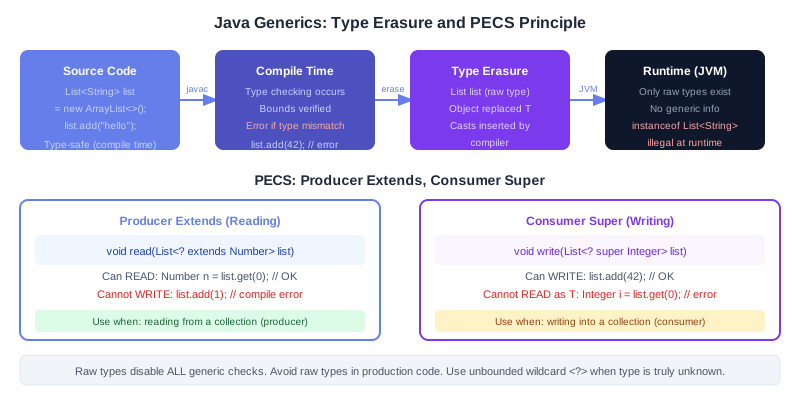
"Java generics are compile-time only — the JVM sees raw types at runtime (type erasure). Use <? extends T> to read from a producer, <? super T> to write to a consumer (PECS). Avoid raw types: they disable all generic safety checks and are a regression to pre-Java-5 code."
Table of Contents
- Why Generics Exist: The Pre-Java-5 Cast Nightmare
- Type Erasure: What Happens at Compile Time vs Runtime
- Bounded Type Parameters: extends and super
- PECS: Producer Extends, Consumer Super
- Generic Methods: When the Type Parameter Is on the Method
- Wildcards vs Type Parameters: When to Use Each
- Reifiable vs Non-Reifiable Types
- Common Generics Pitfalls in Production
- Generics with Varargs and Heap Pollution
- Conclusion & Quick Reference
1. Why Generics Exist: The Pre-Java-5 Cast Nightmare
Before Java 5 (2004), all collection APIs worked with raw Object types. Every insertion and retrieval required explicit casting, and type errors only appeared at runtime — often in production. This was the norm:
// Pre-Java-5: raw types, runtime ClassCastException lurking
List names = new ArrayList();
names.add("Alice");
names.add("Bob");
names.add(42);  // compiles fine — disaster waiting to happen

// At some point later, far away in the codebase...
String name = (String) names.get(2);  // ClassCastException at runtime!

// After Java 5 generics:
List<String> names = new ArrayList<>();
names.add("Alice");
names.add(42);  // compile error: incompatible types — caught immediately!
Generics were introduced to move type errors from runtime to compile time. They provide type safety, eliminate most explicit casts, and enable better IDE tooling. The key insight: generics are entirely a compiler feature — the JVM has no concept of them.
Generic Class and Interface Declaration
// Generic class with single type parameter
public class Box<T> {
    private T value;

    public Box(T value) { this.value = value; }
    public T get() { return value; }
    public <R> Box<R> map(Function<T, R> mapper) {
        return new Box<>(mapper.apply(value));
    }
}

// Generic interface
public interface Repository<T, ID> {
    T findById(ID id);
    List<T> findAll();
    T save(T entity);
    void deleteById(ID id);
}

// Multiple bounded type parameters
public class Pair<A extends Comparable<A>, B> {
    private final A first;
    private final B second;
    // ...
}
2. Type Erasure: What Happens at Compile Time vs Runtime
Type erasure is the mechanism by which the Java compiler removes all generic type information after type checking. The resulting bytecode looks exactly like pre-generic code — with Object replacing type parameters and compiler-inserted casts where needed.
The Erasure Process in Detail
// Source code (what you write):
public class Box<T> {
    private T value;
    public T get() { return value; }
}
Box<String> box = new Box<>("hello");
String s = box.get();

// After type erasure (what the JVM sees in bytecode):
public class Box {
    private Object value;        // T erased to Object
    public Object get() { return value; }
}
Box box = new Box("hello");
String s = (String) box.get();  // compiler inserts cast

// With bounded type parameter — erased to bound, not Object:
public class NumberBox<T extends Number> {
    private T value;
    public double doubleValue() { return value.doubleValue(); } // T -> Number
}
// Erased to:
public class NumberBox {
    private Number value;                                   // T -> Number
    public double doubleValue() { return value.doubleValue(); }
}
Consequences of Type Erasure
- Cannot use instanceof with generic types:
obj instanceof List<String>is a compile error — useobj instanceof List<?> - Cannot create generic arrays:
new T[10]is forbidden; usenew Object[10]and cast, or useArray.newInstance() - Cannot create instances of type parameters:
new T()is illegal; use aSupplier<T>orClass<T>token - Static fields cannot use the class type parameter:
static T defaultValueis illegal — statics are shared across all parameterizations - Cannot catch generic exception types:
catch (T e)where T extends Throwable is forbidden
// Runtime type token pattern — workaround for type erasure
public class TypeSafeContainer<T> {
    private final Class<T> type;
    private final List<Object> items = new ArrayList<>();

    public TypeSafeContainer(Class<T> type) { this.type = type; }

    public void add(T item) { items.add(item); }

    public T get(int index) {
        return type.cast(items.get(index));  // safe cast using Class token
    }
}

TypeSafeContainer<String> c = new TypeSafeContainer<>(String.class);
c.add("hello");
String s = c.get(0); // type-safe, no unchecked warning3. Bounded Type Parameters: extends and super
Unbounded type parameters (T) accept any type. Bounded type parameters constrain the range of acceptable types, enabling access to methods from the bound.
Upper Bounded: <T extends X>
// T must be Number or a subtype of Number
public <T extends Number> double sum(List<T> list) {
    double total = 0;
    for (T item : list) {
        total += item.doubleValue();  // can call Number methods!
    }
    return total;
}

// Multiple bounds — class must come first, interfaces after &
public <T extends Comparable<T> & Serializable> T findMin(List<T> list) {
    return list.stream().min(Comparator.naturalOrder()).orElseThrow();
}

// Upper bounded wildcard (different from bounded type param!)
public double sumWildcard(List<? extends Number> list) {
    return list.stream().mapToDouble(Number::doubleValue).sum();
}
Lower Bounded: <? super X>
// Can add Integers (and subtypes) to the list
public void addNumbers(List<? super Integer> list) {
    list.add(1);
    list.add(2);
    list.add(3);
    // Reading: only safe as Object
    Object obj = list.get(0);  // compiles but loses type info
}

// Accepts List<Integer>, List<Number>, List<Object>
addNumbers(new ArrayList<Integer>());  // OK
addNumbers(new ArrayList<Number>());   // OK
addNumbers(new ArrayList<Object>());   // OK
addNumbers(new ArrayList<Double>());   // compile error: Double is not supertype of Integer
4. PECS: Producer Extends, Consumer Super
PECS is Joshua Bloch's mnemonic from Effective Java for deciding which wildcard to use. It has a simple rule: if the collection produces values you read from it, use ? extends T. If it consumes values you write into it, use ? super T.
The Mental Model
Producer (source you read from): List<? extends Animal> — could be a List<Dog>, List<Cat>, or List<Animal>. You can safely read Animal objects, but cannot safely add (you don't know the exact type). Consumer (sink you write into): List<? super Dog> — could be List<Dog>, List<Animal>, or List<Object>. You can safely add Dog objects, but reading gives you only Object.
// Classic PECS example: copy from source (producer) into dest (consumer)
public static <T> void copy(List<? extends T> src, List<? super T> dest) {
    for (T item : src) {
        dest.add(item);
    }
}

List<Integer> ints = List.of(1, 2, 3);
List<Number> nums = new ArrayList<>();
copy(ints, nums);  // Integer extends Number: src=producer, dest=consumer ✓

// Real-world: Collections.sort uses PECS
public static <T> void sort(List<T> list, Comparator<? super T> c) {
    // Comparator is a consumer of T — it reads T values to compare them
    // ? super T means it accepts Comparator<T>, Comparator<SuperclassOfT>, etc.
}

// Practical example: generic merge sort
public <T extends Comparable<? super T>> List<T> mergeSort(List<T> list) {
    // ? super T: uses compareTo from T or any supertype that T's compareTo delegates to
    if (list.size() <= 1) return list;
    int mid = list.size() / 2;
    List<T> left = mergeSort(new ArrayList<>(list.subList(0, mid)));
    List<T> right = mergeSort(new ArrayList<>(list.subList(mid, list.size())));
    return merge(left, right);
}
5. Generic Methods: When the Type Parameter Is on the Method
Generic methods have their own type parameter list, declared before the return type. They enable type inference at the call site and are more flexible than wildcards for methods that need to relate types between parameters and return values.
public class GenericUtils {
    // Type parameter on method — inferred from argument
    public static <T> Optional<T> findFirst(List<T> list, Predicate<T> predicate) {
        return list.stream().filter(predicate).findFirst();
    }

    // Multiple type parameters relating input to output
    public static <K, V> Map<V, K> invertMap(Map<K, V> original) {
        return original.entrySet().stream()
            .collect(Collectors.toMap(Map.Entry::getValue, Map.Entry::getKey));
    }

    // Bounded generic method
    public static <T extends Comparable<T>> T clamp(T value, T min, T max) {
        if (value.compareTo(min) < 0) return min;
        if (value.compareTo(max) > 0) return max;
        return value;
    }

    // Factory pattern using Class token to work around type erasure
    public static <T> T createInstance(Class<T> clazz) throws ReflectiveOperationException {
        return clazz.getDeclaredConstructor().newInstance();
    }
}

// Usage — type inferred automatically:
Optional<String> result = GenericUtils.findFirst(names, s -> s.startsWith("A"));
Map<Integer, String> inverted = GenericUtils.invertMap(Map.of(1, "one", 2, "two"));
int clamped = GenericUtils.clamp(15, 0, 10);  // returns 10
6. Wildcards vs Type Parameters: When to Use Each
Choosing between a wildcard (?) and a named type parameter (T) is a common source of confusion. The key distinction: use a named type parameter when you need to relate types between parameters or return value; use wildcards when you only need flexibility without relating types.
| Scenario | Use | Example |
|---|---|---|
| Return type depends on parameter type | <T> named param | <T> T first(List<T> list) |
| Two params must have same type | <T> named param | <T> void swap(T[] a, int i, int j) |
| Read-only, no relationship needed | ? extends T | void print(List<?> list) |
| Write-only sink collection | ? super T | void fill(List<? super T> dest) |
| API with maximum flexibility | ? extends T | Collections.sort wildcard comparator |
7. Reifiable vs Non-Reifiable Types
A reifiable type has complete type information available at runtime. A non-reifiable type loses type information due to erasure. This distinction matters for arrays, instanceof checks, and varargs.
- Reifiable: primitive types (
int,long), raw types (List), unbounded wildcards (List<?>), non-generic classes (String), arrays of reifiable types (String[]) - Non-reifiable: parameterized types like
List<String>,Map<K,V>, generic type parameters likeT, bounded wildcards likeList<? extends Number>
// ILLEGAL — cannot create generic array (T not reifiable)
T[] array = new T[10];  // compile error

// LEGAL alternatives:
@SuppressWarnings("unchecked")
T[] array = (T[]) new Object[10];  // unchecked cast warning

// Or use ArrayList<T> instead of T[]

// instanceof with non-reifiable types:
Object obj = new ArrayList<String>();
if (obj instanceof List<?>) { }         // OK — unbounded wildcard is reifiable
if (obj instanceof List<String>) { }    // compile error — non-reifiable type

// Checking at runtime with reflection:
boolean isList = List.class.isInstance(obj);  // OK — uses raw type
8. Common Generics Pitfalls in Production
Pitfall 1: Raw Types Break All Safety Checks
// Using raw type infects the ENTIRE type safety:
List rawList = new ArrayList<String>();
rawList.add(42);  // no compile warning when using raw type!

List<String> strings = rawList;  // unchecked assignment
String s = strings.get(0);  // ClassCastException at runtime!
Pitfall 2: Invariance — List<Dog> is NOT a List<Animal>
// Java arrays are covariant (and this is a design flaw):
Animal[] animals = new Dog[5];   // compiles
animals[0] = new Cat();          // compiles but throws ArrayStoreException at runtime!

// Java generics are INVARIANT — this is intentional and correct:
List<Animal> animals = new ArrayList<Dog>();  // compile error!
// If this were allowed: animals.add(new Cat()) would corrupt the Dog list

// Use wildcards for covariance when needed:
List<? extends Animal> animals = new ArrayList<Dog>();  // OK, but read-only
Pitfall 3: Overloading with Erasure Conflicts
// These two methods have the same erasure — compile error:
public void process(List<String> list) { }
public void process(List<Integer> list) { }  // ERROR: same erasure List

// Fix: use different method names or different parameter structure:
public void processStrings(List<String> list) { }
public void processIntegers(List<Integer> list) { }
// or use a generic method:
public <T> void process(List<T> list, Class<T> type) { }
9. Generics with Varargs and Heap Pollution
Heap pollution occurs when a variable of a parameterized type refers to an object of a different type. Generic varargs are particularly problematic because varargs create arrays, and generic arrays are non-reifiable.
// This method causes heap pollution — unchecked warning:
public static <T> List<T> asList(T... elements) {
    // elements is actually Object[] at runtime, not T[]
    // If the array is modified externally, it can cause ClassCastException later
    return Arrays.asList(elements);
}

// @SafeVarargs: promise to compiler that the method doesn't pollute the heap
@SafeVarargs
public static <T> List<T> listOf(T... elements) {
    // Safe only if: we don't store the array, don't pass it to untrusted code
    return Collections.unmodifiableList(Arrays.asList(elements));
}

// Classic heap pollution example:
@SafeVarargs  // WRONG — this method DOES cause pollution
static <T> T[] toArray(T... args) {
    return args;  // returns the backing array — do NOT annotate as SafeVarargs!
}

String[] strings = toArray("a", "b");  // heap pollution!
Object[] objects = toArray("a", "b");
objects[0] = new Integer(1);           // ArrayStoreException!
Only annotate with @SafeVarargs if the method does not store or expose the varargs array. The annotation suppresses the compiler warning — it does not make the code safe; that is your responsibility to verify.
10. Conclusion & Quick Reference
Java Generics require understanding both the compile-time model (type checking, bounds, PECS) and the runtime model (type erasure, reifiability). Master these rules and you will write APIs that are both flexible and type-safe.
Quick Reference Checklist
- ✅ Never use raw types — always parameterize generics
- ✅ PECS: Producer =
? extends T, Consumer =? super T - ✅ Use named type parameters when return type must relate to input types
- ✅ Use unbounded wildcard
?when the type is truly irrelevant - ✅ Remember:
List<Dog>is NOT aList<Animal>— generics are invariant - ✅ Use Class<T> token for runtime type operations when type erasure causes issues
- ✅ Only apply
@SafeVarargswhen the varargs array is not stored or exposed - ✅ For generic arrays, prefer
List<T>overT[] - ✅ Suppressed unchecked warnings must be documented in comments explaining why they are safe