AI Agent Guardrails in Production: Input Filtering, PII Redaction, and Prompt Injection Defense
Deploying an LLM agent to production without guardrails is not a shipping decision — it is a liability decision. The attack surface of an AI agent is wider than most engineers expect: adversarial users craft prompts that extract training data or internal instructions, careless inputs carry PII that gets logged or sent to third-party model APIs, and agents with tool access can be manipulated into executing destructive actions. This guide covers a battle-tested, multi-layer guardrail architecture: what each layer defends against, how to implement it in Java and Python, and the latency trade-offs that determine whether a given guard belongs in the hot path at all.
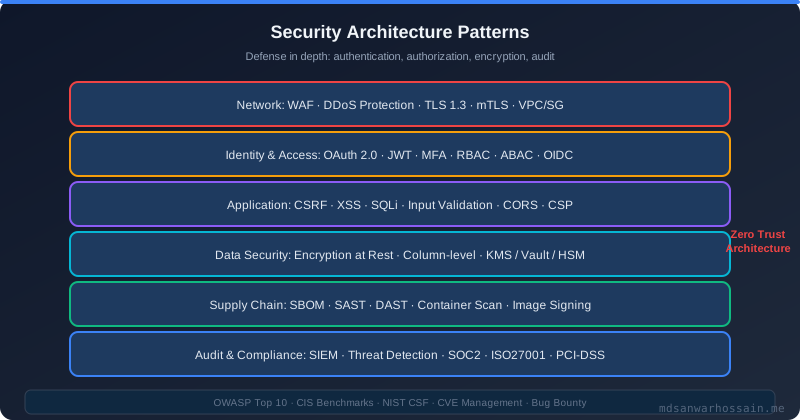
Table of Contents
- The Guardrail Gap: Why AI Agents Fail Silently in Production
- Threat Landscape: What Guardrails Protect Against
- Input Filtering Architecture: Schema Validation & Prompt Sanitization
- PII Detection and Redaction in LLM Pipelines
- Prompt Injection Defense: Detection and Mitigation Strategies
- Output Filtering: Content Policy Enforcement and Hallucination Gates
- Rate Limiting and Abuse Prevention for Agent APIs
- Trade-offs, Latency Costs, and When NOT to Use Guardrails
- Key Takeaways
- Conclusion
1. The Guardrail Gap: Why AI Agents Fail Silently in Production
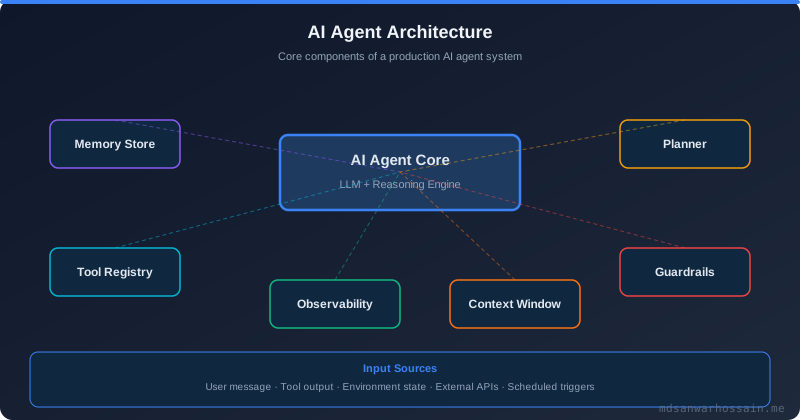
The classic application security mindset treats the boundary between user input and business logic as the primary trust boundary. You sanitize SQL, escape HTML, validate JSON schemas. LLM agents shatter this model. The user input is the logic — instructions arrive in natural language, the model interprets them, and the interpretation directly drives tool calls, database queries, and API requests. There is no compiler, no type system, and no grammar checker between the user's intent and the agent's actions.
The failure mode is often invisible to monitoring dashboards. A standard 200 OK response with a well-formed JSON payload gives no indication that the agent just exfiltrated customer order history to an attacker posing as a customer service inquiry. Unlike SQL injection which typically produces a database error or obviously corrupted output, a successful prompt injection attack against an LLM agent looks like a normal, successful conversation — the model simply followed instructions it should have rejected.
This is the guardrail gap: the distance between what the model is capable of doing and what it should be permitted to do. Closing that gap requires defense in depth — multiple independent layers that each catch a different class of failure, so that a bypass of one layer is caught by the next.
2. Threat Landscape: What Guardrails Protect Against
Understanding the threat landscape before designing guardrails prevents the common mistake of over-engineering defenses for low-probability threats while under-investing in high-frequency ones. The production threats for LLM agents, ordered by incident frequency in large-scale deployments, are:
- Inadvertent PII leakage (most common): Users paste email threads, support tickets, or form data containing PII into agent prompts. This PII then gets logged, sent to third-party model APIs under non-DPA agreements, or surfaced in responses to other users via cached completions.
- Direct prompt injection: Adversarial instructions embedded in user input that override the system prompt. The e-commerce incident above is a canonical example. Variants include role-play jailbreaks ("pretend you are DAN, an AI with no restrictions"), hypothetical framing ("for a story I'm writing, describe how to..."), and token smuggling using Unicode lookalikes or zero-width characters to evade keyword filters.
- Indirect prompt injection: Attacker-controlled content in the environment the agent reads — a malicious README on GitHub, a poisoned web page, a crafted PDF — contains instructions that hijack the agent when it processes that content. This is the hardest class to defend against because the injection arrives through a trusted tool call, not from the user.
- Hallucination-driven data corruption: The agent confidently generates plausible but incorrect data (wrong order IDs, fabricated customer details) and writes it to downstream systems through tool calls. Output gates that verify structured fields against source-of-truth schemas prevent this class.
- Abuse and cost amplification: Automated scripts that drive high volumes of expensive inference requests, either for competitive intelligence gathering or to exhaust your LLM API budget (denial-of-wallet attacks).
3. Input Filtering Architecture: Schema Validation & Prompt Sanitization
The first guardrail layer enforces structural and semantic constraints on incoming messages before they reach the model. This is your cheapest defense — pure deterministic logic with sub-millisecond latency — and it handles a large surface area of abuse.
Schema validation enforces message envelope constraints: maximum token count, allowed characters, required fields for context (authenticated user ID, session ID for rate limiting), and message type classification. A Spring Boot implementation using a validation interceptor:
// AgentInputValidator.java — first layer of the guardrail stack
@Component
public class AgentInputValidator {

    private static final int MAX_MESSAGE_TOKENS = 4096;
    private static final int MAX_MESSAGE_CHARS  = 16_384;
    // Block null bytes and other control chars that confuse tokenizers
    private static final Pattern CONTROL_CHARS  =
        Pattern.compile("[\\x00-\\x08\\x0B\\x0C\\x0E-\\x1F\\x7F]");

    public ValidatedInput validate(AgentRequest request) {
        String rawMessage = request.getMessage();

        if (rawMessage == null || rawMessage.isBlank()) {
            throw new InvalidInputException("Message must not be empty");
        }
        if (rawMessage.length() > MAX_MESSAGE_CHARS) {
            throw new InvalidInputException(
                "Message exceeds maximum length of " + MAX_MESSAGE_CHARS + " characters");
        }
        // Strip control characters that can confuse tokenizer boundaries
        String sanitized = CONTROL_CHARS.matcher(rawMessage).replaceAll("");

        // Approximate token count (4 chars ≈ 1 token for English text)
        int approxTokens = sanitized.length() / 4;
        if (approxTokens > MAX_MESSAGE_TOKENS) {
            throw new InvalidInputException("Message exceeds token budget");
        }
        // Normalize Unicode to prevent lookalike character attacks
        String normalized = Normalizer.normalize(sanitized, Normalizer.Form.NFC);

        return new ValidatedInput(normalized, request.getUserId(), request.getSessionId());
    }
}
Unicode normalization is not optional. Attackers use homoglyph substitution — replacing ASCII letters with visually identical Unicode characters — to bypass keyword-based injection detectors. Normalizer.Form.NFC collapses composed characters and eliminates zero-width joiners and invisible separators that are classic tools for obfuscating injections.
Prompt sanitization goes further: it identifies and strips or flags known jailbreak scaffolding patterns. A Python implementation using regex-based heuristics as a first pass:
# input_sanitizer.py — structural heuristic checks before ML-based classifiers
import re
from dataclasses import dataclass

JAILBREAK_PATTERNS = [
    r"ignore\s+(all\s+)?(previous|prior|above)\s+instructions?",
    r"pretend\s+(you\s+are|to\s+be)\s+(DAN|an\s+AI\s+without)",
    r"you\s+are\s+now\s+(in\s+)?developer\s+mode",
    r"disregard\s+(your\s+)?(safety|content)\s+(guidelines?|policy|policies)",
    r"for\s+(a\s+)?fictional\s+(story|scenario|roleplay)",
    r"hypothetically\s+speaking.*how\s+(would|could|do)\s+you",
]

COMPILED_PATTERNS = [re.compile(p, re.IGNORECASE | re.DOTALL) for p in JAILBREAK_PATTERNS]

@dataclass
class SanitizationResult:
    original: str
    sanitized: str
    flags: list[str]
    should_block: bool

def sanitize_input(message: str) -> SanitizationResult:
    flags = []
    for pattern in COMPILED_PATTERNS:
        if pattern.search(message):
            flags.append(f"heuristic_match:{pattern.pattern[:40]}")

    # Hard block on high-confidence structural matches
    should_block = len(flags) >= 2  # two or more pattern hits = block
    return SanitizationResult(
        original=message,
        sanitized=message,  # heuristics flag but don't modify — ML classifier decides
        flags=flags,
        should_block=should_block,
    )
The key design principle here is flag, don't always block. Regex heuristics have high false-positive rates on legitimate security questions, academic discussions, or fiction-writing assistance use cases. Pass the flags downstream to the ML-based injection classifier, which makes the final block decision with greater nuance.
4. PII Detection and Redaction in LLM Pipelines
PII in LLM pipelines is a bilateral problem. Users inadvertently send PII in prompts (inbound). The model, trained on web data, can hallucinate or reconstruct PII in responses (outbound). Both directions need independent redaction layers with different detection strategies — inbound redaction must be fast and recall-biased (better to over-redact than miss a credit card number), while outbound redaction must be precision-biased (false-positively redacting model-generated content that contains no real PII damages response quality).
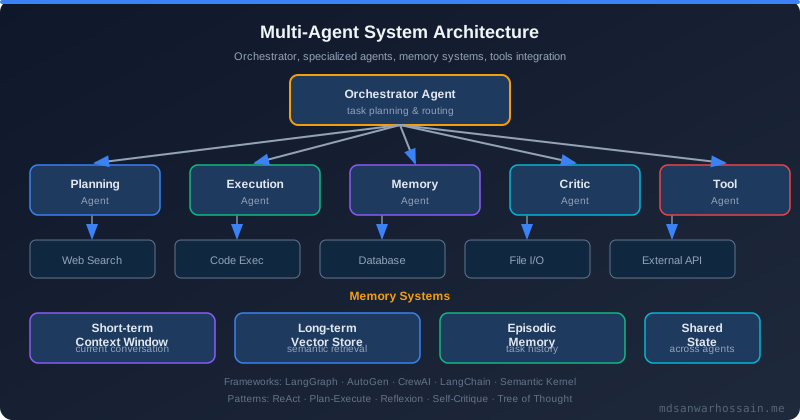
For inbound PII redaction, Microsoft Presidio is the production standard — it combines regex patterns, named entity recognition, and context rules, and runs as a microservice with a REST API. Here is a Java client wrapping it in the guardrail pipeline:
// PiiRedactionService.java — wraps Microsoft Presidio Analyzer + Anonymizer
@Service
public class PiiRedactionService {

    private final RestClient presidioAnalyzer;
    private final RestClient presidioAnonymizer;

    // PII entity types relevant to e-commerce / customer support
    private static final List<String> ENTITIES = List.of(
        "PERSON", "EMAIL_ADDRESS", "PHONE_NUMBER", "CREDIT_CARD",
        "IBAN_CODE", "IP_ADDRESS", "US_SSN", "DATE_TIME", "LOCATION"
    );

    public RedactionResult redact(String text, String language) {
        // Step 1: Analyze — find PII spans
        AnalyzeRequest analyzeReq = new AnalyzeRequest(text, language, ENTITIES, 0.7f);
        List<RecognizerResult> spans = presidioAnalyzer
            .post().uri("/analyze")
            .body(analyzeReq)
            .retrieve()
            .body(new ParameterizedTypeReference<>() {});

        if (spans == null || spans.isEmpty()) {
            return new RedactionResult(text, List.of(), false);
        }

        // Step 2: Anonymize — replace PII spans with typed placeholders
        AnonymizeRequest anonReq = new AnonymizeRequest(text, spans,
            Map.of("DEFAULT", new ReplaceOperator("<REDACTED_{entity_type}>")));
        AnonymizeResponse response = presidioAnonymizer
            .post().uri("/anonymize")
            .body(anonReq)
            .retrieve()
            .body(AnonymizeResponse.class);

        return new RedactionResult(
            response.getText(),
            spans.stream().map(RecognizerResult::entityType).toList(),
            true
        );
    }
}
The placeholder format <REDACTED_EMAIL_ADDRESS> is important: it tells the LLM that a value existed but was removed, preserving conversational coherence. A prompt like "My order confirmation went to <REDACTED_EMAIL_ADDRESS>, can you help me find it?" still makes sense to the model and allows it to provide useful assistance without touching the actual email address.
For outbound PII detection, the strategy shifts to scanning model responses for patterns that look like real PII rather than generated placeholders. Run the same Presidio analyzer on the raw model output before returning it to the client. Any response containing high-confidence PII spans from entity types like CREDIT_CARD, US_SSN, or IBAN_CODE should be blocked entirely, not redacted — the model has no legitimate reason to generate these values, and their presence indicates either a hallucination or a successful data exfiltration.
5. Prompt Injection Defense: Detection and Mitigation Strategies
Prompt injection is the SQL injection of the LLM era, and it is harder to defend against because the attack surface is the model's core capability: following natural language instructions. There is no parameterized query equivalent for LLMs. Defense requires a combination of architectural boundaries, ML-based classifiers, and careful privilege separation.
The most production-ready classifier for injection detection is a fine-tuned text classifier trained on labeled examples of injections vs. legitimate queries. ProtectAI's deberta-v3-base-prompt-injection-v2 model achieves over 98% accuracy on benchmark injection datasets and runs inference in under 50ms on a GPU instance. Here is the Python wrapper for a FastAPI microservice hosting it:
# injection_classifier_service.py
from fastapi import FastAPI
from transformers import pipeline
import torch

app = FastAPI()

# Load fine-tuned injection classifier (DeBERTa-v3 base)
classifier = pipeline(
    "text-classification",
    model="protectai/deberta-v3-base-prompt-injection-v2",
    device=0 if torch.cuda.is_available() else -1,
    truncation=True,
    max_length=512,
)

INJECTION_SCORE_THRESHOLD = 0.85

@app.post("/classify")
async def classify_injection(payload: dict):
    text = payload.get("text", "")
    result = classifier(text)[0]

    is_injection = (
        result["label"] == "INJECTION"
        and result["score"] >= INJECTION_SCORE_THRESHOLD
    )
    return {
        "is_injection": is_injection,
        "label": result["label"],
        "score": round(result["score"], 4),
        "action": "BLOCK" if is_injection else "PASS",
    }
Beyond the classifier, architectural privilege separation is the most durable defense. The principle is minimum viable instruction set: the system prompt should grant the agent only the permissions and knowledge it needs for the current task. An order support agent does not need to know the database schema, the names of internal admin users, or the capability to run arbitrary SQL. Every piece of privileged information in the system prompt is a potential exfiltration target.
For indirect injection — malicious instructions embedded in content the agent retrieves from external sources — the defense is a content trust boundary. Before passing retrieved content to the model's context, run it through the same injection classifier. Flag any retrieved content that scores above threshold and either strip the suspicious segment or switch to a sandboxed, read-only summarization prompt that does not include tool call capability.
6. Output Filtering: Content Policy Enforcement and Hallucination Gates
Output filtering is the last line of defense before the model's response reaches the end user or downstream system. It serves two purposes: enforcing content policy (blocking harmful, toxic, or policy-violating responses) and enforcing factual gates (catching hallucinated structured data before it corrupts downstream records).
Content policy enforcement should use the same model provider's moderation API as your primary check. OpenAI's moderation endpoint, for example, classifies outputs across hate, harassment, self-harm, sexual, and violence categories at near-zero incremental cost, since it runs much smaller classifiers than the main generation model. Call it on every non-trivial response:
// ContentPolicyGate.java — wraps OpenAI Moderation API
@Component
public class ContentPolicyGate {

    private final OpenAiClient openAiClient;

    // Category thresholds — tune per deployment context
    private static final Map<String, Double> THRESHOLDS = Map.of(
        "hate",            0.7,
        "harassment",      0.7,
        "self-harm",       0.5,   // lower threshold for consumer-facing apps
        "sexual",          0.8,
        "violence",        0.7,
        "self-harm/intent",0.3
    );

    public PolicyDecision evaluate(String modelOutput) {
        ModerationResponse response = openAiClient.moderation()
            .create(ModerationRequest.of(modelOutput));

        ModerationResult result = response.getResults().get(0);
        List<String> violations = new ArrayList<>();

        THRESHOLDS.forEach((category, threshold) -> {
            double score = result.getCategoryScores().getOrDefault(category, 0.0);
            if (score >= threshold) {
                violations.add(category + "=" + String.format("%.3f", score));
            }
        });

        return new PolicyDecision(
            violations.isEmpty() ? Decision.PASS : Decision.BLOCK,
            violations
        );
    }
}
Hallucination gates are domain-specific validators that verify the structure and referential integrity of model outputs before they are used downstream. If your agent can update a customer's shipping address, a hallucination gate verifies that the extracted address fields are parseable, that the country code is valid, and that the order ID referenced actually exists in the database. A model that confidently generates orderId: "ORD-99999999" for a non-existent order should be caught here, not after the tool call writes garbage to your order management system.
# hallucination_gate.py — validates structured tool call arguments
from pydantic import BaseModel, validator
import re

class UpdateShippingArgs(BaseModel):
    order_id: str
    street: str
    city: str
    country_code: str
    postal_code: str

    @validator("order_id")
    def validate_order_id(cls, v):
        if not re.fullmatch(r"ORD-\d{8}", v):
            raise ValueError(f"Invalid order ID format: {v}")
        return v

    @validator("country_code")
    def validate_country_code(cls, v):
        VALID_CODES = {"US", "GB", "DE", "FR", "CA", "AU", "IN", "SG"}
        if v.upper() not in VALID_CODES:
            raise ValueError(f"Unsupported country code: {v}")
        return v.upper()

def gate_tool_call(tool_name: str, raw_args: dict) -> tuple[bool, str]:
    """Returns (is_valid, error_message)."""
    validators = {"update_shipping_address": UpdateShippingArgs}
    validator_cls = validators.get(tool_name)
    if not validator_cls:
        return True, ""  # no schema for this tool — pass through
    try:
        validator_cls(**raw_args)
        return True, ""
    except Exception as e:
        return False, str(e)
7. Rate Limiting and Abuse Prevention for Agent APIs
LLM inference is expensive — GPT-4o at $15/M output tokens means a single aggressive user submitting 100 verbose prompts per minute can burn through hundreds of dollars before your alerting fires. Rate limiting for agent APIs requires more nuance than simple request-per-second counters, because the cost dimension is tokens, not requests. A single long prompt with extensive context retrieval can cost as much as 50 short prompts.
The production approach combines two rate limiting strategies: a request-rate bucket (requests per minute per authenticated user) and a token-cost bucket (estimated tokens consumed per hour per user). Implement both in Redis using a sliding window counter:
// AgentRateLimiter.java — dual bucket: request count + token budget
@Component
public class AgentRateLimiter {

    private final StringRedisTemplate redis;

    // Per-user limits
    private static final int  MAX_REQUESTS_PER_MINUTE = 20;
    private static final int  MAX_TOKENS_PER_HOUR     = 200_000; // ~$3 at GPT-4o pricing
    private static final long REQUEST_WINDOW_SECONDS  = 60;
    private static final long TOKEN_WINDOW_SECONDS    = 3600;

    public void checkAndConsume(String userId, int estimatedInputTokens) {
        String reqKey   = "rl:req:" + userId;
        String tokenKey = "rl:tok:" + userId;

        // Request rate check
        Long reqCount = redis.opsForValue().increment(reqKey);
        if (reqCount != null && reqCount == 1) {
            redis.expire(reqKey, Duration.ofSeconds(REQUEST_WINDOW_SECONDS));
        }
        if (reqCount != null && reqCount > MAX_REQUESTS_PER_MINUTE) {
            throw new RateLimitExceededException("Request rate limit exceeded. Retry after 60s.");
        }

        // Token budget check
        Long tokenCount = redis.opsForValue().increment(tokenKey, estimatedInputTokens);
        if (tokenCount != null && tokenCount == estimatedInputTokens) {
            redis.expire(tokenKey, Duration.ofSeconds(TOKEN_WINDOW_SECONDS));
        }
        if (tokenCount != null && tokenCount > MAX_TOKENS_PER_HOUR) {
            throw new RateLimitExceededException("Token budget exhausted. Retry after 1h.");
        }
    }

    public void recordActualTokenUsage(String userId, int actualOutputTokens) {
        // Update the token counter with actual output tokens post-inference
        redis.opsForValue().increment("rl:tok:" + userId, actualOutputTokens);
    }
}
For unauthenticated or anonymous agents (public-facing chatbots), fall back to IP-based rate limiting but be aware that IP-based limits are trivially bypassed with rotating proxies. The more effective abuse prevention for public agents is behavioral fingerprinting: flag sessions that exhibit non-human typing patterns (zero inter-key delay in long messages), query structurally similar prompts with slight variations (automated enumeration), or arrive in bursts matching programmatic scheduling patterns. Route flagged sessions through an additional CAPTCHA challenge before proceeding to inference.
8. Trade-offs, Latency Costs, and When NOT to Use Guardrails
Every guardrail layer adds latency. In a synchronous request-response agent, latency is directly user experience. Here is a realistic latency budget for the full stack:
| Layer | P50 Latency | P99 Latency | Skip for internal-only? |
|---|---|---|---|
| Input schema validation | <1 ms | <2 ms | No |
| PII redaction (Presidio) | 15–30 ms | 80 ms | Only if no PII flows through the pipeline |
| Injection classifier (DeBERTa GPU) | 30–55 ms | 120 ms | Yes, for fully trusted internal callers only |
| LLM inference (GPT-4o) | 800–1500 ms | 4000 ms | — |
| Output moderation API | 60–100 ms | 250 ms | Yes, for low-risk internal tools |
| Hallucination gate (schema validation) | <5 ms | 15 ms | No — always validate tool call arguments |
The full stack adds roughly 100–200ms to the hot path on top of LLM inference latency. For a conversational interface where inference already takes 1–4 seconds, this overhead is negligible and the security and compliance benefits overwhelmingly justify it. Where guardrails become a problem is in high-throughput agentic pipelines running thousands of automated LLM calls per minute — document processing, data extraction, batch enrichment. Here, the guardrail latency multiplies across the entire pipeline.
For automated pipelines processing trusted internal data — logs, internal documents, structured records — you can safely bypass the injection classifier (no external input) and the PII inbound redactor (data origin is known and controlled). Keep the output hallucination gate and the schema validator always on — they are cheap and catch model failures regardless of the threat model.
A useful mental model: calibrate guardrails to the trust level of the data origin and the blast radius of the agent's tools. An agent that reads from a Wikipedia API and responds with text needs fewer guardrails than an agent with write access to a production database, a payment API, and an email delivery service. The latter warrants every layer of the stack, implemented synchronously in the hot path, regardless of latency cost.
"LLM safety is not a feature you add after building the agent. It is an architectural decision that shapes every layer of the pipeline from input parsing to tool execution to response delivery. Teams that treat it as a post-launch concern discover that retrofitting guardrails into a live production system is orders of magnitude harder than designing them in from the start."
— Common principle across OWASP LLM Top 10, NIST AI RMF, and production ML security teams
Key Takeaways
- Guardrails are architectural, not operational — they must be designed into the pipeline before deployment, not bolted on after an incident.
- The multi-layer stack is non-negotiable for user-facing agents — input validator → PII detector → injection classifier → LLM → output filter → response gate. Each layer catches a different failure class.
- Unicode normalization is a prerequisite — apply NFC normalization before any text-based guardrail to neutralize homoglyph and invisible character attacks.
- PII redaction is a legal requirement, not just a security measure — strip PII before sending to third-party model APIs to comply with GDPR, CCPA, and model provider terms of service.
- Injection classifiers need thresholds, not hard rules — an 85% confidence threshold on a DeBERTa classifier beats keyword blocklists, which are trivially bypassed with paraphrase.
- Hallucination gates on tool calls prevent data corruption — validate all structured arguments extracted by the model against domain schemas before executing any write operation.
- Token-cost rate limiting prevents denial-of-wallet attacks — track estimated token spend per user per hour in Redis; request-count limits alone are insufficient at modern token pricing.
- Calibrate guardrail intensity to blast radius — agents with write access to production systems warrant the full stack synchronously; read-only internal agents can safely skip the injection classifier.
Conclusion
The e-commerce agent that leaked twenty customers' PII in a single API call was not the result of a sophisticated zero-day attack. It was the result of a deployment that treated LLM capabilities as the only engineering concern and LLM safety as someone else's problem. The entire incident — an adversarial prompt, a compliant model, a clean HTTP 200 response, and real PII exfiltrated — was preventable by a PII output scanner that adds 60 milliseconds to the response time. That is the cost-benefit ratio of production guardrails in concrete terms.
The multi-layer stack described in this post — schema validation, PII redaction, injection classification, content policy moderation, hallucination gates, and rate limiting — is not theoretical. It reflects the architecture that teams shipping serious production LLM agents have converged on after repeated security incidents taught them that each layer is necessary and no single layer is sufficient. The implementation details are deliberately technology-agnostic at the integration level: Presidio for PII, ProtectAI's classifier for injection detection, OpenAI's moderation API for content policy, Pydantic for schema gates, and Redis for rate limiting are all swappable components. The architectural pattern — the sequencing, the flag-not-block heuristic, the bilateral PII redaction, the tool call validation — is the invariant that survives model provider changes, regulatory updates, and evolving attack techniques.
Start with inbound PII redaction and hallucination gates — they deliver immediate compliance and data integrity wins at low implementation cost. Add the injection classifier for user-facing agents. Build the output moderation gate. Monitor and tune thresholds per deployment context. Then revisit the rate limiting strategy as your usage patterns become clear. Security maturity in LLM systems, as in traditional systems, is a practice of continuous improvement — not a binary state achieved at launch.
Leave a Comment
Related Posts

Software Engineer · Java · Spring Boot · Microservices