Cache Stampede Prevention in High-Traffic Microservices: Techniques, Patterns, and Production Solutions
A cache stampede is not a gradual degradation — it is an instantaneous cliff. One moment your service is handling 80,000 requests per second with a 96% cache hit rate and a database idling at 5% utilization. The next moment, a TTL expiry fires, thousands of threads simultaneously discover a cache miss, and your database absorbs a vertical load spike it was never provisioned for. Understanding how to prevent this failure mode — before your next Black Friday, marketing campaign, or viral moment — is essential for any engineer building high-traffic services.
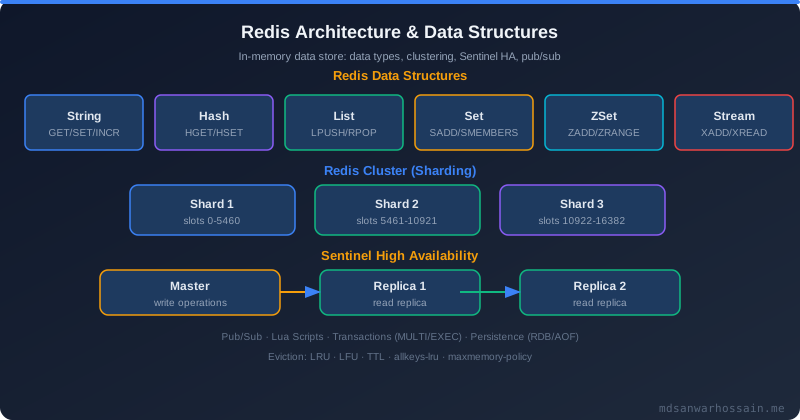
Table of Contents
- The Cache Stampede That Took Down Production
- Anatomy of a Cache Stampede
- Solution 1: Distributed Mutex Lock
- Solution 2: Probabilistic Early Expiry (PER)
- Solution 3: Request Coalescing / Promise-Based Deduplication
- Solution 4: TTL Jitter and Warm Cache Strategies
- Monitoring and Detection
- Choosing the Right Pattern
- Key Takeaways
- Conclusion
1. The Cache Stampede That Took Down Production
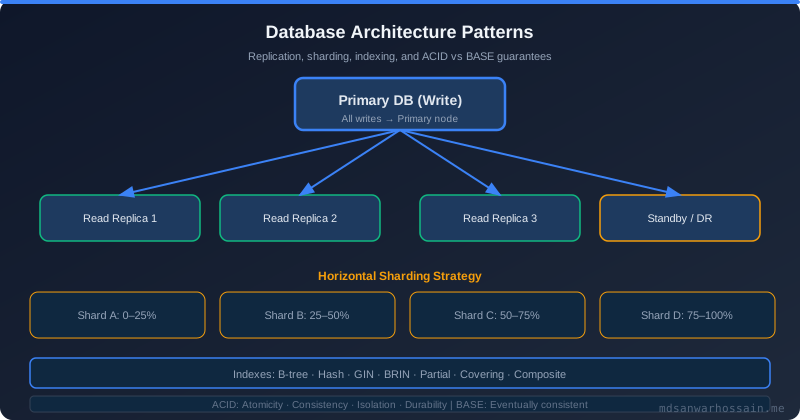
It was 00:05 on a Black Friday morning. The e-commerce platform had been running smoothly for hours, the traffic curve climbing steadily toward the expected peak. The product catalog — 50,000 items with pricing, inventory, and metadata — was cached in Redis with a TTL of exactly 3,600 seconds. Every item had been loaded into cache at the same time during the last deployment, 60 minutes earlier.
A cache stampede — also called the thundering herd problem or a cache miss storm — is the simultaneous cache miss of a high-traffic key (or large set of keys) by a large number of concurrent requests, all of which then proceed to query the underlying data source at the same moment. It is fundamentally different from gradual load increases: there is no ramp-up time for the database to adapt, no opportunity for connection pool queuing to smooth the spike, and no time for circuit breakers to activate before the connection pool exhausts.
Cache stampedes happen in predictable circumstances: cache TTL expiry (especially synchronized expiry of bulk-loaded data), cache server restarts or failovers, application cold starts after deployment, and planned cache invalidation events like price updates or inventory flushes. The irony is that stampedes are most dangerous precisely when traffic is highest — the exact moment when cache hit rates matter most.
The severity of a stampede scales with two factors: the number of concurrent requests hitting the miss simultaneously, and the time required to recompute and populate the cache entry. A key with 10,000 concurrent requesters and a 200ms database query time means 10,000 simultaneous database queries sustained for 200ms — a load that most production databases are not provisioned to handle. The formula is stark: stampede_severity = concurrent_requests × db_query_duration_ms.
2. Anatomy of a Cache Stampede
The root cause of every cache stampede is a race condition between the "check cache" operation and the "populate cache" operation. In the naïve cache-aside pattern, every thread independently performs: (1) check cache for key, (2) on miss, query the database, (3) write the result to cache. Under normal conditions this works because the window between step 1 and step 3 is short enough that few other threads arrive during that window. Under high concurrency, thousands of threads can execute step 1 before any single thread completes step 3.
Timeline of a Cache Stampede (T = milliseconds)

T=0ms    Cache key "product:catalog" expires (TTL reached)
T=1ms    Thread-1: GET product:catalog → MISS
T=1ms    Thread-2: GET product:catalog → MISS  (race begins)
T=1ms    Thread-3..N: GET product:catalog → MISS (N threads)
T=2ms    Thread-1: SELECT * FROM products → DB hit #1
T=2ms    Thread-2: SELECT * FROM products → DB hit #2
T=2ms    Thread-3..N: SELECT * FROM products → DB hits #3..N
T=50ms   DB connection pool exhausted (max 200 connections)
T=51ms   New requests: connection acquisition timeout
T=55ms   Application: HTTP 503 errors begin
T=200ms  Thread-1: SET product:catalog (result) EX 3600
T=200ms  Thread-2..N: SET product:catalog (duplicate writes)
T=205ms  Cache populated — but database is already overwhelmed
Notice that even after the cache is populated at T=200ms, the damage is done: hundreds of threads have already queued database connections, and those queries will complete regardless of whether the cache is warm. The connection pool exhaustion is not resolved by cache repopulation — it resolves only when the queued queries drain, which takes as long as queue_depth × query_time seconds.
Standard cache patterns fail under high concurrency not because they are wrong in theory, but because they assume a low probability of concurrent misses. When cache hit rates are 96%+, that assumption is accurate for any given key under normal load. When TTL expiry is synchronized across thousands of keys and traffic is at its highest, the assumption fails completely.
3. Solution 1: Distributed Mutex Lock (Cache-Aside with Lock)
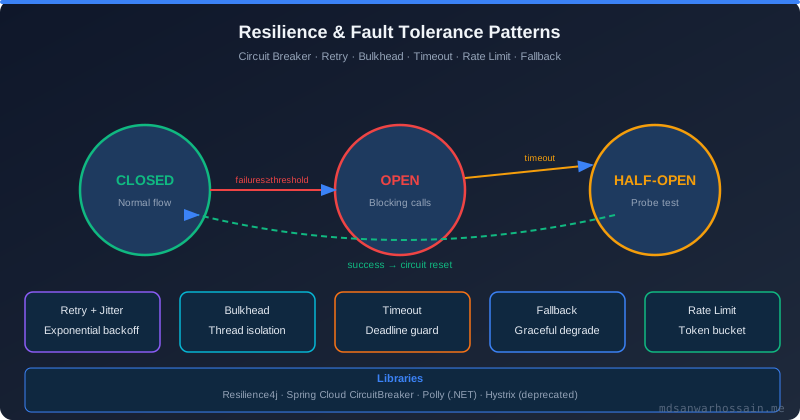
The most intuitive solution is to serialize cache population: when a thread detects a cache miss, it attempts to acquire a distributed lock before querying the database. Only the thread that acquires the lock proceeds to populate the cache; all other threads that detect the miss wait briefly and then re-read the now-populated cache value. This converts the N-thread database hit into a 1-thread database query followed by N cache reads.
In Redis, the distributed lock is implemented with SET key value NX PX milliseconds — an atomic operation that sets the key only if it does not already exist, with an expiry to prevent deadlocks if the lock holder crashes. Redisson, the production-grade Redis client for Java, provides a RLock abstraction that handles lock acquisition, renewal (watchdog), and release with appropriate exception handling.
import org.redisson.api.RLock;
import org.redisson.api.RedissonClient;
import java.util.concurrent.TimeUnit;

@Service
public class CacheStampedeGuard {

    private final RedissonClient redisson;
    private final RedisTemplate<String, Object> redisTemplate;
    private final ProductRepository productRepository;

    public List<Product> getProductCatalog() {
        String cacheKey = "product:catalog";
        String lockKey  = "lock:product:catalog";

        // Fast path: cache hit (no lock needed)
        List<Product> cached = (List<Product>) redisTemplate.opsForValue().get(cacheKey);
        if (cached != null) return cached;

        // Slow path: cache miss — try to acquire lock
        RLock lock = redisson.getLock(lockKey);
        try {
            boolean acquired = lock.tryLock(2, 10, TimeUnit.SECONDS);
            if (acquired) {
                // Re-check cache after acquiring lock (double-checked locking)
                cached = (List<Product>) redisTemplate.opsForValue().get(cacheKey);
                if (cached != null) return cached;

                // We are the designated populator — query DB and fill cache
                List<Product> products = productRepository.findAll();
                redisTemplate.opsForValue().set(cacheKey, products, 3600, TimeUnit.SECONDS);
                return products;
            } else {
                // Another thread holds the lock; wait and retry from cache
                TimeUnit.MILLISECONDS.sleep(50);
                cached = (List<Product>) redisTemplate.opsForValue().get(cacheKey);
                return cached != null ? cached : productRepository.findAll();
            }
        } catch (InterruptedException e) {
            Thread.currentThread().interrupt();
            return productRepository.findAll();
        } finally {
            if (lock.isHeldByCurrentThread()) lock.unlock();
        }
    }
}
The double-checked locking on line 22 is critical: after acquiring the lock, re-read the cache before querying the database. The thread that wins the lock may have waited while another lock holder already populated the cache. Skipping the re-check causes redundant database queries.
The primary drawback of the mutex approach is that waiting threads are blocked — they hold an HTTP thread while sleeping, consuming thread pool capacity. Under high sustained miss rates, thread pool exhaustion can occur even though the database is protected. The timeout values need careful tuning: too short and threads fall through to direct database calls defeating the purpose; too long and the thread pool drains. A 2-second wait timeout with a 50ms retry sleep is a reasonable starting point for read-heavy services with sub-second database queries.
4. Solution 2: Probabilistic Early Expiry (PER)
Probabilistic Early Expiry, described in the 2015 paper "Optimal Probabilistic Cache Stampede Prevention" by Vattani, Chierichetti, and Lowenstein, is arguably the most elegant solution to the cache stampede problem. It works by proactively recomputing the cache value before its TTL actually expires, using a probability function that increases as the expiry approaches. The key insight: under high traffic, the cache entry is refreshed in the background while it is still valid — the cache never actually experiences a miss for a hot key.
The algorithm: when a thread reads a cache entry, it calculates whether it should trigger an early recomputation. The probability increases exponentially as the remaining TTL decreases. The formula is:
currentTime - delta * beta * ln(random()) is greater than the expiry time. Where delta is the time the last recomputation took (in seconds), beta is a tunable parameter (typically 1.0), and random() is a uniform random variable in (0, 1). This ensures that expensive-to-compute entries trigger earlier recomputation, and the probability of triggering grows as expiry approaches.
import java.time.Instant;

@Service
public class ProbabilisticEarlyExpiryCache {

    private final RedisTemplate<String, CacheEntry> redisTemplate;
    private final ProductRepository productRepository;
    private static final double BETA = 1.0;

    public List<Product> getProductCatalog() {
        String cacheKey = "per:product:catalog";
        CacheEntry entry = redisTemplate.opsForValue().get(cacheKey);

        if (entry == null || shouldEarlyRecompute(entry)) {
            long recomputeStart = System.currentTimeMillis();
            List<Product> products = productRepository.findAll();
            long delta = System.currentTimeMillis() - recomputeStart;

            long ttlSeconds = 3600;
            long expiryEpoch = Instant.now().getEpochSecond() + ttlSeconds;
            CacheEntry newEntry = new CacheEntry(products, expiryEpoch, delta);
            redisTemplate.opsForValue().set(cacheKey, newEntry, ttlSeconds + 60,
                                            TimeUnit.SECONDS);
            return products;
        }
        return entry.getData();
    }

    private boolean shouldEarlyRecompute(CacheEntry entry) {
        double remainingTtl = entry.getExpiryEpoch() - Instant.now().getEpochSecond();
        if (remainingTtl <= 0) return true; // already expired

        // PER formula: recompute if adjusted time exceeds expiry
        double adjustedNow = Instant.now().getEpochSecond()
                             - (entry.getDeltaMs() / 1000.0) * BETA * Math.log(Math.random());
        return adjustedNow >= entry.getExpiryEpoch();
    }
}
The beauty of PER is what it eliminates: there are no locks, no blocking threads, no coordination between instances, and no cache misses under sustained load. Each application instance independently decides whether to refresh the cache, and the probability function ensures that on average only one instance triggers a recomputation at any given time — without any distributed coordination. The cache entry is always valid when returned to the caller.
PER works best for read-heavy keys with expensive computation (100ms+ database queries), smooth and predictable traffic patterns, and cases where slightly stale data (within one TTL period) is acceptable. It is less suitable for keys that must be invalidated immediately on write events — for those, event-driven cache invalidation via a message queue is the better approach.
5. Solution 3: Request Coalescing / Promise-Based Deduplication
Request coalescing takes a fundamentally different approach: instead of serializing access to the database or probabilistically refreshing ahead of time, it deduplicates in-flight requests at the application layer. If 1,000 threads simultaneously discover a cache miss for the same key, only one database query is issued. All 1,000 threads subscribe to the same CompletableFuture, and when the single database query completes, all 1,000 threads receive the result simultaneously. Zero blocking; one database hit regardless of concurrent miss count.
import java.util.concurrent.CompletableFuture;
import java.util.concurrent.ConcurrentHashMap;

@Service
public class CoalescingCacheService {

    private final RedisTemplate<String, Object> redisTemplate;
    private final ProductRepository productRepository;

    // In-flight request registry: key → shared CompletableFuture
    private final ConcurrentHashMap<String, CompletableFuture<List<Product>>>
            inFlight = new ConcurrentHashMap<>();

    public CompletableFuture<List<Product>> getProductCatalogAsync() {
        String cacheKey = "product:catalog";

        // Fast path: cache hit
        List<Product> cached = (List<Product>) redisTemplate.opsForValue().get(cacheKey);
        if (cached != null) return CompletableFuture.completedFuture(cached);

        // Coalescing: compute or join an in-flight request
        return inFlight.computeIfAbsent(cacheKey, k ->
            CompletableFuture
                .supplyAsync(() -> {
                    List<Product> products = productRepository.findAll();
                    redisTemplate.opsForValue().set(cacheKey, products,
                                                    3600, TimeUnit.SECONDS);
                    return products;
                })
                .whenComplete((result, ex) -> inFlight.remove(cacheKey))
        );
    }
}
ConcurrentHashMap.computeIfAbsent is the key to thread safety here: it atomically checks for the key's presence and inserts a new value only if absent, all in a single operation. The first thread to call computeIfAbsent creates the CompletableFuture and triggers the database query. All subsequent threads that call computeIfAbsent within the same miss window find the existing future and subscribe to it — no new database queries are issued. When the query completes, whenComplete removes the entry from the registry so future misses trigger a fresh query rather than reusing a completed future.
Coalescing is the most efficient pattern for extremely hot keys with massive concurrent access — homepage data, trending item lists, global configuration. It makes no blocking calls and issues exactly one database query per cache miss window per key, regardless of how many threads are waiting. The trade-off is implementation complexity: the in-flight registry is an additional data structure to reason about, and the async API (CompletableFuture) propagates upward through the call stack.
6. Solution 4: TTL Jitter and Warm Cache Strategies
The root cause of the Black Friday incident was not high traffic — it was the synchronized expiry of 50,000 cache entries all loaded at the same time. TTL jitter directly addresses this: instead of setting every cache entry to exactly 3,600 seconds, add a random offset from a uniform distribution. A jitter range of ±10% means entries expire between 3,240 and 3,960 seconds, spreading the expiry events over 12 minutes instead of a single second.
import java.util.concurrent.ThreadLocalRandom;
import org.springframework.cache.annotation.Cacheable;

@Service
public class JitteredCacheService {

    private static final long BASE_TTL_SECONDS = 3600;
    private static final double JITTER_FRACTION = 0.1; // ±10%

    private long jitteredTtl() {
        long jitterRange = (long) (BASE_TTL_SECONDS * JITTER_FRACTION);
        return BASE_TTL_SECONDS + ThreadLocalRandom.current()
                                                   .nextLong(-jitterRange, jitterRange);
    }

    public Product getProduct(String productId) {
        String cacheKey = "product:" + productId;
        Product cached = (Product) redisTemplate.opsForValue().get(cacheKey);
        if (cached != null) return cached;

        Product product = productRepository.findById(productId).orElseThrow();
        redisTemplate.opsForValue().set(cacheKey, product, jitteredTtl(), TimeUnit.SECONDS);
        return product;
    }

    // Background scheduled refresh — warms cache before expiry
    @Scheduled(fixedDelayString = "${cache.warmup.interval:PT30M}")
    public void warmProductCatalogCache() {
        productRepository.findAll().forEach(p -> {
            String key = "product:" + p.getId();
            redisTemplate.opsForValue().set(key, p, jitteredTtl(), TimeUnit.SECONDS);
        });
    }
}
Cache warming is the proactive counterpart to jitter: rather than waiting for entries to expire under load, a background process refreshes them before expiry. A scheduled task that re-populates the product catalog every 30 minutes — while the existing entries are still valid — ensures there is never a cold cache moment. The background refresh runs from a service instance under no user-facing load, interacting with the database at a controlled rate without affecting production latency.
Tiered TTL applies the principle of proportionality: not all data has the same staleness tolerance or access frequency. Global configuration that rarely changes and is accessed by every request should have a long TTL (hours) with aggressive warming. Individual product inventory counts, which change frequently and stale values cause real business problems, should have short TTLs (seconds to minutes) with event-driven invalidation. Building a TTL tier model aligned with data change rate and staleness tolerance is foundational cache hygiene that reduces stampede risk across the board.
7. Monitoring and Detection
A cache stampede is detectable before it causes a full outage if you monitor the right signals. The two most important leading indicators are: a sudden spike in the database active connection count, and a simultaneous drop in the cache hit rate. Either signal alone is unremarkable; together they are a high-confidence stampede signature.
// Micrometer instrumentation for cache hit/miss tracking
@Service
public class InstrumentedCacheService {

    private final MeterRegistry meterRegistry;
    private final Counter cacheHits;
    private final Counter cacheMisses;

    public InstrumentedCacheService(MeterRegistry meterRegistry) {
        this.meterRegistry = meterRegistry;
        this.cacheHits   = Counter.builder("cache.requests")
                                  .tag("result", "hit")
                                  .register(meterRegistry);
        this.cacheMisses = Counter.builder("cache.requests")
                                  .tag("result", "miss")
                                  .register(meterRegistry);
    }

    public Product getProduct(String id) {
        Product cached = redisTemplate.opsForValue().get("product:" + id);
        if (cached != null) {
            cacheHits.increment();
            return cached;
        }
        cacheMisses.increment();
        // ... load from DB and populate cache
        return loadAndCache(id);
    }
}
With Micrometer exporting to Prometheus, the cache miss rate over a 2-minute window is computed as:
# Prometheus alerting rule for cache stampede detection
groups:
  - name: cache_stampede
    rules:
      - alert: CacheMissRateHigh
        expr: |
          rate(cache_requests_total{result="miss"}[2m]) /
          rate(cache_requests_total[2m]) > 0.5
        for: 2m
        labels:
          severity: critical
        annotations:
          summary: "Cache miss rate exceeds 50% — potential stampede in progress"
          description: "Cache miss rate is {{ $value | humanizePercentage }} over last 2 minutes"
The 2-minute for clause prevents false positives from brief miss spikes during normal deployment events. A sustained 50%+ miss rate for 2 minutes almost always indicates either a cache stampede in progress or a cache server failure — both require immediate investigation. Complement this alert with a Grafana dashboard showing cache hit rate, database connection pool utilization, and application error rate on the same time axis. The visual correlation between the three signals is often more useful for post-mortem analysis than any individual alert.
A post-mortem checklist for cache stampede incidents should include: documenting the miss rate trajectory (was it gradual or instantaneous), identifying the specific keys that missed (was it one hot key or a synchronized bulk expiry), calculating the actual database load at peak miss rate, and tracing whether connection pool exhaustion preceded or followed the miss spike. This analysis directly identifies which prevention pattern would have been most effective.
8. Choosing the Right Pattern
No single pattern is universally superior. The right choice depends on your traffic pattern, key cardinality, cache computation time, and tolerance for implementation complexity.
| Pattern | Complexity | Effectiveness | Best Use Case |
|---|---|---|---|
| Mutex Lock | Medium | High | Moderate traffic, any key type |
| Probabilistic Early Expiry | Low–Medium | Very High | Read-heavy, expensive compute, stale OK |
| Request Coalescing | High | Very High | Extremely hot keys, async-friendly stack |
| TTL Jitter + Cache Warming | Low | Medium | Bulk-loaded data, synchronized expiry risk |
For most production services, the pragmatic recommendation is to apply TTL jitter as a baseline hygiene measure across all cache writes — it is two lines of code and prevents the most common class of synchronized stampede. Layer PER on top for your highest-traffic, most expensive-to-compute keys: homepage data, recommendation models, and configuration. Reserve request coalescing for the handful of keys where concurrent miss count during a cold start exceeds 1,000 — the added complexity is only justified at that scale. Use the mutex pattern as a transitional measure when migrating an existing naïve cache-aside implementation: it is the safest drop-in improvement before more sophisticated patterns are implemented.
9. Key Takeaways
- Cache stampedes are architectural failures, not capacity failures — adding more database replicas does not solve the root cause; preventing concurrent misses does.
- Apply TTL jitter universally as a zero-cost baseline:
ttl = base_ttl + random(-base_ttl*0.1, base_ttl*0.1)prevents synchronized bulk expiry with two lines of code. - Probabilistic Early Expiry is lock-free and coordination-free — the most elegant solution for read-heavy hot keys where slightly stale data is acceptable.
- Request coalescing issues exactly one database query per cache miss window regardless of concurrent requesters — the most efficient pattern for extremely hot keys in async-friendly architectures.
- Monitor cache miss rate + DB connection utilization together — the combination of a sudden miss rate spike and connection pool pressure is a high-confidence stampede signature that can trigger automated mitigation before human intervention.
- Cache warming before peak events is operational discipline — know your cache TTLs relative to your deployment schedule and always pre-warm critical keys before planned high-traffic events.
10. Conclusion
The cache stampede is one of those failures that feels obvious in retrospect — of course thousands of threads hitting a cold cache simultaneously will overwhelm the database — but is surprisingly easy to introduce and surprisingly difficult to diagnose in real time. The 8-minute Black Friday outage described in Section 1 was caused by a single architectural oversight: using a fixed TTL for bulk-loaded data without any of the prevention patterns described in this article.
The good news is that all four prevention patterns are well-understood, battle-tested, and implementable in an afternoon of focused engineering work. TTL jitter costs nothing. Probabilistic early expiry is 30 lines of stateless code. Request coalescing with CompletableFuture is an elegant application of Java's concurrency primitives. Distributed mutex locks are a one-dependency addition with Redisson. None of these require infrastructure changes or architectural rewrites.
Start with the simplest pattern that addresses your specific risk profile. Instrument everything — cache hit rate, database connection utilization, and per-key miss frequency — so that the next potential stampede is visible in your dashboards as a warning trend rather than arriving as a 2 a.m. PagerDuty alert. The engineers who sleep through Black Friday are the ones who designed their cache layer for graceful degradation, not just happy-path performance.
Leave a Comment
Related Posts
Last updated: April 2026

Software Engineer · Java · Spring Boot · Microservices