Microservices Architecture Patterns: Building Resilient, Scalable Distributed Systems
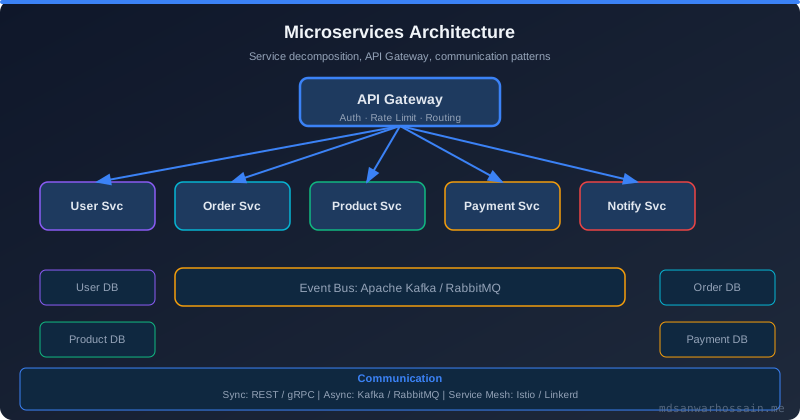
Microservices promise independent scalability, team autonomy, and faster deployments — but they introduce a new class of distributed systems problems that can sink a project if not addressed with the right architectural patterns. This guide covers the essential patterns every Java microservices engineer must internalize before deploying to production.
TL;DR
"A deep-dive into real-world microservices architecture patterns: saga pattern, outbox pattern, circuit breaker, CQRS, service mesh, and API gateway design."
Table of Contents
- Why Microservices? The Business Case and the Reality
- Service Decomposition: How to Draw the Right Boundaries
- Communication Patterns: Synchronous vs Asynchronous
- The Saga Pattern for Distributed Transactions
- The Outbox Pattern: Guaranteed Event Delivery
- Circuit Breaker and Resilience Patterns
- Service Mesh: When Istio or Linkerd Makes Sense
- Deployment and Observability at Scale
Why Microservices? The Business Case and the Reality
Microservices architecture gained mainstream adoption as organizations scaled beyond what a single monolithic deployment could efficiently support. The business drivers are real: independent deployment of services means a bug in the recommendation engine does not require redeploying the checkout service. Small, autonomous teams can own their services end to end — from code to Kubernetes deployment to on-call rotation — without coordination tax. And individual services can be scaled horizontally to match demand without scaling the entire application.
However, the reality of microservices is more nuanced than the marketing literature suggests. A monolith has one network boundary; microservices have dozens or hundreds. What was a function call is now an HTTP request that can timeout, fail, or return stale data. What was a database transaction spanning multiple tables is now a distributed transaction spanning multiple services, each with its own data store. Operational complexity multiplies: you need service discovery, distributed tracing, centralized logging, circuit breakers, and a robust CI/CD pipeline before your first service goes live.
The engineers who succeed with microservices are not those who decompose the monolith fastest — they are those who apply the right patterns to tame the inherent complexity of distributed systems.
Service Decomposition: How to Draw the Right Boundaries
The most consequential decision in a microservices architecture is where to draw service boundaries. Get this wrong and you end up with a distributed monolith: all the operational complexity of microservices with none of the team autonomy benefits, because every change requires coordinating deployments across multiple services.
Domain-Driven Design and Bounded Contexts
Domain-Driven Design (DDD) provides the most principled approach to service decomposition. A bounded context is a linguistic boundary within which a domain model is internally consistent. The word "Order" means something specific in the Order Management context and something slightly different in the Fulfillment context. Aligning service boundaries with bounded contexts ensures that each service has a coherent, internally consistent model and that inter-service contracts are minimal and well-defined.
Practical steps: run Event Storming workshops with domain experts and engineers to identify domain events (OrderPlaced, PaymentConfirmed, ItemShipped) and the aggregates that emit them. Aggregates that are always modified together and have strong consistency requirements belong in the same service. Aggregates that are modified independently and can tolerate eventual consistency are candidates for separate services.
The Strangler Fig Pattern
When migrating a monolith to microservices, the strangler fig pattern is the safest approach. Rather than a big-bang rewrite, you incrementally extract bounded contexts into standalone services, routing traffic to the new service while the monolith still handles unextracted functionality. The monolith gradually "dies" as its responsibilities are strangled away. This approach allows you to validate each extracted service in production before proceeding to the next, keeping risk manageable.
Communication Patterns: Synchronous vs Asynchronous
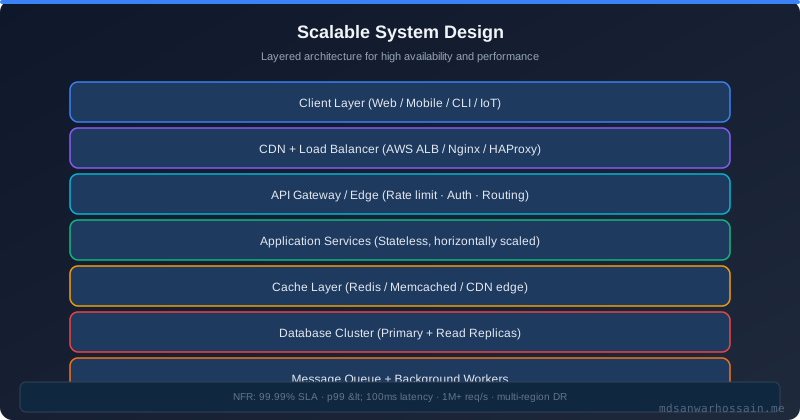
Choosing the right communication mechanism between services is critical to both correctness and resilience.
Synchronous communication (REST or gRPC) is appropriate when the caller genuinely needs the response before it can proceed, and when the callee is expected to be available. REST is ubiquitous and easy to debug; gRPC offers strongly-typed contracts (protobuf), bi-directional streaming, and significantly lower latency and payload size for high-throughput internal APIs. Use synchronous calls sparingly — each synchronous dependency chain increases the blast radius of a downstream failure.
Asynchronous communication via a message broker (Apache Kafka, RabbitMQ) decouples the producer from the consumer in time. The producer publishes an event and moves on; consumers process it when they are ready. This makes the system more resilient to transient failures and allows consumers to be scaled independently. Kafka is the dominant choice for high-throughput event streaming, providing durable, ordered, replayable event logs that also serve as the foundation for event sourcing architectures.
"Design services to fail gracefully. In a distributed system, partial failure is not an exception — it is the steady state. Build for it from day one."
The Saga Pattern for Distributed Transactions
In a monolith, a business operation spanning multiple tables can be wrapped in a single ACID database transaction. In a microservices architecture, where each service owns its data store, there is no such luxury. The Saga pattern addresses this by decomposing a distributed transaction into a sequence of local transactions, each publishing an event or message that triggers the next step. If any step fails, compensating transactions undo the preceding steps.
Choreography-Based Sagas
In a choreography saga, each service listens for events and reacts by performing its local transaction and publishing the next event. There is no central coordinator — the flow emerges from the event chain. This is highly decoupled but can be difficult to reason about when the number of services grows.
Orchestration-Based Sagas
In an orchestration saga, a dedicated saga orchestrator (often implemented as a state machine) tells each participant what to do. The orchestrator tracks the saga's state and handles failures by invoking compensating transactions. This centralized control makes the flow easier to visualize and debug, at the cost of introducing a central component.
Here is an example of an order saga orchestrated via Kafka in a Spring Boot application:
// Order Service publishes OrderCreated event to Kafka
@Service
public class OrderService {

    private final KafkaTemplate<String, OrderEvent> kafkaTemplate;
    private final OrderRepository orderRepository;

    public Order placeOrder(CreateOrderRequest request) {
        Order order = Order.builder()
            .id(UUID.randomUUID().toString())
            .customerId(request.customerId())
            .items(request.items())
            .status(OrderStatus.PENDING)
            .build();
        orderRepository.save(order);

        kafkaTemplate.send("order-events",
            order.getId(),
            new OrderCreatedEvent(order.getId(), order.customerId(), order.totalAmount()));

        return order;
    }

    // Compensation: called when payment fails
    @KafkaListener(topics = "payment-failed-events")
    public void onPaymentFailed(PaymentFailedEvent event) {
        orderRepository.findById(event.orderId()).ifPresent(order -> {
            order.setStatus(OrderStatus.CANCELLED);
            orderRepository.save(order);
        });
    }
}

// Payment Service listens for OrderCreated, publishes PaymentConfirmed or PaymentFailed
@Service
public class PaymentService {

    @KafkaListener(topics = "order-events")
    public void onOrderCreated(OrderCreatedEvent event) {
        boolean success = processPayment(event.customerId(), event.amount());
        String topic = success ? "payment-confirmed-events" : "payment-failed-events";
        kafkaTemplate.send(topic, event.orderId(),
            success
                ? new PaymentConfirmedEvent(event.orderId())
                : new PaymentFailedEvent(event.orderId(), "Insufficient funds"));
    }
}

// Inventory Service listens for PaymentConfirmed, reserves stock
@Service
public class InventoryService {

    @KafkaListener(topics = "payment-confirmed-events")
    public void onPaymentConfirmed(PaymentConfirmedEvent event) {
        boolean reserved = reserveStock(event.orderId());
        String topic = reserved ? "order-confirmed-events" : "stock-unavailable-events";
        kafkaTemplate.send(topic, event.orderId(),
            reserved
                ? new OrderConfirmedEvent(event.orderId())
                : new StockUnavailableEvent(event.orderId()));
    }
}
Each service performs a local transaction and publishes the outcome. The compensating path (payment failure → cancel order) is handled by the Order Service listening on the payment-failed-events topic. This choreography is loosely coupled but requires careful monitoring to track saga state across services.
The Outbox Pattern: Guaranteed Event Delivery
A subtle but critical problem in event-driven microservices: how do you guarantee that an event is published to Kafka if and only if the local database transaction commits? A naive implementation — save to DB, then publish to Kafka — can lose events if the application crashes between the two steps, or publish duplicate events if the Kafka publish succeeds but the DB commit rolls back.
The Outbox pattern solves this with atomicity. Instead of publishing to Kafka directly, you write the event to an outbox table in the same database transaction as the business state change. A separate relay process (a Debezium CDC connector or a polling publisher) reads new rows from the outbox table and publishes them to Kafka, then marks them as sent. Since the event write and the business state change are in the same ACID transaction, they are atomically consistent.
-- PostgreSQL outbox table schema
CREATE TABLE outbox_events (
    id          UUID PRIMARY KEY DEFAULT gen_random_uuid(),
    aggregate_type VARCHAR(255) NOT NULL,  -- e.g. 'Order'
    aggregate_id   VARCHAR(255) NOT NULL,  -- e.g. order UUID
    event_type     VARCHAR(255) NOT NULL,  -- e.g. 'OrderCreated'
    payload        JSONB         NOT NULL,
    created_at     TIMESTAMPTZ   NOT NULL DEFAULT NOW(),
    published      BOOLEAN       NOT NULL DEFAULT FALSE
);
// Spring Boot service writing to outbox within the same transaction
@Transactional
public Order placeOrder(CreateOrderRequest request) {
    Order order = orderRepository.save(Order.from(request));

    OutboxEvent event = OutboxEvent.builder()
        .aggregateType("Order")
        .aggregateId(order.getId())
        .eventType("OrderCreated")
        .payload(objectMapper.writeValueAsString(
            new OrderCreatedEvent(order.getId(), order.getCustomerId(), order.getTotalAmount())))
        .build();
    outboxRepository.save(event);  // Same transaction as orderRepository.save()

    return order;
}
Debezium monitors the PostgreSQL Write-Ahead Log (WAL) and streams outbox rows to Kafka as they are committed, providing exactly-once semantics with no polling overhead and sub-second latency.
Circuit Breaker and Resilience Patterns
When Service A calls Service B synchronously and B becomes slow or unavailable, without a circuit breaker, A's threads accumulate waiting for B to respond, eventually exhausting A's thread pool and causing A to fail as well — a cascading failure. The circuit breaker pattern prevents this by monitoring failure rates and short-circuiting calls to a failing dependency, returning a fast fallback response instead of waiting for a timeout.
Resilience4j is the de-facto library for resilience patterns in Java microservices:
@Service
public class ProductService {

    private final CircuitBreaker circuitBreaker =
        CircuitBreaker.ofDefaults("inventoryService");

    private final Retry retry = Retry.of("inventoryService",
        RetryConfig.custom()
            .maxAttempts(3)
            .waitDuration(Duration.ofMillis(500))
            .build());

    public int getAvailableStock(String productId) {
        Supplier<Integer> stockCall = CircuitBreaker
            .decorateSupplier(circuitBreaker, () -> inventoryClient.getStock(productId));
        Supplier<Integer> withRetry = Retry.decorateSupplier(retry, stockCall);

        return Try.ofSupplier(withRetry)
            .recover(throwable -> -1)  // Fallback: unknown stock
            .get();
    }
}
Beyond circuit breakers, always combine with timeouts (never let a thread wait indefinitely for a downstream call), bulkheads (isolate thread pools per downstream dependency to prevent one failing service from exhausting shared resources), and rate limiters (protect downstream services from being overwhelmed by upstream bursts).
Service Mesh: When Istio or Linkerd Makes Sense
A service mesh moves cross-cutting concerns — mTLS encryption, load balancing, circuit breaking, retries, distributed tracing — out of application code and into a sidecar proxy deployed alongside each service container. Every request between services passes through the sidecar (typically Envoy proxy), which enforces policies and emits telemetry without any changes to application code.
Istio is the most feature-rich option, offering fine-grained traffic management (canary deployments, traffic splitting, fault injection for chaos engineering), mutual TLS for all inter-service communication, and deep observability via Prometheus, Grafana, and Jaeger integrations. Linkerd is a lighter-weight alternative with lower operational overhead, focused on reliability and simplicity over advanced traffic management.
The right time to introduce a service mesh is when you have 10+ services and the overhead of managing TLS certificates, retry logic, and observability individually in each service becomes unsustainable. For smaller deployments, Spring Boot's built-in resilience4j integration and centralized logging are usually sufficient.
Deployment and Observability at Scale
Microservices without observability are flying blind. A single user request may traverse 10 services; when it fails, you need to reconstruct the exact path it took and identify where it went wrong. The three pillars of observability are:
- Logs: Structured JSON logs with correlation IDs (trace IDs) that allow you to filter all log lines related to a single request across all services. Use a centralized log aggregation platform (ELK stack, Grafana Loki).
- Metrics: Expose RED metrics per service: Rate (requests per second), Errors (error rate), and Duration (latency percentiles — p50, p95, p99). Instrument with Micrometer in Spring Boot, scrape with Prometheus, and visualize in Grafana.
- Traces: Distributed tracing with OpenTelemetry propagates a trace context (trace ID, span ID) across all service calls. Each service creates a child span for its portion of the work. The resulting trace tree reveals exactly where latency is introduced. Use Jaeger or Zipkin as the trace backend.
On Kubernetes, deploy each service with resource requests and limits, readiness and liveness probes, and horizontal pod autoscaling based on custom metrics (request rate, queue depth). Use namespaces for environment isolation and NetworkPolicies to restrict which services can communicate with each other, implementing least-privilege networking.
"You are not done building a microservice until you can answer three questions in under two minutes for any production incident: what failed, why it failed, and what was the user impact."
Microservices architecture is not a destination — it is a continuous practice of refining boundaries, hardening communication patterns, and investing in observability. The patterns covered here — Saga, Outbox, Circuit Breaker, CQRS, and Service Mesh — are not theoretical constructs. They are battle-tested solutions to the distributed systems problems you will inevitably encounter as your system grows. Master them, and you will build systems that degrade gracefully, recover automatically, and scale confidently.
Leave a Comment
Related Posts

Software Engineer · Java · Spring Boot · Microservices