Clean Code in Java & Spring Boot: Naming, Functions & SOLID Applied to Microservices
Clean code is not about aesthetics — it is about the cost of change. Code that is read ten times for every one time it is written must reward readers with clarity. This guide translates Robert C. Martin's principles into concrete Java and Spring Boot patterns for production microservices teams.
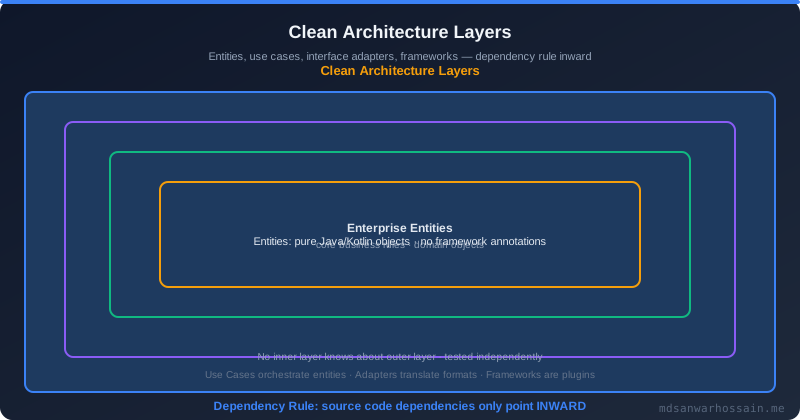
Table of Contents
Naming Conventions That Reveal Intent
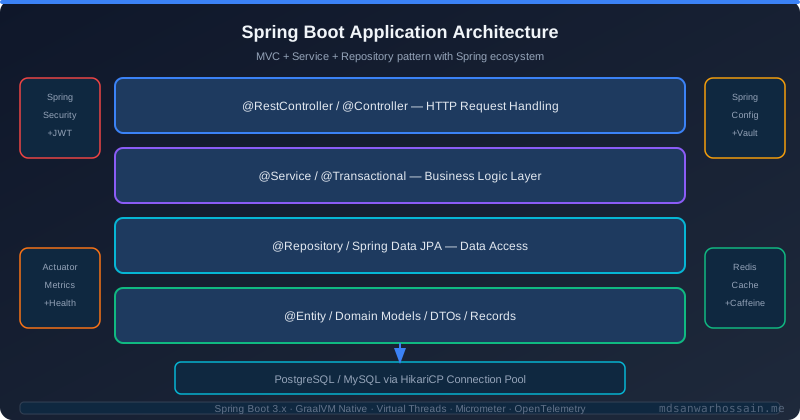
The single highest-leverage clean code practice is naming. A name that reveals intent eliminates the need for a comment and removes a cognitive step from every future reader of the code. In Java and Spring Boot, this principle applies at every level: class names, method names, variable names, and Spring bean names.
Classes should be nouns that describe what they are, not verbs that describe what they do. A class named UserProcessor tells you it processes users but not what kind of processing. A class named UserActivationService tells you exactly what responsibility it holds. The noun specificity maps directly to the Single Responsibility Principle: a narrow noun implies a focused responsibility.
// Poor: vague noun, unclear responsibility
public class UserProcessor { ... }
public class DataHelper { ... }
public class UtilsManager { ... }

// Clean: specific nouns that reveal responsibility
public class UserActivationService { ... }
public class OrderFulfillmentCoordinator { ... }
public class PaymentGatewayAdapter { ... }
Method names should be verbs or verb phrases that describe the operation performed. Boolean-returning methods should read as questions: isActive(), hasPermission(), canRefund(). Methods that retrieve data should use get, find, or fetch — with the distinction that get implies the data is known to exist (throws if not found) and find returns an Optional (absence is expected).
// Reveals intent at the call site — no need to look at the implementation
Optional<User> findByEmail(String email);    // absence is normal
User getById(UUID id);                       // throws if not found
boolean isEligibleForDiscount(Order order);  // reads as a question
void activateAccount(UUID accountId);        // imperative command
Variable names should be proportional to their scope. A loop variable in a two-line loop can be i. A variable used across fifty lines of a method should have a full descriptive name. The rule of thumb: the longer the scope, the longer the name must be to remain unambiguous.
// Short scope — short name is fine
for (int i = 0; i < retryCount; i++) { retry(); }

// Long scope — descriptive name required
int maximumAllowedConcurrentSessionsPerUser = config.getSessionLimit();
Duration tokenExpiryDurationForPremiumAccounts = Duration.ofDays(90);
Writing Focused Functions
Robert C. Martin's rule is that functions should do one thing. In practice, "one thing" means one level of abstraction. A function that orchestrates a business workflow should call other functions; it should not also contain low-level implementation details like date formatting or string parsing. When a function mixes abstraction levels, reading it requires constantly shifting mental context.
// Mixed abstraction levels — hard to follow
public OrderConfirmation processOrder(OrderRequest request) {
    // Level: input validation
    if (request.getItems() == null || request.getItems().isEmpty()) {
        throw new IllegalArgumentException("Order must have items");
    }
    // Level: business rule
    BigDecimal total = request.getItems().stream()
        .map(item -> item.getPrice().multiply(BigDecimal.valueOf(item.getQuantity())))
        .reduce(BigDecimal.ZERO, BigDecimal::add);
    // Level: infrastructure concern
    String confirmationNumber = "ORD-" + System.currentTimeMillis();
    // Level: persistence
    Order order = new Order(request, total, confirmationNumber);
    orderRepository.save(order);
    eventPublisher.publish(new OrderPlacedEvent(order));
    return new OrderConfirmation(confirmationNumber, total);
}
// Single level of abstraction — each step is a named operation
public OrderConfirmation processOrder(OrderRequest request) {
validateOrderRequest(request);
BigDecimal total = calculateOrderTotal(request.getItems());
Order order = createOrder(request, total);
persistOrder(order);
publishOrderEvent(order);
return buildConfirmation(order);
}
private void validateOrderRequest(OrderRequest request) {
if (request.getItems() == null || request.getItems().isEmpty()) {
throw new InvalidOrderException("Order must contain at least one item");
}
}
private BigDecimal calculateOrderTotal(List<OrderItem> items) {
return items.stream()
.map(item -> item.getPrice().multiply(BigDecimal.valueOf(item.getQuantity())))
.reduce(BigDecimal.ZERO, BigDecimal::add);
}The refactored version is readable like a table of contents. You can understand the high-level flow without reading any private method. If you need to understand how the total is calculated, you drill into calculateOrderTotal. This stepdown rule — high-level operations at the top, details nested below — is the most effective structure for navigating large service classes.
Function arguments: Zero is best, one is good, two is acceptable, three requires justification, four or more demands a parameter object. When a method takes four or more parameters, the parameters almost always cluster into a concept that deserves its own class. Creating that class is not over-engineering — it is naming the concept.
SOLID Principles in Spring Boot Services
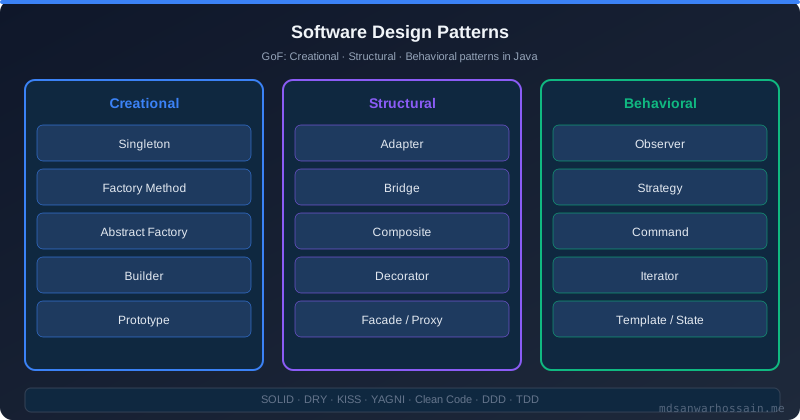
The five SOLID principles are most valuable when understood as heuristics for how to split classes and manage dependencies, not as rules to follow mechanically.
Single Responsibility Principle (SRP): A class should have one reason to change. In Spring Boot, the most common SRP violation is a service class that handles business logic, validation, formatting, and persistence in one place. When requirements change — and they always do — you want to change one class, not trace the ripples through a god class.
// SRP violation: PaymentService handles too many concerns
@Service
public class PaymentService {
    public void processPayment(PaymentRequest request) {
        // Validation logic
        if (request.getAmount().compareTo(BigDecimal.ZERO) <= 0) { ... }
        // Fraud detection logic
        if (fraudDetector.isSuspicious(request)) { ... }
        // Payment gateway integration
        gatewayClient.charge(request);
        // Notification logic
        emailService.sendReceipt(request);
        // Audit logging
        auditLog.record(request);
    }
}

// SRP applied: each concern in its own class
@Service
public class PaymentOrchestrationService {
    public PaymentResult processPayment(PaymentRequest request) {
        paymentValidator.validate(request);
        fraudScreeningService.screen(request);
        PaymentResult result = paymentGateway.charge(request);
        notificationService.sendReceipt(result);
        auditService.recordPayment(result);
        return result;
    }
}
Open/Closed Principle (OCP): Classes should be open for extension but closed for modification. In Spring Boot, the Strategy pattern implements OCP cleanly. Instead of adding a new if branch to a service every time a new payment provider is supported, define a PaymentGateway interface and add a new implementation. The service that uses the interface is never modified.
// OCP: adding a new payment provider requires no change to PaymentService
public interface PaymentGateway {
    PaymentResult charge(PaymentRequest request);
    boolean supports(PaymentMethod method);
}

@Component
public class StripeGateway implements PaymentGateway { ... }

@Component
public class PayPalGateway implements PaymentGateway { ... }

@Service
public class PaymentService {
    private final List<PaymentGateway> gateways;
    public PaymentResult processPayment(PaymentRequest request) {
        PaymentGateway gateway = gateways.stream()
            .filter(g -> g.supports(request.getMethod()))
            .findFirst()
            .orElseThrow(() -> new UnsupportedPaymentMethodException(request.getMethod()));
        return gateway.charge(request);
    }
}
Liskov Substitution Principle (LSP): Subtypes must be substitutable for their base types. The most common LSP violation in Java is overriding a method to throw an exception the supertype contract does not declare. If ReadOnlyUserRepository extends UserRepository but throws UnsupportedOperationException from save(), code that uses UserRepository breaks at runtime when it receives a ReadOnlyUserRepository.
Interface Segregation Principle (ISP): Clients should not be forced to depend on interfaces they do not use. A UserRepository interface that defines twenty methods forces every test double to implement nineteen irrelevant methods. Define narrow, focused interfaces — UserReader, UserWriter, UserSearcher — and compose them where all capabilities are needed.
Dependency Inversion Principle (DIP): High-level modules should not depend on low-level modules; both should depend on abstractions. In Spring Boot this is implemented with constructor injection. Inject interfaces, not concrete classes. The Spring container resolves the concrete implementation; the dependent class never imports it.
// DIP: depends on abstraction, not concrete implementation
@Service
public class OrderService {
    private final OrderRepository orderRepository;     // interface
    private final PaymentGateway paymentGateway;       // interface
    private final InventoryService inventoryService;   // interface

    // Constructor injection — makes dependencies explicit and testable
    public OrderService(OrderRepository orderRepository,
                        PaymentGateway paymentGateway,
                        InventoryService inventoryService) {
        this.orderRepository = orderRepository;
        this.paymentGateway = paymentGateway;
        this.inventoryService = inventoryService;
    }
}
Clean Exception Handling
Java exception handling is one of the most abused areas of clean code. The core principle: use exceptions to signal genuinely exceptional conditions, not to control normal flow. A user not being found when searching by email is not exceptional — absence is an expected result. Throw an exception only when a condition represents an assumption violation that the calling code cannot recover from locally.
In Spring Boot microservices, define a hierarchy of domain exceptions that express business failures in the domain language:
// Domain exception hierarchy
public class DomainException extends RuntimeException {
    private final String errorCode;
    public DomainException(String errorCode, String message) {
        super(message);
        this.errorCode = errorCode;
    }
    public String getErrorCode() { return errorCode; }
}

public class OrderNotFoundException extends DomainException {
    public OrderNotFoundException(UUID orderId) {
        super("ORDER_NOT_FOUND", "Order not found: " + orderId);
    }
}

public class InsufficientInventoryException extends DomainException {
    public InsufficientInventoryException(String sku, int requested, int available) {
        super("INSUFFICIENT_INVENTORY",
              String.format("Requested %d units of %s but only %d available", requested, sku, available));
    }
}
Handle these domain exceptions centrally in Spring Boot with @RestControllerAdvice. A single global exception handler translates domain exceptions to appropriate HTTP responses, keeping controller methods clean of try-catch blocks:
@RestControllerAdvice
public class GlobalExceptionHandler {
    @ExceptionHandler(OrderNotFoundException.class)
    @ResponseStatus(HttpStatus.NOT_FOUND)
    public ErrorResponse handleOrderNotFound(OrderNotFoundException ex) {
        return new ErrorResponse(ex.getErrorCode(), ex.getMessage());
    }

    @ExceptionHandler(InsufficientInventoryException.class)
    @ResponseStatus(HttpStatus.CONFLICT)
    public ErrorResponse handleInsufficientInventory(InsufficientInventoryException ex) {
        return new ErrorResponse(ex.getErrorCode(), ex.getMessage());
    }
}
Testing as a Clean Code Discipline
Clean tests are as important as clean production code. Tests that are hard to read become tests that are not trusted, not updated when behaviour changes, and eventually deleted. The three rules of clean tests: one concept per test, arrange-act-assert structure, and descriptive test names that describe the scenario and expected outcome.
// Clean test: one concept, clear structure, descriptive name
@Test
void shouldRejectOrderWhenInventoryIsInsufficient() {
    // Arrange
    UUID productId = UUID.randomUUID();
    OrderRequest request = new OrderRequest(productId, 10);
    when(inventoryService.getAvailableStock(productId)).thenReturn(3);

    // Act + Assert
    assertThatThrownBy(() -> orderService.placeOrder(request))
        .isInstanceOf(InsufficientInventoryException.class)
        .hasMessageContaining("Requested 10 units");
}

@Test
void shouldApplyLoyaltyDiscountWhenCustomerHasGoldStatus() {
    // Arrange
    Customer goldCustomer = CustomerFixtures.goldTierCustomer();
    Order order = OrderFixtures.orderWithTotal(Money.of(100, "USD"));

    // Act
    Money discountedTotal = pricingService.applyDiscounts(order, goldCustomer);

    // Assert
    assertThat(discountedTotal).isEqualTo(Money.of(90, "USD")); // 10% gold discount
}
Test fixtures — factory methods or builder objects that create valid test objects — dramatically reduce test boilerplate and make tests resilient to constructor signature changes. When a constructor gains a new required field, fix the fixture once instead of updating fifty test methods.
Refactoring Legacy Java Code Incrementally
Legacy Java codebases present the clean code challenge in its most difficult form: you cannot rewrite the whole thing, the existing tests (if any) are brittle, and the business cannot stop while you refactor. The most effective approach is the Boy Scout Rule: always leave the code a little cleaner than you found it. Rename one unclear variable when you touch a class. Extract one long method into named sub-methods when you add a feature. These small improvements compound across hundreds of commits.
The strangler fig pattern is the most reliable strategy for incremental structural improvement: build a new, clean implementation alongside the old one, route new behaviour to the new implementation, and retire the old implementation as its call sites are migrated. Applied to a god service class, you extract one responsibility into a new focused service, inject the new service where the old one is used, and delete the extracted code from the god class. After ten iterations the god class is gone.
// Before: OrderService handles everything
@Service
public class OrderService {
    public void processOrder(Order order) {
        // 200 lines of mixed concerns: validation, inventory, payment, notification, audit
    }
}

// After iteration 1: extract notification concern
@Service
public class OrderService {
    private final OrderNotificationService notificationService; // extracted

    public void processOrder(Order order) {
        // ... validation, inventory, payment still here
        notificationService.notifyOrderPlaced(order); // delegates
        // ... audit still here
    }
}

// After iteration 5: all concerns extracted
@Service
public class OrderOrchestrationService {
    public void processOrder(OrderRequest request) {
        Order order = orderCreationService.create(request);
        inventoryService.reserve(order);
        paymentService.charge(order);
        notificationService.notifyOrderPlaced(order);
        auditService.recordOrderPlaced(order);
    }
}
Code Review Culture for Clean Code
Code review is the team's quality gate for clean code. The most productive review culture focuses reviews on maintainability — naming clarity, responsibility isolation, testability — rather than style preferences. A linter or formatter automates style; reviewers should spend their limited attention on what tools cannot check: does this name reveal intent? Does this class have a single responsibility? Will the next developer understand this without comments?
Define a team-level working agreement for clean code that covers naming conventions (camelCase, noun classes, verb methods), acceptable function length (a practical guideline: if a method does not fit in a screen, consider extracting), and SOLID principles as a review checklist. Review comments that reference a shared principle ("this method mixes two abstraction levels") are faster to write, easier to understand, and less contentious than subjective style feedback.
The most underused clean code review practice is the "read-aloud test": read a method name aloud at the call site and check whether it says what you expect. orderService.process(order) fails the test — process what? orderService.placeOrder(request) passes — you know exactly what happens.
"Clean code is not written for the compiler — it is written for the next developer who reads it, which is usually yourself six months later wondering what you were thinking."
Key Takeaways
- Names reveal intent. Specific nouns for classes, verb phrases for methods, proportional variable names for scope.
- Functions do one thing at one level of abstraction. Extract until each function reads like a table of contents for the step below it.
- SOLID principles guide class splitting and dependency management. SRP and DIP deliver the greatest daily return in Spring Boot codebases.
- Domain exception hierarchies plus a central
@RestControllerAdvicekeep controllers and services free of try-catch boilerplate. - Tests are documentation. Name them to describe the scenario and expected outcome; one concept per test.
- Refactor incrementally using the strangler fig pattern and Boy Scout Rule. Rewrites are rarely the answer.
Conclusion
Clean code in Java and Spring Boot is a discipline of consistency applied at scale. Any single principle applied once produces marginal improvement. The same principles applied consistently across a team, a codebase, and a year produce a system where new developers contribute confidently within days, where bugs are isolated rather than systemic, and where features take hours instead of weeks to add safely.
The investment in clean code is highest early and pays perpetually. A method renamed from process to activateCustomerAccount eliminates a question every future reader would have had. A function split from 150 lines into five focused methods eliminates a comprehension barrier that would have slowed every future change. These are not aesthetic choices — they are engineering economics applied at the level where most software projects ultimately succeed or fail: the daily velocity of understanding and changing existing code.
Leave a Comment
Related Posts

Software Engineer · Java · Spring Boot · Microservices