Clean Architecture in Modern Applications: Principles, Layers, and Real-World Java Examples
Clean Architecture is not a pattern to apply in small doses — it is a discipline of thinking about dependency direction, business rule isolation, and framework independence that transforms how a codebase evolves over years. This guide shows how to apply it practically in Java and Spring Boot projects.
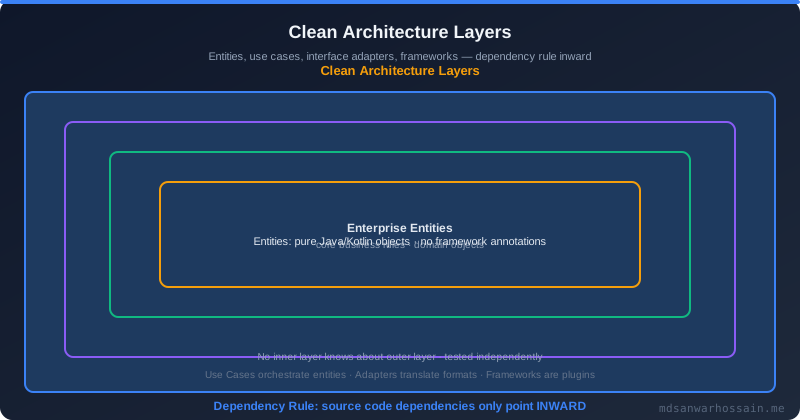
Table of Contents
The Central Insight: Dependency Direction Is Everything
Robert C. Martin's Clean Architecture is fundamentally about one rule: source code dependencies must point inward, toward business rules. The outer layers (frameworks, databases, UIs) depend on the inner layers (use cases and entities). The inner layers know nothing about the outer layers. This inversion means you can replace your web framework, your database, or your messaging system without modifying a single line of business logic.
In practice, most Java applications violate this rule extensively. Controllers call repository interfaces directly. Entities are annotated with JPA annotations, coupling domain objects to the persistence framework. Service classes import Spring annotations, making them unrunnable without a Spring container. These violations are harmless in small codebases but become serious liabilities at scale: they make business logic hard to test without spinning up infrastructure, and they make framework migrations expensive.
The Four Layers
Layer 1: Entities (Enterprise Business Rules)
Entities encapsulate the most fundamental business rules of your application — rules that would be true regardless of whether the application exists in a web context, a batch context, or a CLI context. In a banking system, the rule that "a transfer must not overdraw an account" is an entity-level rule. Entities are plain Java objects with no framework dependencies, no annotations, and no infrastructure concerns. They can be instantiated and tested with a single constructor call.
// Pure entity — no framework imports
public class BankAccount {
    private final AccountId id;
    private Money balance;
    private final AccountStatus status;
    public TransferResult debit(Money amount) {
        if (status != AccountStatus.ACTIVE)
            return TransferResult.failure("Account is not active");
        if (balance.isLessThan(amount))
            return TransferResult.failure("Insufficient funds");
        balance = balance.subtract(amount);
        return TransferResult.success(balance);
    }
    public void credit(Money amount) {
        if (status != AccountStatus.ACTIVE)
            throw new IllegalStateException("Cannot credit inactive account");
        balance = balance.add(amount);
    }
}
Layer 2: Use Cases (Application Business Rules)
Use cases orchestrate the flow of data to and from entities, and direct those entities to use their business rules to achieve the goal of the use case. A use case is a single application-specific operation: TransferFunds, RegisterUser, CancelOrder. Each use case class has a single public method (typically execute) that takes a request model and returns a response model. Use cases depend on entities and on outgoing port interfaces, but never on frameworks or databases directly.
// Use case depending only on port interfaces, not on implementations
public class TransferFundsUseCase {
    private final AccountRepository accountRepository;  // port interface
    private final EventPublisher eventPublisher;       // port interface
    public TransferResult execute(TransferFundsCommand cmd) {
        BankAccount source = accountRepository.findById(cmd.sourceId())
            .orElseThrow(() -> new AccountNotFoundException(cmd.sourceId()));
        BankAccount target = accountRepository.findById(cmd.targetId())
            .orElseThrow(() -> new AccountNotFoundException(cmd.targetId()));
        TransferResult debitResult = source.debit(cmd.amount());
        if (debitResult.isFailed()) return debitResult;
        target.credit(cmd.amount());
        accountRepository.save(source);
        accountRepository.save(target);
        eventPublisher.publish(new FundsTransferredEvent(cmd.sourceId(), cmd.targetId(), cmd.amount()));
        return TransferResult.success(source.getBalance());
    }
}
Layer 3: Interface Adapters
Interface adapters translate data between the format most convenient for use cases/entities and the format most convenient for external agencies like databases, web frameworks, or message brokers. This is where Spring MVC controllers live — they translate HTTP requests into use case commands and translate use case responses into HTTP response bodies. Repository implementations live here too — they translate between domain objects and JPA entities.
A key discipline: the controller should be thin. It validates input, calls the use case, and formats output. No business logic belongs here. If you find yourself writing conditionals in a controller beyond basic input validation, those conditions belong in a use case.
Layer 4: Frameworks and Drivers
The outermost layer contains frameworks and drivers: Spring Boot, Hibernate, Kafka, Redis, external APIs. This layer is mostly glue code that wires everything together. The application's main function lives here, creating the concrete implementations and injecting them into the inner layers via dependency injection. Because this layer depends on the inner layers and not vice versa, swapping the database from PostgreSQL to MongoDB is a change in the adapter and framework layer only.
Hexagonal Architecture: A Related View
Hexagonal Architecture (also called Ports and Adapters) is a closely related pattern that makes the dependency inversion explicit with the language of ports and adapters. Ports are the interfaces the application exposes (driving ports for incoming use cases) or requires (driven ports for outgoing interactions like databases). Adapters are the concrete implementations of those ports — a Spring MVC controller adapts HTTP to a driving port, and a JPA repository implementation adapts the driven port to PostgreSQL.
The terminology makes architectural conversations clearer: "we need a new adapter for the payment port" rather than "we need to integrate the new payment provider."
Mapping Between Layers
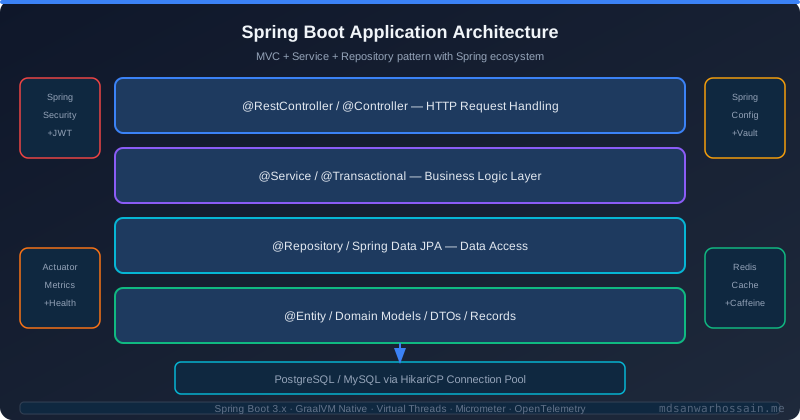
One practical challenge of Clean Architecture is the proliferation of mapping code between layers. Domain entities must be mapped to DTOs for controllers, to JPA entities for persistence, and to events for messaging. This mapping is essential to keep layers independent but adds boilerplate. Tools like MapStruct generate mapping code at compile time with zero reflection overhead. Accepting the mapping cost is the pragmatic choice — the testability and independence it buys pays compound interest over the life of a project.
Common Mistakes
Anemic domain model: Entities are just data bags with getters and setters; all logic lives in services. This violates the entity layer's responsibility for business rules. Move business logic into entities where it belongs.
Use cases that call each other: Use cases should call repositories and domain services, not other use cases. If you feel the urge to call one use case from another, extract the shared behavior into a domain service.
Leaking framework dependencies inward: The most common violation is placing @Entity or @Document annotations on domain objects. Create separate persistence entities in the adapter layer and map to/from domain objects.
"The goal of Clean Architecture is to produce a system that is flexible, testable, and independent of frameworks, databases, and UIs. The cost is more layers. The payoff is a codebase that developers can change confidently at any scale."
Key Takeaways
- The single rule of Clean Architecture: source code dependencies must point inward.
- The four layers: entities (business rules), use cases (application logic), interface adapters, frameworks/drivers.
- Use cases depend on port interfaces; concrete implementations live in the adapter layer.
- MapStruct eliminates the performance cost of inter-layer mapping boilerplate.
- The most common violations: anemic entities, use cases calling use cases, JPA annotations on domain objects.
Real-World Problem: The Framework Migration Trap
A large insurance platform built over six years had its entire business logic intertwined with Spring MVC and JPA. Controllers called JPA repositories directly. Domain entities had @Entity annotations. Service classes were only testable with a full Spring context. When the team needed to migrate from REST to event-driven processing for claims handling, the work was estimated at eight months because changing the delivery mechanism required modifying every layer of the application. There was no separation between business rules and the technology delivering them.
After a six-month refactoring to Clean Architecture, the same team migrated claims processing from synchronous REST to Kafka event-driven processing in three weeks, touching only the interface adapter layer. The use cases and entities remained completely unchanged. The domain logic had zero knowledge that the delivery mechanism had changed. This is the compound return on Clean Architecture investment — not the first feature, but the tenth framework change, the third team that joins the project, the infrastructure migration that would have taken a year.
Solution Approach: Applying Clean Architecture to a Spring Boot Service
Translating Clean Architecture principles to a Spring Boot codebase requires concrete decisions about package structure and dependency direction. The recommended package layout follows the layer boundaries explicitly:
com.example.billing/
├── domain/
│   ├── model/           # Entities: BankAccount, Payment, Invoice
│   └── service/         # Domain services: FraudDetectionService
├── application/
│   ├── port/
│   │   ├── in/          # Driving ports: TransferFundsUseCase (interface)
│   │   └── out/         # Driven ports: AccountRepository, EventPublisher
│   └── usecase/         # Use case implementations
├── adapter/
│   ├── in/
│   │   ├── web/         # Spring MVC controllers
│   │   └── messaging/   # Kafka consumers
│   └── out/
│       ├── persistence/ # JPA repository implementations + JPA entities
│       └── messaging/   # Kafka producer implementations
└── config/              # Spring @Configuration classes, Bean wiring
The critical rule is that imports only flow inward: adapter imports application, application imports domain, domain imports nothing from the other layers. The config package is the only place where Spring's dependency injection wires concrete implementations to port interfaces. This means the entire domain and application packages are runnable in a plain JUnit test without any Spring context.
Optimization: Making Clean Architecture Pragmatic
The most common objection to Clean Architecture is the mapping overhead. Each layer boundary requires converting between representation types: the JPA entity is not the domain entity; the REST DTO is not the use case response model. This mapping is real work, but it can be dramatically reduced with MapStruct, which generates compile-time mapping code with no runtime reflection. Define a @Mapper interface for each adapter boundary and MapStruct generates the implementation automatically from field names and type conversions.
For services where the overhead is genuinely not justified — internal utilities, simple CRUD services, data pipeline components — a pragmatic subset of the principles still provides value without full layer separation. The core rule (business logic should not import framework classes) can be enforced with ArchUnit, a library that lets you write architecture rules as unit tests: noClasses().that().resideInPackage("..domain..").should().dependOnClassesThat().resideInPackage("..springframework..").
Conclusion
Clean Architecture is a discipline of deferral — defer decisions about frameworks, databases, and delivery mechanisms as long as possible so the business rules can evolve independently. In practice, this means designing use cases and entities before choosing persistence strategies, and choosing persistence strategies before choosing web frameworks. The payoff accumulates over years: systems that are easy to test because business logic has no infrastructure dependencies, easy to refactor because layers are isolated, and easy to understand because each class has a single, clearly-scoped responsibility. For long-lived Java applications handling complex business domains, Clean Architecture is the highest-return structural investment a team can make.
Frequently Asked Questions
What is The Central Insight and how does it work?
Robert C. Martin's Clean Architecture is fundamentally about one rule: source code dependencies must point inward, toward business rules. The outer layers (frameworks, databases, UIs) depend on the inner layers (use cases and entities). The inner layers know nothing about the outer layers. This inversion means you can replace your web framework, your database, or your messaging system without modifying a single line of business logic. In practice, most Java applications violate this rule extensively. Controllers call repository interfaces directly. Entities are annotated with JPA annotations, coupling domain objects to the persistence framework. Service classes import Spring annotations, making them unrunnable without a Spring container.
What is Layer 1 and how does it work?
Entities encapsulate the most fundamental business rules of your application — rules that would be true regardless of whether the application exists in a web context, a batch context, or a CLI context. In a banking system, the rule that "a transfer must not overdraw an account" is an entity-level rule. Entities are plain Java objects with no framework dependencies, no annotations, and no infrastructure concerns. They can be instantiated and tested with a single constructor call.
What is Layer 2 and how does it work?
Use cases orchestrate the flow of data to and from entities, and direct those entities to use their business rules to achieve the goal of the use case. A use case is a single application-specific operation: TransferFunds, RegisterUser, CancelOrder. Each use case class has a single public method (typically execute ) that takes a request model and returns a response model. Use cases depend on entities and on outgoing port interfaces, but never on frameworks or databases directly.
What is Layer 3 and how does it work?
Interface adapters translate data between the format most convenient for use cases/entities and the format most convenient for external agencies like databases, web frameworks, or message brokers. This is where Spring MVC controllers live — they translate HTTP requests into use case commands and translate use case responses into HTTP response bodies. Repository implementations live here too — they translate between domain objects and JPA entities. A key discipline: the controller should be thin. It validates input, calls the use case, and formats output. No business logic belongs here. If you find yourself writing conditionals in a controller beyond basic input validation, those conditions belong in a use case.
What is Layer 4 and how does it work?
The outermost layer contains frameworks and drivers: Spring Boot, Hibernate, Kafka, Redis, external APIs. This layer is mostly glue code that wires everything together. The application's main function lives here, creating the concrete implementations and injecting them into the inner layers via dependency injection. Because this layer depends on the inner layers and not vice versa, swapping the database from PostgreSQL to MongoDB is a change in the adapter and framework layer only.
Leave a Comment
Related Posts

Software Engineer · Java · Spring Boot · Microservices