Clean Code & Maintainability: Real-World Engineering Guide for Java Developers
1. What Clean Code Actually Means (Beyond Robert Martin)
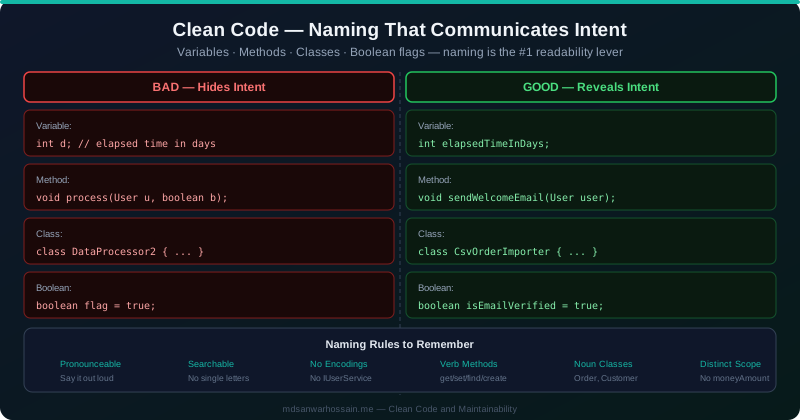
Robert Martin's Clean Code is foundational, but the real-world definition of clean code in a production team goes beyond formatting and function length. Clean code is code that is readable (any team member can understand it quickly), changeable (modifications can be made with confidence, not fear), and testable (behaviors can be verified in isolation).
The business case for clean code is measured in concrete outcomes. Unclean code creates a compounding cost that shows up across the entire software delivery lifecycle:
| Attribute | Clean Code | Unclean Code |
|---|---|---|
| Code review time | 15–30 minutes per PR | 60–90 minutes (decoding intent) |
| Bug rate | Low (clear intent, good tests) | High (hidden assumptions, side effects) |
| New engineer onboarding | 1–2 weeks to first contribution | 4–6 weeks (understanding codebase) |
| Deployment confidence | High (test coverage, clear scope) | Fear-driven (unknown side effects) |
| Feature delivery speed | Consistent over time | Slows down as debt compounds |
2. Naming: The Most Impactful Single Change
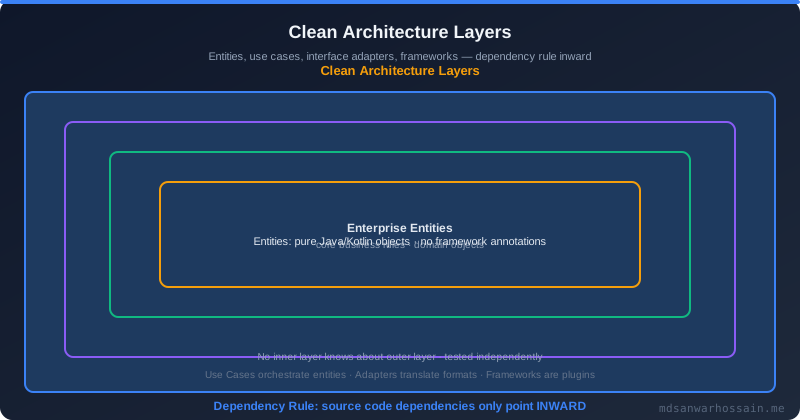
Studies consistently show that developers spend 70% of coding time reading code. Good naming is the single highest-leverage improvement you can make. Every poorly named variable is a cognitive tax paid by every developer who reads that code forever.
Variables & Fields
// BAD: Single letters and meaningless names force reader to track context
int d;               // days? data? dimension?
String tmp;          // temporary what?
List<Object> data;  // data is every variable ever

// GOOD: Names that reveal intent make code read like prose
int elapsedTimeInDays;
String customerEmailAddress;
List<OrderItem> pendingOrderItems;
Method Names
// BAD: Generic verbs that tell us nothing about what they do
public void process(Object input) { ... }
public Response handle(Request req) { ... }
public void doStuff(User u) { ... }

// GOOD: Verb + specific noun that tells you exactly what happens
public void processOrderPayment(Order order, PaymentMethod method) { ... }
public CustomerAgeVerificationResult validateCustomerAge(Customer customer) { ... }
public void cancelExpiredSubscriptions(LocalDate asOf) { ... }
Class Names & Boolean Variables
// BAD: Generic class names say what it is, not what it does
public class OrderManager { ... }      // manages what?
public class DataProcessor { ... }     // processes what kind of data?
public class UserHandler { ... }       // handles users how?

// GOOD: Specific class names that express role
public class OrderPaymentProcessor { ... }
public class CustomerCsvImportService { ... }
public class ExpiredSessionCleaner { ... }

// BAD: Boolean names that don't read naturally in conditions
boolean isValid;   // valid for what?
boolean flag;      // what does this flag?

// GOOD: Boolean names that read like questions
boolean isEligibleForLoyaltyDiscount;
boolean hasActiveSubscription;
boolean isEmailVerified;
// Usage reads like English: if (customer.isEligibleForLoyaltyDiscount()) { ... }customerList not list, orderCount not count, maxRetryAttempts not max. If the name includes the type (e.g., customerString), that's a sign the variable scope is too large or the type is wrong.
3. Functions: Small, Single-Purpose, Testable
The 20-line rule is a useful heuristic: if a function exceeds 20 lines, it likely has multiple responsibilities. Functions should do one thing, do it well, and do it only. The real test: can you name the function with a verb + specific noun without using "and" or "or"?
// BAD: 80-line method doing 6 different things — impossible to test individually
@PostMapping("/users")
public ResponseEntity<UserDto> createUserAccount(@RequestBody UserRegistrationRequest req) {
    // Validate email format
    if (!req.getEmail().matches("^[A-Za-z0-9+_.-]+@(.+)$")) {
        throw new ValidationException("Invalid email");
    }
    // Check for duplicate
    if (userRepository.existsByEmail(req.getEmail())) {
        throw new DuplicateEmailException(req.getEmail());
    }
    // Hash password (50+ lines omitted)
    // Save to database
    // Send welcome email
    // Publish UserRegistered event
    // Log audit trail
    // ... 70+ more lines
}

// GOOD: Orchestrator delegates to focused, independently testable methods
@PostMapping("/users")
public ResponseEntity<UserDto> createUserAccount(@Valid @RequestBody UserRegistrationRequest req) {
    UserDto user = userRegistrationService.register(req);
    return ResponseEntity.created(URI.create("/users/" + user.id())).body(user);
}

@Service
@RequiredArgsConstructor
public class UserRegistrationService {
    public UserDto register(UserRegistrationRequest req) {
        validateUniqueEmail(req.email());
        User user = buildNewUser(req);
        userRepository.save(user);
        sendWelcomeEmail(user);
        publishRegistrationEvent(user);
        auditLog.record(AuditEvent.userRegistered(user.getId()));
        return UserDto.from(user);
    }

    private void validateUniqueEmail(String email) {
        if (userRepository.existsByEmail(email)) {
            throw new DuplicateEmailException(email);
        }
    }

    private User buildNewUser(UserRegistrationRequest req) {
        return User.builder()
            .id(UUID.randomUUID().toString())
            .email(req.email())
            .passwordHash(passwordEncoder.encode(req.password()))
            .createdAt(Instant.now())
            .build();
    }
}
Flag Arguments & Command-Query Separation
// BAD: Boolean flag parameter (what does 'true' mean here at call site?)
userService.createUser(request, true);  // true = ???

public User createUser(UserRequest req, boolean sendConfirmationEmail) {
    // Two code paths in one function — effectively two functions merged
    ...
}

// GOOD: Two explicit, intention-revealing methods
public User createUserWithEmailConfirmation(UserRequest req) { ... }
public User createUserSilently(UserRequest req) { ... }

// Command-Query Separation (CQS): methods either return a value OR have side effects, not both
// BAD: Mixed — modifies state AND returns value
public boolean disableAndGetAccount(String userId) {
    account.setEnabled(false);
    accountRepository.save(account);
    return account.isPremium(); // why does disable return premium status?
}

// GOOD: Separate concerns
public void disableAccount(String userId) { ... }           // command
public boolean isAccountPremium(String userId) { ... }      // query
4. Comments: When They Help vs When They Hurt
The most insightful advice on comments: every comment is a failure to express intent in code — sometimes a justified failure, but a failure nonetheless. Comments answer why, not what. Code already says what.
- Good comments: Legal/license headers. Complex algorithm explanation with academic citation. Business rule rationale that isn't obvious from the domain.
// TODO: TICKET-4521 — replace with rate-limiter once deployed - Bad comments: Redundant (restating what the code obviously says). Misleading (outdated, contradicting current behavior). Commented-out code (use git for history). Section dividers.
// BAD: Comment explains WHAT, not WHY — code already says what
// Check if user age is greater than or equal to 18
if (user.getAge() >= 18) {
    allowAccess();
}

// BAD: Outdated comment contradicts the code (the worst kind)
// Returns user by ID
public List<User> findUsersByDepartment(String departmentId) { ... }

// BAD: Commented-out code pollutes the codebase
// userRepository.deleteByEmail(email); // removed 2023-03-14, maybe put back later?

// GOOD: Comment explains WHY (business rule rationale not obvious from code)
// GDPR Article 8: processing children's data requires parental consent.
// We block access rather than collecting consent to keep the flow simple.
if (user.getAge() < 16) {
    throw new MinorUserAccessDeniedException(user.getId());
}

// GOOD: Complex algorithm with citation
// Uses Luhn algorithm (ISO/IEC 7812-1) to validate credit card numbers.
// Reference: https://en.wikipedia.org/wiki/Luhn_algorithm
public boolean isValidCreditCardNumber(String cardNumber) { ... }
5. Error Handling: Exceptions as First-Class Citizens
Error handling is not an afterthought — it is part of the interface contract of every method. Poorly designed error handling is one of the leading causes of hard-to-debug production incidents.
Returning Null vs Throwing vs Optional
// BAD: Returning null forces every caller to remember the null-check
public User findUserById(String id) {
    return userRepository.findById(id); // returns null if not found
}
// Callers: if (user != null) ... — easy to forget, leads to NPEs in production

// GOOD option 1: Throw a domain exception when absence is an error
public User getUserById(String id) {
    return userRepository.findById(id)
        .orElseThrow(() -> new UserNotFoundException("User not found: " + id));
}

// GOOD option 2: Return Optional when absence is a normal, expected outcome
public Optional<User> findUserByEmail(String email) {
    return userRepository.findByEmail(email);
}
// Callers must explicitly handle absence: findUserByEmail(email).ifPresent(this::welcomeBack)
Domain-Specific Exceptions & Global Handler
// BAD: Generic exceptions convey no information about what went wrong
throw new RuntimeException("error");
throw new Exception("something failed in processing");

// BAD: Swallowed exception — the worst anti-pattern in Java
try {
    riskyOperation();
} catch (Exception e) {
    // Silently ignored — bug is buried, system appears to work
}

// GOOD: Domain-specific exception hierarchy
public class OrderNotFoundException extends RuntimeException {
    private final String orderId;
    public OrderNotFoundException(String orderId) {
        super("Order not found: " + orderId);
        this.orderId = orderId;
    }
    public String getOrderId() { return orderId; }
}

public class PaymentDeclinedException extends RuntimeException {
    private final String reason;
    private final String transactionId;
    // constructor, getters
}

// GOOD: Global exception handler via @ControllerAdvice
@RestControllerAdvice
@Slf4j
public class GlobalExceptionHandler {

    @ExceptionHandler(OrderNotFoundException.class)
    public ResponseEntity<ErrorResponse> handleOrderNotFound(OrderNotFoundException ex) {
        log.warn("Order not found: {}", ex.getOrderId());
        return ResponseEntity.status(HttpStatus.NOT_FOUND)
            .body(ErrorResponse.of("ORDER_NOT_FOUND", ex.getMessage()));
    }

    @ExceptionHandler(PaymentDeclinedException.class)
    public ResponseEntity<ErrorResponse> handlePaymentDeclined(PaymentDeclinedException ex) {
        log.info("Payment declined for transaction {}: {}", ex.getTransactionId(), ex.getReason());
        return ResponseEntity.status(HttpStatus.PAYMENT_REQUIRED)
            .body(ErrorResponse.of("PAYMENT_DECLINED", ex.getReason()));
    }

    @ExceptionHandler(ConstraintViolationException.class)
    public ResponseEntity<ErrorResponse> handleValidation(ConstraintViolationException ex) {
        String message = ex.getConstraintViolations().stream()
            .map(cv -> cv.getPropertyPath() + ": " + cv.getMessage())
            .collect(Collectors.joining(", "));
        return ResponseEntity.badRequest()
            .body(ErrorResponse.of("VALIDATION_FAILED", message));
    }
}
6. Code Organization: Packages, Layers, Cohesion
Package by feature (also called vertical slicing) is the single most impactful structural change you can make to a Spring Boot application. It groups all code for a business feature together, making it easy to find, understand, and independently evolve.
// BAD: Package by layer — a single feature spans 3 packages
com.example.ecommerce.controller.OrderController
com.example.ecommerce.controller.ProductController
com.example.ecommerce.service.OrderService
com.example.ecommerce.service.ProductService
com.example.ecommerce.repository.OrderRepository
com.example.ecommerce.repository.ProductRepository
// Adding a new field to an order entity requires touching files in 3 packages

// GOOD: Package by feature — the order domain is self-contained
com.example.ecommerce.order.OrderController
com.example.ecommerce.order.OrderService
com.example.ecommerce.order.OrderRepository
com.example.ecommerce.order.Order              // entity
com.example.ecommerce.order.OrderItem          // value object
com.example.ecommerce.order.OrderStatus        // enum
com.example.ecommerce.order.CreateOrderCommand // command DTO
com.example.ecommerce.order.OrderDto           // response DTO

com.example.ecommerce.product.ProductController
com.example.ecommerce.product.ProductService
com.example.ecommerce.product.ProductRepository
com.example.ecommerce.product.Product
// Adding a new field to an order entity: all changes in one packageOrderController, you probably also change OrderService, Order, and OrderDto — they're all in one place.
7. Maintainability Metrics You Should Actually Track
Code quality metrics provide objective signals about technical debt accumulation. The goal is early warning, not micromanagement. Automate these in your CI pipeline so teams see trends over time.
| Metric | Tool | Good Threshold | Action Required |
|---|---|---|---|
| Cyclomatic Complexity | SonarQube, PMD | < 10 per method | > 15: refactor to smaller methods |
| Code Coverage | JaCoCo | 70–80% meaningful | < 60%: identify uncovered business logic |
| Technical Debt Ratio | SonarQube | < 5% | > 10%: schedule debt reduction sprint |
| Cognitive Complexity | SonarQube | < 15 per method | > 25: restructure flow |
| Duplication Rate | SonarQube, CPD | < 3% | > 5%: extract shared utilities |
8. Testability as a Design Constraint
If a class is hard to test, that difficulty is a design signal, not a testing problem. Hard-to-test code is typically coupled, has hidden dependencies, or violates the Single Responsibility Principle. Fixing testability problems always improves design.
// BAD: OrderService creates its own dependencies — untestable without a real database
public class OrderService {
    private OrderRepository orderRepository = new JpaOrderRepository(); // hard-coded
    private PaymentGateway payment = new StripePaymentGateway("prod-key"); // hard-coded

    public Order createOrder(CreateOrderCommand cmd) {
        // Cannot test without real DB and Stripe API!
        ...
    }
}

// GOOD: Constructor injection makes dependencies explicit and swappable in tests
@Service
@RequiredArgsConstructor  // Lombok generates constructor for all final fields
public class OrderService {
    private final OrderRepository orderRepository;   // injected
    private final PaymentGateway paymentGateway;     // injected

    public Order createOrder(CreateOrderCommand cmd) {
        // Test can inject mock OrderRepository and mock PaymentGateway
        ...
    }
}

// Test: inject mocks without Spring context (pure unit test)
@ExtendWith(MockitoExtension.class)
class OrderServiceTest {
    @Mock private OrderRepository orderRepository;
    @Mock private PaymentGateway paymentGateway;
    @InjectMocks private OrderService orderService;

    @Test
    void should_createOrder_when_paymentSucceeds() {
        // Arrange
        CreateOrderCommand cmd = buildValidCommand();
        when(paymentGateway.charge(any(), any())).thenReturn(PaymentResult.success("txn-123"));
        when(orderRepository.save(any())).thenAnswer(inv -> inv.getArgument(0));

        // Act
        Order result = orderService.createOrder(cmd);

        // Assert
        assertThat(result.getStatus()).isEqualTo(OrderStatus.CONFIRMED);
        verify(orderRepository).save(any(Order.class));
    }
}should_[expectedBehavior]_when_[stateOrCondition](). Example: should_returnDiscount_when_customerIsVIP(). This makes test names read like specifications and test failure messages instantly communicate what broke and under what condition.
9. Clean Code in Spring Boot: Practical Patterns
Thin Controllers
// BAD: Fat controller with business logic
@RestController
@RequestMapping("/orders")
public class OrderController {
    @PostMapping
    public ResponseEntity<?> createOrder(@RequestBody CreateOrderRequest req) {
        // 50+ lines of validation, business rules, DB calls, event publishing
        // Cannot test business logic without spinning up HTTP layer
        if (req.getItems().isEmpty()) return ResponseEntity.badRequest().body("No items");
        Order order = new Order(); order.setCustomerId(req.getCustomerId());
        // ... 40 more lines
    }
}

// GOOD: Thin controller — HTTP concerns only, delegates business logic to service
@RestController
@RequestMapping("/api/orders")
@RequiredArgsConstructor
public class OrderController {

    private final OrderService orderService;

    @PostMapping
    public ResponseEntity<OrderDto> createOrder(@Valid @RequestBody CreateOrderRequest req) {
        OrderDto order = orderService.createOrder(req.toCommand());
        return ResponseEntity.created(URI.create("/api/orders/" + order.id())).body(order);
    }

    @GetMapping("/{orderId}")
    public OrderDto getOrder(@PathVariable String orderId) {
        return orderService.getOrder(orderId);
    }

    @DeleteMapping("/{orderId}")
    @ResponseStatus(HttpStatus.NO_CONTENT)
    public void cancelOrder(@PathVariable String orderId) {
        orderService.cancelOrder(orderId);
    }
}
@ConfigurationProperties vs @Value & Constructor Injection
// BAD: @Value scattered everywhere — no type safety, no validation, hard to test
@Service
public class PaymentService {
    @Value("${payment.stripe.api-key}") private String apiKey;
    @Value("${payment.stripe.timeout}") private int timeout;
    @Value("${payment.stripe.retry-attempts}") private int retryAttempts;
    @Value("${payment.stripe.base-url}") private String baseUrl;
}

// GOOD: @ConfigurationProperties groups related settings with type safety and validation
@ConfigurationProperties(prefix = "payment.stripe")
@Validated
public record StripeProperties(
    @NotBlank String apiKey,
    @Min(1) @Max(30) int timeoutSeconds,
    @Min(1) @Max(5) int retryAttempts,
    @NotBlank String baseUrl
) {}

@Service
@RequiredArgsConstructor
public class PaymentService {
    private final StripeProperties stripeConfig; // all config in one place, type-safe
}

// BAD: Field injection with @Autowired — hides dependencies, untestable without Spring
@Service
public class OrderService {
    @Autowired private OrderRepository orderRepository; // hidden dependency
    @Autowired private PaymentGateway paymentGateway;   // hidden dependency
}

// GOOD: Constructor injection — explicit dependencies, testable without Spring
@Service
@RequiredArgsConstructor
public class OrderService {
    private final OrderRepository orderRepository;  // required, explicit
    private final PaymentGateway paymentGateway;    // required, explicit
}
10. Real-World Maintainability: What Teams Get Wrong
These are the five most common maintainability failures observed in engineering teams building production Java systems:
1. "We'll Refactor Later" (Technical Debt Compound Interest)
Technical debt is not free to carry — it charges compound interest in the form of slower feature development, more bugs, and longer code reviews. Research shows that teams spend 23-42% of engineering time dealing with technical debt. Fix: Budget 20% of each sprint for debt reduction. Track debt ratio in SonarQube and make it a visible team metric.
2. Inconsistent Code Style (No Enforced Formatter)
Code style inconsistency creates cognitive friction when reading code. Every mental context switch from one style to another costs focus. Fix: Enforce Google Java Format or Spotless in CI. A PR that fails CI because of a missing import sort is a PR that didn't waste a reviewer's time on style nits.
3. Reviewing for Correctness, Not Readability
Code reviews that only check "does it work?" miss the long-term maintainability lens. Fix: Add a readability checklist to your PR template: Can a new team member understand this in 5 minutes? Are names precise? Are error cases handled? Are responsibilities cleanly separated?
4. Comments as Documentation Substitute
When code is confusing, teams add comments instead of improving the code. Comments rot — code changes but comments are not updated, creating misleading noise. Fix: If you're about to write a comment to explain code, first ask if you can rename the variables and extract methods to make it self-explanatory.
5. Skipping Architecture Decision Records (ADRs)
Six months after a critical architectural decision, no one remembers why it was made. New engineers reverse good decisions because the rationale is lost. Fix: Use Architecture Decision Records (ADRs) — short Markdown files stored in the repository that capture the context, the decision, the alternatives considered, and the consequences. They take 15 minutes to write and save hours of future debate.
11. Performance Considerations for Clean Code
A common objection to clean code is performance: "extracting methods adds overhead, small classes have more object creation, abstraction layers cost cycles." In 99% of cases, this is premature optimization driven by myth, not measurement.
- Method call overhead: The JIT compiler inlines small method calls aggressively. Thousands of method extractions have zero measurable impact on JVM performance in typical business logic.
- Object creation from extracting methods: Modern JVMs with generational garbage collection handle short-lived object allocation very efficiently. Creating a small DTO or value object per request is rarely a bottleneck.
- Logging string formatting: This is a real concern. Use lazy evaluation:
log.debug("Order {}", orderId)notlog.debug("Order " + orderId). The former only formats the string if DEBUG is enabled.
// BAD: String concatenation in logging — always allocates, even when level is disabled
log.debug("Processing order " + orderId + " for customer " + customerId + " with " + itemCount + " items");

// GOOD: SLF4J parameterized logging — no allocation unless DEBUG is enabled
log.debug("Processing order {} for customer {} with {} items", orderId, customerId, itemCount);

// ALSO GOOD: Supplier-based lazy evaluation for expensive computations
log.debug("Order details: {}", () -> expensiveOrderDetailsSupplier.get());
The Rule: Write clean, readable code first. When performance problems appear (measured by a profiler, not assumed), optimize the specific hot paths identified by data. Never trade readability for speculative performance gains.
12. Interview Insights & FAQ
Q: How do you balance clean code with delivery pressure?
Clean code is faster delivery, not slower — in the medium to long term. The false trade-off framing comes from confusing short-term and long-term velocity. Good naming and small functions reduce code review time, make bugs surface faster in testing, and accelerate onboarding. The appropriate response to delivery pressure is to make the technical debt explicit and visible, not to accept it silently.
Q: What's the single most important clean code practice you'd enforce on a team?
Meaningful naming. Everything else — small functions, good structure, low complexity — is hard to achieve consistently with poor naming, and easier to achieve naturally with good naming. If every variable and method name precisely describes what it is and what it does, the code often self-organizes into clean structure.
Q: How do you handle legacy codebases that violate every clean code principle?
The Boy Scout Rule: "leave the campsite cleaner than you found it." Every time you touch a module to add a feature or fix a bug, improve its readability slightly. Don't refactor what you're not changing. Use the Strangler Fig pattern at the code level: wrap the messy class in a clean interface, write new code behind the clean interface, and gradually migrate the mess. Never do a big-bang refactoring of a large legacy module — the risk is too high.
FAQ
Q: Is 100% test coverage the goal?
No. 100% line coverage is easy to achieve with meaningless tests. Aim for 70-80% meaningful coverage on business logic, with tests that verify behavior under both happy-path and edge conditions. Use mutation testing (PIT) to verify your tests actually catch bugs.
Q: Is package-by-feature always better than package-by-layer?
For domain-rich business applications (e-commerce, fintech, logistics), feature packaging is almost always better. For infrastructure-heavy applications (API gateways, data pipelines), layer-based organization can make more sense. Choose based on which axis of change is more common in your codebase.
Q: Should I use Lombok in production code?
Yes, selectively. @RequiredArgsConstructor, @Value, @Builder, and @Slf4j are the most valuable Lombok annotations — they reduce boilerplate without hiding semantically important code. Avoid @Data on JPA entities (causes equals/hashCode issues with Hibernate). Be consistent: if one file uses Lombok, use it throughout the project.
Q: How do I convince my team to adopt clean code practices?
Lead by example in your own PRs first. Then introduce one measurable metric (e.g., cyclomatic complexity in CI) with a generous initial threshold. When the team sees the metric catching genuinely complex code, the value becomes self-evident. Avoid "clean code lecture" PR comments — suggest concrete improvements instead.
Key Takeaways
- Clean code is about enabling confident change, not aesthetic perfection.
- Naming is the highest-leverage improvement — rename before refactoring structure.
- Functions should do one thing; if you need "and" in the name, split it.
- Comments answer why; code says what. Rewrite confusing code instead of commenting it.
- Hard-to-test code is a design problem — fix the design, not the test.
- Package by feature, inject by constructor, validate with
@Valid, handle errors globally.
Leave a Comment
Related Posts
Clean Code in Java & Spring Boot
Naming, functions & SOLID applied to production microservices.
SOLID Principles in Java
Real-world refactoring patterns for Spring Boot microservices.
Code Smells & Refactoring in Java
Detect and fix the 12 most dangerous Java code anti-patterns.