Distributed System Challenges: What Every Senior Engineer Must Know in 2026
Distributed systems are where elegant theory meets brutal reality. Networks fail, clocks drift, processes crash, and messages are delivered out of order or twice. Understanding these failure modes — and designing around them — is the defining skill of senior engineers in 2026.
Every senior engineer who has operated a distributed system at scale has a collection of stories that sound absurd until you've lived them: the payment that was charged twice because a network timeout caused a retry; the inventory count that went negative because two services read the same stock simultaneously; the database backup that completed successfully every night until the one night a restore was actually needed. These are not tales of incompetence. They are the inevitable consequences of distributed computing's fundamental constraints — constraints that every engineer building at scale must understand deeply.
Table of Contents
- The 8 Fallacies of Distributed Computing (Revisited for 2026)
- CAP Theorem in Practice: Choosing Consistency vs Availability
- Network Partitions and What to Do When They Happen
- Distributed Consensus: Raft, Paxos, and ZooKeeper
- Data Consistency Patterns: Eventual Consistency, Sagas, and 2PC
- Distributed Transactions: The Real Cost
- Idempotency and Retry Strategies
- Clock Synchronization and the Dangers of Time
- Service-to-Service Failure Modes and Resilience
- Debugging Distributed Systems: Observability Tooling
- Conclusion
The 8 Fallacies of Distributed Computing (Revisited for 2026)
Peter Deutsch's eight fallacies, originally articulated in the 1990s, remain embarrassingly current. Microservices and cloud-native architectures have made them more relevant, not less, because they now apply to dozens of services rather than two monoliths.
- The network is reliable. In a 500-service microservices platform, with each service making multiple network calls per request, the probability that all calls succeed is the product of individual success rates — and that product falls fast.
- Latency is zero. Even in the same datacenter, network round trips add up. A request touching 8 services in sequence, each adding 10ms of latency, adds 80ms before any business logic runs.
- Bandwidth is infinite. Chatty service interfaces that return complete objects when only a field is needed cause real performance problems at scale. Design APIs for the client, not for the convenience of the provider.
- The network is secure. Service mesh mTLS is not optional for sensitive data in 2026.
- Topology doesn't change. Container orchestration means services move. IP addresses change. Service instances come and go. Design for dynamic topology.
- There is one administrator. Multi-team ownership means configuration drift, diverging security posture, and inconsistent operational practices.
- Transport cost is zero. Serialization, compression, and protocol overhead matter at scale.
- The network is homogeneous. In hybrid cloud/on-premise environments, MTU differences, firewall rules, and NAT traversal create non-obvious failure modes.
"The difference between a junior engineer and a senior engineer in distributed systems is not knowing these fallacies — it's having been burned by each of them."
CAP Theorem in Practice: Choosing Consistency vs Availability
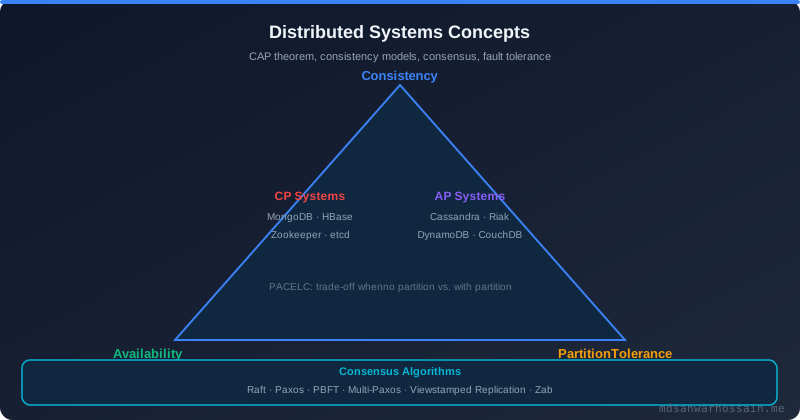
The CAP theorem states that in the presence of a network partition, a distributed system must choose between consistency (every read sees the most recent write) and availability (every request receives a non-error response). In practice, network partitions are not optional — they happen — so the real design question is: how does my system behave when a partition occurs?
CP Systems (Consistency + Partition Tolerance)
Financial transactions, inventory management, and anything where stale data causes monetary loss. Examples: distributed databases with strong consistency (PostgreSQL with synchronous replication, CockroachDB, etcd). During a partition, these systems reject writes rather than risk divergence.
AP Systems (Availability + Partition Tolerance)
User sessions, caching, feature flags, shopping cart state — domains where serving slightly stale data is vastly preferable to serving an error. Examples: Cassandra, DynamoDB, Redis with eventual consistency. These systems accept writes during partitions and reconcile afterward.
The practical insight: most real systems are neither purely CP nor purely AP — they require different consistency guarantees per operation. A financial system might use strong consistency for balance debits but eventual consistency for transaction history queries. Design your consistency model operation by operation, not system by system.
Network Partitions and What to Do When They Happen
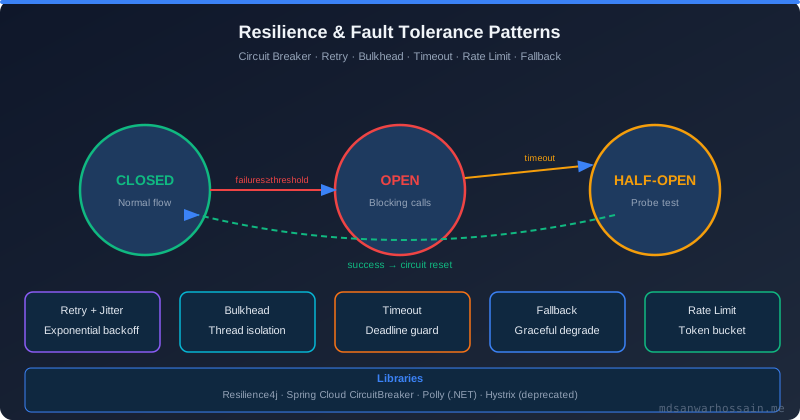
A network partition between two services means neither can reach the other. How your system behaves during a partition is a design decision that must be made deliberately:
- Fail fast and propagate the error: Return a 503 to the client immediately. Appropriate when the downstream service is critical to the operation. Forces the client to retry or use a fallback.
- Serve from cache: Return the last known good data with a staleness indicator. Appropriate for read-heavy operations where slightly stale data is acceptable.
- Accept writes and queue for later reconciliation: Write to a local store or message queue; sync when connectivity is restored. Requires idempotency and conflict resolution logic.
- Degrade gracefully: Proceed with reduced functionality. An e-commerce checkout can complete without the recommendation engine. A social feed can load without the ad service.
The dangerous response is inconsistency: sometimes failing fast, sometimes serving stale data, with no documented behaviour. During an incident, the engineers debugging your system need to know what to expect.
Distributed Consensus: Raft, Paxos, and ZooKeeper
Distributed consensus — getting multiple nodes to agree on a value despite failures — is one of the hardest problems in computer science. Understanding consensus algorithms helps you reason about the systems built on top of them: etcd (Kubernetes' datastore), ZooKeeper (Kafka's coordination), and databases with multi-node replication.
Raft
Raft was explicitly designed to be understandable. The core idea: elect a leader, have the leader manage all writes, replicate writes to a majority of followers before acknowledging success. If the leader fails, elect a new one. etcd, CockroachDB, and TiKV are all built on Raft. Understanding Raft's leader election and log replication mechanisms helps you predict how your Kubernetes cluster will behave during node failures.
Paxos
Paxos is older and notoriously difficult to understand, but underpins systems like Google Spanner and Chubby. Multi-Paxos (the practical variant) uses a stable leader, similar to Raft, for efficiency. If you encounter correctness bugs in consensus systems, they're often in leader election edge cases.
ZooKeeper
ZooKeeper uses ZAB (ZooKeeper Atomic Broadcast), a Paxos variant optimized for write ordering. Kafka historically used ZooKeeper for broker coordination, but KRaft mode (Kafka 3.3+) eliminates this dependency. ZooKeeper is still widely deployed but should be considered mature infrastructure rather than the thing you build new systems on.
Data Consistency Patterns: Eventual Consistency, Sagas, and 2PC
When a business operation spans multiple services (e.g., place order → reserve inventory → charge payment → dispatch notification), ensuring consistency across all steps without a distributed transaction is the central challenge of microservices data management.
Saga Pattern
A saga is a sequence of local transactions, each publishing an event that triggers the next step. If a step fails, compensating transactions undo previous steps:
// Choreography-based saga (event-driven)
// Step 1: OrderService creates order in PENDING state, publishes OrderCreated
// Step 2: InventoryService receives OrderCreated, reserves stock, publishes StockReserved
// Step 3: PaymentService receives StockReserved, charges card, publishes PaymentCharged
// Step 4: OrderService receives PaymentCharged, marks order CONFIRMED

// Compensation chain on failure:
// PaymentService fails → publishes PaymentFailed
// InventoryService receives PaymentFailed → releases reservation, publishes StockReleased
// OrderService receives StockReleased → marks order CANCELLED
Orchestration-based sagas use a dedicated orchestrator service (often implemented with a workflow engine like Temporal or Camunda) to coordinate steps and compensations. Orchestration is easier to debug and monitor; choreography is more loosely coupled. Both are valid — choose based on complexity and team size.
Two-Phase Commit (2PC)
2PC provides strong consistency across distributed participants: a coordinator first sends PREPARE to all participants; if all respond OK, it sends COMMIT; otherwise ROLLBACK. The fatal flaw: if the coordinator crashes after PREPARE but before COMMIT, participants are left in a blocking uncertain state. 2PC is appropriate for tightly controlled environments (same organization, same datacenter) but is generally too fragile for microservices across different teams or cloud providers.
Distributed Transactions: The Real Cost
Every distributed transaction locks resources across services until the transaction completes. Under normal conditions, this adds latency proportional to the number of participants and network round trips. Under failure conditions, it can cause indefinite blocking, cascading timeouts, and correctness violations when coordinators fail mid-transaction.
The engineering consensus in 2026: avoid distributed transactions wherever possible. Instead, design for eventual consistency with compensating actions (saga pattern), use idempotent operations, and accept that your system will occasionally be temporarily inconsistent — and build the tooling to detect and resolve that inconsistency automatically.
Idempotency and Retry Strategies
Idempotency is the property that performing the same operation multiple times has the same effect as performing it once. This is essential for retry safety in distributed systems:
// Idempotency key pattern for payment processing
@PostMapping("/payments")
public ResponseEntity<PaymentResult> processPayment(
        @RequestHeader("Idempotency-Key") String idempotencyKey,
        @RequestBody PaymentRequest request) {

    // Check if we've seen this key before
    Optional<PaymentResult> existing = idempotencyStore.get(idempotencyKey);
    if (existing.isPresent()) {
        return ResponseEntity.ok(existing.get());  // Return cached result
    }

    PaymentResult result = paymentProcessor.charge(request);
    idempotencyStore.store(idempotencyKey, result, Duration.ofDays(7));
    return ResponseEntity.ok(result);
}
For retry strategies, use exponential backoff with jitter to prevent retry storms. Jitter distributes retries over time, preventing all clients from retrying simultaneously after a service recovery:
long backoffMs = (long) (Math.pow(2, attemptNumber) * 100L * (0.5 + Math.random() * 0.5));
Thread.sleep(Math.min(backoffMs, MAX_BACKOFF_MS));
Clock Synchronization and the Dangers of Time
Distributed systems engineers have a saying: never trust a clock you didn't set yourself. Wall clocks drift, NTP synchronization introduces uncertainty, and cloud VMs can experience significant clock jumps during live migration. This has concrete consequences:
- Sequence ordering: Don't use timestamps to determine the order of distributed events. Use logical clocks (Lamport timestamps, vector clocks) or monotonic sequence numbers generated by a single source of truth.
- JWT expiration: Always add a clock skew tolerance (typically 30-60 seconds) when validating JWT expiration times across services.
- Distributed locking: Fencing tokens (monotonically increasing numbers issued with locks) protect against scenarios where a process pauses after acquiring a lock, then resumes after the lock has expired and been acquired by another process.
- Event timestamps: Use event creation time from the originating service (with NTP synchronization) and treat it as approximate. For exact ordering, use Kafka offsets or database sequence columns.
Service-to-Service Failure Modes and Resilience
Beyond simple timeouts, distributed services fail in subtle ways that compound if not handled:
- Partial response failure: A service returns a 200 with an incomplete response body. Validate response completeness, not just HTTP status codes.
- Slow downstream: A downstream service doesn't fail — it just takes 30 seconds instead of 100ms. Without timeouts, this creates thread pool exhaustion. Always configure aggressive timeouts.
- Thundering herd: A cache expires at the same moment for thousands of concurrent requests; all hit the database simultaneously. Use probabilistic cache expiration or a cache-aside pattern with a single-flight mechanism.
- Cascading failure: Service A depends on B, B depends on C. C becomes slow; B's thread pool fills waiting for C; A's thread pool fills waiting for B. Isolate thread pools per downstream dependency (bulkhead pattern).
Debugging Distributed Systems: Observability Tooling
When something goes wrong in a distributed system, the blast radius spans logs across dozens of service instances, metrics across multiple time series databases, and traces across several network hops. Effective debugging requires correlating these signals automatically:
- Structured logging with trace context: Every log line must include trace ID, span ID, service name, and host. Use OpenTelemetry's log correlation to propagate context automatically.
- Distributed tracing: A complete trace shows every service involved in a request, with timing for each span. Jaeger, Tempo, and Zipkin all provide flame graph views that make slow spans immediately visible.
- Exemplars: Link high-latency Prometheus metric samples to their originating trace IDs. Grafana supports exemplar display natively, letting you jump from a latency spike in a chart directly to the offending trace.
- Correlation IDs: Even without full distributed tracing, a correlation ID in every log and event lets you reconstruct request flow across services by grepping a single ID across your log aggregation system.
Key Takeaways
- The 8 fallacies of distributed computing are not historical curiosities — they are active failure modes in every microservices deployment.
- CAP theorem requires operation-level consistency decisions, not just system-level ones.
- Saga patterns (choreography or orchestration) are the production-proven alternative to distributed transactions in microservices.
- Idempotency is non-negotiable for any operation that can be retried — design for it from the start, not as an afterthought.
- Never trust wall clocks for ordering; use logical clocks, Kafka offsets, or database sequences.
- Observability — structured logs, metrics with exemplars, distributed tracing — is what separates a debuggable system from a black box.
- Every failure mode in a distributed system can be designed around. The prerequisite is understanding the failure mode first.
Conclusion
Distributed systems are not a subset of software engineering — they are a discipline with their own body of theory, failure modes, and hard-won patterns. The engineers who are most effective in this domain are those who have moved beyond "it works on my machine" to deeply internalizing what can go wrong across a network, under load, and during partial failures. The good news is that the patterns for handling these challenges — circuit breakers, idempotency, sagas, exponential backoff, structured observability — are well-understood and implementable. The barrier is knowledge, not tooling. Build that knowledge deliberately, and every system you design will be more resilient for it.
Leave a Comment
Related Posts

Software Engineer · Java · Spring Boot · Microservices