MySQL vs PostgreSQL: When to Choose Which for Your Java Backend in 2026
"MySQL vs PostgreSQL" is one of the most searched database questions at 50,000+ searches per month — and for good reason. Both are excellent, production-proven, open-source relational databases that work seamlessly with Spring Boot and JPA. But they have genuinely different strengths, and the wrong choice leads to years of workarounds. This guide covers the architectural differences that matter for Java backend developers in 2026: storage engines, MVCC implementations, JSON support, full-text search, replication models, and the extension ecosystem that is reshaping the choice decision.
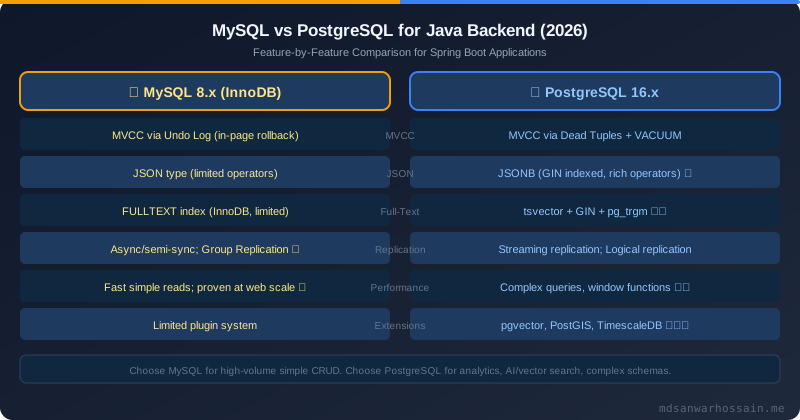
Table of Contents
- Architecture: Storage Engines vs MVCC via VACUUM
- JSON Support: MySQL JSON vs PostgreSQL JSONB
- Full-Text Search: MySQL FULLTEXT vs PostgreSQL tsvector
- Replication: Group Replication vs Streaming Replication
- Extensions: pgvector, PostGIS, TimescaleDB vs MySQL Plugins
- Spring Boot & JPA: Dialect Differences That Matter
- Performance: OLTP vs OLAP Workload Patterns
- Decision Framework: Choose MySQL or PostgreSQL
- Key Takeaways
1. Architecture: Storage Engines vs MVCC via VACUUM
MySQL's pluggable storage engine architecture means different engines can power different tables: InnoDB for transactional OLTP, MyISAM (legacy) for read-heavy tables with no transactions, Memory for session data, and Archive for compressed historical records. In practice, 99% of production MySQL usage is InnoDB. PostgreSQL has no pluggable engine — the storage layer is monolithic, and the project invests all optimization into that single engine.
The most consequential architectural difference is how each database implements MVCC:
- MySQL InnoDB MVCC: Old row versions are stored in the Undo Log (separate from the main data file). Readers follow a pointer chain to find the visible version. The purge thread cleans up old undo records asynchronously.
- PostgreSQL MVCC: Old versions (dead tuples) are stored inline in the heap table file alongside live rows. VACUUM reclaims this space. A table with heavy UPDATE traffic inflates on disk until VACUUM runs — called "table bloat."
For write-heavy applications, InnoDB's undo log approach avoids table bloat without manual tuning. PostgreSQL requires proper autovacuum configuration to prevent bloat from impacting query performance.
autovacuum_vacuum_scale_factor = 0.01 (trigger VACUUM after 1% of rows are dead, not the default 20%) for high-throughput tables. Default settings are tuned for average workloads, not high-write applications.
2. JSON Support: MySQL JSON vs PostgreSQL JSONB
Both databases support JSON storage, but with very different capabilities. PostgreSQL's JSONB is stored in a binary decomposed format, is GIN-indexable, and supports a rich set of operators and functions. MySQL's JSON type validates on insert but offers limited indexing (only functional indexes on extracted paths, added in 8.0):
| Feature | MySQL 8.x JSON | PostgreSQL JSONB |
|---|---|---|
| Storage format | Binary (optimized) with text fallback | Binary decomposed (faster reads) |
| Indexing | Functional index on extracted path only | GIN index on entire document ✓✓ |
| Operators | JSON_EXTRACT, JSON_CONTAINS | @>, <@, ?, ?|, ?&, #> (rich set) ✓✓ |
| Path queries | $.field syntax only | jsonpath (ISO/IEC 19075-6 standard) ✓ |
-- PostgreSQL JSONB: powerful containment and GIN index
CREATE INDEX idx_product_tags ON products USING GIN (attributes jsonb_path_ops);

-- Find products where attributes contain a specific color
SELECT id, name FROM products
WHERE attributes @> '{"color": "blue", "size": "L"}';

-- MySQL: requires functional index for similar query
ALTER TABLE products ADD INDEX idx_color ((JSON_UNQUOTE(JSON_EXTRACT(attributes, '$.color'))));
SELECT id, name FROM products WHERE JSON_EXTRACT(attributes, '$.color') = 'blue';
-- Cannot index multiple JSON paths together — one functional index per path
For Spring Boot applications with semi-structured data (product catalogs with varying attributes, user preferences, event payloads), PostgreSQL JSONB is significantly more capable. MySQL's JSON is adequate for simple storage and extraction but struggles with complex document queries at scale.
3. Full-Text Search: MySQL FULLTEXT vs PostgreSQL tsvector
Both databases support full-text search natively, eliminating the need for a separate Elasticsearch cluster for many use cases:
-- PostgreSQL: tsvector with GIN index (superior relevance ranking)
ALTER TABLE articles ADD COLUMN search_vector tsvector
    GENERATED ALWAYS AS (
        to_tsvector('english', coalesce(title, '') || ' ' || coalesce(body, ''))
    ) STORED;

CREATE INDEX idx_articles_fts ON articles USING GIN (search_vector);

-- Ranked search with ts_rank
SELECT title, ts_rank(search_vector, query) AS rank
FROM articles, to_tsquery('english', 'java & microservices') query
WHERE search_vector @@ query
ORDER BY rank DESC
LIMIT 10;

-- MySQL FULLTEXT: simpler syntax, adequate for basic use cases
ALTER TABLE articles ADD FULLTEXT INDEX ft_idx (title, body);
SELECT title, MATCH(title, body) AGAINST ('java microservices' IN NATURAL LANGUAGE MODE) AS score
FROM articles
WHERE MATCH(title, body) AGAINST ('java microservices')
ORDER BY score DESC;
PostgreSQL's text search supports phrase search, stemming, custom dictionaries, and the pg_trgm extension for fuzzy matching. MySQL's FULLTEXT search is adequate for simple keyword matching but lacks phrase proximity operators and custom stemming. For a Spring Boot application where search quality matters, PostgreSQL is the stronger choice.
4. Extensions: pgvector, PostGIS, TimescaleDB vs MySQL Plugins
PostgreSQL's extension ecosystem is its single biggest differentiator in 2026. Extensions add first-class data types, index types, and query operators to the core database:
| Extension | What It Adds | Java Use Case |
|---|---|---|
| pgvector | vector data type + HNSW/IVFFlat indexes | RAG with Spring AI, semantic search, recommendation |
| PostGIS | geometry types, spatial indexes, GIS functions | Location-based services, radius search, geofencing |
| TimescaleDB | hypertables, continuous aggregates, compression | IoT metrics, application telemetry, financial time series |
| pg_trgm | trigram similarity, fuzzy text matching | Autocomplete, "did you mean?", name matching |
-- pgvector: Add vector similarity search to your existing PostgreSQL database
CREATE EXTENSION IF NOT EXISTS vector;

CREATE TABLE documents (
    id BIGSERIAL PRIMARY KEY,
    content TEXT,
    embedding vector(1536)  -- OpenAI text-embedding-3-small dimension
);

CREATE INDEX ON documents USING hnsw (embedding vector_cosine_ops);

-- Spring AI PgVectorStore uses this automatically — no custom SQL needed
-- Semantic similarity search:
SELECT content, 1 - (embedding <=> '[0.1, 0.2, ...]'::vector) AS similarity
FROM documents
ORDER BY embedding <=> '[0.1, 0.2, ...]'::vector
LIMIT 5;
MySQL has no equivalent to pgvector. If your Spring AI / LangChain4j application needs vector search and you're already on MySQL, you must either add a separate vector database (Chroma, Weaviate, Pinecone) or migrate to PostgreSQL. PostgreSQL + pgvector consolidates your relational and vector storage into a single database, simplifying architecture significantly.
5. Spring Boot & JPA: Dialect Differences That Matter
Hibernate and Spring Data JPA abstract away most SQL dialect differences, but several behaviors diverge in ways that affect Spring Boot applications:
# application.properties — database-specific settings

## MySQL
spring.jpa.database-platform=org.hibernate.dialect.MySQL8Dialect
spring.datasource.url=jdbc:mysql://localhost:3306/mydb?useSSL=false&serverTimezone=UTC
# MySQL-specific: enable binary log for CDC / replication
spring.jpa.properties.hibernate.dialect.storage_engine=innodb

## PostgreSQL
spring.jpa.database-platform=org.hibernate.dialect.PostgreSQLDialect
spring.datasource.url=jdbc:postgresql://localhost:5432/mydb
# PostgreSQL-specific: use schemas for multi-tenancy
spring.jpa.properties.hibernate.default_schema=public| Behavior | MySQL / Hibernate | PostgreSQL / Hibernate |
|---|---|---|
| Boolean mapping | TINYINT(1) by default | Native BOOLEAN type |
| Sequence generation | AUTO_INCREMENT (identity) | SEQUENCE (allocationSize=50 pooling) |
| LIMIT / OFFSET | LIMIT ? OFFSET ? | LIMIT ? OFFSET ? (same syntax, both work) |
| Schema case sensitivity | Case-insensitive on Windows, case-sensitive on Linux | Always case-sensitive for identifiers in quotes |
| Upsert | INSERT ... ON DUPLICATE KEY UPDATE | INSERT ... ON CONFLICT DO UPDATE |
6. Performance: OLTP vs OLAP Workload Patterns
Neither database is universally faster. Performance depends heavily on workload type, schema design, and configuration. General patterns observed in production:
- Simple OLTP (single-row reads/writes, simple joins): MySQL InnoDB is generally faster due to simpler execution plan overhead and better buffer pool hit rates for primary key lookups. MySQL's query cache (deprecated in 8.0) aside, the InnoDB clustered index makes single-row access very efficient.
- Complex queries (window functions, CTEs, lateral joins, aggregations): PostgreSQL's query planner is significantly more sophisticated, handles complex joins better, and supports features like parallel query execution and hash joins that MySQL implements more conservatively.
- Write-heavy with MVCC bloat: MySQL avoids table bloat via undo log; PostgreSQL needs autovacuum tuning. Without proper autovacuum, PostgreSQL tables become bloated and sequential scans slow down.
- Connection management: MySQL handles thousands of concurrent connections with lower overhead per connection than PostgreSQL. PostgreSQL users often deploy PgBouncer for connection pooling to compensate.
7. Decision Framework: Choose MySQL or PostgreSQL
🐬 Choose MySQL InnoDB when:
- Your workload is primarily simple CRUD: e-commerce orders, user accounts, session data
- You have massive scale with simple access patterns (high-volume web apps: Twitter-scale inserts)
- Your team has existing MySQL expertise and tooling (Percona Toolkit, mydumper)
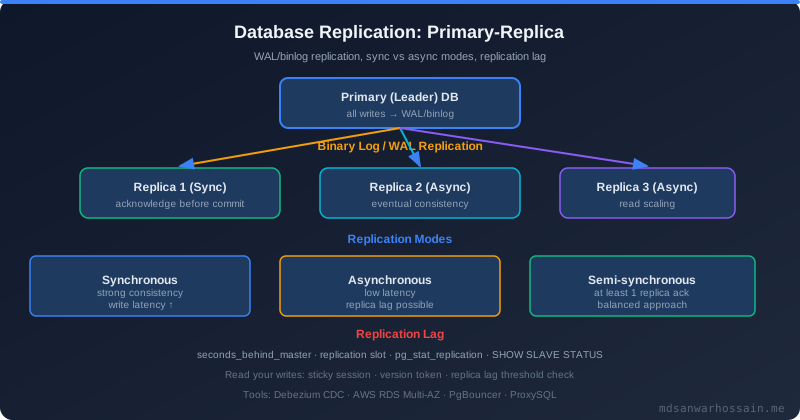
- You need Group Replication for active-active multi-master writes
- You're using AWS RDS or Aurora MySQL and want managed replication/failover
- Your ORM usage is straightforward and you won't need advanced SQL features
🐘 Choose PostgreSQL when:
- You need vector search with Spring AI (pgvector extension — no MySQL equivalent)
- Your schema uses JSONB for semi-structured data with complex queries
- You need full-text search with relevance ranking and custom dictionaries
- Your application uses window functions, CTEs, lateral joins, or array types
- You're building a geospatial feature (PostGIS)
- You need time-series data (TimescaleDB)
- You're on Kubernetes and want reliable WAL-based streaming replication with Patroni
- You value SQL standards compliance and advanced query planner capabilities
8. Key Takeaways
- MySQL InnoDB stores old row versions in the Undo Log (no table bloat); PostgreSQL stores dead tuples inline and relies on VACUUM (requires autovacuum tuning for write-heavy apps).
- PostgreSQL JSONB with GIN indexes is dramatically more capable than MySQL JSON for semi-structured data queries — the difference shows at scale.
- PostgreSQL's extension ecosystem (pgvector, PostGIS, TimescaleDB) is unmatched — if you need vector search for Spring AI, PostgreSQL is the only self-hosted relational choice.
- MySQL has better raw connection scaling and simpler tuning for high-volume simple OLTP; PostgreSQL has a more capable query planner for complex analytical queries.
- Both work perfectly with Spring Boot / JPA — dialect differences are minor for standard use cases, but PostgreSQL-specific features (arrays, JSONB operators, window functions) require native queries in JPA.
- For 2026 greenfield projects: if AI features are planned, default to PostgreSQL + pgvector. For high-volume simple CRUD with existing MySQL expertise, MySQL remains an excellent choice.
Frequently Asked Questions
What is Architecture and how does it work?
MySQL's pluggable storage engine architecture means different engines can power different tables: InnoDB for transactional OLTP, MyISAM (legacy) for read-heavy tables with no transactions, Memory for session data, and Archive for compressed historical records. In practice, 99% of production MySQL usage is InnoDB. PostgreSQL has no pluggable engine — the storage layer is monolithic, and the project invests all optimization into that single engine. The most consequential architectural difference is how each database implements MVCC: For write-heavy applications, InnoDB's undo log approach avoids table bloat without manual tuning. PostgreSQL requires proper autovacuum configuration to prevent bloat from impacting query performance. MySQL InnoDB MVCC: Old row versions are stored in the Undo Log (separate from the main data file). Readers follow a pointer chain to find the visible version.
What is JSON Support and how does it work?
Both databases support JSON storage, but with very different capabilities. PostgreSQL's JSONB is stored in a binary decomposed format, is GIN-indexable, and supports a rich set of operators and functions. MySQL's JSON type validates on insert but offers limited indexing (only functional indexes on extracted paths, added in 8.0): -- PostgreSQL JSONB: powerful containment and GIN index CREATE INDEX idx_product_tags ON products USING GIN (attributes jsonb_path_ops); -- Find products where attributes contain a specific color SELECT id, name FROM products WHERE attributes @> '{"color": "blue", "size": "L"}'; -- MySQL: requires functional index for similar query ALTER TABLE products ADD INDEX idx_color ((JSON_UNQUOTE(JSON_EXTRACT(attributes, '$.color')))); SELECT id, name FROM products WHERE JSON_EXTRACT(attributes, '$.color') = 'blue'; -- Cannot index multiple JSON paths together — one functional index per path For Spring Boot applications.
What is Full-Text Search and how does it work?
Both databases support full-text search natively, eliminating the need for a separate Elasticsearch cluster for many use cases: -- PostgreSQL: tsvector with GIN index (superior relevance ranking) ALTER TABLE articles ADD COLUMN search_vector tsvector GENERATED ALWAYS AS ( to_tsvector('english', coalesce(title, '') || ' ' || coalesce(body, '')) ) STORED; CREATE INDEX idx_articles_fts ON articles USING GIN (search_vector); -- Ranked search with ts_rank SELECT title, ts_rank(search_vector, query) AS rank FROM articles, to_tsquery('english', 'java & microservices') query WHERE search_vector @@ query ORDER BY rank DESC LIMIT 10; -- MySQL FULLTEXT: simpler syntax, adequate for basic use cases ALTER TABLE articles ADD FULLTEXT INDEX ft_idx (title, body); SELECT title, MATCH(title, body) AGAINST ('java microservices' IN NATURAL LANGUAGE MODE) AS score FROM articles WHERE MATCH(title, body) AGAINST ('java microservices') ORDER BY score DESC; PostgreSQL's.
What is Extensions and how does it work?
PostgreSQL's extension ecosystem is its single biggest differentiator in 2026. Extensions add first-class data types, index types, and query operators to the core database: -- pgvector: Add vector similarity search to your existing PostgreSQL database CREATE EXTENSION IF NOT EXISTS vector; CREATE TABLE documents ( id BIGSERIAL PRIMARY KEY, content TEXT, embedding vector(1536) -- OpenAI text-embedding-3-small dimension ); CREATE INDEX ON documents USING hnsw (embedding vector_cosine_ops); -- Spring AI PgVectorStore uses this automatically — no custom SQL needed -- Semantic similarity search: SELECT content, 1 - (embedding <=> '[0.1, 0.2, ...]'::vector) AS similarity FROM documents ORDER BY embedding <=> '[0.1, 0.2, ...]'::vector LIMIT 5; MySQL has no equivalent to pgvector.
How do you implement Spring Boot & JPA?
Hibernate and Spring Data JPA abstract away most SQL dialect differences, but several behaviors diverge in ways that affect Spring Boot applications:
Leave a Comment
Which database does your Java backend use, and why? Share your architecture decisions and migration experiences below.
Leave a Comment
Related Posts

Software Engineer · Java · Spring Boot · Microservices