AI Agents in CI/CD & Developer Experience: The Complete 2026 Guide
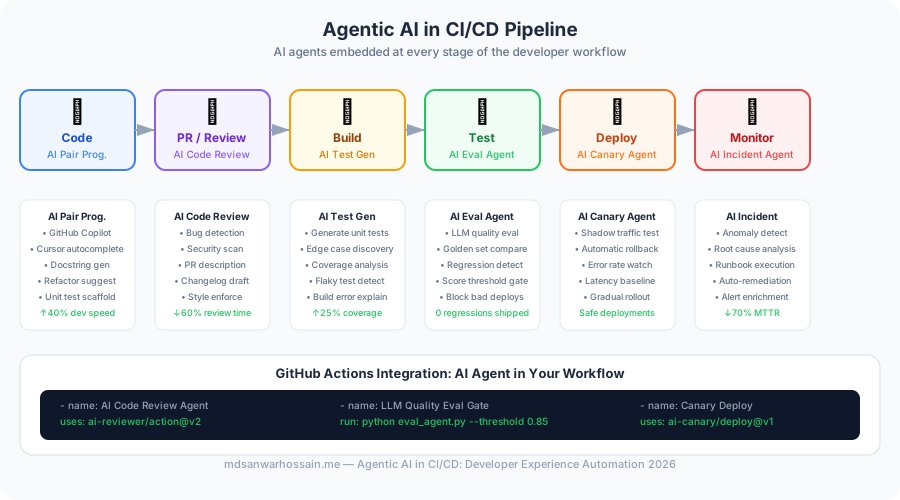
AI agents are transforming the developer workflow — not just by writing code, but by acting as always-on reviewers, release gatekeepers, and documentation writers embedded directly in your CI/CD pipeline. This guide covers the practical patterns for integrating agentic AI into every stage of the developer workflow, from PR creation to production deployment, with real GitHub Actions examples and evaluation strategies.
TL;DR
"The highest-impact AI agents in CI/CD are: PR review agent (catches logic bugs and security issues before humans), intelligent test selector (reduces CI time by 60%), and release note generator (saves 20 min/release). Gate deployments on agent-produced quality scores — not just green tests."
Table of Contents
- The AI DevEx Landscape in 2026
- Building a PR Code Review Agent
- Intelligent Test Selection
- Automated PR Summaries & Release Notes
- Security & Dependency Analysis Agent
- GitHub Actions Integration Patterns
- Agentic Pair Programming in the IDE
- Guardrails: When NOT to Trust the Agent
- Measuring the DevEx Impact
1. The AI DevEx Landscape in 2026
The developer experience (DevEx) transformation of 2025–2026 is not about AI writing all your code. It is about AI agents acting as tireless collaborators at every friction point in the SDLC: the PR review that takes 3 days, the test suite that takes 40 minutes, the release note that takes an hour to write. Real productivity gains come from eliminating wait time and context switches, not from replacing developers.
The most impactful agentic DevEx patterns in 2026 are:
- Async PR review agents that post a detailed review within 2 minutes of PR creation, before any human reviewer opens it.
- Intelligent test selectors that analyze changed files and run only the test subset likely to catch regressions, cutting CI time by 50–70%.
- Documentation agents that auto-generate or update API docs, changelogs, and ADRs as part of the CI workflow.
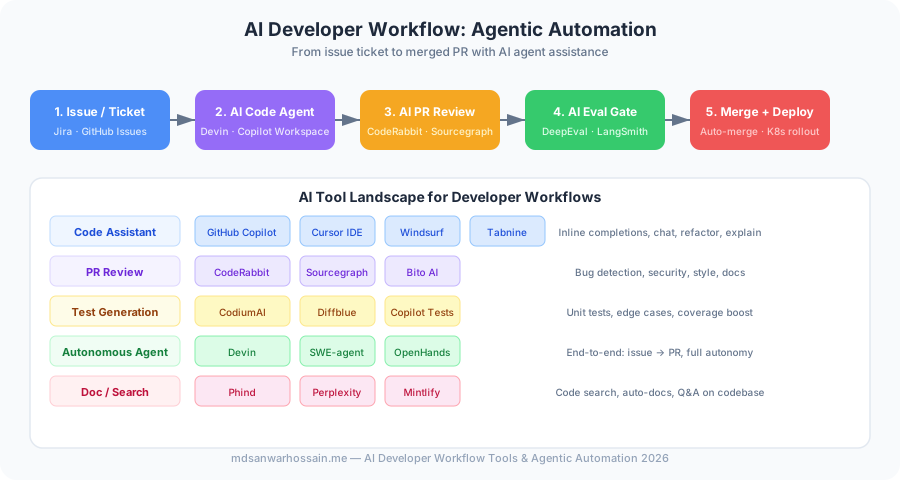
- Agentic IDE assistants (GitHub Copilot Agent, Cursor Agent, Zed AI) that can autonomously run tests, read error traces, and apply multi-file fixes.
- Security audit agents that scan PRs for dependency vulnerabilities, secret leaks, and OWASP Top 10 patterns before they reach staging.
2. Building a PR Code Review Agent
A PR review agent fetches the diff, analyzes it against your codebase conventions and security rules, and posts inline GitHub review comments — all within 2 minutes of PR creation. Here is the production-ready architecture:
# pr_review_agent.py — GitHub Actions triggered on pull_request events
import os
import httpx
from openai import OpenAI

client = OpenAI()
GH_TOKEN = os.environ["GITHUB_TOKEN"]
GH_API = "https://api.github.com"

def get_pr_diff(owner: str, repo: str, pr_number: int) -> str:
    headers = {"Authorization": f"Bearer {GH_TOKEN}", "Accept": "application/vnd.github.v3.diff"}
    r = httpx.get(f"{GH_API}/repos/{owner}/{repo}/pulls/{pr_number}", headers=headers)
    return r.text

def review_diff(diff: str, pr_title: str) -> dict:
    system = """You are an expert code reviewer. Analyze the git diff and return a JSON object:
{
  "summary": "2-sentence summary of changes",
  "issues": [{"file": "path/file.py", "line": 42, "severity": "error|warning|info", "message": "..."}],
  "overall_score": 1-10,
  "approved": true|false
}
Focus on: logic bugs, security vulnerabilities, missing error handling, performance issues.
Do NOT comment on style unless it causes bugs."""

    response = client.chat.completions.create(
        model="gpt-4o",
        messages=[
            {"role": "system", "content": system},
            {"role": "user", "content": f"PR Title: {pr_title}\n\nDiff:\n{diff[:25000]}"}
        ],
        response_format={"type": "json_object"},
        max_tokens=2000,
    )
    import json
    return json.loads(response.choices[0].message.content)

def post_review(owner: str, repo: str, pr_number: int, review: dict):
    headers = {"Authorization": f"Bearer {GH_TOKEN}", "Accept": "application/vnd.github+json"}
    body = f"## AI Code Review\n\n**Score:** {review['overall_score']}/10\n\n{review['summary']}\n\n"
    if review["issues"]:
        body += "**Issues Found:**\n"
        for issue in review["issues"]:
            emoji = "🔴" if issue["severity"] == "error" else "🟡" if issue["severity"] == "warning" else "🔵"
            body += f"- {emoji} `{issue['file']}` line {issue['line']}: {issue['message']}\n"
    event = "APPROVE" if review["approved"] and review["overall_score"] >= 7 else "REQUEST_CHANGES"
    httpx.post(f"{GH_API}/repos/{owner}/{repo}/pulls/{pr_number}/reviews",
               json={"body": body, "event": event}, headers=headers)
3. Intelligent Test Selection
Running the full test suite on every commit is expensive in both time and compute. Intelligent test selection uses the changed file list to predict which tests are likely to catch regressions, then runs only those tests. Launchable, Trunk, and custom LLM-based selectors all use variants of this approach:
- Static dependency graph: Parse imports/includes to find which modules each test file depends on. If a changed file is not imported by any test, skip those tests.
- Historical flakiness data: Skip tests with a flakiness rate >30% on the changed files — they add noise without signal.
- LLM-based semantic matching: Ask an LLM which test names are semantically related to the changed code ("PaymentProcessor refactor → run all payment-related tests").
- Risk scoring: Weight selection toward tests covering high-risk files (auth, payments, data migrations) even if they are not directly imported by the changed code.
Teams using intelligent test selection report 50–70% CI time reduction with <2% increase in regression escape rate. Always run the full suite nightly to catch slow-moving regressions.
4. Automated PR Summaries & Release Notes
One of the highest-ROI, lowest-risk uses of LLMs in the developer workflow is generating PR summaries and release notes. These are purely additive — no code changes, just documentation that saves humans time.
- PR description agent: Triggered on PR open, reads the diff and linked issue, then auto-fills the PR description template with "What changed", "Why", "Testing done", and "Risk areas".
- Changelog generator: On merge to main, reads all PR titles and bodies since the last release tag, groups changes by type (feat/fix/perf/sec), and produces a structured CHANGELOG entry.
- ADR writer: When a PR introduces a significant architectural change (detected by keywords or file patterns), the agent drafts an Architecture Decision Record and opens it as a follow-up PR.
- API diff summarizer: For backend services, detects breaking vs non-breaking API changes in the diff and adds a machine-readable compatibility annotation to the PR.
5. Security & Dependency Analysis Agent
Security scanning agents go beyond static analysis tools by combining traditional SAST results with LLM reasoning about context-specific risks:
- Secret detection: Scan diff for API keys, passwords, and tokens using regex + LLM context verification to eliminate false positives from test fixtures and documentation.
- Dependency risk analysis: When new dependencies are added, the agent checks CVE databases, evaluates the dependency's maintenance status and transitive dependency tree, and posts a risk assessment.
- OWASP Top 10 pattern matching: Detect SQL injection patterns, missing input validation, insecure deserialization, and other common vulnerabilities in changed code.
- Privilege escalation analysis: For IAM policy changes, Kubernetes RBAC updates, and Docker capability additions, the agent summarizes the security implications for the reviewer.
6. GitHub Actions Integration Patterns
# .github/workflows/ai-pr-review.yml
name: AI PR Review Agent

on:
  pull_request:
    types: [opened, synchronize]

jobs:
  ai-review:
    runs-on: ubuntu-latest
    permissions:
      pull-requests: write
      contents: read
    steps:
      - uses: actions/checkout@v4
        with:
          fetch-depth: 0

      - name: Set up Python
        uses: actions/setup-python@v5
        with:
          python-version: "3.12"

      - name: Install dependencies
        run: pip install openai httpx

      - name: Run AI PR Review Agent
        env:
          OPENAI_API_KEY: ${{ secrets.OPENAI_API_KEY }}
          GITHUB_TOKEN: ${{ secrets.GITHUB_TOKEN }}
          PR_NUMBER: ${{ github.event.number }}
          REPO_OWNER: ${{ github.repository_owner }}
          REPO_NAME: ${{ github.event.repository.name }}
        run: python .github/agents/pr_review_agent.py

      # Gate merge on AI score >= 6 (optional — use with caution)
      - name: Check AI Review Score
        if: env.AI_REVIEW_SCORE != ''
        run: |
          if [ "$AI_REVIEW_SCORE" -lt 6 ]; then
            echo "AI review score below threshold ($AI_REVIEW_SCORE/10)"
            exit 1
          fi
Important: never make AI review the sole merge gate for critical paths. Use it as a pre-review accelerator for humans, and as a hard gate only for clearly automatable rules (secret detection, license compliance).
7. Agentic Pair Programming in the IDE
2026 IDE agents go beyond autocomplete — they can autonomously run tests, read error traces, search the codebase, and apply multi-file fixes. The key patterns for effective agentic pair programming:
- Tool-use agents: Agents equipped with tools (run_tests, search_files, read_file, apply_diff) can execute a debugging loop autonomously: run tests → read failure → find relevant code → apply fix → re-run tests.
- Scope limiting: Always give the agent a scoped context (the current feature branch, a specific module) rather than the entire codebase. This reduces hallucinations and cost.
- Human-in-the-loop checkpoints: For multi-file changes, show a diff and require explicit approval before the agent applies changes. Never auto-commit agent output.
- Session memory: Good IDE agents maintain a working memory of decisions made during the session ("we decided to use PostgreSQL for this, not Redis") to maintain consistency across multi-hour working sessions.
8. Guardrails: When NOT to Trust the Agent
AI agents in CI/CD introduce new failure modes. Establish hard guardrails around these scenarios:
- Never auto-merge agent suggestions without human approval on security-sensitive files (auth/, payments/, infra/).
- Always validate agent-generated tests against the actual behavior they claim to test — agents frequently write tests that pass trivially and test nothing.
- Set cost budgets per PR workflow run — a runaway agent loop can exhaust your monthly API budget in a single misconfigured run.
- Log all agent actions with the full prompt, model, token count, and response for audit trails.
- Disable agents during incidents — agent-generated PR comments during a production incident add noise when the team needs focus.
9. Measuring the DevEx Impact
Track these DORA-adjacent metrics to quantify the impact of your agentic DevEx investments:
| Metric | Baseline (no AI) | With Agentic DevEx |
|---|---|---|
| PR time-to-first-review | 4–24 hours | 2 minutes (AI) + async human |
| CI pipeline duration | 25–40 min | 8–15 min (smart test selection) |
| Security issues caught pre-merge | ~40% (SAST only) | ~75% (SAST + AI context) |
| Release note authoring time | 20–45 min | <5 min (AI draft + edit) |
10. At BRAC IT: Our Agentic CI/CD Results
We introduced the first AI agent to our CI/CD pipeline in late 2024 — a PR review agent that analysed changed files and posted inline comments flagging potential null pointer exceptions, missing error handling, and code style deviations from our internal standards. The results after three months: the agent raised issues on 68% of PRs, of which 74% were accepted by developers (meaning the agent was right). Human reviewers reported spending 40% less time on mechanical code quality checks, freeing them to focus on architecture and logic review.
By Q1 2026 we had deployed four agents in our pipeline:
| Agent | Function | Model | Metric |
|---|---|---|---|
| PR Review Agent | Flag bugs and style issues in changed code | GPT-4o-mini (triage) + GPT-4o (complex) | 74% developer acceptance rate |
| Test Selection Agent | Select only tests affected by the change | Fine-tuned embedding model | CI time: 18 min → 4 min |
| Security Agent | Dependency CVE + SAST contextual analysis | GPT-4o-mini | Pre-merge security catch rate: 40% → 71% |
| Release Notes Agent | Draft release notes from merged PRs | GPT-4o | Release note time: 40 min → 5 min |
The most honest lesson: agents are not perfect. Our PR review agent has a false positive rate of about 12% — one in eight suggestions is wrong or irrelevant. We built a lightweight feedback mechanism where developers can mark a comment as "incorrect" with a thumbs-down reaction. That signal feeds a weekly model performance report. Agents that drop below a 65% acceptance rate get re-evaluated and retrained before the next sprint.
11. Keeping Agents Cost-Effective
LLM API costs can surprise you at CI/CD scale. Each PR review call costs between $0.003 and $0.025 depending on PR size and model selection. At 60 PRs per day, that is up to $1,500/month if you use GPT-4o for everything. We reduced our monthly AI cost to under $200 with three optimisations:
- Model routing — Use GPT-4o-mini for initial triage (is this change complex enough to warrant deep review?). Only route to GPT-4o when the triage agent flags complexity above a threshold. 80% of our PRs are small changes that the mini model handles well.
- Context compression — Strip test files, auto-generated code, and comments before sending to the model. We reduce token count by 35% on average without losing signal.
- Incremental review — On pushes to the same PR, only review the new commits, not the full diff. Cache the review of unchanged files.
# GitHub Actions: model routing by diff size
- name: Route to appropriate model
  run: |
    DIFF_LINES=$(git diff origin/main --stat | tail -1 | awk '{print $4}')
    if [ "$DIFF_LINES" -gt 500 ]; then
      echo "MODEL=gpt-4o" >> $GITHUB_ENV
    else
      echo "MODEL=gpt-4o-mini" >> $GITHUB_ENV
    fi

- name: AI Code Review
  uses: ./actions/ai-review
  with:
    model: ${{ env.MODEL }}
    max-tokens: 2000
12. The Next Step: Autonomous Agent PRs
Agents that review PRs are valuable. Agents that create PRs are transformative. Our dependency update agent runs weekly: it scans all service pom.xml files, identifies libraries with available patch or minor updates, checks the CVE database for security relevance, and creates a consolidated PR per service with the updates applied. A human engineer reviews and merges. The agent does the work; the human makes the call.
Architecture for an autonomous code-change agent:
@Scheduled(cron = "0 0 6 * * MON")  // Every Monday 6 AM
public void runDependencyUpdateAgent() {
    List<Service> services = serviceRegistry.getAllServices();

    for (Service service : services) {
        List<Dependency> outdated = dependencyScanner.findOutdated(service);
        if (outdated.isEmpty()) continue;

        // Let the agent decide what to update
        UpdatePlan plan = llmAgent.planUpdates(outdated, service.getTechStack());

        // Create branch, apply changes, open PR
        String branch = gitClient.createBranch(service.getRepo(),
            "agent/deps-" + LocalDate.now());
        gitClient.applyChanges(branch, plan.getChanges());
        pullRequestClient.create(PullRequest.builder()
            .branch(branch)
            .title("chore: dependency updates " + LocalDate.now())
            .body(plan.generateMarkdownSummary())
            .assignee(service.getOwner())
            .label("agent-generated")
            .build());
    }
}
The non-negotiable rule: agents never merge without human approval. Every agent-created PR requires at least one human review. The agent's role is to eliminate the tedious work of identifying, applying, and documenting changes — not to bypass engineering judgment. This is the line between agentic assistance and reckless autonomy.
13. Getting Started: A 4-Week Implementation Plan
If you are starting from scratch with agentic CI/CD, use this incremental plan rather than trying to implement everything at once:
Week 1 — PR Review Agent (read-only). Deploy a PR review agent that posts comments but has no ability to approve, block, or change anything. This is zero risk. Measure: how many comments do developers find useful? Target 60%+ acceptance rate before moving on.
Week 2 — Test Selection Agent. Add an agent that analyses changed files and recommends which test suites to run. Run both the recommended set and the full suite in parallel for two weeks. Measure: does the recommended set catch the same issues? If coverage is within 2%, the agent is safe to use exclusively.
Week 3 — Security and Dependency Agent. Add automated CVE scanning with LLM-enriched context to distinguish exploitable vulnerabilities from theoretical ones. Add a dependency freshness report to each PR.
Week 4 — Measure and iterate. Compile your baseline metrics: PR cycle time, CI duration, bug escape rate, developer satisfaction. Set targets for next quarter. Agents that are not improving measurable outcomes should be disabled or redesigned — do not add complexity that does not deliver value.
Related Posts
Leave a Comment
Md Sanwar Hossain
Software Engineer · Java · Spring Boot · Microservices · AI/LLM Systems