Agentic AI Code Review Pipelines: Automating PR Analysis, Bug Detection & Style Enforcement
Code review is one of the highest-value engineering activities — and one of the most expensive bottlenecks. Senior engineers spend hours every week reviewing pull requests, catching the same recurring issues: missing null checks, SQL injection risks, inconsistent naming, and architectural violations. Agentic AI systems change this equation. By orchestrating multiple specialized LLM agents — each focused on static analysis, security scanning, style enforcement, and context-aware architectural review — teams can automate the first-pass review, free humans for higher-order judgment, and enforce consistency at scale without reviewer fatigue.
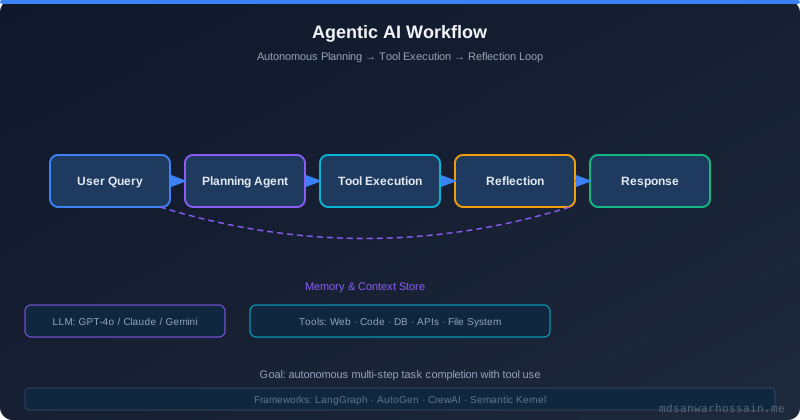
Table of Contents
- The Code Review Bottleneck: When Human Reviewers Can't Keep Up
- Architecture: Multi-Agent Code Review System Design
- Static Analysis Agent: Reading Diffs and Spotting Anti-Patterns
- Security Scanning Agent: OWASP Top 10 Pattern Detection
- Context-Aware Review: RAG with Codebase Knowledge Base
- GitHub Actions Integration: Triggered PR Review Workflow
- Guardrails: Preventing False Positives and Hallucinations
- Production Failure: Agent Blocking Wrong PRs and Feedback Loops
- Trade-offs: AI Review vs Human Review in High-Stakes Domains
- Key Takeaways
1. The Code Review Bottleneck: When Human Reviewers Can't Keep Up
In high-velocity engineering teams, pull requests pile up faster than reviewers can process them. Studies show that code review wait times average 4–24 hours, with reviewers spending 60–90 minutes per day just on reviews. The cognitive load is asymmetric: reviewers must context-switch into unfamiliar code, hold entire module semantics in working memory, and apply consistent standards across thousands of lines of diff. This produces review fatigue — late-afternoon reviews catch far fewer bugs than morning reviews. The result is inconsistency: the same anti-pattern gets flagged in one PR and silently merged in another.
Agentic AI pipelines solve a specific slice of this problem: consistent first-pass review. They cannot replace the experienced engineer who recognizes that a change breaks an unspoken architectural contract, but they excel at detecting repeatable patterns — null pointer risks, missing input validation, style inconsistencies, and known security anti-patterns. By handling the mechanical 40–60% of review feedback automatically, AI agents free human reviewers to focus on design quality, correctness of business logic, and cross-service implications — the work that genuinely requires deep domain expertise and cannot be automated.
2. Architecture: Multi-Agent Code Review System Design
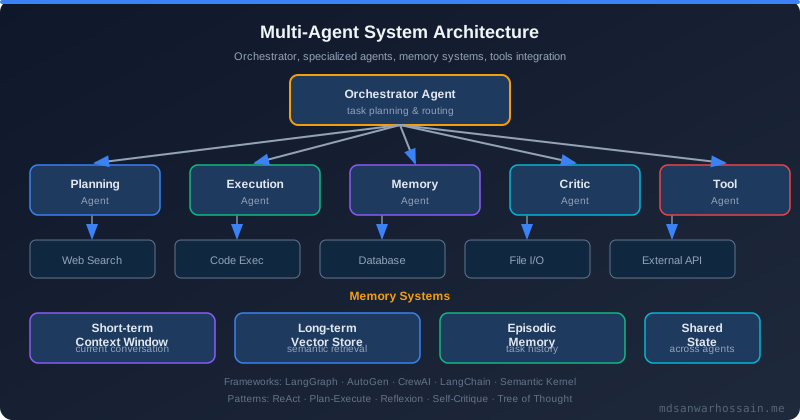
The agentic code review system follows an orchestrator-worker pattern. An OrchestratorAgent receives the PR payload — diff, file list, metadata — and fans out work to three specialized sub-agents running in parallel: StaticAnalysisAgent, SecurityAgent, and StyleAgent. Each agent processes the diff independently with its own focused system prompt and context. Their findings flow back to the OrchestratorAgent, which delegates to an AggregatorAgent responsible for deduplication, conflict resolution, severity scoring, and formatting the final GitHub PR comment.
The AggregatorAgent merges overlapping findings (e.g., the security agent and static analysis agent both flag the same SQL concatenation) and applies business rules: maximum 15 inline comments per PR to avoid overwhelming developers, suppression of low-confidence findings below a threshold, and escalation of critical security issues to human reviewers via Slack webhook. The entire pipeline completes in under 45 seconds for PRs under 500 lines, well within GitHub's check timeout window.
// OrchestratorAgent — fan-out to specialized sub-agents
public class OrchestratorAgent {

    private final StaticAnalysisAgent staticAgent;
    private final SecurityAgent securityAgent;
    private final StyleAgent styleAgent;
    private final AggregatorAgent aggregator;
    private final ExecutorService pool = Executors.newFixedThreadPool(3);

    public ReviewResult review(PullRequestDiff diff) throws Exception {
        // Fan out in parallel
        Future<List<Finding>> staticFuture  = pool.submit(() -> staticAgent.analyze(diff));
        Future<List<Finding>> securityFuture = pool.submit(() -> securityAgent.scan(diff));
        Future<List<Finding>> styleFuture    = pool.submit(() -> styleAgent.check(diff));

        List<Finding> allFindings = new ArrayList<>();
        allFindings.addAll(staticFuture.get(30, TimeUnit.SECONDS));
        allFindings.addAll(securityFuture.get(30, TimeUnit.SECONDS));
        allFindings.addAll(styleFuture.get(30, TimeUnit.SECONDS));

        return aggregator.aggregate(allFindings, diff.getMetadata());
    }
}
3. Static Analysis Agent: Reading Diffs and Spotting Anti-Patterns
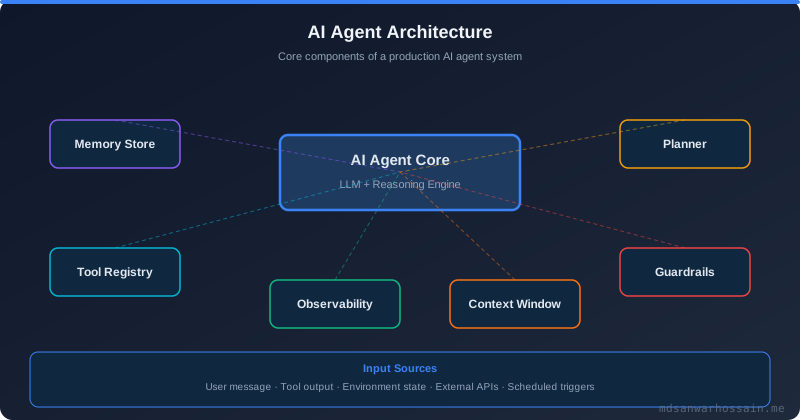
The StaticAnalysisAgent receives a structured representation of the git diff: each changed hunk annotated with filename, start line, end line, and the surrounding context (±10 lines). It constructs a focused LLM prompt combining the diff with a system instruction enumerating the anti-patterns to detect: unguarded null dereferences, resource leaks (unclosed streams/connections), overly broad exception catches, inappropriate use of raw types, N+1 query patterns in loops, and missing thread-safety annotations.
Critically, the agent is prompted to output structured JSON rather than prose — a deterministic schema that downstream systems can parse reliably. Each finding includes the file path, line number, severity (CRITICAL / HIGH / MEDIUM / LOW / INFO), a short message, and a suggested fix. The structured output contract makes the agent's output machine-parseable and prevents the hallucinated line numbers and vague descriptions that plague free-text reviews. The agent also receives the full method or class surrounding each changed hunk, not just the diff lines, to give sufficient context for accurate analysis.
// Structured JSON output schema from StaticAnalysisAgent
{
  "findings": [
    {
      "file": "src/main/java/com/example/OrderService.java",
      "line": 47,
      "severity": "HIGH",
      "rule": "NULL_DEREFERENCE",
      "message": "Method result 'findById()' may return null; dereference at line 47 without null check.",
      "suggestion": "Use Optional.ofNullable() or assert non-null before accessing .getStatus().",
      "confidence": 0.91
    },
    {
      "file": "src/main/java/com/example/ReportController.java",
      "line": 83,
      "severity": "MEDIUM",
      "rule": "BROAD_EXCEPTION_CATCH",
      "message": "Catching generic Exception hides specific failure modes; prefer IOException or custom exceptions.",
      "suggestion": "Replace catch(Exception e) with specific exception types.",
      "confidence": 0.87
    }
  ]
}4. Security Scanning Agent: OWASP Top 10 Pattern Detection
The SecurityAgent runs a two-phase analysis. Phase one is deterministic regex-based pre-screening: the diff is scanned with a set of compiled patterns covering hardcoded credentials (password\s*=\s*"[^"]+"), SQL string concatenation (\"SELECT.*\"\s*\+), disabled certificate validation (setHostnameVerifier|ALLOW_ALL_HOSTNAME_VERIFIER), and insecure deserialization (ObjectInputStream|readObject). Pre-screening is fast, cheap, and catches obvious issues without burning LLM tokens.
Phase two passes only the pre-screened high-risk hunks to the LLM with a security-focused system prompt aligned to the OWASP Top 10. The prompt explicitly asks the model to reason about injection risks (A03), broken access control (A01), cryptographic failures (A02), and insecure design (A04). The combination of deterministic pattern matching and LLM reasoning dramatically reduces both false negatives (missed vulnerabilities) and false positives (hallucinated threats in safe code). Critical severity findings from the security agent trigger an automatic Slack alert to the security guild, bypassing the normal reviewer assignment flow.
5. Context-Aware Review: RAG with Codebase Knowledge Base
Raw diff analysis suffers from context blindness: the agent sees what changed but not why the surrounding architecture exists. A retrieval-augmented generation layer solves this. The codebase knowledge base is built by chunking architectural decision records (ADRs), coding standards documents, module READMEs, and representative interface definitions into 512-token segments, then embedding each chunk with a text-embedding model (e.g., text-embedding-3-small). The resulting vector index lives in a lightweight store such as ChromaDB or pgvector.
When a PR arrives, the changed file paths and a summary of the diff are embedded and used to query the knowledge base. The top-5 retrieved chunks — which might include "Module X must not depend on Module Y directly" or "All database queries must go through the Repository abstraction layer" — are injected into the agent's context window. This allows the agent to flag architectural violations that no regex pattern could detect: a service directly instantiating a repository from another bounded context, or a controller bypassing the service layer to call a DAO directly. RAG turns the agent from a syntactic checker into a shallow architectural reviewer.
# RAG context retrieval for PR diff
import chromadb
from openai import OpenAI

client = OpenAI()
chroma = chromadb.PersistentClient(path="./codebase-kb")
collection = chroma.get_collection("architecture-docs")

def retrieve_context(diff_summary: str, n_results: int = 5) -> list[str]:
    embedding = client.embeddings.create(
        model="text-embedding-3-small",
        input=diff_summary
    ).data[0].embedding

    results = collection.query(
        query_embeddings=[embedding],
        n_results=n_results,
        include=["documents", "metadatas"]
    )
    return results["documents"][0]  # list of relevant chunks

def build_review_prompt(diff: str, context_chunks: list[str]) -> str:
    context_block = "\n\n---\n\n".join(context_chunks)
    return f"""You are an expert code reviewer. Use the architectural context below
to identify violations of project standards and design decisions.

## Architectural Context
{context_block}

## Pull Request Diff
{diff}

Return findings as JSON with schema: [{{file, line, severity, rule, message, suggestion, confidence}}]
"""
6. GitHub Actions Integration: Triggered PR Review Workflow
The review pipeline is triggered by the pull_request event via GitHub Actions. The workflow fetches the diff using the GitHub API, calls the AI review service (deployed as a containerized FastAPI application), receives structured findings, and posts inline comments using the GitHub Pull Request Review API. The comment includes file, line, and body fields matching the GitHub Review API contract, producing native inline PR comments indistinguishable from human reviewer comments.
The workflow is careful not to block the PR on AI findings unless severity is CRITICAL — to avoid the anti-pattern of AI becoming a bureaucratic gatekeeper. MEDIUM and LOW findings post as informational comments with a "Suggestions" review state. HIGH severity findings post as "Request changes" only if human-in-the-loop confirmation is enabled for that repository. The integration respects GitHub's rate limits: the review API caps at 60 review comments per request, so the aggregator enforces a hard limit of 15 inline comments, prioritizing by severity.
# .github/workflows/ai-code-review.yml
name: AI Code Review

on:
  pull_request:
    types: [opened, synchronize, reopened]

jobs:
  ai-review:
    runs-on: ubuntu-latest
    permissions:
      pull-requests: write
      contents: read

    steps:
      - name: Checkout
        uses: actions/checkout@v4
        with:
          fetch-depth: 0

      - name: Fetch PR Diff
        id: diff
        run: |
          git diff origin/${{ github.base_ref }}...HEAD > pr.diff
          echo "diff_size=$(wc -l < pr.diff)" >> $GITHUB_OUTPUT

      - name: Run AI Review
        if: steps.diff.outputs.diff_size < 2000
        id: review
        run: |
          RESPONSE=$(curl -sf -X POST "${{ secrets.AI_REVIEW_API_URL }}/review" \
            -H "Authorization: Bearer ${{ secrets.AI_REVIEW_API_KEY }}" \
            -H "Content-Type: application/json" \
            -d "{\"diff\": $(cat pr.diff | jq -Rs .), \"pr_number\": ${{ github.event.pull_request.number }}}")
          echo "findings=$RESPONSE" >> $GITHUB_OUTPUT

      - name: Post Review Comments
        uses: actions/github-script@v7
        with:
          script: |
            const findings = JSON.parse('${{ steps.review.outputs.findings }}');
            const comments = findings.slice(0, 15).map(f => ({
              path: f.file,
              line: f.line,
              body: `**[AI Review - ${f.severity}]** ${f.message}\n\n💡 *${f.suggestion}*`
            }));
            if (comments.length > 0) {
              await github.rest.pulls.createReview({
                owner: context.repo.owner,
                repo: context.repo.repo,
                pull_number: context.issue.number,
                event: 'COMMENT',
                comments
              });
            }
7. Guardrails: Preventing False Positives and Hallucinations
LLMs hallucinate. In a code review context, hallucinations manifest as comments on non-existent lines, severity misclassification, and fabricated rule violations. Four guardrails mitigate these risks. First, confidence thresholds: every finding includes a confidence score (0.0–1.0) derived from the agent's self-assessed certainty. Findings below 0.75 are silently dropped. Second, line number validation: the aggregator verifies that every reported line number actually exists in the diff hunks — any finding with an out-of-range line is discarded before posting.
Third, max comment budget: no more than 15 inline comments per PR regardless of how many findings the agents return. This prevents the "wall of red" anti-pattern that causes developers to dismiss all AI feedback reflexively. Fourth, human-in-the-loop escalation: CRITICAL severity findings do not post automatically. They enter a review queue where a designated security reviewer sees the AI's reasoning and makes the final call within a 2-hour SLA. This preserves human authority over the highest-stakes decisions while still accelerating the signal delivery compared to traditional async review.
8. Production Failure: Agent Blocking Wrong PRs and Feedback Loops
In a real deployment, the security agent began flagging generated test code as production security vulnerabilities. The culprit: integration tests for a payment module included hardcoded fake card numbers and mock credentials (password = "test_secret_123") to exercise authentication flows. The security agent's regex patterns matched these test fixtures as real credential exposures and posted CRITICAL findings — which, with auto-blocking enabled at the time, halted 17 PRs in a single afternoon. CI pipelines stalled, developers lost trust in the system, and teams began ignoring all AI comments entirely.
The fix required two changes. First, the security agent was updated to suppress findings in files matching patterns like **/test/**, **/*Test.java, and **/*Spec.groovy, since test code operates under different security assumptions. Second, the feedback loop mechanism was implemented: developers can react to AI comments with a 👎 emoji to signal a false positive. These signals are persisted and used to fine-tune the prompts weekly — the system learns which patterns in which file contexts generate false positives and adds explicit negative examples to the system prompt. Within three weeks, the false positive rate dropped from 18% to under 4%.
9. Trade-offs: AI Review vs Human Review in High-Stakes Domains
AI code review is not a replacement for human review — it is a force multiplier with well-defined limitations. AI agents excel at: pattern recognition across large diffs, enforcing style consistency, catching common security anti-patterns, and reviewing code at 3 AM during international deployments. They struggle with: understanding business intent (why this change matters), detecting subtle race conditions requiring deep concurrency expertise, evaluating whether a refactor violates an implicit service contract not captured in documentation, and any finding that requires cross-PR historical context.
In financial services and healthcare domains, AI review findings must be treated as advisory, never authoritative. Regulatory compliance (PCI-DSS, HIPAA) requires documented human sign-off on security-sensitive changes — an AI comment does not constitute a compliance review. The optimal pattern is AI as first reviewer, human as final approver: the AI review resolves in minutes, the developer addresses mechanical issues before a human reviewer ever opens the PR, and the human review focuses exclusively on correctness, completeness, and design quality. Teams using this pattern report 35–50% reduction in human review time per PR without degrading defect escape rate.
10. Key Takeaways
Agentic AI code review pipelines are production-viable today, but require deliberate architecture to avoid becoming noise generators that erode developer trust. The multi-agent pattern — orchestrator delegating to specialized StaticAnalysisAgent, SecurityAgent, and StyleAgent, aggregated into bounded PR comments — delivers consistent first-pass review at machine speed. RAG with a codebase knowledge base elevates agents from syntactic checkers to shallow architectural reviewers. GitHub Actions integration makes the pipeline invisible to developers: it behaves like a fast, always-available reviewer posting native PR comments.
The critical investment is in guardrails: confidence thresholds, line number validation, comment budgets, test file exclusions, and human escalation paths for critical findings. The feedback loop — collecting developer reactions to AI comments and using them to refine prompts — is what separates a static tool from an adaptive system that improves with use. Start with a low-confidence, high-volume advisory mode, measure acceptance rates, tune aggressively, and only tighten guardrails toward blocking behavior once false positive rates are demonstrably below 5%.
Leave a Comment
Related Posts

Software Engineer · Java · Spring Boot · Microservices