Agentic RAG: Dynamic Retrieval Strategies for Production AI Applications
Naive RAG — embed, retrieve top-k, stuff into context — fails on complex queries, temporal data, multi-hop reasoning, and out-of-distribution questions. Agentic RAG replaces the fixed retrieval pipeline with an AI agent that reasons about which retrieval strategy to use, when to retrieve, and whether the retrieved context is sufficient. This is the production standard for 2025–2026.
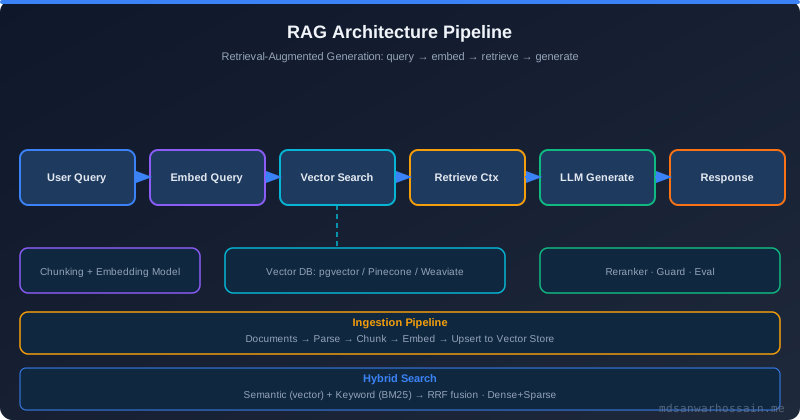
Table of Contents
- Why Naive RAG Fails in Production
- What Is Agentic RAG?
- Core Agentic RAG Patterns
- Query Decomposition and Sub-Question Routing
- Multi-Source Retrieval with Adaptive Routing
- Self-RAG: Retrieval Quality Verification
- Production Architecture and Observability
- Failure Scenarios and Debugging
- Trade-offs and Optimization
- Key Takeaways
1. Why Naive RAG Fails in Production
The standard RAG pipeline — embed query → cosine similarity search → retrieve top-5 chunks → LLM generates answer — works surprisingly well in demos. In production, it breaks down in predictable ways:
- Multi-hop queries: "What is the difference between our Q3 2024 and Q3 2025 revenue growth rate?" requires two separate retrievals and a comparison. A single embedding similarity search can't decompose this.
- Temporal freshness mismatch: The vector index may be 3 days stale. A query about "today's pricing" retrieves outdated chunks with high similarity but wrong data.
- Wrong knowledge source: A question about a customer's account balance should go to a live database, not a vector store. A question about API documentation should go to the vector store, not the database.
- Insufficient context: Top-k retrieved chunks contain 40% noise. The LLM hallucinates to fill gaps rather than acknowledging uncertainty.
- No retrieval needed: For "what is 2+2?", naive RAG wastes 200ms on a vector search. An agent can recognize general knowledge questions and answer directly.
2. What Is Agentic RAG?
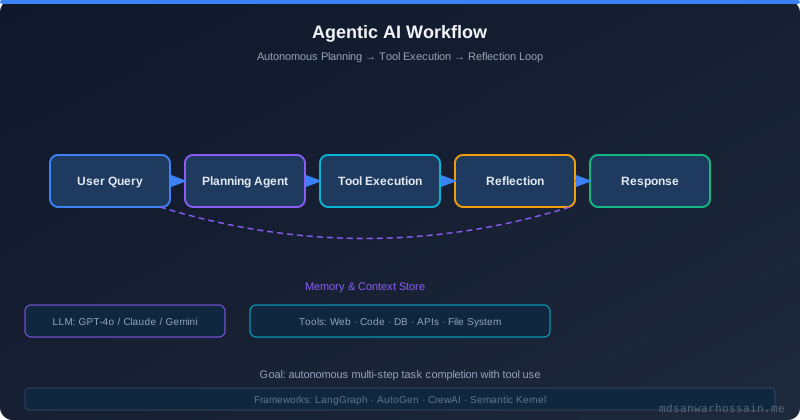
Agentic RAG replaces the fixed retrieval pipeline with an LLM-powered reasoning loop that treats retrieval as a tool call. The agent decides:
- Whether to retrieve at all (can I answer from general knowledge or memory?)
- What to retrieve (decompose complex queries into sub-questions)
- Where to retrieve from (vector store, database, web search, API)
- Whether retrieval was sufficient (grade retrieved context; re-retrieve if insufficient)
- Whether the answer is grounded (self-check: is the answer supported by retrieved context?)
This is fundamentally different from naive RAG — instead of a deterministic pipeline, you have a reasoning loop with conditional branching. The cost is higher latency and LLM token usage. The benefit is dramatically better accuracy and reliability on complex queries.
3. Core Agentic RAG Patterns
Pattern 1: Corrective RAG (CRAG)
After initial retrieval, the agent grades the relevance of retrieved documents (Relevant / Irrelevant / Ambiguous). If the grade is Irrelevant, it triggers a web search or alternative source retrieval. If Ambiguous, it refines the query and re-retrieves. Only after satisfactory context does it generate the answer.
Pattern 2: Adaptive RAG
Query classification before retrieval: classify the incoming query as (a) no retrieval needed, (b) simple single-hop retrieval, or (c) complex multi-hop retrieval. Route to the appropriate pipeline. This reduces unnecessary retrieval overhead and latency for simple queries while enabling full Agentic RAG for complex ones.
Pattern 3: Self-RAG
The LLM generates special reflection tokens during generation: [Retrieve], [IsRel], [IsSup], [IsUse]. These tokens signal: "I need to retrieve more", "Is this chunk relevant?", "Does this chunk support my statement?", "Is this generation useful?". Self-RAG fine-tunes the LLM to interleave these tokens naturally during generation.
4. Query Decomposition and Sub-Question Routing
Multi-hop queries must be decomposed into atomic sub-questions. Each sub-question can then be answered independently and the results composed:
from langchain.chat_models import ChatAnthropic
from langchain.schema import HumanMessage

DECOMPOSITION_PROMPT = """
Given this complex question, decompose it into 2-4 independent sub-questions
that can each be answered with a single retrieval operation.

Question: {question}

Return ONLY a JSON array of sub-questions.
"""

async def decompose_query(question: str) -> list[str]:
    llm = ChatAnthropic(model="claude-3-5-sonnet-20241022")
    response = await llm.ainvoke([
        HumanMessage(content=DECOMPOSITION_PROMPT.format(question=question))
    ])
    return json.loads(response.content)

# Example:
# Input: "How does our Q3 2025 revenue compare to Q3 2024, and which product line drove the growth?"
# Output: [
#   "What was the total revenue in Q3 2025?",
#   "What was the total revenue in Q3 2024?",
#   "Which product line had the highest revenue growth in Q3 2025?"
# ]
Sub-questions are then executed in parallel (when independent) or sequentially (when the answer to one informs the next — step-back prompting). Results are synthesized by the agent into the final answer.
5. Multi-Source Retrieval with Adaptive Routing
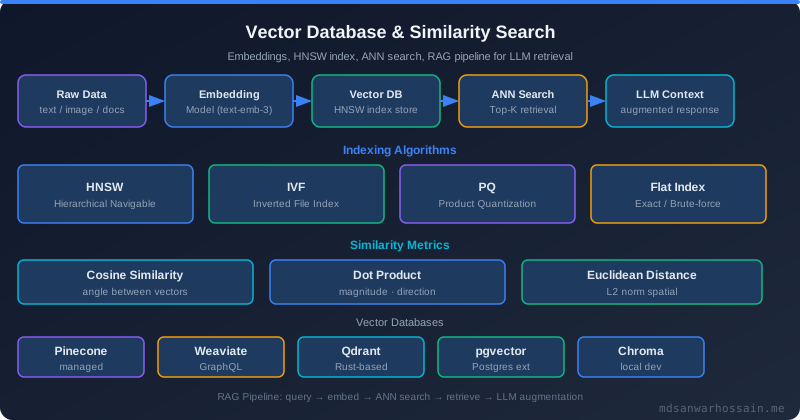
Production AI applications have multiple knowledge sources. An agent needs to route each sub-question to the right source:
├── Account/transaction data → SQL database query tool
├── Product documentation → Vector store (embeddings)
├── Recent news (<7 days) → Web search tool
├── Internal policies → Structured data store
└── General knowledge → LLM parametric memory (no retrieval)
ROUTING_PROMPT = """
Given this question, determine the best retrieval source.
Options: vector_store | sql_database | web_search | no_retrieval

Question: {question}

Rules:
- Account balances, transactions → sql_database
- Product docs, FAQs, policies → vector_store
- Events after 2025-01-01 → web_search
- Basic math, general knowledge → no_retrieval

Return ONLY the source name.
"""

async def route_query(question: str) -> str:
    response = await llm.ainvoke([
        HumanMessage(content=ROUTING_PROMPT.format(question=question))
    ])
    return response.content.strip()
6. Self-RAG: Retrieval Quality Verification
After retrieval, the agent grades the quality of retrieved documents before generation. If the grader determines the context is insufficient, it either re-retrieves with a modified query or falls back to an alternative source:
RELEVANCE_GRADER_PROMPT = """
You are evaluating whether a retrieved document is relevant to a question.

Question: {question}
Retrieved Document: {document}

Is this document relevant? Score: relevant | partially_relevant | irrelevant
Confidence: 0.0-1.0
JSON response only.
"""

async def grade_retrieval(question: str, documents: list[str]) -> RetrievalGrade:
    grades = await asyncio.gather(*[
        grade_single_document(question, doc)
        for doc in documents
    ])
    relevant_docs = [d for d, g in zip(documents, grades)
                     if g.score in ("relevant", "partially_relevant")
                     and g.confidence > 0.7]

    if len(relevant_docs) < 2:
        return RetrievalGrade.INSUFFICIENT
    elif any(g.score == "relevant" and g.confidence > 0.9 for g in grades):
        return RetrievalGrade.SUFFICIENT
    else:
        return RetrievalGrade.NEEDS_REFINEMENT
The hallucination check adds a final safety layer: after generation, the agent verifies that every factual claim in the answer is grounded in the retrieved context. Claims not grounded in context are flagged or removed.
7. Production Architecture and Observability
An Agentic RAG production system requires observability at every step of the reasoning loop — not just the final answer:
- Trace each reasoning step: Log the query classification decision, sub-questions generated, sources routed to, relevance grades, and final grounding check. Use LangSmith, LangFuse, or custom OpenTelemetry spans.
- Track retrieval quality metrics: Average relevance grade per source, re-retrieval rate, insufficient context rate. High re-retrieval rate indicates embedding quality issues or poor chunking strategy.
- Monitor latency per step: Decomposition adds ~500ms, grading adds ~300ms per document. Set per-step SLOs and alert when steps exceed them.
- Cache decomposition results: Semantically similar queries often decompose into the same sub-questions. Cache decomposition outputs with query embedding similarity. TTL: 1 hour for dynamic data queries; 24 hours for static documentation queries.
8. Failure Scenarios and Debugging
Failure 1: Infinite Re-Retrieval Loop
If the relevance grader is too strict, every retrieval attempt grades as "insufficient," triggering a loop. Implement a hard limit of 3 retrieval attempts per sub-question. On exhaustion, generate a "I could not find sufficient information" response rather than looping.
Failure 2: Over-Decomposition
Complex queries decomposed into 8+ sub-questions create exponential LLM cost and latency. Limit decomposition to 4 sub-questions maximum. For queries requiring more, use step-by-step decomposition with early stopping when the answer becomes sufficient.
Failure 3: Router Misclassification
The routing LLM incorrectly classifies a query (e.g., routes a real-time data query to the vector store). Log all routing decisions with confidence scores. Add a fallback: if the routed source returns zero results, try the next-best source automatically.
9. Trade-offs and Optimization
- Latency vs. accuracy: Full Agentic RAG with decomposition + grading + hallucination check adds 1.5–3 seconds versus naive RAG. For real-time chatbots, use streaming output + progressive disclosure: show initial answer while background verification runs.
- Cost vs. quality: Using GPT-4o/Claude 3.5 Sonnet for routing and grading is expensive at scale. Fine-tune or use smaller models (GPT-4o-mini, Claude Haiku) for routing and grading steps; reserve the large model for final answer generation.
- Parallelization: Sub-question retrievals that are independent should run in parallel (asyncio.gather). Sequential execution of 4 independent sub-questions at 500ms each = 2s total vs. 500ms with parallelization.
10. Key Takeaways
- Naive RAG fails on multi-hop, temporal, and cross-source queries — Agentic RAG addresses these with reasoning loops.
- Query decomposition + parallel sub-question retrieval is the highest-ROI improvement over naive RAG.
- Adaptive routing to the correct knowledge source (vector store vs. database vs. web) is essential for multi-source applications.
- Relevance grading prevents LLM hallucination from insufficient or irrelevant retrieved context.
- Use smaller models (Haiku, GPT-4o-mini) for routing and grading; reserve large models for final generation.
- Instrument every step of the reasoning loop — retrieval quality metrics are as important as answer quality metrics.
Conclusion
Agentic RAG represents the maturation of RAG from a simple retrieval shortcut to a full reasoning system. The teams that adopt it in 2025–2026 will build AI applications that can handle the complex, ambiguous, multi-source queries that real users actually ask — not just the clean, single-hop questions that naive RAG demos well on.
Start with query decomposition — it's the most impactful addition with the least operational complexity. Add adaptive routing and relevance grading iteratively, measuring accuracy gains at each step.
Frequently Asked Questions
Why Naive RAG Fails in Production?
The standard RAG pipeline — embed query → cosine similarity search → retrieve top-5 chunks → LLM generates answer — works surprisingly well in demos. In production, it breaks down in predictable ways: Multi-hop queries: "What is the difference between our Q3 2024 and Q3 2025 revenue growth rate?" requires two separate retrievals and a comparison. A single embedding similarity search can't decompose this. Temporal freshness mismatch: The vector index may be 3 days stale. A query about "today's pricing" retrieves outdated chunks with high similarity but wrong data. Wrong knowledge source: A question about a customer's account balance should go to a live database, not a vector store. A question about API documentation should go to the vector store, not the database.
What Is Agentic RAG?
Agentic RAG replaces the fixed retrieval pipeline with an LLM-powered reasoning loop that treats retrieval as a tool call . The agent decides: This is fundamentally different from naive RAG — instead of a deterministic pipeline, you have a reasoning loop with conditional branching. The cost is higher latency and LLM token usage. The benefit is dramatically better accuracy and reliability on complex queries. Whether to retrieve at all (can I answer from general knowledge or memory?) What to retrieve (decompose complex queries into sub-questions) Where to retrieve from (vector store, database, web search, API) Whether retrieval was sufficient (grade retrieved context; re-retrieve if insufficient)
How does the Pattern 1 work and when should you use it?
After initial retrieval, the agent grades the relevance of retrieved documents (Relevant / Irrelevant / Ambiguous). If the grade is Irrelevant, it triggers a web search or alternative source retrieval. If Ambiguous, it refines the query and re-retrieves. Only after satisfactory context does it generate the answer.
How does the Pattern 2 work and when should you use it?
Query classification before retrieval: classify the incoming query as (a) no retrieval needed, (b) simple single-hop retrieval, or (c) complex multi-hop retrieval. Route to the appropriate pipeline. This reduces unnecessary retrieval overhead and latency for simple queries while enabling full Agentic RAG for complex ones.
How does the Pattern 3 work and when should you use it?
The LLM generates special reflection tokens during generation: [Retrieve] , [IsRel] , [IsSup] , [IsUse] . These tokens signal: "I need to retrieve more", "Is this chunk relevant?", "Does this chunk support my statement?", "Is this generation useful?". Self-RAG fine-tunes the LLM to interleave these tokens naturally during generation.
Leave a Comment
Related Posts

Software Engineer · Java · Spring Boot · Microservices