RAG Architecture for Enterprise Software: A Practical Engineering Guide
RAG systems can dramatically improve AI answer quality—but only when the retrieval layer is engineered with the same rigor as the generation layer. Most RAG failures are retrieval failures, not model failures.
TL;DR
"RAG architecture for enterprise AI: indexing strategy, hybrid retrieval, reranking, grounding safeguards, and evaluation metrics for production systems."
Imagine asking your company's internal AI assistant, "What is our SLA for Priority 1 incidents?" and receiving a confident, fluent answer that cites a policy document from two years ago that has since been superseded. The answer sounds authoritative. The user trusts it. The guidance is wrong. This is the RAG accuracy problem in enterprise systems, and it is why thoughtful RAG architecture is not optional—it is mission-critical.
Retrieval-Augmented Generation (RAG) is the most widely deployed pattern for grounding large language model responses in organizational knowledge. It works by retrieving relevant documents from a knowledge base and providing them as context to the LLM before generation. Done well, RAG significantly reduces hallucination rates and keeps answers grounded in current, authoritative information. Done poorly, it provides a false sense of accuracy while amplifying confidently stated errors. This guide covers the architecture decisions that separate reliable enterprise RAG from brittle, production-risky implementations.
Table of Contents
Why RAG Is the Default Pattern for Enterprise AI
Enterprise software teams deploy RAG for knowledge assistants, support automation, document Q&A, and internal search because it solves the core limitations of LLMs for organizational use: LLMs are trained on public data, not your internal knowledge; their training data has a cutoff date; and they hallucinate confidently when they do not know something. RAG addresses all three by grounding responses in your actual documents, retrieved at query time.
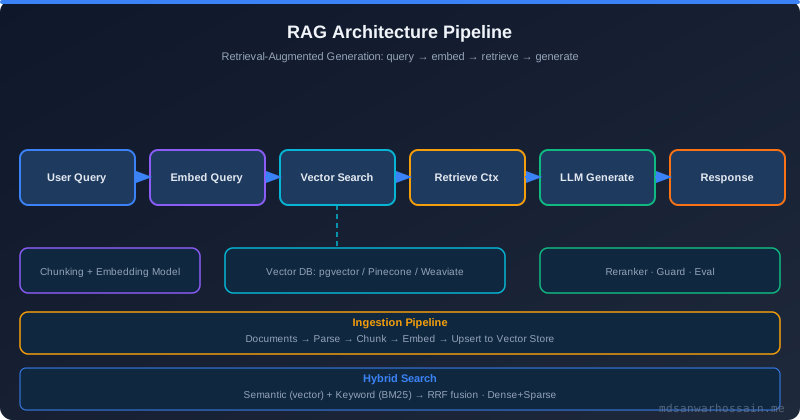
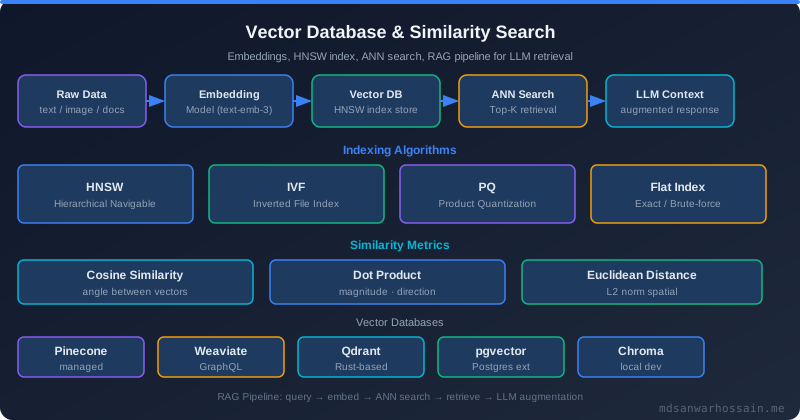
The pattern is deceptively simple: embed user queries and documents into vector space, retrieve the most semantically similar documents, and pass them to the LLM as context. But each step in this pipeline has significant engineering complexity, and the quality of the final answer depends heavily on retrieval precision—not just on the LLM's capabilities.
Real-World Use Cases
Internal knowledge management and policy Q&A
Large organizations maintain thousands of policy documents, runbooks, compliance guides, and technical standards. A RAG-powered assistant allows employees to ask natural-language questions and receive grounded answers with source citations—dramatically reducing the time spent searching SharePoint or Confluence. The freshness of the index directly impacts trust: stale documents erode confidence faster than any other quality issue.
Customer support knowledge base
Support agents using RAG assistants get accurate, product-specific answers based on current documentation rather than relying on general LLM knowledge. This reduces handling time, improves answer consistency, and allows new agents to reach productivity faster. Accuracy requirements here are high—a wrong answer to a customer creates both support cost and brand risk.
Code and API documentation assistant
Developer-facing RAG systems that can answer questions about internal APIs, SDK usage, and architecture decisions based on up-to-date documentation significantly reduce the time developers spend reading docs or asking colleagues. These systems require strong code-aware chunking and retrieval strategies since code snippets and technical prose have very different embedding characteristics.
Core Architecture Decisions
1) Chunking strategy: semantics first, not arbitrary token limits
How you divide documents into chunks fundamentally determines retrieval quality. Arbitrary fixed-size chunks split semantic units, causing retrieved passages that are context-incomplete. Instead, chunk by natural semantic boundaries: paragraphs, sections, or logical sub-topics. For code and structured documents, chunk by function, class, or table row. Experiment with chunk overlap to preserve cross-boundary context. Add rich metadata to each chunk: source document, section title, author, last-modified date, document version, and access permissions.
2) Hybrid retrieval: combine vector and keyword search
Pure vector similarity search excels at semantic matching but struggles with exact terminology, product names, error codes, and specific identifiers. Pure keyword search (BM25) misses semantic paraphrases and synonyms. Hybrid retrieval combines both approaches, typically with a weighted fusion (Reciprocal Rank Fusion is a popular algorithm). In enterprise environments, hybrid retrieval consistently outperforms either approach in isolation for knowledge base Q&A.
3) Reranking for precision
After initial retrieval, a reranking model (cross-encoder architecture) re-scores the top-N candidates based on their relevance to the query with higher precision than embedding similarity. This two-stage approach—fast retrieval to get candidates, then precise reranking to select context—significantly improves the quality of context passed to the LLM. Cross-encoder rerankers like Cohere Rerank and BGE-Reranker-v2 are well-established choices for enterprise RAG.
4) Metadata filtering to enforce freshness and access control
Vector similarity alone does not know that a document is outdated or that the user lacks permission to access it. Implement metadata filters that restrict retrieval to documents within an acceptable freshness window (e.g., modified within the past 12 months) and match the user's access rights. This prevents the "confidently wrong and outdated" failure mode and ensures compliance with document-level access controls.
5) Answer grounding and source attribution
Every RAG response should include source citations: document name, section, and last-modified date. This serves two purposes. First, it gives users the ability to verify answers against authoritative sources—essential for trust in high-stakes contexts. Second, it makes hallucination visible: if the LLM fabricates a fact not present in any retrieved document, citation review surfaces the gap. Implement faithfulness checks that verify claims in the generated answer are supported by retrieved evidence.
6) Evaluation pipeline with measurable metrics
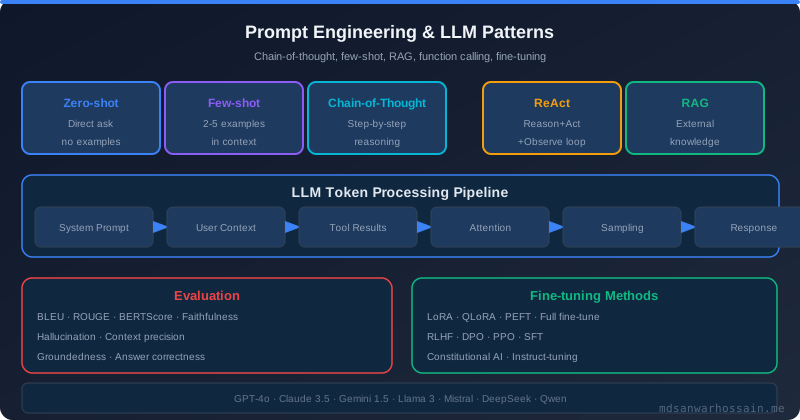
RAG quality must be measured objectively, not assessed by demos. Build an evaluation pipeline that measures: recall@k (is the correct document in the top-k retrieved results?), faithfulness (does the generated answer only contain claims supported by retrieved documents?), answer relevance (does the answer actually address the question?), and context precision (are retrieved documents relevant to the query?). Tools like RAGAS, TruLens, and DeepEval provide frameworks for these measurements. Define minimum quality thresholds and run evaluations on every prompt or pipeline change.
7) Handle low-confidence and no-answer cases explicitly
A RAG system that always generates an answer—even when it has no good evidence—creates false confidence. Implement confidence thresholds: if retrieval quality is below a minimum score, or if retrieved documents do not sufficiently address the query, return a calibrated response: "I could not find reliable information on this. Please consult [source] or contact [team]." Refusing to answer well is a feature, not a limitation.
Tools & Technologies
- Pinecone / Weaviate / Qdrant — Managed and open-source vector databases for embedding storage and retrieval
- pgvector — PostgreSQL extension for vector search, useful when minimizing infrastructure sprawl
- LangChain / LlamaIndex — RAG orchestration frameworks with built-in chunking, retrieval, and chain management
- Cohere Rerank / BGE-Reranker — Cross-encoder reranking models for retrieval precision improvement
- RAGAS / TruLens — RAG evaluation frameworks for measuring faithfulness, relevance, and recall
- OpenSearch / Elasticsearch — Hybrid retrieval engines combining BM25 and vector search
- Unstructured.io — Document parsing and chunking for PDFs, Word docs, and web content
Agentic AI and Advanced RAG
The next evolution of RAG is agentic RAG—where an AI agent actively decides what to retrieve, when to retrieve, and how to combine multiple retrieval steps to answer complex multi-hop questions. Instead of a single query-retrieve-generate cycle, the agent might issue multiple targeted queries, verify retrieved information for consistency, and synthesize a structured answer from heterogeneous sources. This is especially powerful for research-style queries that require connecting information across multiple documents.
Agentic RAG requires stronger guardrails: explicit retrieval budgets (maximum number of retrievals per query), source quality validation, and audit logging of every retrieval decision. The benefit is substantially better answers for complex queries; the cost is higher latency and more opportunities for failure. Start with simple RAG and introduce agentic retrieval only for query types where you have measured precision improvements in evaluation.
Future Trends
RAG architecture will continue to evolve with multimodal retrieval (images, tables, audio transcripts alongside text), graph-augmented retrieval for complex relationship queries, real-time document indexing for freshness-critical applications, and tighter integration of access control enforcement at the retrieval layer. Evaluation tooling will mature significantly, making it easier to measure RAG quality across diverse enterprise document types.
Building the Ingestion Pipeline: Document Processing at Scale
The RAG ingestion pipeline is the foundation of retrieval quality. Poor chunking, wrong embedding models, or inconsistent metadata destroy retrieval precision before a single query is ever issued. Building a production ingestion pipeline requires careful decisions at each stage: document loading, cleaning, chunking, embedding, and indexing.
Document Loading and Preprocessing
Document loaders extract raw text from diverse source formats: PDF, DOCX, HTML, Confluence pages, Jira tickets, Slack threads, and database records. The critical preprocessing step is normalization: strip HTML tags, expand abbreviations, standardize date formats, and remove boilerplate headers and footers that appear in every document but carry no semantic value. Boilerplate content included in every chunk will pull semantically unrelated documents into every search result, degrading precision from the start.
Chunking Strategy
Chunk size is one of the highest-leverage decisions in RAG. Too large and you waste context window space on irrelevant content surrounding the answer; too small and you lose the surrounding context needed to correctly interpret the passage. The right size depends on your document type and the nature of the questions being asked:
- Policy documents: 512–1024 tokens, split on paragraph boundaries, with 100-token overlap to preserve cross-paragraph context
- API documentation: Function/method level — one chunk per endpoint or method with its full signature, description, and example
- Source code: One chunk per function or class; never split mid-function as partial code loses semantic meaning entirely
- Meeting notes / support tickets: 256–512 tokens, split on speaker or time boundaries rather than arbitrary token counts
Spring AI Ingestion Pipeline Example
The following shows a complete Spring AI ingestion pipeline with recursive chunking, metadata enrichment, and vector store indexing:
@Service
@Slf4j
public class DocumentIngestionService {
    private final VectorStore vectorStore;

    public void ingestFromPath(Path documentPath, Map<String, Object> sourceMetadata) {
        // 1. Load document using Apache Tika (multi-format: PDF, DOCX, HTML)
        Resource resource = new FileSystemResource(documentPath);
        TikaDocumentReader reader = new TikaDocumentReader(resource);
        List<Document> rawDocs = reader.get();

        // 2. Chunk with recursive character splitting
        TextSplitter splitter = new TokenTextSplitter(
            512,   // chunk size in tokens
            100,   // overlap tokens to preserve cross-chunk context
            5,     // minimum chunk length (discard micro-fragments)
            10000, // maximum chunk length guard
            true   // keep separator characters for readability
        );
        List<Document> chunks = splitter.apply(rawDocs);

        // 3. Enrich metadata on each chunk for filtering and attribution
        for (int i = 0; i < chunks.size(); i++) {
            chunks.get(i).getMetadata().putAll(sourceMetadata);
            chunks.get(i).getMetadata().put("ingested_at", Instant.now().toString());
            chunks.get(i).getMetadata().put("chunk_index", i);
            chunks.get(i).getMetadata().put("source_file",
                documentPath.getFileName().toString());
        }

        // 4. Embed and store — Spring AI handles batching internally
        vectorStore.add(chunks);
        log.info("Ingested {} chunks from {}", chunks.size(), documentPath);
    }
}

# application.yml — Spring AI pgvector configuration
# spring:
#   ai:
#     vectorstore:
#       pgvector:
#         index-type: HNSW
#         distance-type: COSINE_DISTANCE
#         dimensions: 1536
For large-scale ingestion (millions of documents), process asynchronously using a message queue (Kafka or SQS) to fan out ingestion workers. Track ingestion status in a metadata table with document_id, status, ingested_at, and chunk_count so you can identify and retry failed documents and monitor pipeline health over time.
Evaluation Framework: Measuring RAG Quality with RAGAS
You cannot improve what you cannot measure. RAG systems require a dedicated evaluation framework that runs continuously against a curated set of question-answer pairs with known ground truth. RAGAS (Retrieval Augmented Generation Assessment) provides a suite of reference-free metrics computed automatically using an LLM-as-judge approach, enabling rapid iteration on retrieval and generation parameters without expensive human evaluation at every step.
Core RAGAS Metrics
| Metric | What it Measures | Score Range | Acceptable Minimum |
|---|---|---|---|
| Faithfulness | Are all claims in the answer supported by retrieved context? | 0–1 | >0.85 |
| Answer Relevancy | How directly does the answer address the original question? | 0–1 | >0.80 |
| Context Precision | What fraction of retrieved chunks were actually relevant? | 0–1 | >0.70 |
| Context Recall | Was all information needed to answer the question retrieved? | 0–1 | >0.75 |
| Answer Correctness | Factual and semantic similarity to ground truth answer | 0–1 | >0.75 |
Run RAGAS evaluation as part of your CI/CD pipeline on every change to chunking parameters, embedding models, or prompt templates. A regression in Faithfulness indicates the LLM is generating claims not grounded in retrieved context — the most dangerous failure mode in enterprise RAG. A regression in Context Precision indicates retrieval noise — you are fetching irrelevant chunks that confuse the LLM and waste context window space.
RAG vs Fine-Tuning: When to Use Which Strategy
RAG and fine-tuning are often presented as competing strategies, but they address different problems. RAG provides dynamic, updatable knowledge from external sources. Fine-tuning adapts the model's style, format, reasoning patterns, and vocabulary for a specific domain. Understanding when to use each — and when to combine them — is one of the most consequential architecture decisions in enterprise AI deployments.
| Dimension | RAG | Fine-Tuning | Recommendation |
|---|---|---|---|
| Cost | Low upfront; per-query retrieval cost | High training cost; lower inference overhead | Start with RAG; fine-tune only when justified by scale |
| Latency | +50–200ms for retrieval step | No retrieval overhead; shorter prompts | Fine-tune for latency-sensitive, high-volume use cases |
| Knowledge Freshness | Real-time; update knowledge without retraining | Static; requires retraining to update facts | RAG wins for any frequently changing knowledge base |
| Accuracy | Depends on retrieval quality; can hallucinate | Better for narrow domain tasks with sufficient training data | Fine-tune for highly specialized domain language |
| Maintenance | Ongoing: re-index as source documents change | Periodic: retrain when domain knowledge shifts significantly | RAG simpler to maintain at small-to-medium team sizes |
| Ideal Use Case | Policy Q&A, doc search, internal knowledge base | Code generation, formatting tasks, consistent tone/style | Combine: RAG for knowledge + fine-tuning for style |
Production RAG Observability: Tracing Retrieval and Generation
Production RAG systems fail in subtle ways: a single bad chunk retrieved consistently degrades answers for an entire category of questions; query rewriting introduces semantic drift; the reranker promotes documents from a deprecated policy version. Without deep observability into every step of the retrieval and generation pipeline, these failures are invisible until users report degraded answer quality.
LangSmith and LangFuse Integration
LangSmith (LangChain's observability platform) and LangFuse (open-source alternative) both provide request-level tracing of RAG pipelines with retrieved chunk inspection, token counts, and latency breakdown per stage. Configure LangFuse with Spring AI using the OpenTelemetry exporter for production tracing:
# application.yml — LangFuse observability via OTLP
management:
  tracing:
    sampling:
      probability: 1.0   # Trace 100% of RAG requests in staging; sample in production

langfuse:
  enabled: true
  public-key: ${LANGFUSE_PUBLIC_KEY}
  secret-key: ${LANGFUSE_SECRET_KEY}
  host: https://cloud.langfuse.com
  log-retrieved-chunks: true
  log-full-prompt: false   # Disable in production to avoid logging PII in prompts
Logging Retrieved Chunks for Debugging
Log the retrieved chunks, their similarity scores, and the final answer as a structured trace for every RAG request. This creates a queryable audit trail that lets you diagnose retrieval failures by inspecting which chunks were retrieved for any failing query:
@Service
public class ObservableRagService {
    private final VectorStore vectorStore;
    private final ChatClient chatClient;
    private final MeterRegistry meterRegistry;

    public RagResponse query(String userQuestion, String userId) {
        Span span = Span.current();
        span.setAttribute("rag.question", userQuestion);
        span.setAttribute("rag.user_id", userId);

        // Retrieve top-K chunks with similarity scores
        List<Document> chunks = vectorStore.similaritySearch(
            SearchRequest.query(userQuestion).withTopK(5));

        // Log retrieved chunk metadata as OpenTelemetry events
        chunks.forEach(doc -> span.addEvent("retrieved_chunk", Attributes.of(
            AttributeKey.stringKey("chunk.source"),
                (String) doc.getMetadata().get("source_file"),
            AttributeKey.doubleKey("chunk.score"),
                (Double) doc.getMetadata().getOrDefault("distance", 0.0)
        )));

        meterRegistry.counter("rag.chunks_retrieved",
            "query_type", classifyQuery(userQuestion))
            .increment(chunks.size());

        String answer = chatClient.prompt()
            .system("Answer using only the provided context. Say 'I don't know' if not covered.")
            .user(buildPrompt(userQuestion, chunks))
            .call()
            .content();

        span.setAttribute("rag.answer_length", answer.length());
        return new RagResponse(answer, extractSources(chunks));
    }
}
Set up Grafana dashboards tracking P50/P95/P99 retrieval latency, average retrieved chunks per query, chunk score distributions, and answer length over time. Anomalies in these metrics are early signals of retrieval quality degradation before users report problems. Alert on faithfulness score drops from your continuous RAGAS evaluation pipeline to catch prompt or index regressions immediately.
Continuous Quality Monitoring with a Golden Dataset
Beyond tracing individual requests, maintain a golden dataset of 100–500 representative questions with human-verified ground truth answers and correct source documents. Run RAGAS evaluation against this golden dataset on every deployment and every significant index update. Store evaluation results over time and visualise them alongside system changes in a Grafana dashboard. A sudden drop in Context Precision after an index rebuild indicates a chunking regression. A gradual decline in Faithfulness after a prompt template change indicates the LLM is drifting away from retrieved context. These patterns are only visible with continuous measurement against a stable ground truth dataset — aggregate user feedback signals are too noisy and too slow to catch regressions early in the deployment lifecycle. Investing in a curated evaluation dataset before you launch your RAG system in production is the highest-leverage quality investment you can make. Without it, you are flying blind on quality and will only learn about regressions when users escalate complaints.
Conclusion
RAG is not a simple add-on to an LLM—it is a full-stack engineering discipline that spans document ingestion, chunking strategy, embedding model selection, hybrid retrieval, reranking, prompt design, grounding verification, evaluation automation, and production observability. The difference between a RAG system that earns user trust and one that quietly undermines it comes down to retrieval precision, freshness control, grounding verification, and honest handling of uncertainty. Invest in your retrieval pipeline with the same rigor you invest in your generation layer. Build evaluation pipelines, measure quality continuously, and design for graceful uncertainty. That is the foundation of enterprise RAG that actually works in production.
Leave a Comment
Related Posts

Software Engineer · Java · Spring Boot · Microservices