API Gateway & Service Mesh: Architecting the Network Layer for Distributed Systems
An API Gateway and a Service Mesh are not competing technologies — they solve different networking problems at different layers. Understanding where each one lives and what it manages is essential for designing the network layer of a production microservices platform.
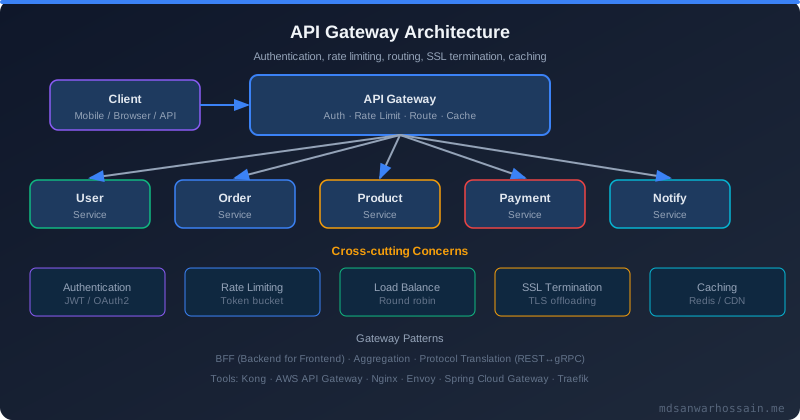
Table of Contents
- The Two Networking Layers
- API Gateway: The Front Door
- Service Mesh: Managing East-West Traffic
- Do You Need Both?
- Real-World Problem: The Authentication Cascade Failure
- Solution Approach: Layered Security and Traffic Control
- Architecture: Traffic Flow in a Production Platform
- Optimization: Reducing Gateway Latency
- Common Pitfalls
- Conclusion
The Two Networking Layers
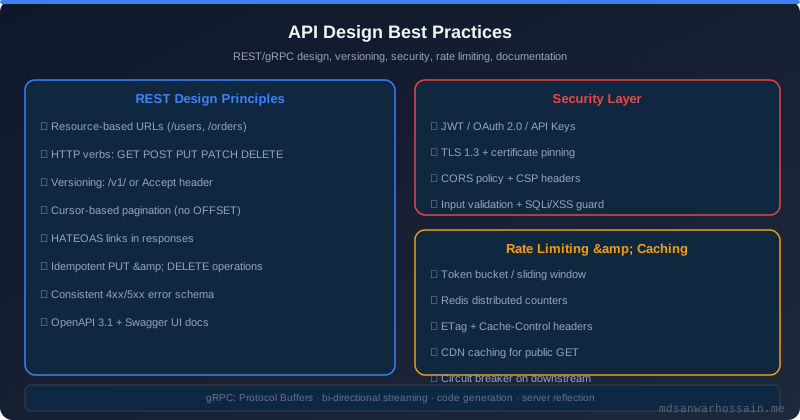
In a microservices architecture, there are two distinct networking boundaries that need management. The north-south boundary is traffic flowing between external clients (browsers, mobile apps, third-party integrations) and the services inside the cluster. The east-west boundary is traffic flowing between services inside the cluster. These two boundaries have fundamentally different requirements, which is why different tools address them.
An API Gateway manages north-south traffic — the entry point into your system from the outside world. A Service Mesh manages east-west traffic — communication between services inside the cluster. The confusion arises because modern API gateways can be deployed inside a cluster and modern service meshes can handle ingress — but their core design philosophy and feature set remain oriented to these distinct use cases.
API Gateway: The Front Door
An API Gateway is a reverse proxy that sits between external clients and your internal services. It consolidates cross-cutting concerns that would otherwise need to be implemented in every service: authentication and authorization, rate limiting, SSL termination, request routing, protocol translation (REST to gRPC, HTTP/1 to HTTP/2), response caching, request/response transformation, and API versioning.
What an API Gateway Handles
- Authentication: Validate JWT tokens, API keys, or OAuth2 access tokens. Reject unauthenticated requests before they reach any internal service.
- Rate limiting: Enforce per-consumer request rate limits to prevent abuse and protect downstream services from overload.
- Routing: Route requests to the correct backend service based on path, hostname, or headers. Enable A/B testing and canary deployments by routing a percentage of traffic to a new service version.
- Request transformation: Add or modify headers (inject user ID from the validated JWT), transform request/response schemas for backward compatibility, and aggregate responses from multiple services (BFF pattern).
- Observability: Log every request with latency, status code, and consumer identity. Emit metrics. Generate distributed trace spans for all proxied requests.
API Gateway Options in 2026
Kong Gateway (open source) is the dominant self-hosted API gateway. Its plugin architecture enables any of the above concerns to be configured declaratively, and its Kubernetes-native Gateway API support makes it manageable as Kubernetes custom resources. AWS API Gateway is the managed option for AWS-hosted services, requiring no infrastructure management. Spring Cloud Gateway is the Java-native option for Spring Boot teams, providing programmatic route configuration with the familiar Spring ecosystem. The choice between them depends on hosting environment, team familiarity, and whether you prefer managed services or self-hosted flexibility.
# Kong Gateway API route configuration (Kubernetes Gateway API)
apiVersion: gateway.networking.k8s.io/v1
kind: HTTPRoute
metadata:
  name: user-service-route
  namespace: production
spec:
  parentRefs:
    - name: main-gateway
  hostnames:
    - api.example.com
  rules:
    - matches:
        - path:
            type: PathPrefix
            value: /v1/users
      backendRefs:
        - name: user-service
          port: 8080
          weight: 100
Service Mesh: Managing East-West Traffic
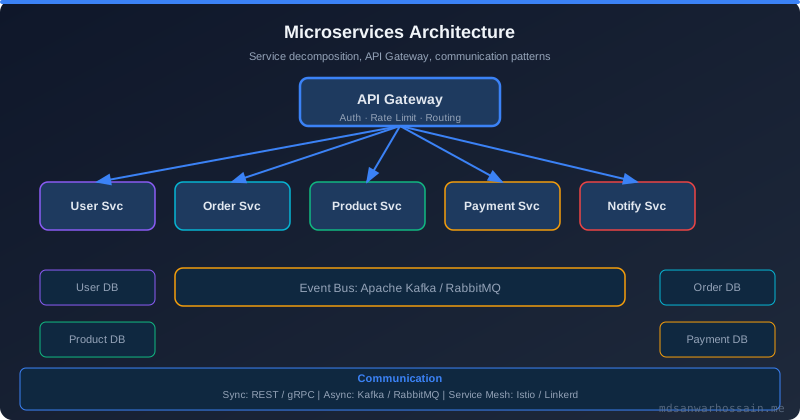
A Service Mesh is a dedicated infrastructure layer for managing service-to-service communication. It is typically implemented as a sidecar proxy (a lightweight proxy container deployed alongside every service pod) that intercepts all network traffic to and from the service. Because the mesh is transparent to the application (no code changes required), it can apply cross-cutting network concerns uniformly across all services regardless of the language or framework they are written in.
What a Service Mesh Provides
Mutual TLS (mTLS): Every service-to-service connection is encrypted and both parties present certificates for mutual authentication. This means a compromised service cannot impersonate another service. The mesh manages certificate issuance and rotation automatically, so applications never touch TLS certificate files. Traffic management: Fine-grained routing rules — weighted traffic splitting for canary deployments, retry policies, circuit breakers, timeout policies — configured declaratively without application code changes. Observability: Automatic distributed tracing (every service call generates a trace span), traffic metrics (request rate, error rate, latency by service pair), and service dependency maps — all without instrumentation in application code.
Istio vs Linkerd
Istio is the most feature-rich service mesh, with powerful traffic management, authorization policies, and integration with the broader Kubernetes ecosystem. Its complexity is also its main drawback — Istio adds significant operational overhead and learning curve. For teams that need fine-grained traffic control, multi-cluster support, and rich RBAC policies, Istio's features justify the cost. Linkerd is the lightweight alternative with a dramatically simpler operational profile. It provides mTLS, observability, and basic traffic management with a smaller resource footprint and gentler learning curve. For teams whose primary needs are mTLS and automatic observability without complex traffic policies, Linkerd is often the better choice.
# Istio VirtualService — canary deployment with 10% traffic to v2
apiVersion: networking.istio.io/v1alpha3
kind: VirtualService
metadata:
  name: user-service
  namespace: production
spec:
  hosts:
    - user-service
  http:
    - match:
        - headers:
            x-canary:
              exact: "true"
      route:
        - destination:
            host: user-service
            subset: v2
    - route:
        - destination:
            host: user-service
            subset: v1
          weight: 90
        - destination:
            host: user-service
            subset: v2
          weight: 10
Do You Need Both?
For small microservices deployments (fewer than five services), adding both an API Gateway and a Service Mesh may be over-engineering. Implement the API Gateway first — it provides the most immediate value (authentication, rate limiting, routing) with manageable complexity. Add a Service Mesh when your east-west communication security posture is a concern (mTLS), when you need zero-code observability across all internal traffic, or when you need sophisticated traffic management for canary deployments.
For large production platforms with many services handling sensitive data, both are often necessary and complementary. The API Gateway handles external access control and public API management; the Service Mesh handles internal traffic security and observability.
"The API Gateway is your front door; the Service Mesh is your building's internal security system. Both are necessary at scale, and neither replaces the other."
Key Takeaways
- API Gateways manage north-south (external-to-internal) traffic; Service Meshes manage east-west (service-to-service) traffic.
- API Gateways consolidate authentication, rate limiting, routing, and protocol translation.
- Service Meshes provide mTLS, automatic observability, and traffic management without application code changes.
- Start with an API Gateway; add a Service Mesh when internal traffic security and observability justify the operational overhead.
- Istio offers the richest features; Linkerd offers the simplest operation. Match the choice to your team's capacity.
Real-World Problem: The Authentication Cascade Failure
A payments platform migrated to microservices and deployed an API gateway for all external traffic. Within two weeks of launch, they experienced a production incident where the gateway's JWT validation service became a single point of failure. Because the gateway was calling a centralized auth service synchronously for every request, a 200ms latency spike in the auth service cascaded into a 5× increase in gateway response times, triggering downstream timeouts across six dependent services. The root cause was missing circuit breaker configuration on the auth call and lack of token caching at the gateway layer.
The fix involved three changes: implementing a short-lived JWT cache in the gateway (tokens are valid for 15 minutes; cache them for 5), adding a circuit breaker with a fallback that rejects with 401 rather than waiting indefinitely, and deploying the auth service as a horizontally scalable deployment behind its own load balancer. After these changes, a full auth service outage caused only new token validations to fail — active sessions with cached tokens continued to work for up to 5 minutes, dramatically reducing blast radius.
Solution Approach: Layered Security and Traffic Control
The correct architecture treats the API gateway and service mesh as complementary security layers, not alternatives. At the gateway, authenticate the external identity (verify the JWT, validate API key scopes, enforce per-consumer rate limits). Strip the external token and inject a service-internal identity header (a signed internal JWT or a header asserting the authenticated user ID). The service mesh then enforces that internal services can only communicate with services they are authorized to call — not just any service in the cluster. Even if an attacker compromises one internal service, mTLS peer authentication and Istio AuthorizationPolicy prevent lateral movement.
# Istio AuthorizationPolicy — only order-service can call payment-service
apiVersion: security.istio.io/v1beta1
kind: AuthorizationPolicy
metadata:
  name: payment-service-policy
  namespace: production
spec:
  selector:
    matchLabels:
      app: payment-service
  rules:
    - from:
        - source:
            principals:
              - "cluster.local/ns/production/sa/order-service"
      to:
        - operation:
            methods: ["POST"]
            paths: ["/v1/payments/*"]
Architecture: Traffic Flow in a Production Platform
A production traffic flow through both layers looks like this: An external client sends a request to api.example.com. The API gateway (Kong, AWS API Gateway, or Spring Cloud Gateway) terminates TLS, validates the client's JWT, enforces rate limits (e.g., 1,000 req/min per API key), and transforms the request — stripping the external token and injecting a signed internal identity header. The request is forwarded to the target service inside the cluster. The service mesh sidecar intercepts the inbound request, verifies mTLS from the gateway's service account, and checks the authorization policy. If allowed, the request reaches the application container. All of this is transparent to the application code.
For observability, both layers emit trace spans that are correlated by a shared X-Request-ID header injected by the gateway. This means a single request ID links gateway logs (rate limit decisions, auth results) to mesh telemetry (inter-service latency, error rates) to application traces (business logic execution) in a unified view.
Optimization: Reducing Gateway Latency
API gateway overhead should be under 5ms for most requests. The main sources of latency are plugin execution order (authenticate first, expensive transformation plugins last), synchronous external calls (always cache auth lookups), and TLS handshake overhead (use session resumption and HTTP/2 multiplexing for persistent client connections). For high-volume endpoints, consider gateway-side response caching for idempotent GET requests with explicit cache-control headers — this can eliminate 60–80% of backend calls for heavily-read catalog or configuration endpoints.
Service mesh overhead from sidecar proxies is typically 1–2ms per hop for Envoy-based meshes under normal load. This becomes significant only when services are extremely latency-sensitive (sub-10ms SLAs) or when the call graph is very deep (10+ hops). For these cases, evaluate whether some service-to-service paths can bypass the mesh proxy using headless service configurations with mTLS certificates managed at the application level.
Common Pitfalls
- Putting business logic in the gateway: Rate limiting, authentication, and routing belong in the gateway. Aggregation, data transformation, and orchestration belong in a dedicated BFF service. Gateways with embedded business logic become impossible to test and maintain.
- Not setting resource limits on the sidecar proxy: Envoy sidecars consume CPU and memory. Under high load without resource limits, they can starve application containers. Always set CPU and memory requests/limits on sidecar containers in production.
- Forgetting to handle mTLS for in-cluster health checks: Kubernetes liveness and readiness probes bypass the mesh by default. Ensure health check endpoints are excluded from mTLS enforcement or configure the mesh to exempt health probe traffic.
- Single-region gateway with no failover plan: The gateway is now a critical path dependency. Deploy in at least two availability zones with automatic failover. Test gateway failure scenarios in staging before they happen in production.
Conclusion
The API gateway and service mesh together form the network foundation of a secure, observable microservices platform. Neither is optional at scale — the gateway controls who enters your system, and the service mesh controls how services communicate once inside. Teams that invest in this network layer upfront spend far less time debugging auth failures, security incidents, and mysterious cross-service latency spikes. The operational complexity is real, but it is bounded complexity with well-understood patterns. The alternative — ad-hoc security and observability bolted onto each service — is unbounded complexity that compounds with every new service added.
Leave a Comment
Related Posts

Software Engineer · Java · Spring Boot · Microservices