AWS CDK vs CloudFormation: Modern Infrastructure as Code for Java Teams
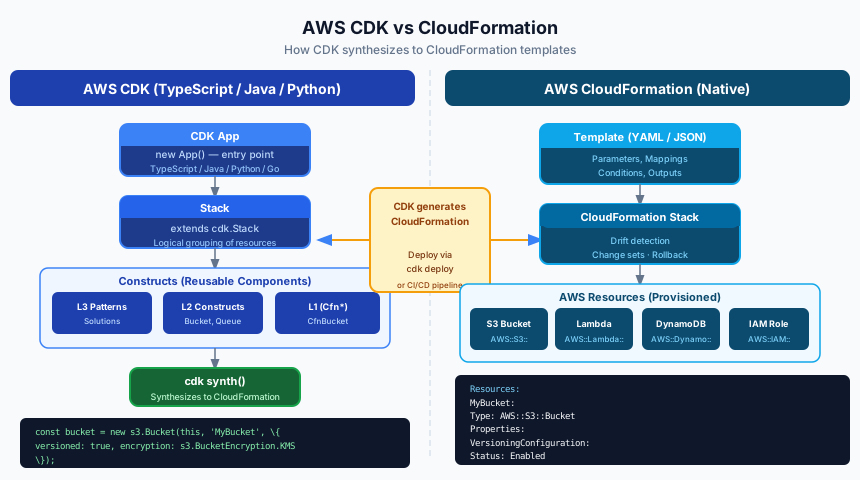
CDK and CloudFormation are not competing runtimes; CDK synthesizes CloudFormation. The real engineering problem is selecting the right abstraction level for speed, governance, reproducibility, and team topology.
TL;DR
Adopt CDK for developer ergonomics and reusable platform abstractions, but keep CloudFormation-level determinism through synthesized template reviews, policy gates, drift detection, and promotion pipelines.
Table of Contents
1. Strategic Context: Why This Choice Matters
Infrastructure code lives longer than most application features. Poor IaC decisions create multi-year drag: brittle deployments, inconsistent environments, and slow compliance reviews. Your goal is not tool purity; your goal is safe delivery at organizational scale.
Decision Matrix for Java-Centric Organizations
| Need | Prefer CDK | Prefer Raw CloudFormation |
|---|---|---|
| Reusable internal platform modules | Yes | Rarely |
| Absolute YAML-level audit readability | With synthesis gate | Yes |
| Rapid experimentation by app teams | Strong fit | Slower |
| Strict enterprise controls | Yes, with policy tooling | Yes |
2. Architecture Layers: CDK Abstraction, CloudFormation Execution
CDK gives software engineering primitives: classes, composition, tests, and versioned libraries. CloudFormation remains the provisioning engine. This means CDK velocity only remains safe when teams continuously inspect synthesized templates.
Construct Strategy for Platform Teams
- L1 constructs for precise, low-level control where compliance is strict.
- L2 constructs for day-to-day app infrastructure.
- L3 internal constructs for opinionated golden paths.
- SemVer every shared construct library; pin in consuming apps.
3. Delivery Pipeline Blueprint
Production pipeline sequence should be deterministic and auditable: compile -> unit test -> synth -> template policy checks -> diff review -> deploy to non-prod -> promote to prod.
App app = new App();
PaymentsPlatformStack stack = new PaymentsPlatformStack(app, "payments-prod");
PolicyAsCodeAssertions.validate(stack);
app.synth();
Policy Controls to Enforce in CI
- Block wildcard IAM actions on privileged roles.
- Require encryption at rest for data stores and messaging services.
- Require mandatory tags for owner, environment, data class, cost center.
- Detect destructive updates on stateful resources before approval.
4. Construct Hierarchy Design and Team Boundaries
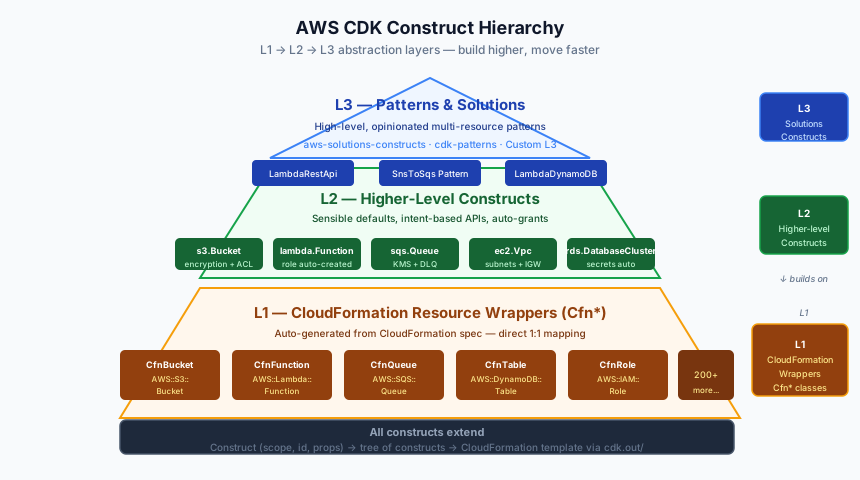
Give platform teams ownership of guardrailed L3 constructs, while product teams consume these abstractions. This minimizes repeated boilerplate and prevents policy drift across dozens of repositories.
5. Stateful Resource Strategy and Change Safety
Separate stateful resources (RDS, OpenSearch, S3 data buckets) from fast-moving stateless compute stacks. This reduces blast radius during frequent app deployments and simplifies rollback decisions.
| Pattern | Advantage | Risk if Ignored |
|---|---|---|
| Dedicated data stack | Stable data lifecycle | Accidental destructive updates |
| Change set review | Predictable rollout | Surprise replacement events |
| Drift detection schedule | Config integrity | Unknown prod divergence |
6. Multi-Account Governance Model
Standardize bootstrap and deployment roles across accounts early. Inconsistent bootstrap stacks are one of the most common causes of CDK deployment failures in enterprise environments.
- One deployment role per environment with clear trust policies.
- SCP guardrails to deny dangerous global actions.
- Centralized artifact bucket and KMS strategy for traceability.
- Promotion model: dev -> staging -> prod with immutable artifacts.
7. Cost, Speed, and Compliance Tradeoffs
CDK often lowers engineering effort but can hide generated complexity. The control mechanism is not to avoid CDK; it is to institutionalize synthesized-template review and policy scanning.
8. Common Pitfalls and Remediation
- Building opaque L3 constructs with no emitted resource docs.
- Relying on manual console fixes instead of source-of-truth updates.
- Skipping cdk diff checks in pull request workflows.
- Mixing app release velocity with data infrastructure lifecycle.
- No stack failure rollback rehearsal in non-prod.
9. Production Checklist for Java Teams
- Versioned shared construct library with changelog discipline.
- Synthesized template artifacts attached to every PR.
- Policy-as-code and tagging rules enforced in CI.
- Drift detection and remediation cadence defined.
- Environment promotion pipeline with approval gates.
10. Conclusion
For Java organizations, CDK is usually the right authoring model and CloudFormation remains the right execution contract. The winning pattern is speed through abstraction, safety through deterministic review, and governance through automation.
11. Enterprise Migration Strategy
In mature IaC programs, enterprise migration strategy must be treated as an operational discipline instead of a one-time setup. Teams should define ownership boundaries, explicit service objectives, and measurable review cadences before scaling traffic or integration count. A practical model starts with a narrow rollout, validates assumptions under synthetic and production-like load, then expands by domain once error handling, alarms, and rollback controls are proven. This sequence reduces blast radius during change and gives engineers predictable evidence for release decisions. Without these guardrails, the platform appears functional in normal conditions but degrades quickly when retries, dependency slowness, or schema drift appear together.
Execution quality depends on documented playbooks for both planned changes and unexpected failures. For enterprise migration strategy, define clear entry criteria, failure thresholds, escalation paths, and compensating actions that can be executed by on-call engineers without waiting for ad-hoc architecture meetings. Include runbook links in alarms, keep dashboards aligned to user-impact indicators, and rehearse failure drills quarterly so teams can validate not only tooling but also communication flow. When this feedback loop is institutionalized, reliability improves steadily, incident timelines shrink, and platform decisions become easier to justify across engineering, security, and business stakeholders.
12. Construct API Design for Platform Teams
In mature IaC programs, construct api design for platform teams must be treated as an operational discipline instead of a one-time setup. Teams should define ownership boundaries, explicit service objectives, and measurable review cadences before scaling traffic or integration count. A practical model starts with a narrow rollout, validates assumptions under synthetic and production-like load, then expands by domain once error handling, alarms, and rollback controls are proven. This sequence reduces blast radius during change and gives engineers predictable evidence for release decisions. Without these guardrails, the platform appears functional in normal conditions but degrades quickly when retries, dependency slowness, or schema drift appear together.
Execution quality depends on documented playbooks for both planned changes and unexpected failures. For construct api design for platform teams, define clear entry criteria, failure thresholds, escalation paths, and compensating actions that can be executed by on-call engineers without waiting for ad-hoc architecture meetings. Include runbook links in alarms, keep dashboards aligned to user-impact indicators, and rehearse failure drills quarterly so teams can validate not only tooling but also communication flow. When this feedback loop is institutionalized, reliability improves steadily, incident timelines shrink, and platform decisions become easier to justify across engineering, security, and business stakeholders.
13. Template Review and Deterministic Change Control
In mature IaC programs, template review and deterministic change control must be treated as an operational discipline instead of a one-time setup. Teams should define ownership boundaries, explicit service objectives, and measurable review cadences before scaling traffic or integration count. A practical model starts with a narrow rollout, validates assumptions under synthetic and production-like load, then expands by domain once error handling, alarms, and rollback controls are proven. This sequence reduces blast radius during change and gives engineers predictable evidence for release decisions. Without these guardrails, the platform appears functional in normal conditions but degrades quickly when retries, dependency slowness, or schema drift appear together.
Execution quality depends on documented playbooks for both planned changes and unexpected failures. For template review and deterministic change control, define clear entry criteria, failure thresholds, escalation paths, and compensating actions that can be executed by on-call engineers without waiting for ad-hoc architecture meetings. Include runbook links in alarms, keep dashboards aligned to user-impact indicators, and rehearse failure drills quarterly so teams can validate not only tooling but also communication flow. When this feedback loop is institutionalized, reliability improves steadily, incident timelines shrink, and platform decisions become easier to justify across engineering, security, and business stakeholders.
A recurring anti-pattern is optimizing for short-term delivery speed while deferring governance controls that appear non-urgent. In practice, deferred controls become expensive debt: incident frequency rises, troubleshooting effort compounds, and cross-team trust drops because behavior is no longer predictable. A better strategy is progressive hardening where every release adds one measurable quality improvement, such as tighter policy checks, stronger contract validation, better cost visibility, or faster rollback automation. This approach keeps delivery momentum while steadily improving the operational safety margin needed for long-term scale.
- Define accountable owners for design, delivery, and incident response.
- Publish runbooks with step-by-step mitigation and rollback paths.
- Track trend metrics weekly and review anomalies with action items.
- Validate controls through drills, not only documentation.
- Retire outdated rules and stale integrations to reduce hidden risk.
14. Pipeline Gating and Policy-as-Code
In mature IaC programs, pipeline gating and policy-as-code must be treated as an operational discipline instead of a one-time setup. Teams should define ownership boundaries, explicit service objectives, and measurable review cadences before scaling traffic or integration count. A practical model starts with a narrow rollout, validates assumptions under synthetic and production-like load, then expands by domain once error handling, alarms, and rollback controls are proven. This sequence reduces blast radius during change and gives engineers predictable evidence for release decisions. Without these guardrails, the platform appears functional in normal conditions but degrades quickly when retries, dependency slowness, or schema drift appear together.
Execution quality depends on documented playbooks for both planned changes and unexpected failures. For pipeline gating and policy-as-code, define clear entry criteria, failure thresholds, escalation paths, and compensating actions that can be executed by on-call engineers without waiting for ad-hoc architecture meetings. Include runbook links in alarms, keep dashboards aligned to user-impact indicators, and rehearse failure drills quarterly so teams can validate not only tooling but also communication flow. When this feedback loop is institutionalized, reliability improves steadily, incident timelines shrink, and platform decisions become easier to justify across engineering, security, and business stakeholders.
15. Stateful Resource Safety and Rollback Logic
In mature IaC programs, stateful resource safety and rollback logic must be treated as an operational discipline instead of a one-time setup. Teams should define ownership boundaries, explicit service objectives, and measurable review cadences before scaling traffic or integration count. A practical model starts with a narrow rollout, validates assumptions under synthetic and production-like load, then expands by domain once error handling, alarms, and rollback controls are proven. This sequence reduces blast radius during change and gives engineers predictable evidence for release decisions. Without these guardrails, the platform appears functional in normal conditions but degrades quickly when retries, dependency slowness, or schema drift appear together.
Execution quality depends on documented playbooks for both planned changes and unexpected failures. For stateful resource safety and rollback logic, define clear entry criteria, failure thresholds, escalation paths, and compensating actions that can be executed by on-call engineers without waiting for ad-hoc architecture meetings. Include runbook links in alarms, keep dashboards aligned to user-impact indicators, and rehearse failure drills quarterly so teams can validate not only tooling but also communication flow. When this feedback loop is institutionalized, reliability improves steadily, incident timelines shrink, and platform decisions become easier to justify across engineering, security, and business stakeholders.
16. Multi-Account Delivery Governance
In mature IaC programs, multi-account delivery governance must be treated as an operational discipline instead of a one-time setup. Teams should define ownership boundaries, explicit service objectives, and measurable review cadences before scaling traffic or integration count. A practical model starts with a narrow rollout, validates assumptions under synthetic and production-like load, then expands by domain once error handling, alarms, and rollback controls are proven. This sequence reduces blast radius during change and gives engineers predictable evidence for release decisions. Without these guardrails, the platform appears functional in normal conditions but degrades quickly when retries, dependency slowness, or schema drift appear together.
Execution quality depends on documented playbooks for both planned changes and unexpected failures. For multi-account delivery governance, define clear entry criteria, failure thresholds, escalation paths, and compensating actions that can be executed by on-call engineers without waiting for ad-hoc architecture meetings. Include runbook links in alarms, keep dashboards aligned to user-impact indicators, and rehearse failure drills quarterly so teams can validate not only tooling but also communication flow. When this feedback loop is institutionalized, reliability improves steadily, incident timelines shrink, and platform decisions become easier to justify across engineering, security, and business stakeholders.
A recurring anti-pattern is optimizing for short-term delivery speed while deferring governance controls that appear non-urgent. In practice, deferred controls become expensive debt: incident frequency rises, troubleshooting effort compounds, and cross-team trust drops because behavior is no longer predictable. A better strategy is progressive hardening where every release adds one measurable quality improvement, such as tighter policy checks, stronger contract validation, better cost visibility, or faster rollback automation. This approach keeps delivery momentum while steadily improving the operational safety margin needed for long-term scale.
- Define accountable owners for design, delivery, and incident response.
- Publish runbooks with step-by-step mitigation and rollback paths.
- Track trend metrics weekly and review anomalies with action items.
- Validate controls through drills, not only documentation.
- Retire outdated rules and stale integrations to reduce hidden risk.
17. Compliance Evidence and Auditability
In mature IaC programs, compliance evidence and auditability must be treated as an operational discipline instead of a one-time setup. Teams should define ownership boundaries, explicit service objectives, and measurable review cadences before scaling traffic or integration count. A practical model starts with a narrow rollout, validates assumptions under synthetic and production-like load, then expands by domain once error handling, alarms, and rollback controls are proven. This sequence reduces blast radius during change and gives engineers predictable evidence for release decisions. Without these guardrails, the platform appears functional in normal conditions but degrades quickly when retries, dependency slowness, or schema drift appear together.
Execution quality depends on documented playbooks for both planned changes and unexpected failures. For compliance evidence and auditability, define clear entry criteria, failure thresholds, escalation paths, and compensating actions that can be executed by on-call engineers without waiting for ad-hoc architecture meetings. Include runbook links in alarms, keep dashboards aligned to user-impact indicators, and rehearse failure drills quarterly so teams can validate not only tooling but also communication flow. When this feedback loop is institutionalized, reliability improves steadily, incident timelines shrink, and platform decisions become easier to justify across engineering, security, and business stakeholders.
18. Cost Controls and Capacity Defaults
In mature IaC programs, cost controls and capacity defaults must be treated as an operational discipline instead of a one-time setup. Teams should define ownership boundaries, explicit service objectives, and measurable review cadences before scaling traffic or integration count. A practical model starts with a narrow rollout, validates assumptions under synthetic and production-like load, then expands by domain once error handling, alarms, and rollback controls are proven. This sequence reduces blast radius during change and gives engineers predictable evidence for release decisions. Without these guardrails, the platform appears functional in normal conditions but degrades quickly when retries, dependency slowness, or schema drift appear together.
Execution quality depends on documented playbooks for both planned changes and unexpected failures. For cost controls and capacity defaults, define clear entry criteria, failure thresholds, escalation paths, and compensating actions that can be executed by on-call engineers without waiting for ad-hoc architecture meetings. Include runbook links in alarms, keep dashboards aligned to user-impact indicators, and rehearse failure drills quarterly so teams can validate not only tooling but also communication flow. When this feedback loop is institutionalized, reliability improves steadily, incident timelines shrink, and platform decisions become easier to justify across engineering, security, and business stakeholders.
19. Anti-Patterns in Shared Abstractions
In mature IaC programs, anti-patterns in shared abstractions must be treated as an operational discipline instead of a one-time setup. Teams should define ownership boundaries, explicit service objectives, and measurable review cadences before scaling traffic or integration count. A practical model starts with a narrow rollout, validates assumptions under synthetic and production-like load, then expands by domain once error handling, alarms, and rollback controls are proven. This sequence reduces blast radius during change and gives engineers predictable evidence for release decisions. Without these guardrails, the platform appears functional in normal conditions but degrades quickly when retries, dependency slowness, or schema drift appear together.
Execution quality depends on documented playbooks for both planned changes and unexpected failures. For anti-patterns in shared abstractions, define clear entry criteria, failure thresholds, escalation paths, and compensating actions that can be executed by on-call engineers without waiting for ad-hoc architecture meetings. Include runbook links in alarms, keep dashboards aligned to user-impact indicators, and rehearse failure drills quarterly so teams can validate not only tooling but also communication flow. When this feedback loop is institutionalized, reliability improves steadily, incident timelines shrink, and platform decisions become easier to justify across engineering, security, and business stakeholders.
A recurring anti-pattern is optimizing for short-term delivery speed while deferring governance controls that appear non-urgent. In practice, deferred controls become expensive debt: incident frequency rises, troubleshooting effort compounds, and cross-team trust drops because behavior is no longer predictable. A better strategy is progressive hardening where every release adds one measurable quality improvement, such as tighter policy checks, stronger contract validation, better cost visibility, or faster rollback automation. This approach keeps delivery momentum while steadily improving the operational safety margin needed for long-term scale.
- Define accountable owners for design, delivery, and incident response.
- Publish runbooks with step-by-step mitigation and rollback paths.
- Track trend metrics weekly and review anomalies with action items.
- Validate controls through drills, not only documentation.
- Retire outdated rules and stale integrations to reduce hidden risk.
20. Operational Playbook for Java Teams
In mature IaC programs, operational playbook for java teams must be treated as an operational discipline instead of a one-time setup. Teams should define ownership boundaries, explicit service objectives, and measurable review cadences before scaling traffic or integration count. A practical model starts with a narrow rollout, validates assumptions under synthetic and production-like load, then expands by domain once error handling, alarms, and rollback controls are proven. This sequence reduces blast radius during change and gives engineers predictable evidence for release decisions. Without these guardrails, the platform appears functional in normal conditions but degrades quickly when retries, dependency slowness, or schema drift appear together.
Execution quality depends on documented playbooks for both planned changes and unexpected failures. For operational playbook for java teams, define clear entry criteria, failure thresholds, escalation paths, and compensating actions that can be executed by on-call engineers without waiting for ad-hoc architecture meetings. Include runbook links in alarms, keep dashboards aligned to user-impact indicators, and rehearse failure drills quarterly so teams can validate not only tooling but also communication flow. When this feedback loop is institutionalized, reliability improves steadily, incident timelines shrink, and platform decisions become easier to justify across engineering, security, and business stakeholders.
A final recommendation for large Java organizations is to institutionalize architecture decision records for every material IaC pattern, especially around state ownership, cross-account trust, and rollback semantics. These records should link to construct versions, policy gates, and operational metrics so future teams can understand why a pattern exists and when it should evolve. When decision context is preserved, platform changes become safer because teams can distinguish intentional controls from historical accidents. Pair this with quarterly portfolio reviews that sample deployed stacks, verify construct adoption consistency, and identify where teams bypassed paved roads. The review should end with concrete enablement work, not only findings, so the platform continuously improves and teams stay aligned on secure, deterministic delivery practices.
Leave a Comment
Related Posts

Software Engineer · Java · Spring Boot · Microservices