AWS CloudWatch & OpenTelemetry: Full Observability for Spring Boot Microservices
Observability is not dashboard quantity; it is incident response capability. For Spring Boot microservices on AWS, OpenTelemetry plus CloudWatch provides a practical model for traces, metrics, logs, and SLO-based operations.
TL;DR
Instrument with OpenTelemetry, process telemetry through a collector, and operate with CloudWatch metrics/logs plus trace correlation. Build SLO-driven alerts, cardinality guardrails, and runbook-linked ownership to cut MTTR.
Table of Contents
1. Operability Goals and Failure-Driven Design
Observability design should begin with failure scenarios: latency regressions, partial dependency outage, queue backlog, and data-consistency drift. Instrumentation choices must map directly to diagnosis and recovery workflows.
The target outcome is fast causality: which request path failed, where latency accumulated, which dependency degraded, and what action restores service.
Signal Framework: Metrics, Traces, Logs, Profiles
| Signal | Primary Question Answered | Common Misuse |
|---|---|---|
| Metrics | Is user-facing health degrading? | Too many vanity counters |
| Traces | Where is latency/error originating? | Broken context propagation |
| Logs | What happened in detail? | PII leakage and noisy debug logs |
| Profiles | Why CPU/memory is abnormal? | Profiling only during incidents |
2. Telemetry Pipeline Architecture
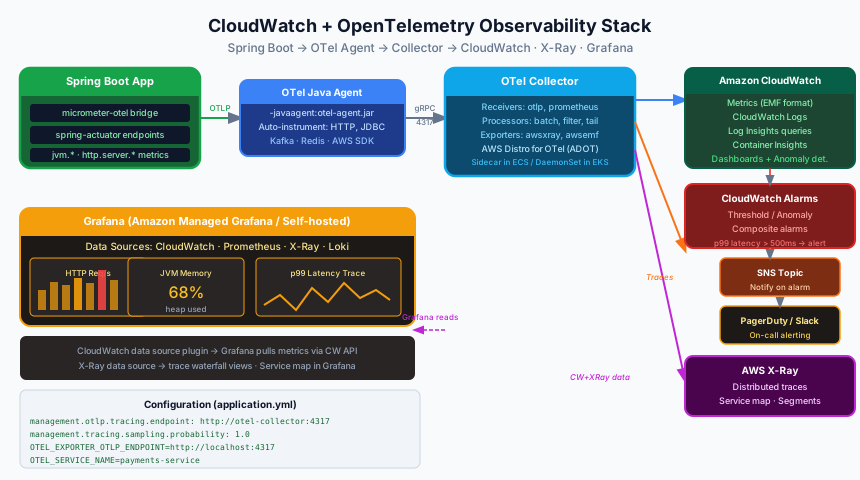
OpenTelemetry should be the instrumentation API, not the backend. This keeps vendor flexibility while allowing CloudWatch-native operations. Add a collector layer for sampling, enrichment, and redaction before export.
Collector Processing Controls
- Attribute normalization for consistent service and environment naming.
- PII redaction processors for logs/spans before backend export.
- Tail-based sampling to retain full traces for error paths.
- Batching and retry settings tuned for burst telemetry traffic.
3. Spring Boot Instrumentation Blueprint
Start with auto-instrumentation, then add manual spans around business-critical flows such as checkout, payment authorization, and fraud decisioning. Business spans carry intent-level context unavailable to generic middleware instrumentation.
Span span = tracer.spanBuilder("payment.authorize").startSpan();
try (Scope ignored = span.makeCurrent()) {
    paymentService.authorize(request);
    span.setAttribute("tenant.id", request.tenantId());
    span.setAttribute("order.id", request.orderId());
} finally {
    span.end();
}
Async Context Propagation Requirements
Trace context must survive queue boundaries (SQS/Kafka), async executors, and scheduled jobs. Without this, traces fragment and become operationally useless during incidents.
4. Operating Stack in CloudWatch
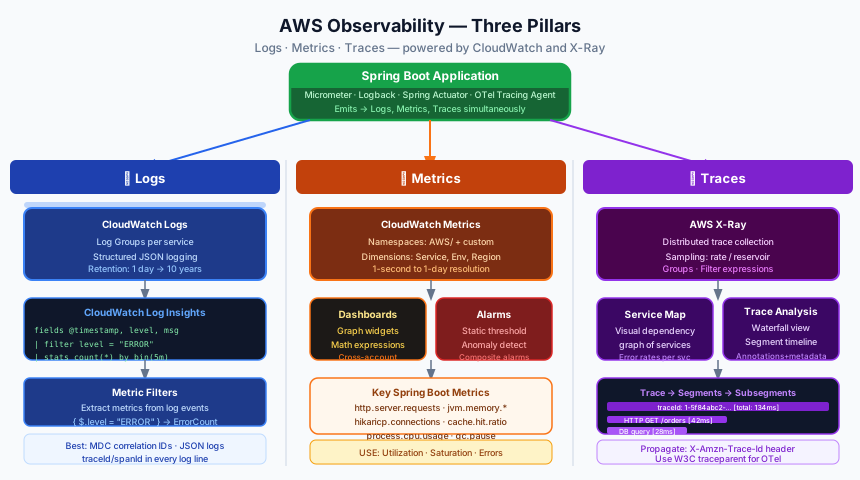
CloudWatch dashboards should be organized by user journeys and SLOs, not infrastructure components alone. Pair service-level dashboards with dependency drill-down views to support fast triage.
5. Alerting Strategy: Burn Rate over Static Thresholds
Static alert thresholds create noise under variable workloads. Prefer multi-window burn-rate alerts aligned to SLOs to catch meaningful degradation while reducing alert fatigue.
| Alert Type | Strength | Risk |
|---|---|---|
| Static threshold | Simple to start | High noise under traffic variation |
| SLO burn-rate | User-impact aligned | Needs defined error budgets |
| Anomaly detection | Adaptive baseline | Can overfit without curation |
6. Telemetry Cost Controls
- Cap high-cardinality dimensions in logs and metrics.
- Use tail sampling to keep high-value traces and drop redundant healthy flows.
- Tune log retention by environment and compliance class.
- Split debug and audit streams to avoid expensive query paths.
- Review monthly telemetry spend against incident outcomes.
7. Common Pitfalls
- No trace-log correlation fields in structured logs.
- Instrumenting everything but owning nothing operationally.
- Alerts without runbook references or clear on-call ownership.
- Collector deployment with default sampling in high-traffic systems.
- Ignoring data privacy in telemetry payloads.
8. Production Checklist
- OpenTelemetry conventions defined across services.
- Collector processing for redaction, enrichment, and sampling.
- SLO dashboards and burn-rate alerts with owner/runbook links.
- Trace context propagation verified in async workflows.
- Monthly telemetry cost and signal-quality review ritual.
9. Conclusion
Observability maturity comes from actionability, not volume. With OpenTelemetry instrumentation discipline and CloudWatch operations rigor, Spring Boot teams can diagnose failures faster, reduce alert fatigue, and maintain better reliability at scale.
11. Maturity Model and Team Adoption
In mature Observability programs, maturity model and team adoption must be treated as an operational discipline instead of a one-time setup. Teams should define ownership boundaries, explicit service objectives, and measurable review cadences before scaling traffic or integration count. A practical model starts with a narrow rollout, validates assumptions under synthetic and production-like load, then expands by domain once error handling, alarms, and rollback controls are proven. This sequence reduces blast radius during change and gives engineers predictable evidence for release decisions. Without these guardrails, the platform appears functional in normal conditions but degrades quickly when retries, dependency slowness, or schema drift appear together.
Execution quality depends on documented playbooks for both planned changes and unexpected failures. For maturity model and team adoption, define clear entry criteria, failure thresholds, escalation paths, and compensating actions that can be executed by on-call engineers without waiting for ad-hoc architecture meetings. Include runbook links in alarms, keep dashboards aligned to user-impact indicators, and rehearse failure drills quarterly so teams can validate not only tooling but also communication flow. When this feedback loop is institutionalized, reliability improves steadily, incident timelines shrink, and platform decisions become easier to justify across engineering, security, and business stakeholders.
12. Instrumentation Standards and Signal Quality
In mature Observability programs, instrumentation standards and signal quality must be treated as an operational discipline instead of a one-time setup. Teams should define ownership boundaries, explicit service objectives, and measurable review cadences before scaling traffic or integration count. A practical model starts with a narrow rollout, validates assumptions under synthetic and production-like load, then expands by domain once error handling, alarms, and rollback controls are proven. This sequence reduces blast radius during change and gives engineers predictable evidence for release decisions. Without these guardrails, the platform appears functional in normal conditions but degrades quickly when retries, dependency slowness, or schema drift appear together.
Execution quality depends on documented playbooks for both planned changes and unexpected failures. For instrumentation standards and signal quality, define clear entry criteria, failure thresholds, escalation paths, and compensating actions that can be executed by on-call engineers without waiting for ad-hoc architecture meetings. Include runbook links in alarms, keep dashboards aligned to user-impact indicators, and rehearse failure drills quarterly so teams can validate not only tooling but also communication flow. When this feedback loop is institutionalized, reliability improves steadily, incident timelines shrink, and platform decisions become easier to justify across engineering, security, and business stakeholders.
13. Collector Reliability and Backpressure Control
In mature Observability programs, collector reliability and backpressure control must be treated as an operational discipline instead of a one-time setup. Teams should define ownership boundaries, explicit service objectives, and measurable review cadences before scaling traffic or integration count. A practical model starts with a narrow rollout, validates assumptions under synthetic and production-like load, then expands by domain once error handling, alarms, and rollback controls are proven. This sequence reduces blast radius during change and gives engineers predictable evidence for release decisions. Without these guardrails, the platform appears functional in normal conditions but degrades quickly when retries, dependency slowness, or schema drift appear together.
Execution quality depends on documented playbooks for both planned changes and unexpected failures. For collector reliability and backpressure control, define clear entry criteria, failure thresholds, escalation paths, and compensating actions that can be executed by on-call engineers without waiting for ad-hoc architecture meetings. Include runbook links in alarms, keep dashboards aligned to user-impact indicators, and rehearse failure drills quarterly so teams can validate not only tooling but also communication flow. When this feedback loop is institutionalized, reliability improves steadily, incident timelines shrink, and platform decisions become easier to justify across engineering, security, and business stakeholders.
A recurring anti-pattern is optimizing for short-term delivery speed while deferring governance controls that appear non-urgent. In practice, deferred controls become expensive debt: incident frequency rises, troubleshooting effort compounds, and cross-team trust drops because behavior is no longer predictable. A better strategy is progressive hardening where every release adds one measurable quality improvement, such as tighter policy checks, stronger contract validation, better cost visibility, or faster rollback automation. This approach keeps delivery momentum while steadily improving the operational safety margin needed for long-term scale.
- Define accountable owners for design, delivery, and incident response.
- Publish runbooks with step-by-step mitigation and rollback paths.
- Track trend metrics weekly and review anomalies with action items.
- Validate controls through drills, not only documentation.
- Retire outdated rules and stale integrations to reduce hidden risk.
14. Trace-Metric-Log Correlation Strategy
In mature Observability programs, trace-metric-log correlation strategy must be treated as an operational discipline instead of a one-time setup. Teams should define ownership boundaries, explicit service objectives, and measurable review cadences before scaling traffic or integration count. A practical model starts with a narrow rollout, validates assumptions under synthetic and production-like load, then expands by domain once error handling, alarms, and rollback controls are proven. This sequence reduces blast radius during change and gives engineers predictable evidence for release decisions. Without these guardrails, the platform appears functional in normal conditions but degrades quickly when retries, dependency slowness, or schema drift appear together.
Execution quality depends on documented playbooks for both planned changes and unexpected failures. For trace-metric-log correlation strategy, define clear entry criteria, failure thresholds, escalation paths, and compensating actions that can be executed by on-call engineers without waiting for ad-hoc architecture meetings. Include runbook links in alarms, keep dashboards aligned to user-impact indicators, and rehearse failure drills quarterly so teams can validate not only tooling but also communication flow. When this feedback loop is institutionalized, reliability improves steadily, incident timelines shrink, and platform decisions become easier to justify across engineering, security, and business stakeholders.
15. SLO Alerting and Burn-Rate Governance
In mature Observability programs, slo alerting and burn-rate governance must be treated as an operational discipline instead of a one-time setup. Teams should define ownership boundaries, explicit service objectives, and measurable review cadences before scaling traffic or integration count. A practical model starts with a narrow rollout, validates assumptions under synthetic and production-like load, then expands by domain once error handling, alarms, and rollback controls are proven. This sequence reduces blast radius during change and gives engineers predictable evidence for release decisions. Without these guardrails, the platform appears functional in normal conditions but degrades quickly when retries, dependency slowness, or schema drift appear together.
Execution quality depends on documented playbooks for both planned changes and unexpected failures. For slo alerting and burn-rate governance, define clear entry criteria, failure thresholds, escalation paths, and compensating actions that can be executed by on-call engineers without waiting for ad-hoc architecture meetings. Include runbook links in alarms, keep dashboards aligned to user-impact indicators, and rehearse failure drills quarterly so teams can validate not only tooling but also communication flow. When this feedback loop is institutionalized, reliability improves steadily, incident timelines shrink, and platform decisions become easier to justify across engineering, security, and business stakeholders.
16. Telemetry Cost Management
In mature Observability programs, telemetry cost management must be treated as an operational discipline instead of a one-time setup. Teams should define ownership boundaries, explicit service objectives, and measurable review cadences before scaling traffic or integration count. A practical model starts with a narrow rollout, validates assumptions under synthetic and production-like load, then expands by domain once error handling, alarms, and rollback controls are proven. This sequence reduces blast radius during change and gives engineers predictable evidence for release decisions. Without these guardrails, the platform appears functional in normal conditions but degrades quickly when retries, dependency slowness, or schema drift appear together.
Execution quality depends on documented playbooks for both planned changes and unexpected failures. For telemetry cost management, define clear entry criteria, failure thresholds, escalation paths, and compensating actions that can be executed by on-call engineers without waiting for ad-hoc architecture meetings. Include runbook links in alarms, keep dashboards aligned to user-impact indicators, and rehearse failure drills quarterly so teams can validate not only tooling but also communication flow. When this feedback loop is institutionalized, reliability improves steadily, incident timelines shrink, and platform decisions become easier to justify across engineering, security, and business stakeholders.
A recurring anti-pattern is optimizing for short-term delivery speed while deferring governance controls that appear non-urgent. In practice, deferred controls become expensive debt: incident frequency rises, troubleshooting effort compounds, and cross-team trust drops because behavior is no longer predictable. A better strategy is progressive hardening where every release adds one measurable quality improvement, such as tighter policy checks, stronger contract validation, better cost visibility, or faster rollback automation. This approach keeps delivery momentum while steadily improving the operational safety margin needed for long-term scale.
- Define accountable owners for design, delivery, and incident response.
- Publish runbooks with step-by-step mitigation and rollback paths.
- Track trend metrics weekly and review anomalies with action items.
- Validate controls through drills, not only documentation.
- Retire outdated rules and stale integrations to reduce hidden risk.
17. Failure Diagnosis Playbooks
In mature Observability programs, failure diagnosis playbooks must be treated as an operational discipline instead of a one-time setup. Teams should define ownership boundaries, explicit service objectives, and measurable review cadences before scaling traffic or integration count. A practical model starts with a narrow rollout, validates assumptions under synthetic and production-like load, then expands by domain once error handling, alarms, and rollback controls are proven. This sequence reduces blast radius during change and gives engineers predictable evidence for release decisions. Without these guardrails, the platform appears functional in normal conditions but degrades quickly when retries, dependency slowness, or schema drift appear together.
Execution quality depends on documented playbooks for both planned changes and unexpected failures. For failure diagnosis playbooks, define clear entry criteria, failure thresholds, escalation paths, and compensating actions that can be executed by on-call engineers without waiting for ad-hoc architecture meetings. Include runbook links in alarms, keep dashboards aligned to user-impact indicators, and rehearse failure drills quarterly so teams can validate not only tooling but also communication flow. When this feedback loop is institutionalized, reliability improves steadily, incident timelines shrink, and platform decisions become easier to justify across engineering, security, and business stakeholders.
18. Data Privacy and Retention Controls
In mature Observability programs, data privacy and retention controls must be treated as an operational discipline instead of a one-time setup. Teams should define ownership boundaries, explicit service objectives, and measurable review cadences before scaling traffic or integration count. A practical model starts with a narrow rollout, validates assumptions under synthetic and production-like load, then expands by domain once error handling, alarms, and rollback controls are proven. This sequence reduces blast radius during change and gives engineers predictable evidence for release decisions. Without these guardrails, the platform appears functional in normal conditions but degrades quickly when retries, dependency slowness, or schema drift appear together.
Execution quality depends on documented playbooks for both planned changes and unexpected failures. For data privacy and retention controls, define clear entry criteria, failure thresholds, escalation paths, and compensating actions that can be executed by on-call engineers without waiting for ad-hoc architecture meetings. Include runbook links in alarms, keep dashboards aligned to user-impact indicators, and rehearse failure drills quarterly so teams can validate not only tooling but also communication flow. When this feedback loop is institutionalized, reliability improves steadily, incident timelines shrink, and platform decisions become easier to justify across engineering, security, and business stakeholders.
19. Operating Model Across Platform and Service Teams
In mature Observability programs, operating model across platform and service teams must be treated as an operational discipline instead of a one-time setup. Teams should define ownership boundaries, explicit service objectives, and measurable review cadences before scaling traffic or integration count. A practical model starts with a narrow rollout, validates assumptions under synthetic and production-like load, then expands by domain once error handling, alarms, and rollback controls are proven. This sequence reduces blast radius during change and gives engineers predictable evidence for release decisions. Without these guardrails, the platform appears functional in normal conditions but degrades quickly when retries, dependency slowness, or schema drift appear together.
Execution quality depends on documented playbooks for both planned changes and unexpected failures. For operating model across platform and service teams, define clear entry criteria, failure thresholds, escalation paths, and compensating actions that can be executed by on-call engineers without waiting for ad-hoc architecture meetings. Include runbook links in alarms, keep dashboards aligned to user-impact indicators, and rehearse failure drills quarterly so teams can validate not only tooling but also communication flow. When this feedback loop is institutionalized, reliability improves steadily, incident timelines shrink, and platform decisions become easier to justify across engineering, security, and business stakeholders.
A recurring anti-pattern is optimizing for short-term delivery speed while deferring governance controls that appear non-urgent. In practice, deferred controls become expensive debt: incident frequency rises, troubleshooting effort compounds, and cross-team trust drops because behavior is no longer predictable. A better strategy is progressive hardening where every release adds one measurable quality improvement, such as tighter policy checks, stronger contract validation, better cost visibility, or faster rollback automation. This approach keeps delivery momentum while steadily improving the operational safety margin needed for long-term scale.
- Define accountable owners for design, delivery, and incident response.
- Publish runbooks with step-by-step mitigation and rollback paths.
- Track trend metrics weekly and review anomalies with action items.
- Validate controls through drills, not only documentation.
- Retire outdated rules and stale integrations to reduce hidden risk.
20. Continuous Improvement Checklist
In mature Observability programs, continuous improvement checklist must be treated as an operational discipline instead of a one-time setup. Teams should define ownership boundaries, explicit service objectives, and measurable review cadences before scaling traffic or integration count. A practical model starts with a narrow rollout, validates assumptions under synthetic and production-like load, then expands by domain once error handling, alarms, and rollback controls are proven. This sequence reduces blast radius during change and gives engineers predictable evidence for release decisions. Without these guardrails, the platform appears functional in normal conditions but degrades quickly when retries, dependency slowness, or schema drift appear together.
Execution quality depends on documented playbooks for both planned changes and unexpected failures. For continuous improvement checklist, define clear entry criteria, failure thresholds, escalation paths, and compensating actions that can be executed by on-call engineers without waiting for ad-hoc architecture meetings. Include runbook links in alarms, keep dashboards aligned to user-impact indicators, and rehearse failure drills quarterly so teams can validate not only tooling but also communication flow. When this feedback loop is institutionalized, reliability improves steadily, incident timelines shrink, and platform decisions become easier to justify across engineering, security, and business stakeholders.
As observability footprint grows, treat dashboard and alert assets as maintainable products with owners, version history, and retirement policy. Unowned dashboards quickly become stale and mislead incident responders during high-pressure events. Assign each critical dashboard an accountable service team and review cadence, then remove or merge low-value views that duplicate signals without adding diagnostic clarity. The same discipline applies to alert rules: if an alert repeatedly fires without actionable outcome, redesign or retire it. This curation mindset keeps operators focused on high-signal telemetry and lowers cognitive load during incidents. Coupled with regular game days and post-incident telemetry improvements, it ensures the monitoring estate stays accurate, useful, and tightly connected to real reliability outcomes.
Finally, integrate observability signals into release governance so risky deployments trigger enhanced monitoring automatically for a defined window. This can include temporary lower sampling thresholds for affected services, tighter alert sensitivity on critical journeys, and explicit on-call awareness during rollout. By linking telemetry behavior to deployment context, teams shorten detection time for regressions and gather richer diagnostic data exactly when needed most. After the window, revert to normal sampling and archive findings for future release planning.
Leave a Comment
Related Posts

Software Engineer · Java · Spring Boot · Microservices