AWS EventBridge, SQS & SNS: Event-Driven Architecture Patterns for Microservices
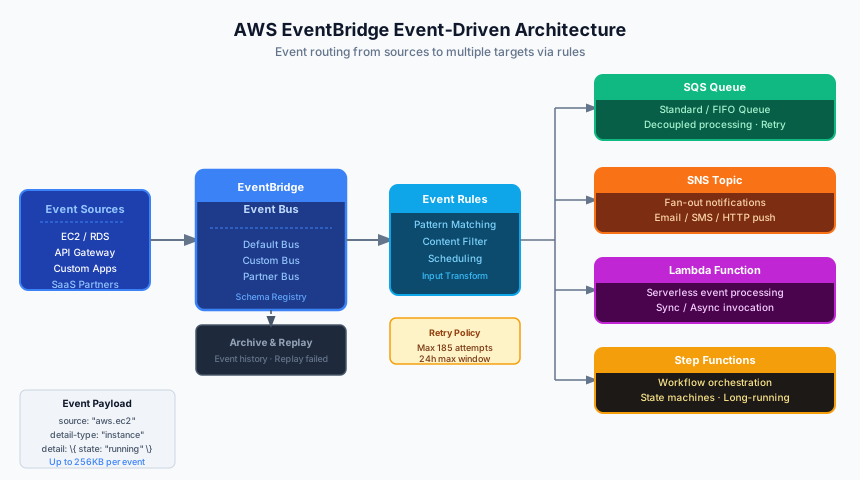
Publishing events is easy; operating event-driven microservices with strict reliability and predictable costs is hard. This deep guide focuses on production architecture, failure semantics, ownership boundaries, and operational guardrails for EventBridge, SNS, and SQS.
TL;DR
Use EventBridge for routing and policy boundaries, SNS for fan-out, and SQS for consumer isolation and backpressure. Combine idempotent handlers, DLQ replay discipline, schema governance, and end-to-end observability to reach production-grade reliability.
Table of Contents
1. Why Most Event-Driven Systems Fail in Production
Most failures are not message-loss bugs. They are ownership failures: ambiguous event contracts, retry storms, and unbounded consumer lag. A resilient architecture starts by defining which service owns the event schema, who can evolve it, and which downstream teams have contractual expectations.
Treat events as public APIs. Versioning, compatibility rules, and deprecation policy should be as strict as REST API versioning. If your event model is undocumented, your incident frequency will increase as teams scale.
Decision Framework: EventBridge vs SNS vs SQS Responsibility
| Concern | Primary Service | Why |
|---|---|---|
| Rule-based routing | EventBridge | Native event patterns, cross-account buses, archive/replay |
| Broadcast fan-out | SNS | Low-latency publish to many subscribers |
| Backpressure and retries | SQS | Durable queueing and consumer-controlled processing |
| Poison message isolation | SQS + DLQ | Operationally safe dead-letter triage |
2. Reference Topology for Multi-Team Microservices
A practical topology is Domain Service -> EventBridge Bus -> SNS Topics -> Consumer-Specific SQS Queues. This chain lets you decouple global routing from service-specific retry and throughput controls.
Event Contract Governance Model
- Require schema version, event id, occurred_at, and trace id in every envelope.
- Allow additive fields without major version bump; treat removal/semantic changes as breaking.
- Publish compatibility scorecards in CI before producer deployment.
- Run replay tests in pre-prod on latest consumer versions.
3. Implementation Blueprint (Spring Boot + AWS SDK v2)
Implement transport handlers and business handlers separately. Transport layer validates envelope and retry semantics; business layer applies domain actions idempotently.
@SqsListener("orders-events-queue")
public void consume(String payload) {
    EventEnvelope envelope = parser.parse(payload);
    schemaValidator.ensureCompatible(envelope);
    if (idempotencyStore.alreadyProcessed(envelope.eventId())) return;

    orderEventHandler.handle(envelope);
    idempotencyStore.markProcessed(envelope.eventId());
}
Idempotency Storage Choices
| Store | Best For | Caveat |
|---|---|---|
| DynamoDB | High-scale event id tracking | Design TTL carefully to avoid premature eviction |
| PostgreSQL | Transactional coupling with business data | Write amplification under high event throughput |
| Redis | Low-latency duplicate suppression | Needs persistence strategy for recovery scenarios |
4. Failure Semantics, Retries, and Replay Operations
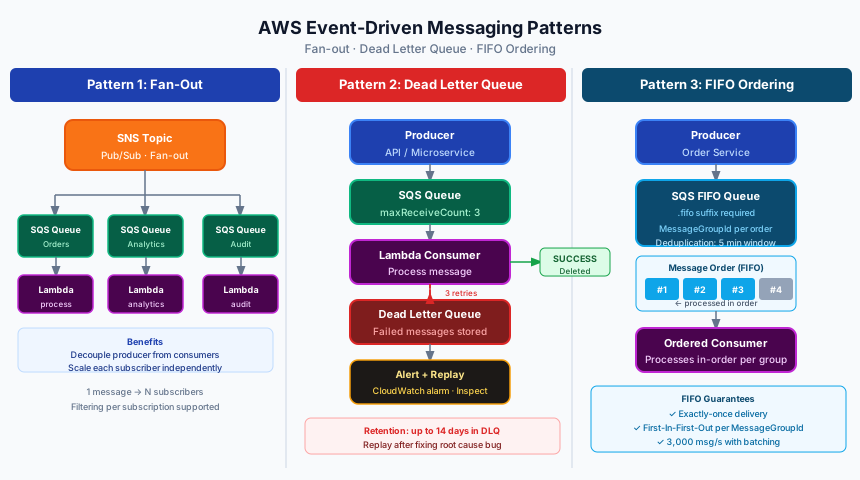
Design around at-least-once delivery as the default. Duplicate deliveries are normal. Your handler quality is measured by whether duplicates are harmless.
DLQ Replay Playbook
- Classify failures into transient, contract, data, and code defects.
- Patch root cause before replay to avoid re-poisoning the queue.
- Replay in controlled batches with maximum in-flight limits.
- Track replay outcome metrics (success %, re-DLQ %, latency).
- Archive postmortem and update runbook defaults.
5. Security, Compliance, and Multi-Account Governance
Use least-privilege IAM by role type: publishers can only PutEvents to approved buses, routers can only invoke specific targets, consumers can only receive from assigned queues. Add KMS CMKs for encryption and CloudTrail for audit trails.
- Use event bus resource policies for controlled cross-account publishes.
- Restrict SNS topic subscriptions by account and protocol.
- Enforce VPC endpoints where network egress controls are required.
- Attach data-classification tags to queues/topics for policy automation.
6. Throughput and Cost Engineering
Cost optimization starts with filtering and payload discipline. Many teams overspend because events are too broad, too chatty, and carry unnecessary data.
| Optimization Lever | Impact | Operational Tradeoff |
|---|---|---|
| EventBridge pattern precision | Reduces unnecessary downstream invocations | Needs strict event taxonomy |
| SQS long polling | Lower empty receive cost | Slightly increased receive latency |
| Payload minimization | Lower transfer/storage and parsing overhead | Requires schema discipline and reference lookup |
7. Operations Model: SLOs, Alerts, and Ownership
Define service-level indicators at queue boundaries: oldest message age, consumer lag growth rate, DLQ inflow, replay success rate, and end-to-end event completion latency.
- Alert on sustained lag growth, not only absolute queue depth.
- Link each alarm to an owner and a runbook URL.
- Run quarterly gamedays that include replay and contract break scenarios.
8. High-Risk Pitfalls to Eliminate Early
- Assuming exactly-once semantics without end-to-end proofs.
- Single shared queue for unrelated domains and SLO classes.
- No schema compatibility tests in CI for event producers.
- DLQ configured but never monitored or replayed.
- No correlation id propagation across producer-consumer boundaries.
9. Production Readiness Checklist
- Documented event ownership and compatibility policy.
- Idempotency strategy tested under duplicate delivery simulations.
- DLQ alarms with runbook-linked replay procedures.
- Security controls: least privilege IAM + encryption + audit logging.
- Cost controls: routing filters, long polling, payload minimization.
10. Conclusion
EventBridge, SNS, and SQS are strongest when each service owns a clear reliability boundary. Build with contract discipline, queue isolation, and replay-ready operations from day one. That foundation keeps microservices evolvable as team count and traffic grow.
11. Production Strategy and Rollout Waves
In mature Event-Driven programs, production strategy and rollout waves must be treated as an operational discipline instead of a one-time setup. Teams should define ownership boundaries, explicit service objectives, and measurable review cadences before scaling traffic or integration count. A practical model starts with a narrow rollout, validates assumptions under synthetic and production-like load, then expands by domain once error handling, alarms, and rollback controls are proven. This sequence reduces blast radius during change and gives engineers predictable evidence for release decisions. Without these guardrails, the platform appears functional in normal conditions but degrades quickly when retries, dependency slowness, or schema drift appear together.
Execution quality depends on documented playbooks for both planned changes and unexpected failures. For production strategy and rollout waves, define clear entry criteria, failure thresholds, escalation paths, and compensating actions that can be executed by on-call engineers without waiting for ad-hoc architecture meetings. Include runbook links in alarms, keep dashboards aligned to user-impact indicators, and rehearse failure drills quarterly so teams can validate not only tooling but also communication flow. When this feedback loop is institutionalized, reliability improves steadily, incident timelines shrink, and platform decisions become easier to justify across engineering, security, and business stakeholders.
12. Consumer Isolation and Queue Topology
In mature Event-Driven programs, consumer isolation and queue topology must be treated as an operational discipline instead of a one-time setup. Teams should define ownership boundaries, explicit service objectives, and measurable review cadences before scaling traffic or integration count. A practical model starts with a narrow rollout, validates assumptions under synthetic and production-like load, then expands by domain once error handling, alarms, and rollback controls are proven. This sequence reduces blast radius during change and gives engineers predictable evidence for release decisions. Without these guardrails, the platform appears functional in normal conditions but degrades quickly when retries, dependency slowness, or schema drift appear together.
Execution quality depends on documented playbooks for both planned changes and unexpected failures. For consumer isolation and queue topology, define clear entry criteria, failure thresholds, escalation paths, and compensating actions that can be executed by on-call engineers without waiting for ad-hoc architecture meetings. Include runbook links in alarms, keep dashboards aligned to user-impact indicators, and rehearse failure drills quarterly so teams can validate not only tooling but also communication flow. When this feedback loop is institutionalized, reliability improves steadily, incident timelines shrink, and platform decisions become easier to justify across engineering, security, and business stakeholders.
13. Contract Governance and Compatibility Discipline
In mature Event-Driven programs, contract governance and compatibility discipline must be treated as an operational discipline instead of a one-time setup. Teams should define ownership boundaries, explicit service objectives, and measurable review cadences before scaling traffic or integration count. A practical model starts with a narrow rollout, validates assumptions under synthetic and production-like load, then expands by domain once error handling, alarms, and rollback controls are proven. This sequence reduces blast radius during change and gives engineers predictable evidence for release decisions. Without these guardrails, the platform appears functional in normal conditions but degrades quickly when retries, dependency slowness, or schema drift appear together.
Execution quality depends on documented playbooks for both planned changes and unexpected failures. For contract governance and compatibility discipline, define clear entry criteria, failure thresholds, escalation paths, and compensating actions that can be executed by on-call engineers without waiting for ad-hoc architecture meetings. Include runbook links in alarms, keep dashboards aligned to user-impact indicators, and rehearse failure drills quarterly so teams can validate not only tooling but also communication flow. When this feedback loop is institutionalized, reliability improves steadily, incident timelines shrink, and platform decisions become easier to justify across engineering, security, and business stakeholders.
A recurring anti-pattern is optimizing for short-term delivery speed while deferring governance controls that appear non-urgent. In practice, deferred controls become expensive debt: incident frequency rises, troubleshooting effort compounds, and cross-team trust drops because behavior is no longer predictable. A better strategy is progressive hardening where every release adds one measurable quality improvement, such as tighter policy checks, stronger contract validation, better cost visibility, or faster rollback automation. This approach keeps delivery momentum while steadily improving the operational safety margin needed for long-term scale.
- Define accountable owners for design, delivery, and incident response.
- Publish runbooks with step-by-step mitigation and rollback paths.
- Track trend metrics weekly and review anomalies with action items.
- Validate controls through drills, not only documentation.
- Retire outdated rules and stale integrations to reduce hidden risk.
14. Replay Engineering and DLQ Operations
In mature Event-Driven programs, replay engineering and dlq operations must be treated as an operational discipline instead of a one-time setup. Teams should define ownership boundaries, explicit service objectives, and measurable review cadences before scaling traffic or integration count. A practical model starts with a narrow rollout, validates assumptions under synthetic and production-like load, then expands by domain once error handling, alarms, and rollback controls are proven. This sequence reduces blast radius during change and gives engineers predictable evidence for release decisions. Without these guardrails, the platform appears functional in normal conditions but degrades quickly when retries, dependency slowness, or schema drift appear together.
Execution quality depends on documented playbooks for both planned changes and unexpected failures. For replay engineering and dlq operations, define clear entry criteria, failure thresholds, escalation paths, and compensating actions that can be executed by on-call engineers without waiting for ad-hoc architecture meetings. Include runbook links in alarms, keep dashboards aligned to user-impact indicators, and rehearse failure drills quarterly so teams can validate not only tooling but also communication flow. When this feedback loop is institutionalized, reliability improves steadily, incident timelines shrink, and platform decisions become easier to justify across engineering, security, and business stakeholders.
15. Failure Scenario Analysis and Mitigation
In mature Event-Driven programs, failure scenario analysis and mitigation must be treated as an operational discipline instead of a one-time setup. Teams should define ownership boundaries, explicit service objectives, and measurable review cadences before scaling traffic or integration count. A practical model starts with a narrow rollout, validates assumptions under synthetic and production-like load, then expands by domain once error handling, alarms, and rollback controls are proven. This sequence reduces blast radius during change and gives engineers predictable evidence for release decisions. Without these guardrails, the platform appears functional in normal conditions but degrades quickly when retries, dependency slowness, or schema drift appear together.
Execution quality depends on documented playbooks for both planned changes and unexpected failures. For failure scenario analysis and mitigation, define clear entry criteria, failure thresholds, escalation paths, and compensating actions that can be executed by on-call engineers without waiting for ad-hoc architecture meetings. Include runbook links in alarms, keep dashboards aligned to user-impact indicators, and rehearse failure drills quarterly so teams can validate not only tooling but also communication flow. When this feedback loop is institutionalized, reliability improves steadily, incident timelines shrink, and platform decisions become easier to justify across engineering, security, and business stakeholders.
16. Multi-Team Ownership and On-Call Model
In mature Event-Driven programs, multi-team ownership and on-call model must be treated as an operational discipline instead of a one-time setup. Teams should define ownership boundaries, explicit service objectives, and measurable review cadences before scaling traffic or integration count. A practical model starts with a narrow rollout, validates assumptions under synthetic and production-like load, then expands by domain once error handling, alarms, and rollback controls are proven. This sequence reduces blast radius during change and gives engineers predictable evidence for release decisions. Without these guardrails, the platform appears functional in normal conditions but degrades quickly when retries, dependency slowness, or schema drift appear together.
Execution quality depends on documented playbooks for both planned changes and unexpected failures. For multi-team ownership and on-call model, define clear entry criteria, failure thresholds, escalation paths, and compensating actions that can be executed by on-call engineers without waiting for ad-hoc architecture meetings. Include runbook links in alarms, keep dashboards aligned to user-impact indicators, and rehearse failure drills quarterly so teams can validate not only tooling but also communication flow. When this feedback loop is institutionalized, reliability improves steadily, incident timelines shrink, and platform decisions become easier to justify across engineering, security, and business stakeholders.
A recurring anti-pattern is optimizing for short-term delivery speed while deferring governance controls that appear non-urgent. In practice, deferred controls become expensive debt: incident frequency rises, troubleshooting effort compounds, and cross-team trust drops because behavior is no longer predictable. A better strategy is progressive hardening where every release adds one measurable quality improvement, such as tighter policy checks, stronger contract validation, better cost visibility, or faster rollback automation. This approach keeps delivery momentum while steadily improving the operational safety margin needed for long-term scale.
- Define accountable owners for design, delivery, and incident response.
- Publish runbooks with step-by-step mitigation and rollback paths.
- Track trend metrics weekly and review anomalies with action items.
- Validate controls through drills, not only documentation.
- Retire outdated rules and stale integrations to reduce hidden risk.
17. Cost Guardrails and Throughput Planning
In mature Event-Driven programs, cost guardrails and throughput planning must be treated as an operational discipline instead of a one-time setup. Teams should define ownership boundaries, explicit service objectives, and measurable review cadences before scaling traffic or integration count. A practical model starts with a narrow rollout, validates assumptions under synthetic and production-like load, then expands by domain once error handling, alarms, and rollback controls are proven. This sequence reduces blast radius during change and gives engineers predictable evidence for release decisions. Without these guardrails, the platform appears functional in normal conditions but degrades quickly when retries, dependency slowness, or schema drift appear together.
Execution quality depends on documented playbooks for both planned changes and unexpected failures. For cost guardrails and throughput planning, define clear entry criteria, failure thresholds, escalation paths, and compensating actions that can be executed by on-call engineers without waiting for ad-hoc architecture meetings. Include runbook links in alarms, keep dashboards aligned to user-impact indicators, and rehearse failure drills quarterly so teams can validate not only tooling but also communication flow. When this feedback loop is institutionalized, reliability improves steadily, incident timelines shrink, and platform decisions become easier to justify across engineering, security, and business stakeholders.
18. Security and Compliance Boundaries
In mature Event-Driven programs, security and compliance boundaries must be treated as an operational discipline instead of a one-time setup. Teams should define ownership boundaries, explicit service objectives, and measurable review cadences before scaling traffic or integration count. A practical model starts with a narrow rollout, validates assumptions under synthetic and production-like load, then expands by domain once error handling, alarms, and rollback controls are proven. This sequence reduces blast radius during change and gives engineers predictable evidence for release decisions. Without these guardrails, the platform appears functional in normal conditions but degrades quickly when retries, dependency slowness, or schema drift appear together.
Execution quality depends on documented playbooks for both planned changes and unexpected failures. For security and compliance boundaries, define clear entry criteria, failure thresholds, escalation paths, and compensating actions that can be executed by on-call engineers without waiting for ad-hoc architecture meetings. Include runbook links in alarms, keep dashboards aligned to user-impact indicators, and rehearse failure drills quarterly so teams can validate not only tooling but also communication flow. When this feedback loop is institutionalized, reliability improves steadily, incident timelines shrink, and platform decisions become easier to justify across engineering, security, and business stakeholders.
19. Anti-Patterns and Their Consequences
In mature Event-Driven programs, anti-patterns and their consequences must be treated as an operational discipline instead of a one-time setup. Teams should define ownership boundaries, explicit service objectives, and measurable review cadences before scaling traffic or integration count. A practical model starts with a narrow rollout, validates assumptions under synthetic and production-like load, then expands by domain once error handling, alarms, and rollback controls are proven. This sequence reduces blast radius during change and gives engineers predictable evidence for release decisions. Without these guardrails, the platform appears functional in normal conditions but degrades quickly when retries, dependency slowness, or schema drift appear together.
Execution quality depends on documented playbooks for both planned changes and unexpected failures. For anti-patterns and their consequences, define clear entry criteria, failure thresholds, escalation paths, and compensating actions that can be executed by on-call engineers without waiting for ad-hoc architecture meetings. Include runbook links in alarms, keep dashboards aligned to user-impact indicators, and rehearse failure drills quarterly so teams can validate not only tooling but also communication flow. When this feedback loop is institutionalized, reliability improves steadily, incident timelines shrink, and platform decisions become easier to justify across engineering, security, and business stakeholders.
A recurring anti-pattern is optimizing for short-term delivery speed while deferring governance controls that appear non-urgent. In practice, deferred controls become expensive debt: incident frequency rises, troubleshooting effort compounds, and cross-team trust drops because behavior is no longer predictable. A better strategy is progressive hardening where every release adds one measurable quality improvement, such as tighter policy checks, stronger contract validation, better cost visibility, or faster rollback automation. This approach keeps delivery momentum while steadily improving the operational safety margin needed for long-term scale.
- Define accountable owners for design, delivery, and incident response.
- Publish runbooks with step-by-step mitigation and rollback paths.
- Track trend metrics weekly and review anomalies with action items.
- Validate controls through drills, not only documentation.
- Retire outdated rules and stale integrations to reduce hidden risk.
20. Implementation Playbook and Readiness Criteria
In mature Event-Driven programs, implementation playbook and readiness criteria must be treated as an operational discipline instead of a one-time setup. Teams should define ownership boundaries, explicit service objectives, and measurable review cadences before scaling traffic or integration count. A practical model starts with a narrow rollout, validates assumptions under synthetic and production-like load, then expands by domain once error handling, alarms, and rollback controls are proven. This sequence reduces blast radius during change and gives engineers predictable evidence for release decisions. Without these guardrails, the platform appears functional in normal conditions but degrades quickly when retries, dependency slowness, or schema drift appear together.
Execution quality depends on documented playbooks for both planned changes and unexpected failures. For implementation playbook and readiness criteria, define clear entry criteria, failure thresholds, escalation paths, and compensating actions that can be executed by on-call engineers without waiting for ad-hoc architecture meetings. Include runbook links in alarms, keep dashboards aligned to user-impact indicators, and rehearse failure drills quarterly so teams can validate not only tooling but also communication flow. When this feedback loop is institutionalized, reliability improves steadily, incident timelines shrink, and platform decisions become easier to justify across engineering, security, and business stakeholders.
Leave a Comment
Related Posts

Software Engineer · Java · Spring Boot · Microservices