AWS IAM Security: Least Privilege, ABAC, SCPs & Cross-Account Access Patterns
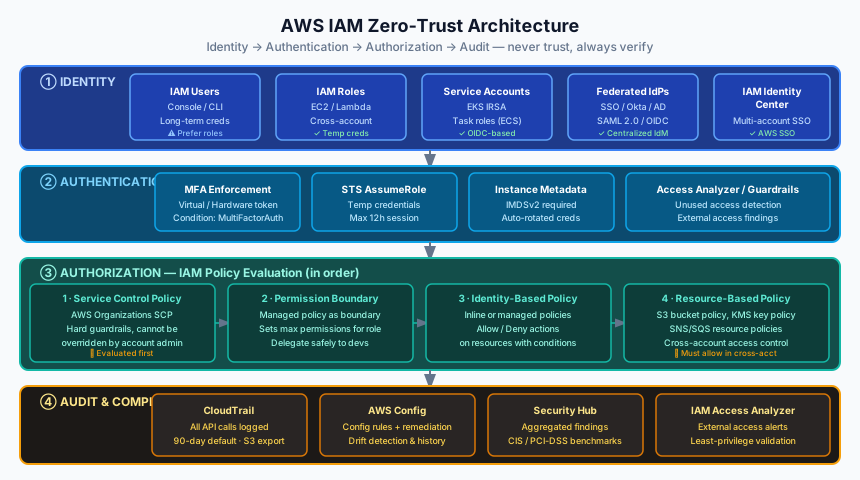
IAM is an architectural control system, not a policy-writing exercise. As organizations scale, access models fail without strict identity boundaries, attribute governance, and preventive guardrails at the organization layer.
TL;DR
Implement identity-class separation, short-lived credentials, ABAC with enforced tagging standards, and SCP deny guardrails. Combine Access Analyzer, policy simulation, and periodic recertification to prevent privilege drift.
Table of Contents
1. Zero-Trust Foundation for AWS IAM
Least privilege degrades naturally over time unless controls are built as feedback loops. Every new service, integration, and emergency change can quietly expand access. The right model assumes compromise and minimizes trust scope by default.
Separate identity classes: human users, workload roles, automation roles, and external principals. Each class needs different authentication controls, policy patterns, and monitoring depth.
Identity Class Design Matrix
| Identity Class | Primary Control | Failure if Missing |
|---|---|---|
| Human admin/federated users | MFA + SSO + session limits | Persistent high-risk privileges |
| Application workload roles | Scoped IAM role + condition keys | Data exfiltration blast radius |
| CI/CD deployer roles | Permissions boundary + approval | Pipeline-driven privilege escalation |
| Third-party principals | External ID + constrained trust | Confused deputy attacks |
2. Organization Guardrails with SCPs
SCPs define the maximum permission envelope. They are the strongest control for preventing dangerous operations across accounts regardless of local IAM policy misconfigurations.
SCP Baseline Controls
- Deny disabling CloudTrail, GuardDuty, and config baselines.
- Deny creation of IAM users/keys in workload accounts where SSO is mandatory.
- Deny risky network or storage public exposure actions unless exception-tagged.
- Deny root account access key operations and unapproved region usage.
3. ABAC at Scale: Policy + Tag Governance
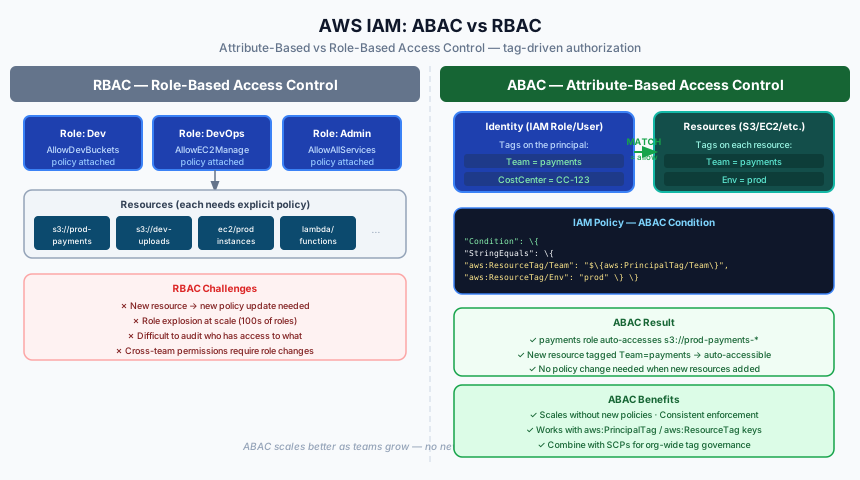
ABAC is powerful when role explosion becomes unmanageable. But ABAC fails without hard tag controls. If principals or resources can set arbitrary tags, authorization becomes bypassable.
ABAC Control Requirements
- Central tag taxonomy with approved keys and value patterns.
- Tag immutability rules for security-critical attributes.
- Automated policy simulation for tag permutations before rollout.
- Exception workflow with expiry and audit requirements.
4. Cross-Account Access Patterns
Cross-account role assumption should always constrain principals and context. Use explicit principals, external IDs for third-party access, and session policies for temporary scope reductions.
{
  "Effect": "Allow",
  "Action": "sts:AssumeRole",
  "Principal": {"AWS": "arn:aws:iam::123456789012:role/deployer"},
  "Condition": {"StringEquals": {"sts:ExternalId": "vendor-2026"}}
}
Trust Policy Audit Checklist
- No wildcard principals in production trust policies.
- Conditions on source account, source arn, or external id where applicable.
- Session duration minimized for operational needs.
- CloudTrail alerts on unusual assume-role volume.
5. Detection and Continuous Right-Sizing
Least privilege is a continuous process. Use IAM Access Analyzer, service last-accessed data, and CloudTrail analytics to prune unused actions and detect broad trust relationships.
| Control Loop | Cadence | Outcome |
|---|---|---|
| Unused permission review | Monthly | Reduced policy surface area |
| Trust relationship scan | Weekly | Early exposure detection |
| Access recertification | Quarterly | Business-validated privilege model |
6. High-Impact Pitfalls
- Attaching broad managed policies as permanent shortcuts.
- ABAC rollout without enforced tag provenance.
- SCP exceptions with no expiry or accountable owner.
- Long-lived access keys in automation contexts.
- No incident drills for compromised role credentials.
7. Security Program Checklist
- Identity class boundaries documented and enforced.
- SCP baseline denies applied across all workload OUs.
- ABAC taxonomy governance and immutable critical tags.
- Cross-account trust audits with explicit conditions.
- Recurring least-privilege recertification and policy pruning.
8. Conclusion
Secure IAM at scale requires preventive guardrails, not heroic manual reviews. Teams that combine SCP boundaries, ABAC discipline, and continuous rightsizing can grow fast without losing control of blast radius.
11. Identity Architecture and Lifecycle Governance
In mature IAM programs, identity architecture and lifecycle governance must be treated as an operational discipline instead of a one-time setup. Teams should define ownership boundaries, explicit service objectives, and measurable review cadences before scaling traffic or integration count. A practical model starts with a narrow rollout, validates assumptions under synthetic and production-like load, then expands by domain once error handling, alarms, and rollback controls are proven. This sequence reduces blast radius during change and gives engineers predictable evidence for release decisions. Without these guardrails, the platform appears functional in normal conditions but degrades quickly when retries, dependency slowness, or schema drift appear together.
Execution quality depends on documented playbooks for both planned changes and unexpected failures. For identity architecture and lifecycle governance, define clear entry criteria, failure thresholds, escalation paths, and compensating actions that can be executed by on-call engineers without waiting for ad-hoc architecture meetings. Include runbook links in alarms, keep dashboards aligned to user-impact indicators, and rehearse failure drills quarterly so teams can validate not only tooling but also communication flow. When this feedback loop is institutionalized, reliability improves steadily, incident timelines shrink, and platform decisions become easier to justify across engineering, security, and business stakeholders.
12. Least Privilege Engineering Program
In mature IAM programs, least privilege engineering program must be treated as an operational discipline instead of a one-time setup. Teams should define ownership boundaries, explicit service objectives, and measurable review cadences before scaling traffic or integration count. A practical model starts with a narrow rollout, validates assumptions under synthetic and production-like load, then expands by domain once error handling, alarms, and rollback controls are proven. This sequence reduces blast radius during change and gives engineers predictable evidence for release decisions. Without these guardrails, the platform appears functional in normal conditions but degrades quickly when retries, dependency slowness, or schema drift appear together.
Execution quality depends on documented playbooks for both planned changes and unexpected failures. For least privilege engineering program, define clear entry criteria, failure thresholds, escalation paths, and compensating actions that can be executed by on-call engineers without waiting for ad-hoc architecture meetings. Include runbook links in alarms, keep dashboards aligned to user-impact indicators, and rehearse failure drills quarterly so teams can validate not only tooling but also communication flow. When this feedback loop is institutionalized, reliability improves steadily, incident timelines shrink, and platform decisions become easier to justify across engineering, security, and business stakeholders.
13. SCP Layering and Exception Management
In mature IAM programs, scp layering and exception management must be treated as an operational discipline instead of a one-time setup. Teams should define ownership boundaries, explicit service objectives, and measurable review cadences before scaling traffic or integration count. A practical model starts with a narrow rollout, validates assumptions under synthetic and production-like load, then expands by domain once error handling, alarms, and rollback controls are proven. This sequence reduces blast radius during change and gives engineers predictable evidence for release decisions. Without these guardrails, the platform appears functional in normal conditions but degrades quickly when retries, dependency slowness, or schema drift appear together.
Execution quality depends on documented playbooks for both planned changes and unexpected failures. For scp layering and exception management, define clear entry criteria, failure thresholds, escalation paths, and compensating actions that can be executed by on-call engineers without waiting for ad-hoc architecture meetings. Include runbook links in alarms, keep dashboards aligned to user-impact indicators, and rehearse failure drills quarterly so teams can validate not only tooling but also communication flow. When this feedback loop is institutionalized, reliability improves steadily, incident timelines shrink, and platform decisions become easier to justify across engineering, security, and business stakeholders.
A recurring anti-pattern is optimizing for short-term delivery speed while deferring governance controls that appear non-urgent. In practice, deferred controls become expensive debt: incident frequency rises, troubleshooting effort compounds, and cross-team trust drops because behavior is no longer predictable. A better strategy is progressive hardening where every release adds one measurable quality improvement, such as tighter policy checks, stronger contract validation, better cost visibility, or faster rollback automation. This approach keeps delivery momentum while steadily improving the operational safety margin needed for long-term scale.
- Define accountable owners for design, delivery, and incident response.
- Publish runbooks with step-by-step mitigation and rollback paths.
- Track trend metrics weekly and review anomalies with action items.
- Validate controls through drills, not only documentation.
- Retire outdated rules and stale integrations to reduce hidden risk.
14. ABAC Tag Integrity and Policy Simulation
In mature IAM programs, abac tag integrity and policy simulation must be treated as an operational discipline instead of a one-time setup. Teams should define ownership boundaries, explicit service objectives, and measurable review cadences before scaling traffic or integration count. A practical model starts with a narrow rollout, validates assumptions under synthetic and production-like load, then expands by domain once error handling, alarms, and rollback controls are proven. This sequence reduces blast radius during change and gives engineers predictable evidence for release decisions. Without these guardrails, the platform appears functional in normal conditions but degrades quickly when retries, dependency slowness, or schema drift appear together.
Execution quality depends on documented playbooks for both planned changes and unexpected failures. For abac tag integrity and policy simulation, define clear entry criteria, failure thresholds, escalation paths, and compensating actions that can be executed by on-call engineers without waiting for ad-hoc architecture meetings. Include runbook links in alarms, keep dashboards aligned to user-impact indicators, and rehearse failure drills quarterly so teams can validate not only tooling but also communication flow. When this feedback loop is institutionalized, reliability improves steadily, incident timelines shrink, and platform decisions become easier to justify across engineering, security, and business stakeholders.
15. Cross-Account Trust Hardening
In mature IAM programs, cross-account trust hardening must be treated as an operational discipline instead of a one-time setup. Teams should define ownership boundaries, explicit service objectives, and measurable review cadences before scaling traffic or integration count. A practical model starts with a narrow rollout, validates assumptions under synthetic and production-like load, then expands by domain once error handling, alarms, and rollback controls are proven. This sequence reduces blast radius during change and gives engineers predictable evidence for release decisions. Without these guardrails, the platform appears functional in normal conditions but degrades quickly when retries, dependency slowness, or schema drift appear together.
Execution quality depends on documented playbooks for both planned changes and unexpected failures. For cross-account trust hardening, define clear entry criteria, failure thresholds, escalation paths, and compensating actions that can be executed by on-call engineers without waiting for ad-hoc architecture meetings. Include runbook links in alarms, keep dashboards aligned to user-impact indicators, and rehearse failure drills quarterly so teams can validate not only tooling but also communication flow. When this feedback loop is institutionalized, reliability improves steadily, incident timelines shrink, and platform decisions become easier to justify across engineering, security, and business stakeholders.
16. Detection, Response, and Continuous Right-Sizing
In mature IAM programs, detection, response, and continuous right-sizing must be treated as an operational discipline instead of a one-time setup. Teams should define ownership boundaries, explicit service objectives, and measurable review cadences before scaling traffic or integration count. A practical model starts with a narrow rollout, validates assumptions under synthetic and production-like load, then expands by domain once error handling, alarms, and rollback controls are proven. This sequence reduces blast radius during change and gives engineers predictable evidence for release decisions. Without these guardrails, the platform appears functional in normal conditions but degrades quickly when retries, dependency slowness, or schema drift appear together.
Execution quality depends on documented playbooks for both planned changes and unexpected failures. For detection, response, and continuous right-sizing, define clear entry criteria, failure thresholds, escalation paths, and compensating actions that can be executed by on-call engineers without waiting for ad-hoc architecture meetings. Include runbook links in alarms, keep dashboards aligned to user-impact indicators, and rehearse failure drills quarterly so teams can validate not only tooling but also communication flow. When this feedback loop is institutionalized, reliability improves steadily, incident timelines shrink, and platform decisions become easier to justify across engineering, security, and business stakeholders.
A recurring anti-pattern is optimizing for short-term delivery speed while deferring governance controls that appear non-urgent. In practice, deferred controls become expensive debt: incident frequency rises, troubleshooting effort compounds, and cross-team trust drops because behavior is no longer predictable. A better strategy is progressive hardening where every release adds one measurable quality improvement, such as tighter policy checks, stronger contract validation, better cost visibility, or faster rollback automation. This approach keeps delivery momentum while steadily improving the operational safety margin needed for long-term scale.
- Define accountable owners for design, delivery, and incident response.
- Publish runbooks with step-by-step mitigation and rollback paths.
- Track trend metrics weekly and review anomalies with action items.
- Validate controls through drills, not only documentation.
- Retire outdated rules and stale integrations to reduce hidden risk.
17. Incident Drills and Containment Procedures
In mature IAM programs, incident drills and containment procedures must be treated as an operational discipline instead of a one-time setup. Teams should define ownership boundaries, explicit service objectives, and measurable review cadences before scaling traffic or integration count. A practical model starts with a narrow rollout, validates assumptions under synthetic and production-like load, then expands by domain once error handling, alarms, and rollback controls are proven. This sequence reduces blast radius during change and gives engineers predictable evidence for release decisions. Without these guardrails, the platform appears functional in normal conditions but degrades quickly when retries, dependency slowness, or schema drift appear together.
Execution quality depends on documented playbooks for both planned changes and unexpected failures. For incident drills and containment procedures, define clear entry criteria, failure thresholds, escalation paths, and compensating actions that can be executed by on-call engineers without waiting for ad-hoc architecture meetings. Include runbook links in alarms, keep dashboards aligned to user-impact indicators, and rehearse failure drills quarterly so teams can validate not only tooling but also communication flow. When this feedback loop is institutionalized, reliability improves steadily, incident timelines shrink, and platform decisions become easier to justify across engineering, security, and business stakeholders.
18. Organizational RACI and Security Operations
In mature IAM programs, organizational raci and security operations must be treated as an operational discipline instead of a one-time setup. Teams should define ownership boundaries, explicit service objectives, and measurable review cadences before scaling traffic or integration count. A practical model starts with a narrow rollout, validates assumptions under synthetic and production-like load, then expands by domain once error handling, alarms, and rollback controls are proven. This sequence reduces blast radius during change and gives engineers predictable evidence for release decisions. Without these guardrails, the platform appears functional in normal conditions but degrades quickly when retries, dependency slowness, or schema drift appear together.
Execution quality depends on documented playbooks for both planned changes and unexpected failures. For organizational raci and security operations, define clear entry criteria, failure thresholds, escalation paths, and compensating actions that can be executed by on-call engineers without waiting for ad-hoc architecture meetings. Include runbook links in alarms, keep dashboards aligned to user-impact indicators, and rehearse failure drills quarterly so teams can validate not only tooling but also communication flow. When this feedback loop is institutionalized, reliability improves steadily, incident timelines shrink, and platform decisions become easier to justify across engineering, security, and business stakeholders.
19. High-Risk Anti-Patterns and Remediation
In mature IAM programs, high-risk anti-patterns and remediation must be treated as an operational discipline instead of a one-time setup. Teams should define ownership boundaries, explicit service objectives, and measurable review cadences before scaling traffic or integration count. A practical model starts with a narrow rollout, validates assumptions under synthetic and production-like load, then expands by domain once error handling, alarms, and rollback controls are proven. This sequence reduces blast radius during change and gives engineers predictable evidence for release decisions. Without these guardrails, the platform appears functional in normal conditions but degrades quickly when retries, dependency slowness, or schema drift appear together.
Execution quality depends on documented playbooks for both planned changes and unexpected failures. For high-risk anti-patterns and remediation, define clear entry criteria, failure thresholds, escalation paths, and compensating actions that can be executed by on-call engineers without waiting for ad-hoc architecture meetings. Include runbook links in alarms, keep dashboards aligned to user-impact indicators, and rehearse failure drills quarterly so teams can validate not only tooling but also communication flow. When this feedback loop is institutionalized, reliability improves steadily, incident timelines shrink, and platform decisions become easier to justify across engineering, security, and business stakeholders.
A recurring anti-pattern is optimizing for short-term delivery speed while deferring governance controls that appear non-urgent. In practice, deferred controls become expensive debt: incident frequency rises, troubleshooting effort compounds, and cross-team trust drops because behavior is no longer predictable. A better strategy is progressive hardening where every release adds one measurable quality improvement, such as tighter policy checks, stronger contract validation, better cost visibility, or faster rollback automation. This approach keeps delivery momentum while steadily improving the operational safety margin needed for long-term scale.
- Define accountable owners for design, delivery, and incident response.
- Publish runbooks with step-by-step mitigation and rollback paths.
- Track trend metrics weekly and review anomalies with action items.
- Validate controls through drills, not only documentation.
- Retire outdated rules and stale integrations to reduce hidden risk.
20. Executive Metrics and Program Outcomes
In mature IAM programs, executive metrics and program outcomes must be treated as an operational discipline instead of a one-time setup. Teams should define ownership boundaries, explicit service objectives, and measurable review cadences before scaling traffic or integration count. A practical model starts with a narrow rollout, validates assumptions under synthetic and production-like load, then expands by domain once error handling, alarms, and rollback controls are proven. This sequence reduces blast radius during change and gives engineers predictable evidence for release decisions. Without these guardrails, the platform appears functional in normal conditions but degrades quickly when retries, dependency slowness, or schema drift appear together.
Execution quality depends on documented playbooks for both planned changes and unexpected failures. For executive metrics and program outcomes, define clear entry criteria, failure thresholds, escalation paths, and compensating actions that can be executed by on-call engineers without waiting for ad-hoc architecture meetings. Include runbook links in alarms, keep dashboards aligned to user-impact indicators, and rehearse failure drills quarterly so teams can validate not only tooling but also communication flow. When this feedback loop is institutionalized, reliability improves steadily, incident timelines shrink, and platform decisions become easier to justify across engineering, security, and business stakeholders.
To keep IAM programs durable, embed security controls into everyday engineering workflows rather than isolated annual initiatives. Require policy changes to include threat assumptions, expected usage evidence, and rollback plan in pull requests. Automate checks for wildcard growth, trust expansion, and missing condition keys so risky changes are visible before merge. Pair automation with periodic human review focused on business context that tools cannot infer, such as whether a role still matches current organizational responsibilities. This blended approach creates a resilient control system: automation catches broad regressions quickly, while targeted human judgment preserves intent and prevents policy sprawl. Over time, the organization gains both stronger preventive controls and faster response capability when suspicious access patterns appear.
Another practical improvement is creating pre-approved emergency access patterns with strict time bounds, automated logging, and mandatory post-use review. During incidents, teams often over-grant permissions because secure escalation paths are not prepared. Predefined break-glass workflows reduce this pressure and keep privileges narrowly scoped even under urgency. After each emergency use, run retrospective analysis to remove unnecessary actions from templates and refine approval criteria. This discipline preserves both operational responsiveness and security posture.
Leave a Comment
Related Posts

Software Engineer · Java · Spring Boot · Microservices