AWS S3 Advanced Patterns: Presigned URLs, Lifecycle Policies & Multipart Upload with Spring Boot
S3 is easy in demos and difficult in production. Real systems must handle secure direct uploads, resumable transfers, lifecycle governance, retention constraints, and cost-aware storage class strategy.
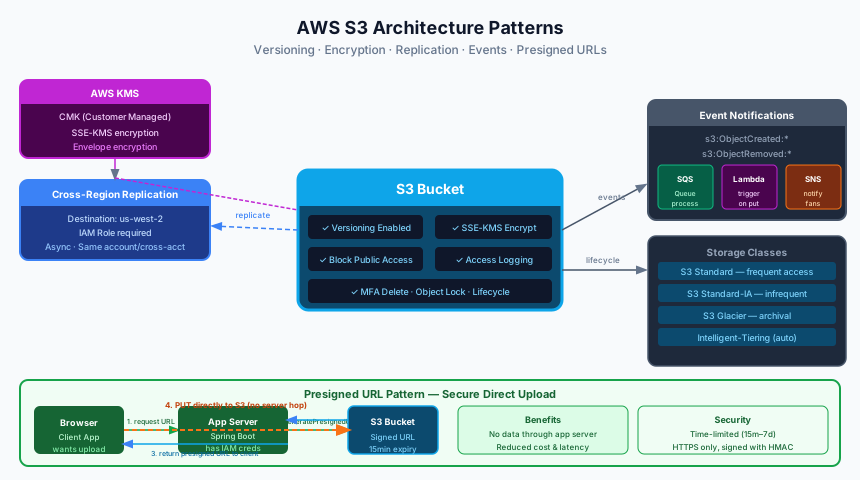
TL;DR
Issue constrained presigned URLs from Spring Boot, use multipart upload for large files, enforce encryption and prefix policies, and treat lifecycle configuration as a product capability with explicit data-class ownership.
Table of Contents
1. Production Challenges Beyond Basic Upload APIs
File workflows fail when architecture treats storage as an afterthought. Typical issues include replayable upload URLs, orphaned multipart sessions, uncontrolled lifecycle transitions, and runaway retrieval costs from cold tiers.
A reliable design separates concerns: authorization and URL issuance in the app tier, object transfer directly between clients and S3, governance through bucket policy + lifecycle + audit controls.
Decision Framework: Single PUT vs Multipart Upload
| Workload Profile | Preferred Pattern | Reason |
|---|---|---|
| Small files, stable network | Single PUT | Low orchestration overhead |
| Large files or mobile clients | Multipart | Resume support and fault isolation by part |
| High-value uploads with strict integrity | Multipart + checksum policy | Granular validation and recoverability |
2. Reference Architecture for Secure Direct Uploads
Spring Boot should authenticate users, validate upload intent, and return constrained presigned URLs. Client uploads directly to S3, then confirms completion with the app. This removes large binary transfer from application instances.
Presigned URL Hardening Checklist
- Short expiry (typically 5-15 minutes) for write URLs.
- Prefix constraints per tenant or workspace id.
- Explicit content type and optional size-bound policy.
- Server-side encryption headers required by policy.
- One-time semantic token mapping where abuse risk is high.
3. Multipart Upload Blueprint with Spring Boot
Store multipart session state (uploadId, target key, part map, checksum) in a durable table. Let clients retry parts independently and finalize only after all part ETags are validated.
CreateMultipartUploadRequest request = CreateMultipartUploadRequest.builder()
    .bucket(bucket)
    .key(objectKey)
    .serverSideEncryption(ServerSideEncryption.AES256)
    .contentType(contentType)
    .build();
String uploadId = s3Client.createMultipartUpload(request).uploadId();
Failure Recovery Design
- Retry failed parts with exponential backoff on client and server hints.
- Expire stale sessions and run automatic abort for abandoned uploads.
- Require client checksum for high-value files.
- Audit finalize operations and emit domain event after successful completion.
4. Lifecycle and Retention Governance
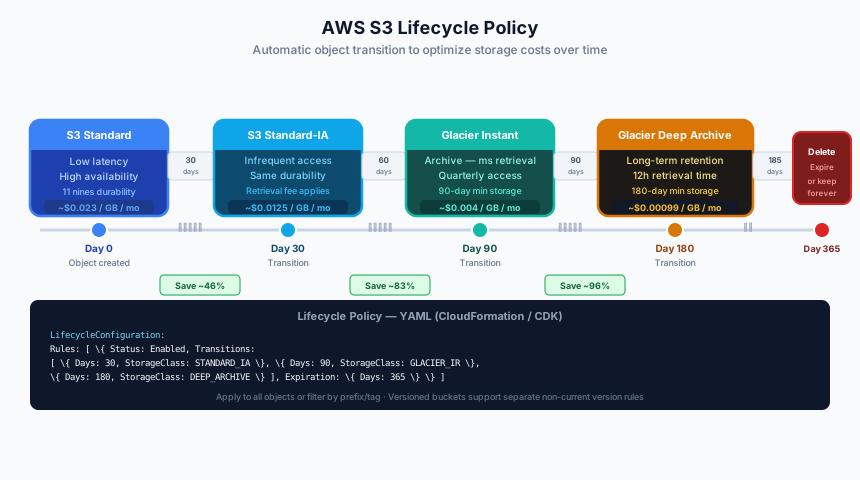
Lifecycle policy should be data-class driven. Do not combine compliance-retained data and disposable media in the same expiration regime. Use prefix + tag filters to apply differentiated transitions.
Storage Class Tradeoff Table
| Class | Use Case | Operational Caveat |
|---|---|---|
| S3 Standard | Hot reads and active objects | Higher storage cost |
| Standard-IA | Infrequent reads | Retrieval + minimum duration charges |
| Glacier tiers | Archive and compliance retention | Restore latency affects business workflows |
5. Security Controls and Data Protection
- Bucket policy deny statements for non-TLS and unencrypted writes.
- Block public access settings enforced at account and bucket level.
- IAM conditions to restrict write keys and request context.
- CloudTrail and access logs for sensitive object operations.
- Optional object lock/retention for regulated workloads.
6. Operating Model: Metrics, Alerts, and Runbooks
Track upload completion rate, median and p95 transfer duration, stale multipart session count, and lifecycle transition anomalies. Alerting should point to runbooks with clear owner accountability.
7. Common Pitfalls
- Long-lived presigned URLs reused by unauthorized clients.
- No metadata model linking objects to business entities.
- Unbounded multipart sessions with hidden storage overhead.
- Lifecycle transitions that conflict with retrieval latency expectations.
- Missing audit coverage for high-sensitivity downloads.
8. Production Checklist
- Presign endpoint with authZ, prefix control, and short TTL.
- Multipart orchestration with resumability and stale abort job.
- Bucket policy with encryption + public access denies.
- Data-class lifecycle mapping and retention ownership.
- Operational dashboards for upload reliability and storage cost.
9. Conclusion
S3 becomes a strategic platform component only when upload security, transfer reliability, and lifecycle governance are engineered together. With these patterns, Spring Boot teams can scale storage workloads safely without hidden cost or compliance surprises.
11. Upload Capability Strategy
In mature S3 programs, upload capability strategy must be treated as an operational discipline instead of a one-time setup. Teams should define ownership boundaries, explicit service objectives, and measurable review cadences before scaling traffic or integration count. A practical model starts with a narrow rollout, validates assumptions under synthetic and production-like load, then expands by domain once error handling, alarms, and rollback controls are proven. This sequence reduces blast radius during change and gives engineers predictable evidence for release decisions. Without these guardrails, the platform appears functional in normal conditions but degrades quickly when retries, dependency slowness, or schema drift appear together.
Execution quality depends on documented playbooks for both planned changes and unexpected failures. For upload capability strategy, define clear entry criteria, failure thresholds, escalation paths, and compensating actions that can be executed by on-call engineers without waiting for ad-hoc architecture meetings. Include runbook links in alarms, keep dashboards aligned to user-impact indicators, and rehearse failure drills quarterly so teams can validate not only tooling but also communication flow. When this feedback loop is institutionalized, reliability improves steadily, incident timelines shrink, and platform decisions become easier to justify across engineering, security, and business stakeholders.
12. Object Key and Metadata Governance
In mature S3 programs, object key and metadata governance must be treated as an operational discipline instead of a one-time setup. Teams should define ownership boundaries, explicit service objectives, and measurable review cadences before scaling traffic or integration count. A practical model starts with a narrow rollout, validates assumptions under synthetic and production-like load, then expands by domain once error handling, alarms, and rollback controls are proven. This sequence reduces blast radius during change and gives engineers predictable evidence for release decisions. Without these guardrails, the platform appears functional in normal conditions but degrades quickly when retries, dependency slowness, or schema drift appear together.
Execution quality depends on documented playbooks for both planned changes and unexpected failures. For object key and metadata governance, define clear entry criteria, failure thresholds, escalation paths, and compensating actions that can be executed by on-call engineers without waiting for ad-hoc architecture meetings. Include runbook links in alarms, keep dashboards aligned to user-impact indicators, and rehearse failure drills quarterly so teams can validate not only tooling but also communication flow. When this feedback loop is institutionalized, reliability improves steadily, incident timelines shrink, and platform decisions become easier to justify across engineering, security, and business stakeholders.
13. Presigned URL Hardening in Production
In mature S3 programs, presigned url hardening in production must be treated as an operational discipline instead of a one-time setup. Teams should define ownership boundaries, explicit service objectives, and measurable review cadences before scaling traffic or integration count. A practical model starts with a narrow rollout, validates assumptions under synthetic and production-like load, then expands by domain once error handling, alarms, and rollback controls are proven. This sequence reduces blast radius during change and gives engineers predictable evidence for release decisions. Without these guardrails, the platform appears functional in normal conditions but degrades quickly when retries, dependency slowness, or schema drift appear together.
Execution quality depends on documented playbooks for both planned changes and unexpected failures. For presigned url hardening in production, define clear entry criteria, failure thresholds, escalation paths, and compensating actions that can be executed by on-call engineers without waiting for ad-hoc architecture meetings. Include runbook links in alarms, keep dashboards aligned to user-impact indicators, and rehearse failure drills quarterly so teams can validate not only tooling but also communication flow. When this feedback loop is institutionalized, reliability improves steadily, incident timelines shrink, and platform decisions become easier to justify across engineering, security, and business stakeholders.
A recurring anti-pattern is optimizing for short-term delivery speed while deferring governance controls that appear non-urgent. In practice, deferred controls become expensive debt: incident frequency rises, troubleshooting effort compounds, and cross-team trust drops because behavior is no longer predictable. A better strategy is progressive hardening where every release adds one measurable quality improvement, such as tighter policy checks, stronger contract validation, better cost visibility, or faster rollback automation. This approach keeps delivery momentum while steadily improving the operational safety margin needed for long-term scale.
- Define accountable owners for design, delivery, and incident response.
- Publish runbooks with step-by-step mitigation and rollback paths.
- Track trend metrics weekly and review anomalies with action items.
- Validate controls through drills, not only documentation.
- Retire outdated rules and stale integrations to reduce hidden risk.
14. Multipart Recovery and Resume Workflows
In mature S3 programs, multipart recovery and resume workflows must be treated as an operational discipline instead of a one-time setup. Teams should define ownership boundaries, explicit service objectives, and measurable review cadences before scaling traffic or integration count. A practical model starts with a narrow rollout, validates assumptions under synthetic and production-like load, then expands by domain once error handling, alarms, and rollback controls are proven. This sequence reduces blast radius during change and gives engineers predictable evidence for release decisions. Without these guardrails, the platform appears functional in normal conditions but degrades quickly when retries, dependency slowness, or schema drift appear together.
Execution quality depends on documented playbooks for both planned changes and unexpected failures. For multipart recovery and resume workflows, define clear entry criteria, failure thresholds, escalation paths, and compensating actions that can be executed by on-call engineers without waiting for ad-hoc architecture meetings. Include runbook links in alarms, keep dashboards aligned to user-impact indicators, and rehearse failure drills quarterly so teams can validate not only tooling but also communication flow. When this feedback loop is institutionalized, reliability improves steadily, incident timelines shrink, and platform decisions become easier to justify across engineering, security, and business stakeholders.
15. Lifecycle and Retention Decision Matrix
In mature S3 programs, lifecycle and retention decision matrix must be treated as an operational discipline instead of a one-time setup. Teams should define ownership boundaries, explicit service objectives, and measurable review cadences before scaling traffic or integration count. A practical model starts with a narrow rollout, validates assumptions under synthetic and production-like load, then expands by domain once error handling, alarms, and rollback controls are proven. This sequence reduces blast radius during change and gives engineers predictable evidence for release decisions. Without these guardrails, the platform appears functional in normal conditions but degrades quickly when retries, dependency slowness, or schema drift appear together.
Execution quality depends on documented playbooks for both planned changes and unexpected failures. For lifecycle and retention decision matrix, define clear entry criteria, failure thresholds, escalation paths, and compensating actions that can be executed by on-call engineers without waiting for ad-hoc architecture meetings. Include runbook links in alarms, keep dashboards aligned to user-impact indicators, and rehearse failure drills quarterly so teams can validate not only tooling but also communication flow. When this feedback loop is institutionalized, reliability improves steadily, incident timelines shrink, and platform decisions become easier to justify across engineering, security, and business stakeholders.
16. Post-Upload Event Pipelines
In mature S3 programs, post-upload event pipelines must be treated as an operational discipline instead of a one-time setup. Teams should define ownership boundaries, explicit service objectives, and measurable review cadences before scaling traffic or integration count. A practical model starts with a narrow rollout, validates assumptions under synthetic and production-like load, then expands by domain once error handling, alarms, and rollback controls are proven. This sequence reduces blast radius during change and gives engineers predictable evidence for release decisions. Without these guardrails, the platform appears functional in normal conditions but degrades quickly when retries, dependency slowness, or schema drift appear together.
Execution quality depends on documented playbooks for both planned changes and unexpected failures. For post-upload event pipelines, define clear entry criteria, failure thresholds, escalation paths, and compensating actions that can be executed by on-call engineers without waiting for ad-hoc architecture meetings. Include runbook links in alarms, keep dashboards aligned to user-impact indicators, and rehearse failure drills quarterly so teams can validate not only tooling but also communication flow. When this feedback loop is institutionalized, reliability improves steadily, incident timelines shrink, and platform decisions become easier to justify across engineering, security, and business stakeholders.
A recurring anti-pattern is optimizing for short-term delivery speed while deferring governance controls that appear non-urgent. In practice, deferred controls become expensive debt: incident frequency rises, troubleshooting effort compounds, and cross-team trust drops because behavior is no longer predictable. A better strategy is progressive hardening where every release adds one measurable quality improvement, such as tighter policy checks, stronger contract validation, better cost visibility, or faster rollback automation. This approach keeps delivery momentum while steadily improving the operational safety margin needed for long-term scale.
- Define accountable owners for design, delivery, and incident response.
- Publish runbooks with step-by-step mitigation and rollback paths.
- Track trend metrics weekly and review anomalies with action items.
- Validate controls through drills, not only documentation.
- Retire outdated rules and stale integrations to reduce hidden risk.
17. Security Operations and Data Protection
In mature S3 programs, security operations and data protection must be treated as an operational discipline instead of a one-time setup. Teams should define ownership boundaries, explicit service objectives, and measurable review cadences before scaling traffic or integration count. A practical model starts with a narrow rollout, validates assumptions under synthetic and production-like load, then expands by domain once error handling, alarms, and rollback controls are proven. This sequence reduces blast radius during change and gives engineers predictable evidence for release decisions. Without these guardrails, the platform appears functional in normal conditions but degrades quickly when retries, dependency slowness, or schema drift appear together.
Execution quality depends on documented playbooks for both planned changes and unexpected failures. For security operations and data protection, define clear entry criteria, failure thresholds, escalation paths, and compensating actions that can be executed by on-call engineers without waiting for ad-hoc architecture meetings. Include runbook links in alarms, keep dashboards aligned to user-impact indicators, and rehearse failure drills quarterly so teams can validate not only tooling but also communication flow. When this feedback loop is institutionalized, reliability improves steadily, incident timelines shrink, and platform decisions become easier to justify across engineering, security, and business stakeholders.
18. Cost Optimization and Storage Class Economics
In mature S3 programs, cost optimization and storage class economics must be treated as an operational discipline instead of a one-time setup. Teams should define ownership boundaries, explicit service objectives, and measurable review cadences before scaling traffic or integration count. A practical model starts with a narrow rollout, validates assumptions under synthetic and production-like load, then expands by domain once error handling, alarms, and rollback controls are proven. This sequence reduces blast radius during change and gives engineers predictable evidence for release decisions. Without these guardrails, the platform appears functional in normal conditions but degrades quickly when retries, dependency slowness, or schema drift appear together.
Execution quality depends on documented playbooks for both planned changes and unexpected failures. For cost optimization and storage class economics, define clear entry criteria, failure thresholds, escalation paths, and compensating actions that can be executed by on-call engineers without waiting for ad-hoc architecture meetings. Include runbook links in alarms, keep dashboards aligned to user-impact indicators, and rehearse failure drills quarterly so teams can validate not only tooling but also communication flow. When this feedback loop is institutionalized, reliability improves steadily, incident timelines shrink, and platform decisions become easier to justify across engineering, security, and business stakeholders.
19. Failure Scenarios and Incident Playbooks
In mature S3 programs, failure scenarios and incident playbooks must be treated as an operational discipline instead of a one-time setup. Teams should define ownership boundaries, explicit service objectives, and measurable review cadences before scaling traffic or integration count. A practical model starts with a narrow rollout, validates assumptions under synthetic and production-like load, then expands by domain once error handling, alarms, and rollback controls are proven. This sequence reduces blast radius during change and gives engineers predictable evidence for release decisions. Without these guardrails, the platform appears functional in normal conditions but degrades quickly when retries, dependency slowness, or schema drift appear together.
Execution quality depends on documented playbooks for both planned changes and unexpected failures. For failure scenarios and incident playbooks, define clear entry criteria, failure thresholds, escalation paths, and compensating actions that can be executed by on-call engineers without waiting for ad-hoc architecture meetings. Include runbook links in alarms, keep dashboards aligned to user-impact indicators, and rehearse failure drills quarterly so teams can validate not only tooling but also communication flow. When this feedback loop is institutionalized, reliability improves steadily, incident timelines shrink, and platform decisions become easier to justify across engineering, security, and business stakeholders.
A recurring anti-pattern is optimizing for short-term delivery speed while deferring governance controls that appear non-urgent. In practice, deferred controls become expensive debt: incident frequency rises, troubleshooting effort compounds, and cross-team trust drops because behavior is no longer predictable. A better strategy is progressive hardening where every release adds one measurable quality improvement, such as tighter policy checks, stronger contract validation, better cost visibility, or faster rollback automation. This approach keeps delivery momentum while steadily improving the operational safety margin needed for long-term scale.
- Define accountable owners for design, delivery, and incident response.
- Publish runbooks with step-by-step mitigation and rollback paths.
- Track trend metrics weekly and review anomalies with action items.
- Validate controls through drills, not only documentation.
- Retire outdated rules and stale integrations to reduce hidden risk.
20. Production Checklist and Control Loop
In mature S3 programs, production checklist and control loop must be treated as an operational discipline instead of a one-time setup. Teams should define ownership boundaries, explicit service objectives, and measurable review cadences before scaling traffic or integration count. A practical model starts with a narrow rollout, validates assumptions under synthetic and production-like load, then expands by domain once error handling, alarms, and rollback controls are proven. This sequence reduces blast radius during change and gives engineers predictable evidence for release decisions. Without these guardrails, the platform appears functional in normal conditions but degrades quickly when retries, dependency slowness, or schema drift appear together.
Execution quality depends on documented playbooks for both planned changes and unexpected failures. For production checklist and control loop, define clear entry criteria, failure thresholds, escalation paths, and compensating actions that can be executed by on-call engineers without waiting for ad-hoc architecture meetings. Include runbook links in alarms, keep dashboards aligned to user-impact indicators, and rehearse failure drills quarterly so teams can validate not only tooling but also communication flow. When this feedback loop is institutionalized, reliability improves steadily, incident timelines shrink, and platform decisions become easier to justify across engineering, security, and business stakeholders.
One pragmatic habit that improves long-term S3 reliability is maintaining a small reliability council for file workflows that reviews incident trends, support tickets, and lifecycle policy outcomes every month. The council should include API engineers, client engineers, security, and operations because file failures often span layers. Use this forum to prune dead prefixes, refine multipart thresholds by device profile, and adjust retention defaults based on real retrieval behavior. Tie every major change to a measurable target such as reduced stale-session backlog or lower retrieval surprise cost. This governance rhythm prevents silent drift and keeps upload architecture aligned with evolving product usage patterns. Teams that run this loop consistently usually discover and fix hidden failure modes before they become high-impact customer incidents.
Leave a Comment
Related Posts

Software Engineer · Java · Spring Boot · Microservices