CAP Theorem in Practice: Consistency vs Availability Trade-offs in Distributed Systems
Every engineer who designs distributed systems will encounter the CAP theorem — and most will misunderstand it. The theorem is precise but often oversimplified to "pick two of three." In practice, partition tolerance is not optional, the real choice is between consistency and availability during network partitions, and the PACELC framework better captures the trade-offs that matter day-to-day.
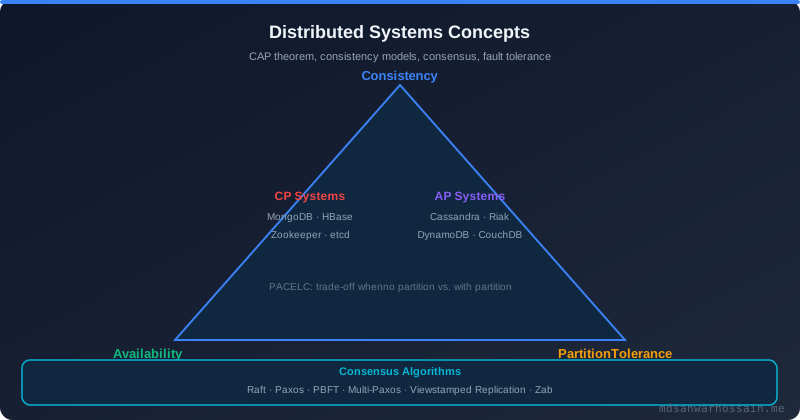
Table of Contents
- Brewer's CAP Theorem Explained
- What "Partition Tolerance" Actually Means
- CP Systems: HBase, ZooKeeper, etcd
- AP Systems: Cassandra, DynamoDB, CouchDB
- The PACELC Extension
- Consistency Models Spectrum
- Vector Clocks, Read Repair, and Anti-Entropy
- Real Examples: Cassandra, DynamoDB, Google Spanner
- Real-World Failures from Wrong CAP Choices
Brewer's CAP Theorem Explained
Eric Brewer presented the CAP conjecture at PODC 2000, and Gilbert and Lynch formally proved it in 2002. The theorem states that a distributed data store can provide at most two of the following three guarantees simultaneously: Consistency (every read receives the most recent write or an error — equivalent to linearizability), Availability (every request receives a non-error response, though it might not contain the most recent write), and Partition Tolerance (the system continues to operate despite an arbitrary number of messages being dropped or delayed by the network between nodes).
The theorem is often misunderstood because "partition tolerance" sounds like an optional feature you can choose to include or exclude. In reality, network partitions happen in every distributed system. Cables fail. Switches lose power. Cloud region connectivity degrades. Any system that runs on more than one machine must handle the scenario where nodes cannot communicate with each other. Partition tolerance is not a design choice — it is a fact of distributed systems. What the theorem actually says is: when a partition occurs, you must choose between consistency and availability.
The real trade-off: when a network partition separates your cluster into two groups that cannot communicate, do you (A) refuse to serve any requests until the partition heals, preserving consistency by not serving potentially stale data (CP), or (B) serve requests from both sides of the partition, accepting that the two sides may diverge and serve different data (AP)?
What "Partition Tolerance" Actually Means
A network partition is not just a complete network outage — it is any scenario where some nodes in a distributed system cannot communicate with some other nodes. This includes: a brief network flap causing 500ms of packet loss, a switch upgrade causing 2 seconds of asymmetric connectivity, a firewall rule change that blocks inter-datacenter traffic, or an AZ failure in AWS. These events happen regularly in production environments at scale. Google's data indicates that at their scale, some form of network partition occurs multiple times per day across their global infrastructure.
Given that partitions are unavoidable, the CAP choice is really about behavior during a partition. A CP system detects the partition and stops accepting writes (or reads from the minority side) to ensure clients always see consistent data. An AP system continues serving all clients but may return stale or conflicting data until the partition heals and nodes reconcile.
The CA category (consistent and available, no partition tolerance) is often presented as a third option, typically associated with single-node relational databases. This is correct for a single node but misleading when discussing distributed systems — a single node has no concept of partition because there is no distributed state to partition. The moment you replicate your PostgreSQL database to a standby, you have a distributed system and must accept CAP trade-offs during replication lag or failover.
CP Systems: HBase, ZooKeeper, etcd
HBase is a CP system — it prioritizes consistency over availability. HBase uses a master-slave architecture where the HMaster manages region assignments and RegionServers host the actual data. During a network partition that separates the HMaster from some RegionServers, HBase detects the isolated RegionServers as dead (via ZooKeeper lease expiry) and marks those regions as unavailable. Client requests targeting those regions receive errors until the partition heals and regions are reassigned to reachable RegionServers. This means HBase may become partially unavailable during network partitions — the CP choice, accepting reduced availability to guarantee that served data is always consistent.
ZooKeeper uses the ZAB (ZooKeeper Atomic Broadcast) consensus protocol and explicitly requires a majority quorum (more than half of nodes) to process writes. If a partition isolates fewer than a quorum of nodes, the minority side refuses to process any read or write requests. A 5-node ZooKeeper cluster can tolerate 2 node failures while maintaining consistency. A partition that splits the 5 nodes into groups of 3 and 2 will have the minority group of 2 refuse all operations. This is the canonical CP behavior: sacrifice availability (minority side goes dark) to preserve consistency (only the majority quorum can make decisions).
etcd (the backing store for Kubernetes) uses the Raft consensus algorithm and makes the same CP trade-off. etcd's consistency guarantee is critical for Kubernetes — you cannot have two Kubernetes API servers with conflicting views of which nodes are available or which pods are scheduled. The CP choice is correct here: incorrect Kubernetes state can cause duplicate pod scheduling or failed deployments, while temporary unavailability of etcd causes a brief period where no new state changes are accepted — far less damaging.
AP Systems: Cassandra, DynamoDB, CouchDB
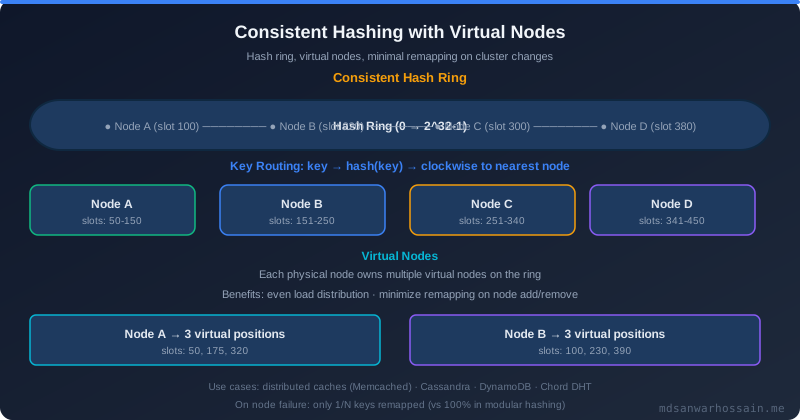
Cassandra is an AP system designed for high availability above all else. Cassandra uses a gossip protocol and consistent hashing for peer-to-peer architecture with no single master. Every node is equal and can accept reads and writes. During a network partition, both sides of the partition continue operating, accepting writes independently. When the partition heals, Cassandra reconciles diverged data using a "last write wins" strategy (based on timestamps) or application-defined merge logic. This means Cassandra clients may observe stale reads immediately after a write, but the system remains fully available during partitions.
Cassandra's consistency is tunable via the CONSISTENCY parameter. CONSISTENCY ONE (default) allows reading from any one replica — highly available but may return stale data. CONSISTENCY QUORUM requires responses from a majority of replicas — stronger consistency at the cost of availability. CONSISTENCY ALL requires all replicas to respond — full consistency but any replica failure causes read failures. The formula for strong consistency is: read quorum + write quorum > replication factor. With RF=3, QUORUM reads (2) + QUORUM writes (2) = 4 > 3, guaranteeing you will always read the most recently written value.
DynamoDB defaults to eventual consistency but offers strongly consistent reads as an option (at 2× the cost). DynamoDB's global tables feature explicitly embraces the AP trade-off: writes are accepted in any region and replicated asynchronously, meaning a read in region A immediately after a write in region B may return the old value until replication completes. This is correct for many use cases (shopping cart, user preferences) and catastrophic for others (financial account balances).
CouchDB takes the AP trade-off further with its multi-master replication model. Multiple CouchDB nodes can independently accept writes, and conflicts are resolved using a deterministic algorithm (highest revision ID wins) or application logic. CouchDB's design explicitly embraces the "offline-first" model where the database can function without network connectivity and synchronize when connected — a fundamentally AP approach.
The PACELC Extension
The CAP theorem only describes behavior during partitions. Daniel Abadi proposed the PACELC framework in 2012 to capture the trade-offs that exist even during normal operation (no partition). PACELC states: if there is a Partition (P), one must choose between Availability (A) and Consistency (C) — just like CAP. Else (E), even without partitions, one must choose between Latency (L) and Consistency (C).
The latency-consistency trade-off is the dominant engineering concern in day-to-day operation. To achieve strong consistency, a distributed database must coordinate across replicas for every write — waiting for acknowledgement from multiple nodes adds latency. To minimize latency, a database can acknowledge a write after persisting to a single node and replicate asynchronously — introducing a window of inconsistency.
PACELC classification of common systems: DynamoDB is PA/EL (available during partitions, low latency during normal operation, eventual consistency). Cassandra with QUORUM is PA/EC (available during partitions, but consistent reads during normal operation). Google Spanner is PC/EC (consistent during partitions — it prioritizes consistency, and latency increases during normal operation to maintain global consistency via TrueTime). HBase is PC/EC. PostgreSQL with synchronous replication is PC/EC.
Consistency Models Spectrum
Consistency is not binary — there is a spectrum of consistency models between strong consistency and eventual consistency, each with different performance and correctness guarantees.
Linearizability (strict consistency): Every operation appears to execute atomically at a single point between its invocation and completion. Once a write is acknowledged, any subsequent read (on any node) returns that write's value or a later value. This is the strongest guarantee, requiring cross-node coordination on every operation. ZooKeeper and etcd provide linearizability.
Sequential consistency: All nodes see operations in the same order, but that order need not match real-time. Node A's writes appear in the same order on Node B as Node A performed them, but Node B may be "behind" real time. Slightly weaker than linearizability but enables higher throughput.
Causal consistency: Operations that are causally related (A happens before B because A caused B) appear in causal order everywhere. Concurrent independent operations may appear in different orders on different nodes. MongoDB with sessions provides causal consistency. This model captures most of the correctness guarantees users actually care about while allowing much more parallelism than linearizability.
Eventual consistency: Given no new updates, all replicas will eventually converge to the same value. Provides no guarantees about when convergence occurs. Cassandra with CONSISTENCY ONE, DynamoDB with eventually consistent reads, and DNS are eventually consistent.
Vector Clocks, Read Repair, and Anti-Entropy
Vector clocks are data structures that track causality in distributed systems. Each node maintains a counter for each other node it knows about. When Node A sends a message to Node B, it includes its vector clock. Node B updates its clock by taking the element-wise maximum. By comparing vector clocks, two versions of data can be classified as: one happened-before the other (one clock dominates), or they are concurrent (neither clock dominates — a conflict). Amazon Dynamo's original design used vector clocks for conflict detection, presenting all concurrent versions to the application for resolution.
Read repair is a mechanism where a read operation that discovers inconsistency between replicas initiates a repair. When a Cassandra QUORUM read receives different values from different replicas, it returns the highest-timestamp value to the client and asynchronously sends the winning value to the replica that had the stale data. Read repair converges inconsistency lazily — data that is read frequently converges quickly; data that is never read may remain inconsistent for the TTL of the data.
Anti-entropy (also called background repair in Cassandra) is a proactive mechanism where nodes regularly compare their data with other replicas and synchronize differences. Cassandra's nodetool repair triggers anti-entropy synchronization using Merkle trees — each node builds a hash tree of its data partition, exchanges the tree with replicas, and identifies divergent subtrees for synchronization. This ensures convergence even for data that is never read.
Real Examples: Cassandra, DynamoDB, Google Spanner
Cassandra at Netflix: Netflix runs Cassandra for their viewing history and user data with a replication factor of 3 across 3 AWS Availability Zones. They use CONSISTENCY LOCAL_QUORUM (quorum within the local datacenter) for their primary region, accepting that a full AZ failure briefly reduces the replication factor for writes until the failed AZ recovers. Netflix explicitly designed their systems to tolerate stale reads — showing a slightly outdated viewing history is acceptable; preventing the user from browsing entirely is not. This is a deliberate AP trade-off appropriate to their use case.
DynamoDB at Amazon: Amazon's shopping cart famously uses DynamoDB (originally Dynamo) with eventual consistency and always-available writes. The design decision is explicit: customers being unable to add items to their cart (availability failure) is worse than the cart occasionally showing duplicate or stale items (consistency failure). Checkout validation provides the last line of defense for inventory and pricing correctness, while the browsing and cart experience prioritizes availability.
Google Spanner: Spanner is the exception that proves the rule — a globally distributed database that claims to be CA (consistent and available). Spanner achieves this using TrueTime (GPS and atomic clocks in every datacenter) to establish global time ordering without relying on network coordination. TrueTime provides bounded uncertainty (typically <7ms) which Spanner uses to ensure external consistency without two-phase commit overhead. However, Spanner still makes availability trade-offs during quorum loss — it is PC/EC in PACELC terms. What it avoids is the high latency-consistency trade-off that plagues other CP systems.
Real-World Failures from Wrong CAP Choices
Choosing the wrong consistency model for your use case is a common source of production incidents. A financial services company chose Cassandra with CONSISTENCY ONE for their account balance service, reasoning that its high availability was valuable. During a network partition event, both sides of the partition accepted balance debit operations for the same account. When the partition healed, the last-write-wins reconciliation combined both debits, resulting in the account being charged twice. The AP choice was incorrect for financial operations requiring strong consistency.
Conversely, a social gaming company chose ZooKeeper (CP) to store game state for 10 million concurrent players, drawn by its linearizability guarantee. During a routine network maintenance window causing a brief partition, ZooKeeper's minority side refused all operations, causing 40% of players to receive errors for 90 seconds. The CP choice was incorrect for a use case where slightly stale leaderboard data was perfectly acceptable but complete unavailability was not.
For the broader distributed systems challenges these trade-offs create, see distributed system challenges. For data layer strategies, see database sharding and scalable system design. For event-driven approaches to managing distributed state, see event-driven architecture and CQRS & event sourcing.
Key Takeaways
- Partition tolerance is not optional: Any distributed system must handle network partitions. CAP is really about the consistency/availability trade-off during partitions.
- Choose based on failure mode severity: If stale data causes more harm than unavailability (financial balances, access control), choose CP. If unavailability causes more harm than stale data (social features, shopping carts), choose AP.
- PACELC is more actionable than CAP: The latency-consistency trade-off during normal operation (no partition) is the concern that affects every request, not just partition scenarios.
- Cassandra consistency is tunable: Don't treat Cassandra as "always AP." QUORUM reads provide strong consistency at the cost of some availability during node failures.
- Vector clocks detect concurrent writes, not resolve them: Application semantics must define the merge strategy for concurrent conflicting writes — last-write-wins is the default but is often incorrect for business data.
- Test your actual partition behavior: Use chaos engineering (Chaos Mesh, AWS Fault Injection Simulator) to simulate network partitions and verify that your system behaves as expected under the CAP trade-offs you've designed for.
Leave a Comment
Related Posts

Software Engineer · Java · Spring Boot · Microservices