Domain-Driven Design in the Microservices Era: Bounded Contexts to Production
Most microservices failures are not technology failures — they are domain modeling failures. When services are cut along technical lines rather than domain boundaries, you get distributed monoliths: services that must coordinate on every change, share databases, and break on every deployment. Domain-Driven Design gives you the conceptual tools to cut services correctly, align them with business capabilities, and evolve them independently over years of product change.
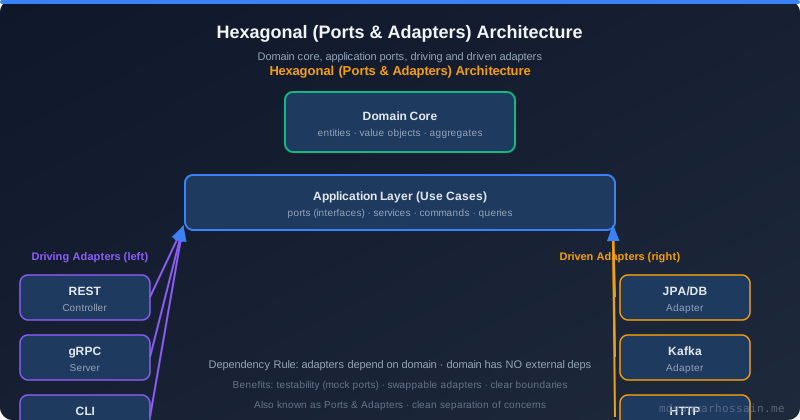
Table of Contents
- Why Microservices Need DDD
- Strategic DDD: Bounded Contexts
- Context Mapping: Making Integration Explicit
- Tactical DDD: Aggregates and Consistency Boundaries
- Value Objects: Eliminating Primitive Obsession
- Domain Events: Asynchronous Integration Between Contexts
- Repository Pattern: Decoupling Domain from Persistence
- Applying DDD in a Spring Boot Microservice: Package Structure
Why Microservices Need DDD
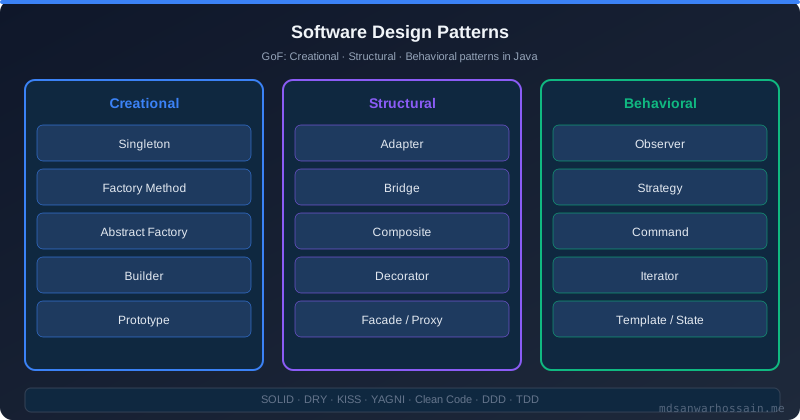
Eric Evans introduced Domain-Driven Design in 2003, a decade before microservices became mainstream. Yet DDD and microservices are philosophically aligned in the most fundamental way: both insist that software structure must reflect business domain structure, not technical infrastructure concerns. When teams adopt microservices without DDD, they typically decompose systems by technical layer (a "users service," a "notifications service," a "data service") — producing services with high coupling and low cohesion that create more coordination overhead than the monolith they replaced.
DDD provides the strategic tools to identify correct service boundaries: bounded contexts that align with business domains, ubiquitous language that eliminates the translation overhead between developers and domain experts, and context maps that make inter-service relationships explicit and intentional. It also provides the tactical tools to design robust service internals: aggregates that enforce consistency boundaries, domain events that enable asynchronous integration, value objects that eliminate primitive obsession, and repositories that decouple domain logic from persistence.
In 2026, with microservices architectures running for years and accumulating technical debt, DDD's strategic patterns are more relevant than ever. Re-applying DDD to legacy microservices architecture reveals misaligned boundaries, overcoupled contexts, and missing domain concepts that are the root cause of development slowdowns and production incidents.
Strategic DDD: Bounded Contexts
A bounded context is the explicit boundary within which a particular domain model applies and the language within it is consistent. The word "Order" means different things to different departments of a retail company: to sales, an order is a commitment to purchase; to fulfillment, an order is a picking list; to finance, an order is a revenue recognition event; to customer service, an order is a support ticket waiting to happen. Each of these is a distinct bounded context with its own model of "Order" — and each maps naturally to a microservice.
Identifying bounded contexts is best done through Event Storming, a collaborative modeling workshop developed by Alberto Brandolini. Event Storming puts domain experts, product managers, and developers in a room (or virtual whiteboard) and works through the system by identifying domain events — things that happened that the business cares about — in roughly chronological order. After mapping all events, the team identifies commands (things that trigger events), aggregates (the business objects that process commands and emit events), and bounded contexts (the natural clusters of events and aggregates).
Common Event Storming signals that reveal bounded context boundaries:
- The same noun means different things in different parts of the flow
- Different teams own different parts of the flow and use different language
- A conceptual "pivot" — a phase transition in the business process (e.g., from "order placed" to "order in fulfillment" to "order shipped")
- Different consistency requirements — some events must be synchronously consistent, others can be eventually consistent
Context Mapping: Making Integration Explicit
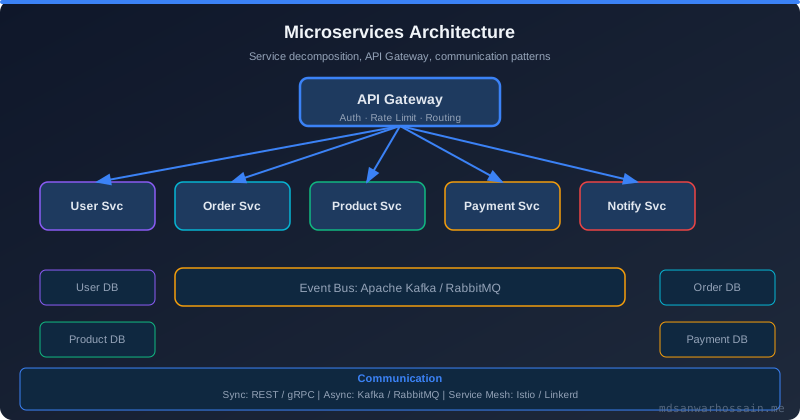
A context map documents the relationships between bounded contexts. These relationships are not all equal — DDD identifies several integration patterns, each with different implications for coupling and autonomy:
Partnership: Two contexts evolve together with coordinated releases. High coupling, justified when contexts are owned by the same team and must stay in sync (e.g., a mobile app context and its dedicated API gateway context).
Customer/Supplier: The downstream (customer) context depends on the upstream (supplier) context. The customer can influence the supplier's API roadmap but cannot dictate it. Common in platform/product-team relationships.
Conformist: The downstream context adopts the upstream model wholesale, with no translation. Used when the upstream is an external system or a legacy core that cannot be negotiated with.
Anti-Corruption Layer (ACL): The downstream context translates the upstream model into its own domain language, protecting its model from the upstream's concepts. This is the most important integration pattern for maintaining long-term domain integrity.
// Anti-Corruption Layer: translating an external shipping provider's model
// into our Fulfillment bounded context's language

// External shipping provider's model (we don't own this)
public class ShipmentTrackingEvent {
    public String trackingId;
    public String status; // "IN_TRANSIT", "OUT_FOR_DELIVERY", "DELIVERED", "EXCEPTION"
    public String timestamp;
    public String carrierCode;
    public String locationCode;
}

// Our Fulfillment context's domain model
public record OrderShipmentStatus(
    OrderId orderId,
    ShipmentState state,
    Instant updatedAt,
    Optional<String> deliveryLocation
) {}

public enum ShipmentState {
    IN_TRANSIT, OUT_FOR_DELIVERY, DELIVERED, DELIVERY_EXCEPTION
}

// The Anti-Corruption Layer — translates external → internal
@Component
public class ShippingProviderAcl {

    private final Map<String, ShipmentState> statusMapping = Map.of(
        "IN_TRANSIT", ShipmentState.IN_TRANSIT,
        "OUT_FOR_DELIVERY", ShipmentState.OUT_FOR_DELIVERY,
        "DELIVERED", ShipmentState.DELIVERED,
        "EXCEPTION", ShipmentState.DELIVERY_EXCEPTION
    );

    public OrderShipmentStatus translate(ShipmentTrackingEvent event, OrderId orderId) {
        ShipmentState state = statusMapping.getOrDefault(
            event.status, ShipmentState.IN_TRANSIT
        );

        return new OrderShipmentStatus(
            orderId,
            state,
            Instant.parse(event.timestamp),
            Optional.ofNullable(event.locationCode)
        );
    }
}
The ACL shields the Fulfillment context from changes in the shipping provider's API. When the provider renames "EXCEPTION" to "DELIVERY_FAILED" in a future API version, only the ACL mapping needs to change — the domain model is untouched. Without the ACL, every part of the Fulfillment domain that references shipment status would need to change.
Tactical DDD: Aggregates and Consistency Boundaries
An aggregate is a cluster of domain objects that must be treated as a single unit for data changes. Every aggregate has a root entity (the Aggregate Root) that is the sole entry point for all state modifications. External objects may hold references only to the aggregate root — never to internal entities or value objects. This enforces the consistency boundary: all changes within an aggregate happen in a single transaction.
// Order aggregate — the Aggregate Root controls all state changes
@Entity
public class Order {
    @Id
    private OrderId id;
    private CustomerId customerId;

    @OneToMany(cascade = CascadeType.ALL, orphanRemoval = true)
    private List<OrderLine> lines = new ArrayList<>();

    private OrderStatus status;
    private Money totalAmount;

    @Version
    private Long version; // Optimistic locking for concurrent modification detection

    // All state changes go through the aggregate root
    public void addItem(ProductId productId, Quantity quantity, Money unitPrice) {
        if (status != OrderStatus.DRAFT) {
            throw new DomainException("Cannot add items to a non-draft order");
        }
        lines.add(new OrderLine(productId, quantity, unitPrice));
        recalculateTotal();
    }

    public void removeItem(ProductId productId) {
        if (status != OrderStatus.DRAFT) {
            throw new DomainException("Cannot remove items from a non-draft order");
        }
        lines.removeIf(line -> line.getProductId().equals(productId));
        recalculateTotal();
    }

    public List<DomainEvent> submit() {
        if (lines.isEmpty()) {
            throw new DomainException("Cannot submit an order with no items");
        }
        if (status != OrderStatus.DRAFT) {
            throw new DomainException("Order is already submitted");
        }
        this.status = OrderStatus.SUBMITTED;
        return List.of(new OrderSubmittedEvent(id, customerId, totalAmount, Instant.now()));
    }

    private void recalculateTotal() {
        this.totalAmount = lines.stream()
            .map(OrderLine::getLineTotal)
            .reduce(Money.ZERO, Money::add);
    }

    // No public setters — all mutation goes through domain methods
}
Several critical design rules govern aggregate design. Keep aggregates small: a common DDD anti-pattern is creating one large aggregate for an entire domain object (e.g., an Order that contains the Customer, Payment, and Shipment). Large aggregates create transaction contention at scale — multiple concurrent operations competing to update the same aggregate row. Identify the minimal consistency boundary and model aggregates to enforce only that.
Reference other aggregates by identity only: An Order does not contain a Customer object — it holds a CustomerId. When the Order service needs customer information, it loads the Customer aggregate through its repository or queries the Customer service. This enforces the bounded context boundary and prevents object graph entanglement across aggregates.
Value Objects: Eliminating Primitive Obsession
Value objects are immutable objects defined entirely by their values, with no identity of their own. They model domain concepts that are naturally value-like: Money, Email, PhoneNumber, Address, Quantity. The primitive obsession anti-pattern — using raw types like String for email addresses, double for money, int for quantity — leads to scattered validation, silent errors (passing USD where EUR is expected), and anemic domain models.
// Primitive obsession — spreads validation everywhere
public void processOrder(String email, double amount, String currency) { ... }

// Value object — encapsulates validation, equality, and domain behavior
public record Money(BigDecimal amount, Currency currency) {

    public Money {
        if (amount == null) throw new IllegalArgumentException("Amount cannot be null");
        if (amount.compareTo(BigDecimal.ZERO) < 0) {
            throw new IllegalArgumentException("Amount cannot be negative");
        }
        if (currency == null) throw new IllegalArgumentException("Currency cannot be null");
        // Normalize to 2 decimal places
        amount = amount.setScale(2, RoundingMode.HALF_UP);
    }

    public Money add(Money other) {
        if (!this.currency.equals(other.currency)) {
            throw new DomainException("Cannot add money of different currencies");
        }
        return new Money(this.amount.add(other.amount), this.currency);
    }

    public Money multiply(int quantity) {
        return new Money(this.amount.multiply(BigDecimal.valueOf(quantity)), this.currency);
    }

    public boolean isGreaterThan(Money other) {
        assertSameCurrency(other);
        return this.amount.compareTo(other.amount) > 0;
    }

    public static Money of(String amount, String currencyCode) {
        return new Money(new BigDecimal(amount), Currency.getInstance(currencyCode));
    }

    public static final Money ZERO = new Money(BigDecimal.ZERO, Currency.getInstance("USD"));

    private void assertSameCurrency(Money other) {
        if (!this.currency.equals(other.currency)) {
            throw new DomainException("Currency mismatch: " + this.currency + " vs " + other.currency);
        }
    }
}
Java records are the ideal implementation vehicle for value objects in Java 21+. The compact constructor syntax (shown above) enables validation without boilerplate, and records provide equals/hashCode/toString automatically based on their components — which is exactly the right semantics for value objects.
Domain Events: Asynchronous Integration Between Contexts
Domain events are the primary mechanism for loosely coupled integration between bounded contexts. When something significant happens in the Order context (OrderSubmittedEvent), other contexts that care — Payment, Fulfillment, Notification — react to that event without the Order context needing to know about them. This is the Open/Closed Principle applied at the service level: Order is closed for modification but open for extension via its event stream.
// Domain event — captures what happened in the domain
public record OrderSubmittedEvent(
    OrderId orderId,
    CustomerId customerId,
    Money totalAmount,
    Instant occurredAt,
    String correlationId
) implements DomainEvent {}

// Publishing domain events with Spring's ApplicationEventPublisher
@Service
@Transactional
public class OrderApplicationService {

    private final OrderRepository orderRepository;
    private final ApplicationEventPublisher eventPublisher;

    public void submitOrder(SubmitOrderCommand command) {
        Order order = orderRepository.findById(command.orderId())
            .orElseThrow(() -> new OrderNotFoundException(command.orderId()));

        List<DomainEvent> events = order.submit();
        orderRepository.save(order);

        // Publish after successful save — ensures consistency
        events.forEach(eventPublisher::publishEvent);
    }
}

// Payment context reacts to the event
@Component
public class OrderSubmittedEventHandler {

    private final PaymentInitiationService paymentService;

    @EventListener
    @Async  // Non-blocking — payment initiation is async
    public void handle(OrderSubmittedEvent event) {
        paymentService.initiatePayment(
            event.orderId(),
            event.totalAmount(),
            event.correlationId()
        );
    }
}
For inter-service events (across microservice boundaries), use a message broker — Kafka, RabbitMQ, or AWS EventBridge — rather than in-process ApplicationEventPublisher. The Outbox Pattern is essential here: write the event to an outbox table in the same transaction as the aggregate change, then publish from the outbox asynchronously. This eliminates the dual-write problem where the aggregate is saved but the event is lost on a crash between the save and the publish.
Repository Pattern: Decoupling Domain from Persistence
The repository pattern provides a collection-like interface for accessing aggregates, shielding the domain from persistence concerns. Domain code that retrieves and stores orders should not know whether they are stored in PostgreSQL, MongoDB, or a distributed cache. The repository interface is defined in the domain layer; the implementation is in the infrastructure layer.
// Domain layer — interface only, no persistence technology
public interface OrderRepository {
    Optional<Order> findById(OrderId id);
    List<Order> findByCustomerAndStatus(CustomerId customerId, OrderStatus status);
    Order save(Order order);
    void delete(OrderId id);
}

// Infrastructure layer — JPA implementation
@Repository
public class JpaOrderRepository implements OrderRepository {

    private final OrderJpaRepository jpaRepository;
    private final OrderMapper mapper;

    @Override
    public Optional<Order> findById(OrderId id) {
        return jpaRepository.findById(id.value())
            .map(mapper::toDomain);
    }

    @Override
    public Order save(Order order) {
        OrderEntity entity = mapper.toEntity(order);
        OrderEntity saved = jpaRepository.save(entity);
        return mapper.toDomain(saved);
    }
}
The mapper between domain objects and JPA entities is the boundary where DDD's independence from persistence concerns is maintained. The domain aggregate has no JPA annotations — no @Entity, no @Id, no @Column. All persistence mapping concerns live in the infrastructure layer, making the domain pure Java objects that can be tested without a database, deployed against different storage backends, and evolved independently of schema changes.
Applying DDD in a Spring Boot Microservice: Package Structure
The DDD package structure makes the architectural intent explicit. A well-structured Spring Boot microservice following DDD conventions looks like:
order-service/
├── domain/
│   ├── model/
│   │   ├── Order.java              # Aggregate Root
│   │   ├── OrderLine.java          # Entity within aggregate
│   │   ├── OrderId.java            # Value Object (identity)
│   │   ├── Money.java              # Value Object
│   │   └── OrderStatus.java        # Enumeration
│   ├── event/
│   │   ├── DomainEvent.java        # Marker interface
│   │   ├── OrderSubmittedEvent.java
│   │   └── OrderCancelledEvent.java
│   ├── repository/
│   │   └── OrderRepository.java    # Repository interface (domain owns this)
│   ├── service/
│   │   └── OrderDomainService.java # Domain logic spanning multiple aggregates
│   └── exception/
│       └── DomainException.java
├── application/
│   ├── command/
│   │   ├── SubmitOrderCommand.java
│   │   └── CancelOrderCommand.java
│   └── service/
│       └── OrderApplicationService.java  # Orchestrates domain objects
├── infrastructure/
│   ├── persistence/
│   │   ├── JpaOrderRepository.java
│   │   ├── OrderEntity.java        # JPA entity — infrastructure only
│   │   └── OrderMapper.java
│   ├── messaging/
│   │   └── KafkaOrderEventPublisher.java
│   └── acl/
│       └── ShippingProviderAcl.java
└── interfaces/
    ├── rest/
    │   ├── OrderController.java
    │   └── OrderDto.java           # REST DTO — interfaces layer only
    └── event/
        └── OrderSubmittedEventHandler.java
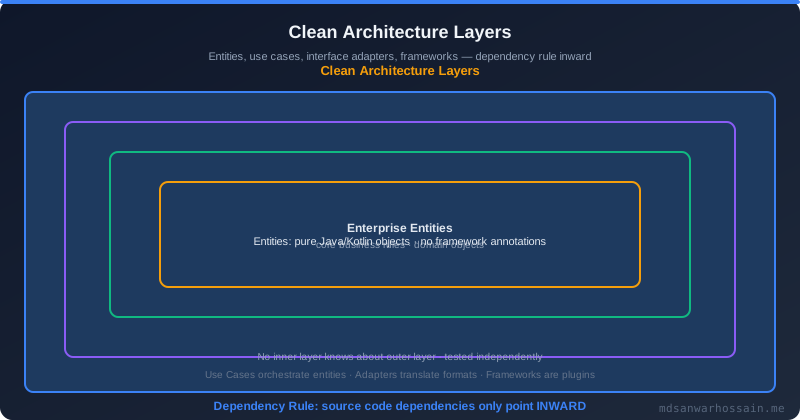
This structure enforces the Dependency Rule: infrastructure depends on domain, application depends on domain, interfaces depend on application. The domain depends on nothing outside itself. This is the hexagonal architecture (ports and adapters) pattern expressed through package structure.
Key Takeaways
- Use Event Storming to find bounded contexts: Collaborative workshops with domain experts reveal natural boundaries that no single developer can identify alone.
- Document your context map: Make every upstream/downstream relationship explicit. Use the ACL pattern whenever integrating with external systems or legacy contexts you don't own.
- Keep aggregates small and focused: Large aggregates create transaction contention and deployment coupling. Each aggregate enforces exactly one consistency invariant.
- Model with value objects, not primitives: Every domain concept — Money, Email, OrderId — should be a value object with its validation and behavior encapsulated.
- Use domain events for cross-context integration: Combine the Outbox Pattern with a message broker for reliable, loosely coupled inter-service communication.
- Enforce the Dependency Rule: Domain layer depends on nothing external. Infrastructure, application, and interfaces depend on domain — never the other direction.
Leave a Comment
Related Posts

Software Engineer · Java · Spring Boot · Microservices