Cross-Region Sagas with Quorum Idempotency: Payments that Survive Partial Outages
Paying across clouds and continents means dealing with inconsistent clocks, intermittent partitions, and partial writes that cannot be rolled back. Senior architects want more than circuit breakers; they need saga choreography that tolerates partial region loss while keeping books balanced. This article explores a practical recipe: cross-region sagas reinforced by quorum idempotency tokens, deterministic retries, and reconciliation streams. We will move from real production scars to implementable blueprints you can roll out this quarter.
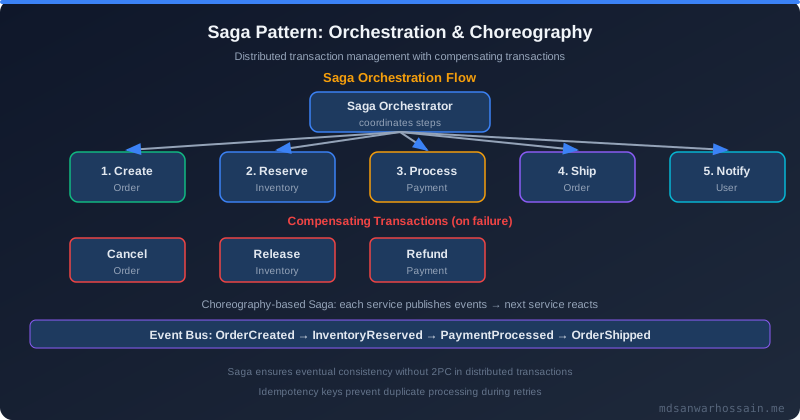
Table of Contents
- Real-world Problem
- Deep Dive
- Solution Approach
- Architecture Explanation
- Failure Scenarios
- Trade-offs
- When NOT to Use
- Optimization Techniques
- Debugging Strategies
- Scaling Considerations
- Mistakes to Avoid
- Key Takeaways
- Code and Config Snippets
- Architecture Diagram Idea
- Featured Image Idea
- Conclusion
- Read Full Blog Here
Real-world Problem
Imagine a customer taps Pay while us-east-1 experiences elevated latency and eu-west-1 is healthy. The payment gateway publishes an authorization event, the ledger service attempts a balance hold, and the risk engine writes a flag. A partial outage creates a dual-write hazard: one region commits the ledger hold while the other fails to persist the risk decision. Later, reconciliation finds a ledger hold without risk approval. Chargebacks rise, auditors frown, and engineering gets a 3 a.m. page.
The crux: multi-step payment workflows span regions and data stores, and we cannot assume atomicity. We need cross-region sagas that remain correct under partitions, preserve exactly-once semantics, and let us repair safely when things drift.
Deep Dive
A payment saga typically touches these steps: authorization with acquirer, ledger hold, risk decision, capture, settlement, notification. Each step lives in a service, often in different regions for latency and sovereignty. Risks arise from:
- Dual write hazards: ledger hold written, risk decision missing.
- Skewed clocks: TTL-based locks expire too soon in one region.
- Inconsistent idempotency: retries create duplicate captures.
- Orphaned outbox rows: message broker unreachable during commit.
- Compensations that reorder: release happens before capture abort.
To survive, we pair sagas with quorum idempotency tokens and a deterministic retry + reconciliation plan.
Solution Approach
The approach combines four pillars:
- Quorum idempotency tokens: Generate a payment-scoped token stored in N-of-M regions. A step executes only after reading a quorum to confirm uniqueness and prior completion status.
- Outbox + inbox: Every state change emits an outbox record committed with business data. Consumers maintain an inbox table keyed by the same idempotency token, ensuring exactly-once effects even across regions.
- Deterministic compensations: Each step owns a compensating action with a monotonic version. Compensation and forward action both check the token state to prevent reordering hazards.
- Reconciliation streams: Periodic scanners join ledger, risk, and outbox to surface drift, then re-drive missing compensations with the same token, ensuring safety under partial outages.
Architecture Explanation
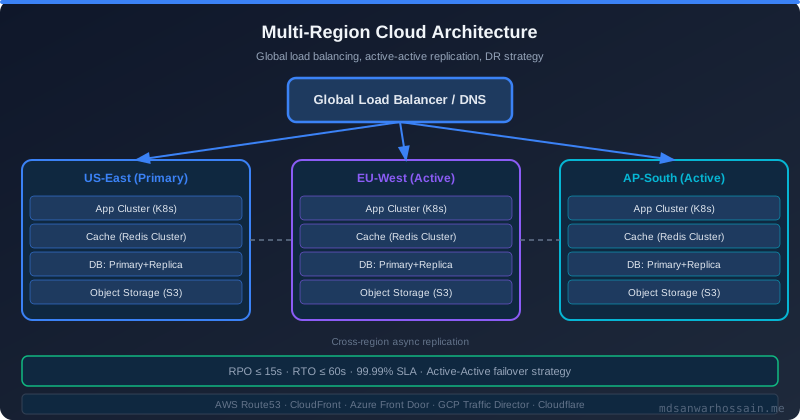
The architecture uses three regions: primary, secondary, and warm-standby. Each service (Gateway, Ledger, Risk, Notification) holds:
- An outbox table replicated cross-region via async streams.
- An inbox table for consumer idempotency.
- A token store persisted to quorum (e.g., DynamoDB global table with conditional writes or CockroachDB transaction).
Flow:
- Gateway receives payment request, writes token with status
INITusing quorum conditional put. - Ledger service reads token, creates hold, writes outbox event "HOLD_CREATED" with token and version.
- Risk consumes HOLD_CREATED, evaluates rules, writes decision outbox "RISK_APPROVED" or "RISK_REJECTED".
- Capture service consumes risk event; if approved, captures funds, updates token to
CAPTURED. - Any failure triggers compensations (release hold, send apology notification) using the same token.
Anchored reference on structured concurrency patterns: structured concurrency for multi-region sagas.
Failure Scenarios
Consider these scenarios and how the architecture responds:
- Region outage after hold, before risk: Token shows HOLD_CREATED, risk not present. Reconciliation triggers risk evaluation in a healthy region. If risk rejects, compensation releases hold safely because token version check prevents double release.
- Broker partition after risk approved: Outbox row exists, message not delivered. Reconciliation scans outbox minus inbox to re-deliver. Capture service inbox prevents duplicate capture.
- Duplicate client retries: Each entry includes the idempotency token; conditional writes ensure only first INIT transitions to HOLD_CREATED. Later retries see stable state and return same outcome.
- Clock skew expiring TTL locks: We avoid TTL locks by relying on quorum tokens and versioned transitions, not wall-clock expirations.
- Compensation reordering: Each action increments token version; compensations require matching or higher version, preventing a release-before-hold anomaly.
Trade-offs
Pros:
- Survives partial outages with bounded drift.
- Deterministic replay through reconciliation.
- Clear auditor trail via outbox + token history.
Cons:
- More storage and write amplification (outbox, inbox, token store).
- Added latency from quorum writes and conditional checks.
- Operational complexity of reconciliation scanners and versioned compensations.
When NOT to Use
Skip this approach if:
- You operate in a single region with strong consistency already guaranteed end-to-end.
- Your payment volume is low and downtime tolerance is high; simpler retries suffice.
- You cannot support reconciliation storage costs or token state history due to regulatory constraints.
Optimization Techniques
- Token sharding: Partition token store by merchant and day to reduce hot partitions.
- Batching outbox replication: Use change data capture with batching to reduce cross-region chatty writes.
- Adaptive backoff: Retries consult token state; exponential backoff only when state unchanged, fast-forward when state advanced.
- Compression of inbox rows: Periodically compact inbox rows to a rolling hash of processed events.
Debugging Strategies
- Token timeline: Render token versions as a timeline showing transitions (INIT → HOLD_CREATED → RISK_APPROVED → CAPTURED or COMPENSATED).
- Outbox/inbox diff: Dashboards comparing outbox events to inbox acknowledgments per region, highlighting stuck deliveries.
- Replay harness: Ability to pick a token and replay from any step using the same idempotency token to guarantee safety.
- Tracing: Propagate token id into tracing spans; add events for version transitions.
Scaling Considerations
- Quorum reads at scale: Use local quorum (e.g., 2 of 3) for speed, with background anti-entropy to fix lagging replicas.
- Hot merchant mitigation: Place merchants with high traffic on dedicated partitions; apply rate limits at token creation to avoid cascading failures.
- Shard reconciliation: Partition reconciliation scanners by token prefix; use leader election per shard to prevent duplicate replays.
- Network-aware routing: Route client requests to nearest healthy region but always write token to quorum to avoid split-brain.
Mistakes to Avoid
- Relying on UUID-only idempotency keys without token state; you lose ordering and compensating safety.
- Using at-least-once message delivery without inbox; duplicates will capture twice.
- Letting compensations be best-effort; they must be first-class steps with version checks.
- Skipping reconciliation because "metrics look fine"; latent drift is invisible until auditors arrive.
Key Takeaways
- Cross-region payments demand saga design with quorum-backed idempotency.
- Outbox+inbox plus reconciliation gives you eventual correctness even during partitions.
- Versioned tokens prevent reordering and duplicate effects during retries or compensations.
- Invest in observability around token timelines and outbox/inbox diffs to debug fast.
Code and Config Snippets
Outbox schema (PostgreSQL)
CREATE TABLE payment_outbox (
  id UUID PRIMARY KEY,
  token TEXT NOT NULL,
  version INT NOT NULL,
  event_type TEXT NOT NULL,
  payload JSONB NOT NULL,
  created_at TIMESTAMPTZ DEFAULT now(),
  delivered BOOLEAN DEFAULT FALSE,
  UNIQUE(token, version, event_type)
);
Inbox schema
CREATE TABLE payment_inbox (
  consumer_service TEXT NOT NULL,
  token TEXT NOT NULL,
  event_type TEXT NOT NULL,
  version INT NOT NULL,
  processed_at TIMESTAMPTZ DEFAULT now(),
  PRIMARY KEY (consumer_service, token, event_type, version)
);
Quorum token update with conditional write (pseudocode)
// Assume distributed store supporting conditional updates
updateToken(tokenId, expectedVersion, newVersion, newState) {
  return store.conditionalUpdate(
    key = tokenId,
    condition = version == expectedVersion,
    set = { version: newVersion, state: newState, updatedAt: now() }
  );
}
Retry logic with token-aware fast-forward
async function processHold(tokenId, payload) {
  const token = await tokens.read(tokenId);
  if (token.state !== 'INIT') return token; // idempotent fast-return
  const updated = await updateToken(tokenId, token.version, token.version + 1, 'HOLD_CREATED');
  if (!updated) throw new RetryableError('Optimistic conflict');
  await outbox.insert({
    token: tokenId,
    version: token.version + 1,
    event_type: 'HOLD_CREATED',
    payload
  });
  return tokens.read(tokenId);
}
Reconciliation query sketch
SELECT o.token, o.event_type, o.version
FROM payment_outbox o
LEFT JOIN payment_inbox i
  ON o.token = i.token
 AND o.event_type = i.event_type
 AND o.version = i.version
WHERE i.token IS NULL
LIMIT 1000;
For a structured approach to orchestrating cross-region tasks, see structured concurrency for saga orchestration.
Architecture Diagram Idea
Sketch: User → API Gateway → Token Store (quorum write). Parallel arrows to Ledger Service (hold + outbox) and Risk Service (decision + outbox). CDC replicates outbox across regions. Capture Service consumes risk + hold events through inbox filters. Reconciliation scanner pulls outbox/inbox gaps and re-drives with tokens. Monitoring overlays show token timelines per region.
Featured Image Idea
A globe with three regions connected by braided lines, each line labeled with a token icon, overlayed with checkpoints labeled "Hold", "Risk", "Capture", and a shield symbolizing idempotency.
Conclusion
Cross-region payment resilience is not about making outages impossible; it is about constraining drift and enabling safe recovery. Quorum idempotency tokens, outbox/inbox pairs, versioned compensations, and reconciliation give you a defensible strategy for both uptime and auditability. With these patterns, a partial outage becomes a controlled variance, not a financial incident.
Read Full Blog Here
For more details on coordinating asynchronous tasks safely, visit the extended walkthrough.
Related Posts
- Designing ledger services for multi-tenant fintech platforms
- Implementing exactly-once semantics with Kafka and inbox tables
- Building reconciliation pipelines with change data capture
- Operational playbooks for partial-region payment incidents
Frequently Asked Questions
What real-world problems does Cross-Region Sagas with Quorum Idempotency solve?
Imagine a customer taps Pay while us-east-1 experiences elevated latency and eu-west-1 is healthy. The payment gateway publishes an authorization event, the ledger service attempts a balance hold, and the risk engine writes a flag. A partial outage creates a dual-write hazard: one region commits the ledger hold while the other fails to persist the risk decision. Later, reconciliation finds a ledger hold without risk approval. Chargebacks rise, auditors frown, and engineering gets a 3 a.m. page. The crux: multi-step payment workflows span regions and data stores, and we cannot assume atomicity. We need cross-region sagas that remain correct under partitions, preserve exactly-once semantics, and let us repair safely when things drift.
How does Cross-Region Sagas with Quorum Idempotency work at a technical level?
A payment saga typically touches these steps: authorization with acquirer, ledger hold, risk decision, capture, settlement, notification. Each step lives in a service, often in different regions for latency and sovereignty. Risks arise from: To survive, we pair sagas with quorum idempotency tokens and a deterministic retry + reconciliation plan. Dual write hazards : ledger hold written, risk decision missing. Skewed clocks : TTL-based locks expire too soon in one region. Inconsistent idempotency : retries create duplicate captures. Orphaned outbox rows : message broker unreachable during commit.
What is the recommended solution approach for Cross-Region Sagas with Quorum Idempotency?
The approach combines four pillars: Quorum idempotency tokens : Generate a payment-scoped token stored in N-of-M regions. A step executes only after reading a quorum to confirm uniqueness and prior completion status. Outbox + inbox : Every state change emits an outbox record committed with business data. Consumers maintain an inbox table keyed by the same idempotency token, ensuring exactly-once effects even across regions. Deterministic compensations : Each step owns a compensating action with a monotonic version. Compensation and forward action both check the token state to prevent reordering hazards. Reconciliation streams : Periodic scanners join ledger, risk, and outbox to surface drift, then re-drive missing compensations with the same token, ensuring safety under partial outages.
How is the architecture designed for Cross-Region Sagas with Quorum Idempotency?
The architecture uses three regions: primary , secondary , and warm-standby . Each service (Gateway, Ledger, Risk, Notification) holds: Flow: Anchored reference on structured concurrency patterns: structured concurrency for multi-region sagas . An outbox table replicated cross-region via async streams. An inbox table for consumer idempotency. A token store persisted to quorum (e.g., DynamoDB global table with conditional writes or CockroachDB transaction). Gateway receives payment request, writes token with status INIT using quorum conditional put.
What failure scenarios should you handle with Cross-Region Sagas with Quorum Idempotency?
Consider these scenarios and how the architecture responds: Region outage after hold, before risk : Token shows HOLD_CREATED, risk not present. Reconciliation triggers risk evaluation in a healthy region. If risk rejects, compensation releases hold safely because token version check prevents double release. Broker partition after risk approved : Outbox row exists, message not delivered. Reconciliation scans outbox minus inbox to re-deliver. Capture service inbox prevents duplicate capture. Duplicate client retries : Each entry includes the idempotency token; conditional writes ensure only first INIT transitions to HOLD_CREATED. Later retries see stable state and return same outcome. Clock skew expiring TTL locks : We avoid TTL locks by relying on quorum tokens and versioned transitions, not wall-clock expirations.
Leave a Comment
Related Posts

Software Engineer · Java · Spring Boot · Microservices