Saga Pattern for Distributed Transactions in Microservices: A Production Guide
Distributed transactions are one of the hardest problems in microservices. The Saga pattern replaces the classical two-phase commit with a series of local transactions and compensating actions — but only if you design it right.
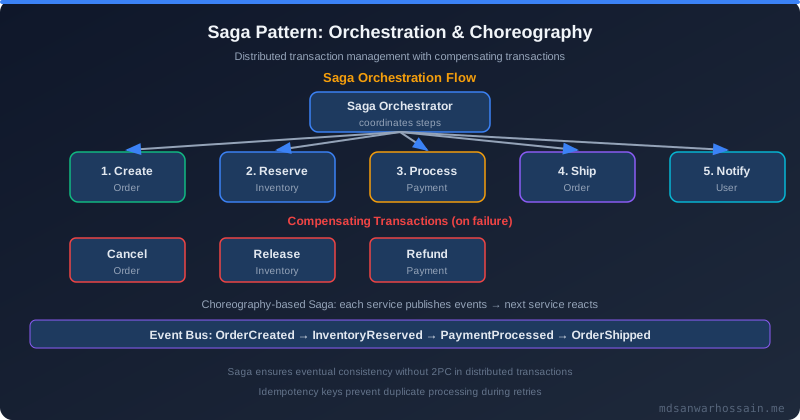
Table of Contents
- Introduction
- Problem Statement
- Choreography vs Orchestration: Two Saga Styles
- Architecture: Orchestrator Workflow
- Compensating Transactions: The Real Complexity
- Practical Implementation in Spring Boot
- Outbox Pattern: Ensuring Reliable Event Publishing
- Performance and Scaling Considerations
- Pros and Cons
- Common Mistakes
- When NOT to Use the Saga Pattern
- Conclusion
Introduction
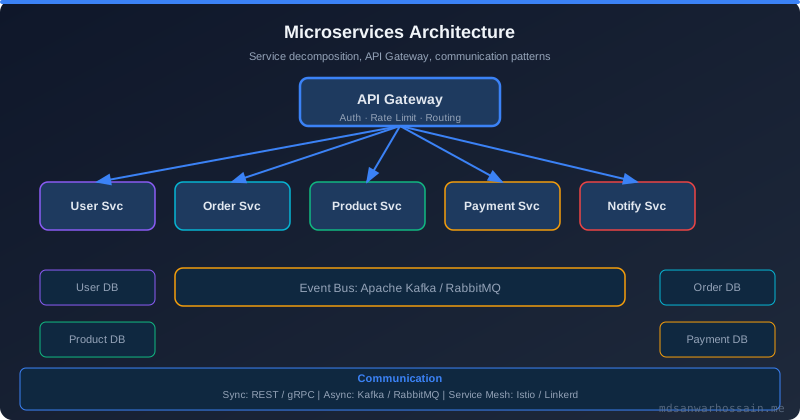
When a monolith handles a business transaction — booking a flight, placing an order, or transferring funds — a single database transaction gives you atomicity for free: either everything commits or nothing does. Move to microservices and each service owns its own database. A cross-service operation now spans multiple network calls and multiple databases, and no distributed ACID guarantee exists out of the box.
The Saga pattern is the industry-standard answer. A saga breaks a long-running business transaction into a sequence of local transactions, each publishing an event or triggering a message that drives the next step. If a step fails, compensating transactions undo the work already done. Teams building payment flows, order management, and reservation systems rely on sagas daily in production — but many underestimate the engineering complexity involved.
Problem Statement
Consider an e-commerce checkout flow that touches four services: Order Service, Inventory Service, Payment Service, and Notification Service. The happy path is straightforward. The hard part is failure handling: what happens when Payment fails after Inventory has already been reserved? What if the Notification Service is unavailable when the order has already been paid? Without a coordinated approach to failure, you end up with partially applied state across multiple databases — a nightmare that is both difficult to detect and expensive to repair manually.
Two-phase commit (2PC) can enforce atomicity but requires all participating services to hold locks while the coordinator decides the outcome. In distributed systems under real load, this creates unacceptable lock contention, coordinator bottlenecks, and brittle behavior when participants go offline. Sagas trade strong consistency for eventual consistency while maintaining business correctness through compensations.
Choreography vs Orchestration: Two Saga Styles
There are two primary approaches to implementing sagas, each with different architectural tradeoffs.
Choreography-Based Sagas
In choreography, each service listens for events and publishes its own events when it completes local work. There is no central coordinator. The Order Service creates an order and publishes an OrderCreated event. The Inventory Service consumes this event, reserves stock, and publishes StockReserved. The Payment Service consumes that and publishes PaymentProcessed. Each service reacts independently.
The benefit is tight decoupling: services do not need to know about each other beyond the events they produce and consume. The downside is that tracing the full saga across service logs becomes difficult. Adding a new step means updating multiple services. Cyclic dependencies can emerge silently. Debugging a failure often requires reconstructing the event timeline across systems.
Orchestration-Based Sagas
In orchestration, a dedicated Saga Orchestrator service drives the workflow. It calls each service explicitly, tracks the saga state, and decides what to do next based on responses. When Payment fails, the orchestrator explicitly triggers compensating calls to release the inventory reservation and cancel the order.
Orchestration provides a single place to inspect saga state, making debugging and monitoring dramatically simpler. It also makes it easy to add conditional logic and retry policies. The tradeoff is that the orchestrator becomes a new component with its own resilience requirements. If the orchestrator goes down mid-saga, you need durable state storage and recovery logic.
For production systems with more than three or four saga steps, orchestration is almost always the more maintainable choice.
Architecture: Orchestrator Workflow
A production orchestrator-based saga typically looks like this: the orchestrator persists saga state in a durable store (a relational database or distributed key-value store) before making any call. After each step, it records the outcome. If the process crashes mid-saga, on restart it reads state and resumes from where it left off. This design enables exactly-once semantic recovery.
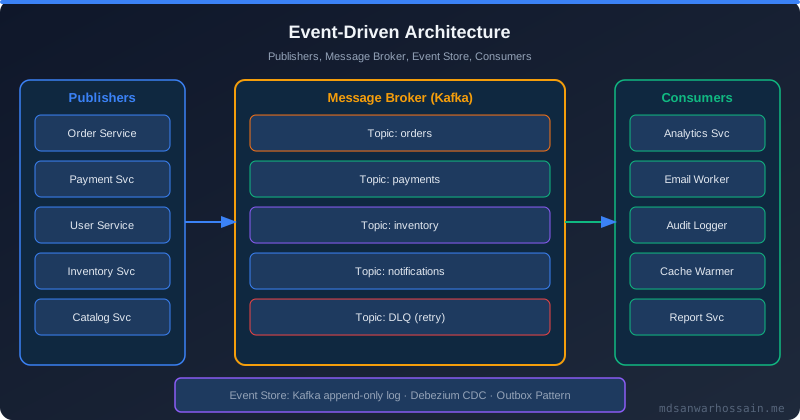
Tools like Axon Framework, Conductor, Temporal, and Amazon Step Functions implement this pattern. When building custom orchestrators on Spring Boot, teams often use the Outbox Pattern in combination with Kafka to ensure that event publishing is atomic with the local database write, preventing lost messages after a crash.
Compensating Transactions: The Real Complexity
Every forward step in a saga must have a corresponding compensating action. Reserve stock → Release stock reservation. Charge payment → Issue refund. Send notification → Send correction notification. Compensations are not always simple reversals. Some actions are difficult to undo cleanly: emails already sent, shipments already dispatched, or regulatory records already filed.
Design compensations carefully. Distinguish between retryable failures (network timeout, service unavailable) and semantic failures (insufficient funds, item out of stock). Retryable failures should use exponential backoff. Semantic failures should trigger compensation immediately without retrying.
Mark each compensating transaction as idempotent. If a compensation is called twice due to network retry, the result must be the same. This requires idempotency tokens, state checks before applying changes, and careful database constraint design.
Practical Implementation in Spring Boot
A typical saga step in a Spring Boot orchestrator uses the following pattern. The orchestrator fetches the current saga state, sends a command to a downstream service via Kafka or REST, and persists the result. The state machine transitions are explicit and tested independently.
// Orchestrator saga step
public void processPayment(String sagaId) {
    SagaState state = sagaRepository.findById(sagaId).orElseThrow();
    if (state.getStatus() != SagaStatus.STOCK_RESERVED) return;

    paymentClient.charge(state.getOrderId(), state.getAmount());
    state.setStatus(SagaStatus.PAYMENT_INITIATED);
    sagaRepository.save(state);
}

// Compensation
public void compensatePayment(String sagaId) {
    SagaState state = sagaRepository.findById(sagaId).orElseThrow();
    if (state.getStatus() != SagaStatus.PAYMENT_INITIATED) return;

    paymentClient.refund(state.getOrderId());
    state.setStatus(SagaStatus.PAYMENT_COMPENSATED);
    sagaRepository.save(state);
}
Notice that both the forward action and the compensation check the current status before executing. This guards against double-execution during retries or recovery after a crash.
Outbox Pattern: Ensuring Reliable Event Publishing
One of the most common saga failure modes is publishing an event after committing a local transaction — and having the publish fail silently. The Outbox Pattern solves this by writing the event to an outbox table in the same local transaction as the business data change. A separate relay process (using Debezium, Kafka Connect, or a polling loop) reads the outbox table and publishes the events reliably. This guarantees that if the transaction commits, the event will eventually be published.
Performance and Scaling Considerations
Sagas add latency compared to simple request-response flows because each step involves network calls and asynchronous coordination. For high-throughput systems, batch the saga state updates and use connection pooling aggressively. Use Kafka partitioning to parallelize saga instances that are independent of each other. Avoid holding database locks between saga steps — design compensations to work with row-level locking at most.
Monitor saga completion time distributions, not just average latency. Sagas that are stuck in intermediate states (neither completed nor compensated) are a leading indicator of bugs or infrastructure failures. Build dashboards that highlight saga age and health by status.
Pros and Cons
Pros: No distributed locks or 2PC. Works across services with different databases. Compensations provide clear failure recovery paths. Scales horizontally. Well-supported by frameworks like Temporal and Axon.
Cons: Eventual consistency means readers may see intermediate states. Compensating transactions require careful design and testing. Debugging and tracing cross-service failures is more complex than in a monolith. Complexity grows with the number of saga steps.
Common Mistakes
Skipping idempotency: Every saga step and compensation must be idempotent. Failing to do this leads to duplicate charges, double refunds, and inventory corruption.
Not handling zombie sagas: Sagas that never complete due to downstream failures can accumulate. Build a monitoring job that detects and escalates stale sagas beyond a configurable TTL.
Treating compensation as optional: Some teams implement the happy path first and leave compensations as a future backlog item. This is a production risk. Compensations are not optional — they are the guarantee that your system remains consistent under failure.
Misusing choreography for complex flows: Choreography works well for simple two- or three-step flows. For flows with conditional branching, retries, or six or more participants, orchestration is far more maintainable.
When NOT to Use the Saga Pattern
If your business process genuinely requires strong consistency — such as financial ledger entries that must balance atomically — and all data lives in the same database, a local ACID transaction is simpler and safer. Use sagas only when services are truly independent and can tolerate eventual consistency. Never introduce the saga pattern to avoid designing a proper data ownership model.
Key Takeaways
- Sagas replace 2PC with a chain of local transactions plus compensating transactions for failure recovery.
- Orchestration offers better observability and maintainability for complex multi-step flows.
- Every forward step must have an idempotent compensating action.
- Use the Outbox Pattern to prevent event loss at transaction boundaries.
- Monitor saga completion time and stale saga counts in production dashboards.
Conclusion
The Saga pattern is essential for any microservices team building business processes that span multiple services and databases. It trades strong consistency for availability and resilience — a trade that is almost always correct in distributed systems at scale. The engineering investment is real: idempotent compensations, durable state management, observability tooling, and careful failure classification. But teams that invest here build payment, order, and reservation flows that are robust, debuggable, and maintainable under real production load.
Frequently Asked Questions
What is Saga Pattern for Distributed Transactions in Microservices and why does it matter?
When a monolith handles a business transaction — booking a flight, placing an order, or transferring funds — a single database transaction gives you atomicity for free: either everything commits or nothing does. Move to microservices and each service owns its own database. A cross-service operation now spans multiple network calls and multiple databases, and no distributed ACID guarantee exists out of the box. The Saga pattern is the industry-standard answer. A saga breaks a long-running business transaction into a sequence of local transactions, each publishing an event or triggering a message that drives the next step. If a step fails, compensating transactions undo the work already done.
What is Problem Statement and how does it work?
Consider an e-commerce checkout flow that touches four services: Order Service, Inventory Service, Payment Service, and Notification Service. The happy path is straightforward. The hard part is failure handling: what happens when Payment fails after Inventory has already been reserved? What if the Notification Service is unavailable when the order has already been paid? Without a coordinated approach to failure, you end up with partially applied state across multiple databases — a nightmare that is both difficult to detect and expensive to repair manually. Two-phase commit (2PC) can enforce atomicity but requires all participating services to hold locks while the coordinator decides the outcome. In distributed systems under real load, this creates unacceptable lock contention, coordinator bottlenecks, and brittle behavior when participants go offline.
What is Choreography-Based Sagas and how does it work?
In choreography, each service listens for events and publishes its own events when it completes local work. There is no central coordinator. The Order Service creates an order and publishes an OrderCreated event. The Inventory Service consumes this event, reserves stock, and publishes StockReserved . The Payment Service consumes that and publishes PaymentProcessed . Each service reacts independently. The benefit is tight decoupling: services do not need to know about each other beyond the events they produce and consume. The downside is that tracing the full saga across service logs becomes difficult. Adding a new step means updating multiple services. Cyclic dependencies can emerge silently. Debugging a failure often requires reconstructing the event timeline across systems.
What is Orchestration-Based Sagas and how does it work?
In orchestration, a dedicated Saga Orchestrator service drives the workflow. It calls each service explicitly, tracks the saga state, and decides what to do next based on responses. When Payment fails, the orchestrator explicitly triggers compensating calls to release the inventory reservation and cancel the order. Orchestration provides a single place to inspect saga state, making debugging and monitoring dramatically simpler. It also makes it easy to add conditional logic and retry policies. The tradeoff is that the orchestrator becomes a new component with its own resilience requirements. If the orchestrator goes down mid-saga, you need durable state storage and recovery logic. For production systems with more than three or four saga steps, orchestration is almost always the more maintainable choice.
What is Architecture and how does it work?
A production orchestrator-based saga typically looks like this: the orchestrator persists saga state in a durable store (a relational database or distributed key-value store) before making any call. After each step, it records the outcome. If the process crashes mid-saga, on restart it reads state and resumes from where it left off. This design enables exactly-once semantic recovery. Tools like Axon Framework, Conductor, Temporal, and Amazon Step Functions implement this pattern. When building custom orchestrators on Spring Boot, teams often use the Outbox Pattern in combination with Kafka to ensure that event publishing is atomic with the local database write, preventing lost messages after a crash.
Leave a Comment

Software Engineer · Java · Spring Boot · Microservices