Java Structured Concurrency: Replacing Thread Pools with Scoped Tasks in Java 21+
Unstructured concurrency has been the silent source of thread leaks, swallowed exceptions, and production nightmares for years. Java 21's Structured Concurrency — now a preview feature maturing toward standardization — fundamentally changes how parallel subtasks are expressed, reasoned about, and safely terminated. In this deep dive, we explore the StructuredTaskScope API, migration patterns from ExecutorService, failure handling strategies, and where the model genuinely shines in production microservices.
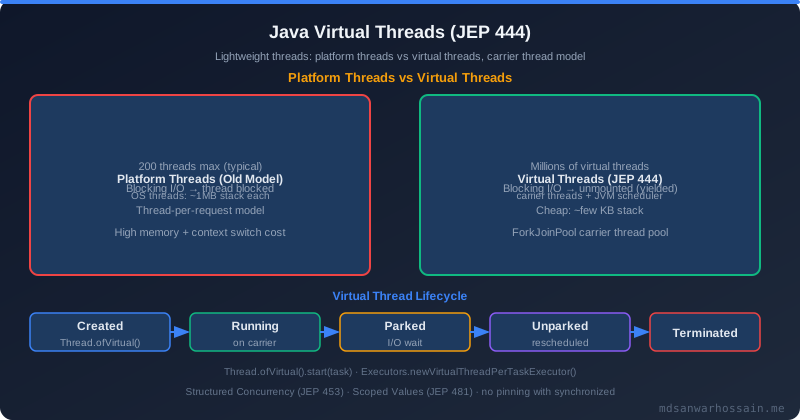
Table of Contents
1. The Problem with Unstructured Concurrency
Consider a common pattern in any payment processing microservice: when a transaction arrives, you need to concurrently call three external services — a fraud detection API, a credit scoring API, and a KYC verification API — and only proceed if all three pass. The natural Java pre-21 implementation leans on ExecutorService and CompletableFuture:
// Legacy unstructured concurrency — looks fine, isn't
ExecutorService pool = Executors.newFixedThreadPool(10);

CompletableFuture<FraudResult> fraudFuture =
    CompletableFuture.supplyAsync(() -> fraudService.check(txn), pool);
CompletableFuture<CreditResult> creditFuture =
    CompletableFuture.supplyAsync(() -> creditService.score(txn), pool);
CompletableFuture<KycResult> kycFuture =
    CompletableFuture.supplyAsync(() -> kycService.verify(txn), pool);

// What happens if creditFuture throws an unchecked exception?
// fraudFuture and kycFuture keep running — consuming threads — forever.
CompletableFuture.allOf(fraudFuture, creditFuture, kycFuture).join();
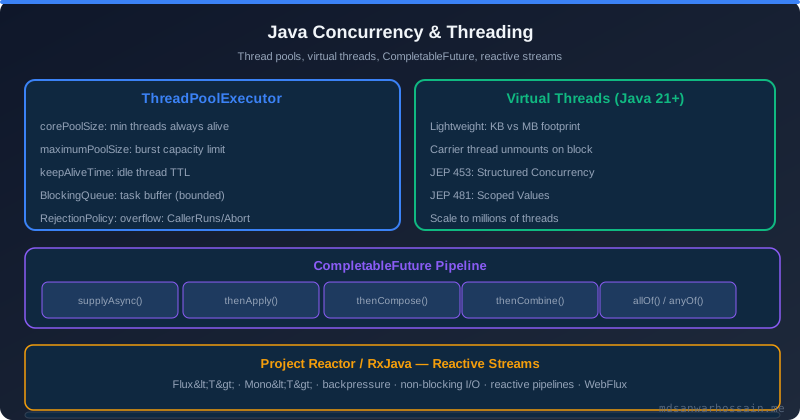
Now imagine the KYC provider's API hangs on a network timeout at 45 seconds. Your fraud and credit checks complete in 200ms, but the thread calling KYC sits blocked on a socket read. Because there is no lifecycle boundary tying those futures to the request handling thread, the calling code has no reliable mechanism to cancel the running subtasks on timeout, propagate the parent's interrupt, or guarantee that all child threads are cleaned up when the method returns. The result is thread pool exhaustion under load — threads piling up waiting for a degraded downstream service, until your service health checks start failing.
The deeper problem is conceptual: unstructured concurrency has no ownership model. Threads are fire-and-forget. Exceptions thrown inside CompletableFuture callbacks are silently swallowed unless you explicitly handle them. The stack trace you see in logs rarely tells you which request triggered the failure, because the spawning context is lost by the time the exception propagates. Debugging becomes archaeological — correlating thread dumps, metrics, and logs across systems.
2. What is Structured Concurrency?
Structured Concurrency is a programming paradigm with a deceptively simple rule: a task's lifetime must not exceed the lifetime of the scope that created it. Subtasks are born inside a lexical scope block and are guaranteed to be finished — either successfully or with an exception — before that block exits. There is a clear parent–child relationship, and the parent is responsible for the outcomes of its children.
The concept isn't new. Go's errgroup package and Python's asyncio.TaskGroup (introduced in Python 3.11) implement the same principle. In Go, goroutine leaks are a well-known class of bug precisely because Go's base go keyword has no ownership — the errgroup pattern was a community-driven correction. Python's asyncio.gather has similar pitfalls: if you don't capture the returned tasks and cancel them explicitly, a failing coroutine won't cancel its siblings. Java's StructuredTaskScope (finalized in JEP 505 for Java 21+) makes the structured model the default API surface for parallel subtasks.
The key insight is that structured concurrency aligns the logical structure of the code with the runtime structure of the threads. When you look at a try-with-resources block wrapping a StructuredTaskScope, you can immediately reason: everything forked inside this block is done before the code after the block runs. No hidden state, no dangling threads, no lost exceptions.
3. StructuredTaskScope API Deep Dive
Java ships two built-in scope policies. ShutdownOnFailure cancels all remaining subtasks as soon as any one subtask throws an exception — ideal for fan-out patterns where you need all results. ShutdownOnSuccess cancels all remaining subtasks as soon as any one subtask succeeds — ideal for hedged requests where you race multiple implementations and take the first winner.
Here is the payment service fan-out rewritten with ShutdownOnFailure:
import java.util.concurrent.StructuredTaskScope;
import java.util.concurrent.StructuredTaskScope.Subtask;

public PaymentDecision evaluateTransaction(Transaction txn) throws Exception {
    try (var scope = new StructuredTaskScope.ShutdownOnFailure()) {

        Subtask<FraudResult>  fraudTask  = scope.fork(() -> fraudService.check(txn));
        Subtask<CreditResult> creditTask = scope.fork(() -> creditService.score(txn));
        Subtask<KycResult>    kycTask    = scope.fork(() -> kycService.verify(txn));

        // Block until ALL complete OR any one fails/scope shuts down
        scope.join()
             .throwIfFailed();  // re-throws the first exception, wrapped if needed

        // All three succeeded — results are available
        return buildDecision(fraudTask.get(), creditTask.get(), kycTask.get());
    }
    // When the try block exits, ALL subtasks are guaranteed done — no leaks
}
The scope.fork() call schedules the callable on a virtual thread. Because virtual threads are cheap (Java 21 virtual threads have ~1KB stack vs. ~1MB for platform threads), you can fork thousands of subtasks without pool exhaustion anxiety. When KYC hangs and you've set a join deadline, the scope cancels kycTask and interrupts its virtual thread automatically — no manual future.cancel(true) scattered across catch blocks.
For hedged read scenarios — for example, querying two replica databases and returning whichever responds first — ShutdownOnSuccess is cleaner:
public UserProfile fetchUser(String userId) throws Exception {
    try (var scope = new StructuredTaskScope.ShutdownOnSuccess<UserProfile>()) {

        scope.fork(() -> primaryDb.find(userId));
        scope.fork(() -> replicaDb.find(userId));

        scope.join();
        return scope.result(); // returns result from whichever finished first
    }
}
4. Replacing Thread Pools: Migration Guide
Migrating from ExecutorService + CompletableFuture is straightforward for request-scoped parallel work, but requires care. The key mental shift is: structured concurrency is not a replacement for all executor usage. It is a replacement for the pattern where you submit tasks and then join/get all results within the same method call.
Before migration — a common Spring Boot service layer:
// BEFORE: Brittle CompletableFuture fan-out
@Service
public class OrderEnrichmentService {
    private final ExecutorService executor =
        Executors.newFixedThreadPool(20, Thread.ofVirtual().factory());

    public EnrichedOrder enrich(Order order) {
        CompletableFuture<InventoryData> invFuture =
            CompletableFuture.supplyAsync(
                () -> inventoryClient.fetch(order.items()), executor);
        CompletableFuture<PricingData> priceFuture =
            CompletableFuture.supplyAsync(
                () -> pricingClient.fetch(order.items()), executor);
        CompletableFuture<ShippingData> shipFuture =
            CompletableFuture.supplyAsync(
                () -> shippingClient.quote(order), executor);

        try {
            CompletableFuture.allOf(invFuture, priceFuture, shipFuture)
                .get(5, TimeUnit.SECONDS);
        } catch (TimeoutException e) {
            // Only cancels the allOf — individual futures keep running!
            invFuture.cancel(true);
            priceFuture.cancel(true);
            shipFuture.cancel(true);
            throw new ServiceException("Enrichment timed out", e);
        } catch (ExecutionException e) {
            throw new ServiceException("Enrichment failed", e.getCause());
        }
        return buildEnrichedOrder(
            invFuture.join(), priceFuture.join(), shipFuture.join());
    }
}
After migration to StructuredTaskScope:
// AFTER: Structured, leak-proof, readable
@Service
public class OrderEnrichmentService {

    public EnrichedOrder enrich(Order order) throws Exception {
        try (var scope = new StructuredTaskScope.ShutdownOnFailure()) {

            var invTask   = scope.fork(() -> inventoryClient.fetch(order.items()));
            var priceTask = scope.fork(() -> pricingClient.fetch(order.items()));
            var shipTask  = scope.fork(() -> shippingClient.quote(order));

            // Deadline: 5 seconds from now; cancels all subtasks if exceeded
            scope.joinUntil(Instant.now().plusSeconds(5))
                 .throwIfFailed();

            return buildEnrichedOrder(
                invTask.get(), priceTask.get(), shipTask.get());
        }
        // Scope exit guarantees all subtasks are done — no explicit cancel calls needed
    }
}
Notice three improvements immediately: no thread pool to size and manage, no manual cancel(true) calls on timeout, and the exception handling path is drastically shorter. The joinUntil(Instant) overload integrates cleanly with deadline propagation from upstream gRPC deadlines or HTTP request timeouts.
5. Handling Partial Failures and Timeouts
The built-in shutdown policies cover the majority of use cases, but production systems often need nuanced semantics: what if you want best-effort enrichment where three out of four calls failing is acceptable, but one specific call failing is fatal? You implement a custom scope by extending StructuredTaskScope.
// Custom scope: fail fast on critical subtask, tolerate optional ones
public class CriticalFirstScope<T> extends StructuredTaskScope<T> {
    private final String criticalTaskName;
    private volatile Throwable criticalFailure;
    private final List<T> successResults = new CopyOnWriteArrayList<>();

    public CriticalFirstScope(String criticalTaskName) {
        this.criticalTaskName = criticalTaskName;
    }

    @Override
    protected void handleComplete(Subtask<? extends T> subtask) {
        if (subtask.state() == Subtask.State.FAILED) {
            if (criticalTaskName.equals(subtask.toString())) {
                criticalFailure = subtask.exception();
                shutdown(); // cancel siblings immediately
            }
            // optional subtask failure — log and continue
        } else if (subtask.state() == Subtask.State.SUCCESS) {
            successResults.add(subtask.get());
        }
    }

    public List<T> results() throws ExecutionException {
        if (criticalFailure != null)
            throw new ExecutionException(criticalFailure);
        return Collections.unmodifiableList(successResults);
    }
}
Timeout handling deserves special attention in distributed systems. scope.joinUntil(Instant) throws TimeoutException when the deadline passes and the scope hasn't completed. After catching TimeoutException, you should still exit the try-with-resources block — the scope's close() will interrupt and await all remaining subtasks. The subtle trap is trying to use results from subtasks that haven't finished: always check subtask.state() before calling subtask.get() in the timeout handler.
CompletableFuture.cancel(true), which only sets a cancellation flag that the task may or may not honour, StructuredTaskScope shutdown sends an interrupt to the virtual thread running the subtask. If your subtask uses interruptible blocking calls (any NIO selector, Thread.sleep, blocking queue operations), the interrupt is delivered immediately, producing fast cancellation without polling.
6. Production Failure Scenarios
Thread leak in legacy code: A common pattern in legacy Spring Boot 2.x services is injecting a shared @Bean executor and submitting tasks without tracking their futures. Under load spikes, the executor queue fills, tasks are rejected with RejectedExecutionException, and the primary thread throws while child tasks continue running. With structured concurrency, this scenario is impossible by construction — the scope blocks the parent until all children finish, and a RejectedExecutionException on fork() is handled in the parent's exception handler directly.
Observability and context propagation: One of the strongest production arguments for structured concurrency is automatic context propagation. OpenTelemetry's Java agent automatically propagates the active Span context from the parent virtual thread to forked subtasks when using StructuredTaskScope. This means your distributed traces correctly show all three parallel checks as child spans of the parent transaction span, without any manual Context.makeCurrent() plumbing.
// OpenTelemetry context flows automatically to forked virtual threads
try (var scope = new StructuredTaskScope.ShutdownOnFailure()) {
    // Active span from current thread is inherited by all forked subtasks
    var fraudTask = scope.fork(() -> {
        // This subtask runs in a child span of the parent span
        Span span = tracer.spanBuilder("fraud-check").startSpan();
        try (var ignored = span.makeCurrent()) {
            return fraudService.check(txn);
        } finally {
            span.end();
        }
    });
    scope.join().throwIfFailed();
    return fraudTask.get();
}
Debugging structured vs unstructured concurrency: Thread dumps from structured concurrent programs are dramatically more useful. Each virtual thread's stack trace includes its parent scope's context because the scope is on the parent's stack. JVM tooling like JFR (Java Flight Recorder) records virtual thread lifecycle events, and tools like VisualVM and async-profiler can visualize the parent–child tree. Compare this to unstructured CompletableFuture chains where threads are anonymous pool workers with no connection to the originating request in the stack dump.
7. Trade-offs and When NOT to Use
Structured concurrency is not a silver bullet, and forcing it into the wrong pattern produces worse code than the alternatives. Understand these boundaries clearly before adopting it in all your parallel code.
Long-running background tasks: If your task logically outlives the request that spawned it — for example, an asynchronous report generation job that the user polls for later — structured concurrency is the wrong tool. The parent request thread would block until the report finishes, which is the opposite of what you want. Use a proper async work queue (Kafka, SQS, or a Spring @Async method backed by a task executor) for fire-and-forget background jobs.
Event loops and reactive systems: If you're running Project Reactor or RxJava pipelines, structured concurrency doesn't compose naturally with reactive operators. Reactor's scheduler model and backpressure mechanisms are orthogonal to StructuredTaskScope's blocking-join model. Trying to bridge them with Mono.fromCallable wrappers around scope blocks usually works but adds unnecessary overhead and conceptual friction. Stick to the reactive model if you've already committed to it.
Unbounded fan-out: If the number of subtasks is not statically bounded — for example, processing every record in a streaming result set in parallel — StructuredTaskScope will happily fork thousands of virtual threads, which is fine, but you lose the natural backpressure that a bounded thread pool provides. Consider batching with a semaphore or using Stream.parallel() with a custom spliterator for truly data-parallel workloads.
API stability: As of Java 21, StructuredTaskScope is still a preview API requiring --enable-preview at compile and runtime. Plan for potential API surface changes in Java 23 or 24 finalization. For production deployments, freeze your JDK version and test preview feature behavior on JDK upgrades specifically.
"Structured concurrency makes the structure of concurrent programs visible in the code, just as structured programming did for sequential control flow decades ago. It is not about performance — it is about correctness, clarity, and the ability to reason about programs under failure."
— Ron Pressler, OpenJDK Project Loom lead
Key Takeaways
- StructuredTaskScope guarantees no thread leaks — all forked subtasks are done before the scope's try block exits, by construction.
- ShutdownOnFailure is your fan-out default — use it whenever you need all N parallel results; it cancels siblings the moment any one fails.
- joinUntil(Instant) enables deadline propagation — map upstream gRPC deadlines or HTTP timeouts directly to scope deadlines for end-to-end timeout enforcement.
- OpenTelemetry context propagates automatically — virtual threads inherit the parent's active span context, eliminating manual context plumbing in distributed traces.
- Custom scopes handle nuanced partial-failure policies — extend StructuredTaskScope and override handleComplete() for scenarios where some failures are tolerable.
- Not a replacement for all concurrency — background jobs, event loops, and reactive pipelines have better-suited concurrency models; use structured concurrency for request-scoped parallel subtasks.
Conclusion
Structured Concurrency is the most significant change to Java's concurrency model since the introduction of java.util.concurrent in Java 5. It doesn't make parallel code faster — virtual threads already handle that — it makes parallel code correct by default. Thread leaks, lost exceptions, and unreachable debugging information are structural flaws of unstructured concurrency, and StructuredTaskScope eliminates them at the language level rather than relying on developer discipline.
For payment services, order enrichment, API aggregation layers, and any microservice that fans out to multiple downstream APIs per request, the migration path from ExecutorService to StructuredTaskScope is almost always a net improvement in correctness, observability, and code readability. Start with ShutdownOnFailure for your fan-out patterns, add joinUntil deadline propagation, and progressively replace your thread pool management boilerplate. The result is concurrent code that reads as clearly as its sequential counterpart — which, as Pressler noted, has been the goal all along.
Leave a Comment
Related Posts

Software Engineer · Java · Spring Boot · Microservices