Dead Letter Queue Patterns: Failure Isolation and Recovery in Event-Driven Microservices
In event-driven systems, a single poison message can halt an entire consumer and cascade into a systemic outage. Dead Letter Queues are not just error buckets—they're a sophisticated failure isolation and recovery mechanism. This post covers DLQ patterns across Kafka, RabbitMQ, and AWS SQS, with real production failure scenarios and recovery strategies.
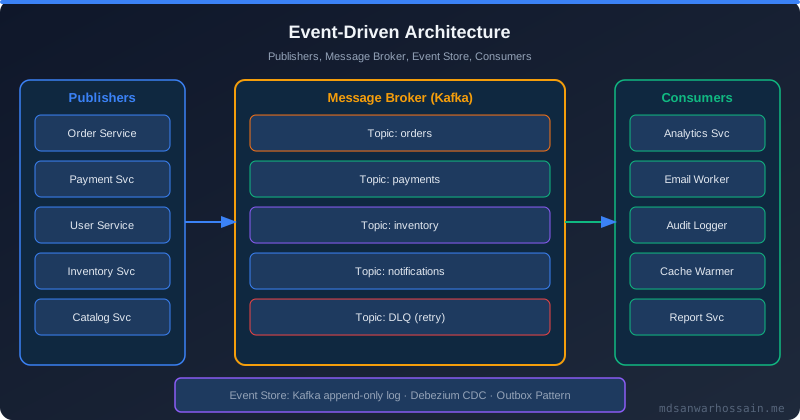
Table of Contents
1. The Poison Message Problem
An order processing service at an e-commerce company suddenly stops processing orders. Monitoring shows the consumer lag growing exponentially. Investigation reveals: one malformed order event—a JSON payload with a null required field generated by a race condition in the producer—is causing the consumer to throw a NullPointerException, retry indefinitely, and block all subsequent messages in the partition.
This is the poison message problem. In ordered message systems (Kafka partitions, FIFO SQS queues), a single unprocessable message can halt all downstream processing. Even in unordered systems, repeated processing attempts of a failed message consume resources and obscure metrics.
2. DLQ Fundamentals: What Goes to a DLQ and Why
A message should be routed to a DLQ when it meets one of these conditions:
- Deserialization failure: The message cannot be parsed. This is a producer bug — the message will never be processable by this consumer version. Send to DLQ immediately (no retries needed).
- Validation failure: The message is parseable but violates business rules (missing required fields, invalid enum values). May be processable after schema correction. Tag for human review.
- Processing exception — transient: A downstream dependency was temporarily unavailable. Should be retried with exponential backoff. Route to DLQ only after max retries exceeded.
- Processing exception — permanent: The business logic threw a definitive error (e.g., entity not found, foreign key violation). Retrying won't help. Route to DLQ immediately.
- TTL expiry: A time-sensitive event (e.g., a price update) that expired before processing. May still need forensic logging even if processing is no longer relevant.
Critical design principle: Not all messages should follow the same DLQ path. Classify failure types at the consumer level and route to failure-type-specific DLQs. This makes recovery pipelines dramatically simpler.
3. Core DLQ Patterns
Pattern 1: Retry Topic Chain (Kafka)
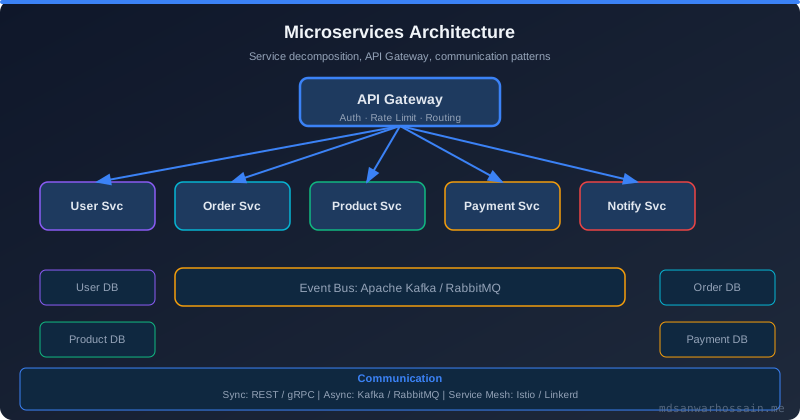
Instead of a single DLQ, use a chain of retry topics with increasing delay: orders.retry-1m → orders.retry-10m → orders.retry-1h → orders.dlq. Each retry topic has a separate consumer with a scheduled delay. This implements exponential backoff without blocking the main topic consumer and without complex in-consumer sleep logic.
↓ failure ↓ still fails ↓ still fails
consumer-0 consumer-1 consumer-2 consumer-3
(delayed 1m) (delayed 10m) (delayed 1h)
Pattern 2: Outbox DLQ (Transactional Routing)
For consumers that write to databases, use the Transactional Outbox pattern for DLQ routing. When processing fails permanently, write the failed event to a dlq_events database table within the same transaction that rolls back the business operation. A separate relay process reads from this table and publishes to the DLQ topic. This ensures exactly-once DLQ delivery even if the consumer crashes after processing but before committing the Kafka offset.
Pattern 3: Parallel DLQ Consumer
Run a dedicated DLQ consumer alongside the main consumer. The DLQ consumer attempts reprocessing at a slower rate (e.g., every 5 minutes, one message at a time). This provides automatic recovery without human intervention for transient failures while applying backpressure to prevent DLQ consumer from overwhelming recovering downstream systems.
4. DLQ Implementation in Kafka
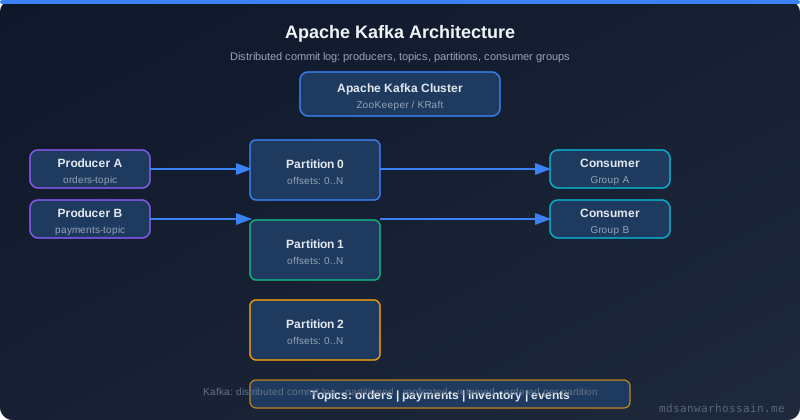
Kafka does not have native DLQ support. Implement it at the consumer application layer using Spring Kafka's SeekToCurrentErrorHandler and DeadLetterPublishingRecoverer:
@Configuration
public class KafkaConsumerConfig {

    @Bean
    public DefaultErrorHandler errorHandler(KafkaTemplate<Object, Object> template) {
        // Publish failed messages to {topic}.DLT topic
        DeadLetterPublishingRecoverer recoverer = new DeadLetterPublishingRecoverer(template,
            (record, ex) -> {
                // Route deserialization errors immediately to DLQ
                if (ex instanceof DeserializationException) {
                    return new TopicPartition(record.topic() + ".dlq", record.partition());
                }
                // Other errors go to retry topic
                return new TopicPartition(record.topic() + ".retry-5m", record.partition());
            });

        // Retry up to 3 times with exponential backoff before sending to DLQ
        ExponentialBackOffWithMaxRetries backOff = new ExponentialBackOffWithMaxRetries(3);
        backOff.setInitialInterval(1000L);
        backOff.setMultiplier(2.0);
        backOff.setMaxInterval(10000L);

        DefaultErrorHandler handler = new DefaultErrorHandler(recoverer, backOff);
        // Don't retry on permanent business errors
        handler.addNotRetryableExceptions(BusinessValidationException.class);
        return handler;
    }
}
Essential DLQ topic configuration: Set adequate retention period (30–90 days) and enable compression. Add headers to DLQ messages: original topic, partition, offset, exception class, exception message, failure timestamp, retry count. This metadata is essential for DLQ analysis and replay tooling.
5. DLQ Implementation in RabbitMQ
RabbitMQ has native DLQ support via Dead Letter Exchanges (DLX). Messages are dead-lettered when: rejected with requeue=false, TTL expires, or queue length limit is exceeded.
@Bean
public Queue ordersQueue() {
    return QueueBuilder.durable("orders")
        .withArgument("x-dead-letter-exchange", "orders.dlx")
        .withArgument("x-dead-letter-routing-key", "orders.dlq")
        .withArgument("x-message-ttl", 300000)  // 5-minute TTL
        .withArgument("x-max-length", 100000)   // overflow protection
        .build();
}

@Bean
public DirectExchange deadLetterExchange() {
    return new DirectExchange("orders.dlx");
}

@Bean
public Queue deadLetterQueue() {
    return QueueBuilder.durable("orders.dlq")
        .withArgument("x-message-ttl", 2592000000L) // 30 days
        .build();
}

@Bean
public Binding dlqBinding() {
    return BindingBuilder.bind(deadLetterQueue())
        .to(deadLetterExchange())
        .with("orders.dlq");
}

// In consumer: reject with requeue=false for poison messages
@RabbitListener(queues = "orders")
public void processOrder(Message message, Channel channel) throws Exception {
    try {
        orderService.process(deserialize(message));
        channel.basicAck(message.getMessageProperties().getDeliveryTag(), false);
    } catch (PermanentFailureException e) {
        // Dead-letter immediately — do not requeue
        channel.basicNack(message.getMessageProperties().getDeliveryTag(), false, false);
    } catch (TransientFailureException e) {
        // Requeue for retry (up to x-delivery-limit times)
        channel.basicNack(message.getMessageProperties().getDeliveryTag(), false, true);
    }
}
6. DLQ in AWS SQS + Spring Boot
AWS SQS has native DLQ support via redrive policies. Messages are automatically moved to the DLQ after maxReceiveCount processing attempts:
# Terraform: SQS queue with DLQ redrive policy
resource "aws_sqs_queue" "orders_dlq" {
  name                        = "orders-dlq"
  message_retention_seconds   = 1209600  # 14 days
  visibility_timeout_seconds  = 30
}

resource "aws_sqs_queue" "orders" {
  name                       = "orders"
  visibility_timeout_seconds = 30
  redrive_policy = jsonencode({
    deadLetterTargetArn = aws_sqs_queue.orders_dlq.arn
    maxReceiveCount     = 3  # 3 attempts before DLQ
  })
}
SQS DLQ monitoring: Create a CloudWatch alarm on NumberOfMessagesSent metric for the DLQ. Any message entering the DLQ should trigger an alert. Treat DLQ depth as a critical metric — a growing DLQ is a silent system failure.
7. DLQ Recovery Pipelines
A DLQ without a recovery strategy is just a slightly delayed failure. Design recovery pipelines from day one:
Recovery Strategy Matrix:
- Automatic replay: DLQ consumer that replays messages back to the original topic after a cooldown period. Best for transient failures (downstream service was temporarily down).
- Transforming replay: A pipeline that reads DLQ messages, applies a transformation or fix (e.g., adds missing fields with default values), and replays to the original topic. Best for schema evolution mismatches.
- Manual triage: For business logic failures, expose a UI or API for operations teams to inspect DLQ messages and take actions: replay individual messages, bulk-replay a time range, or archive permanently failed messages.
- Compensating transaction: For messages that represent state changes that partially succeeded (e.g., an order was created but the payment event couldn't be processed), trigger a compensating action (e.g., cancel the order) rather than replaying the failed event.
8. Real-World Failure Scenarios
Scenario: DLQ Feedback Loop
A team configured automatic DLQ replay: messages in the DLQ are replayed to the original topic every 5 minutes. After a database outage, 50,000 messages accumulated in the DLQ. When the DB recovered, the replay flooded the consumer with 50,000 messages simultaneously — causing another outage. Fix: Rate-limited replay (max 100 messages/minute) and circuit-breaker check before replay: if the consumer lag is high, pause replay.
Scenario: Silent DLQ Growth
A microservice's DLQ grew to 2 million messages over 6 months unnoticed because there was no alert on DLQ depth. The messages contained completed financial transactions that needed to trigger downstream reconciliation—reconciliation hadn't run for 6 months. Fix: DLQ non-zero = PagerDuty alert. Zero tolerance for unmonitored DLQ depth.
9. Trade-offs and Anti-Patterns
- Anti-pattern: Using DLQ as a logging system. Some teams route all errors to DLQ as a debug log. DLQs are operational queues—only messages that need eventual reprocessing belong there.
- Anti-pattern: Infinite retry before DLQ. Retrying 100+ times before DLQ routing means poison messages occupy a consumer for hours. Max 3–5 retries with exponential backoff is the industry standard.
- Anti-pattern: Single global DLQ. Mixing messages from 20 different topics in one DLQ makes recovery impossible. One DLQ per source topic, with routing by failure type.
- Trade-off: Ordering vs. progress. In Kafka, routing to a retry topic breaks partition-level ordering guarantees. If your business logic requires ordered processing (e.g., account balance updates), you cannot skip past a failed message—you must block. Design your consumer ordering requirements explicitly before choosing a DLQ strategy.
10. Key Takeaways
- Classify failure types (deserialization, validation, transient, permanent) and route to separate DLQs for each type.
- Kafka DLQ is application-layer; use Spring Kafka's
DeadLetterPublishingRecovererwith retry topic chains for exponential backoff. - RabbitMQ DLX provides native dead-lettering; configure
x-delivery-limitto prevent infinite retry loops. - Alert on DLQ non-zero depth. A growing DLQ is a silent production failure requiring immediate attention.
- Design replay pipelines for every DLQ from day one — rate-limited, with circuit-breaker protection against replay floods.
- Include full context headers on DLQ messages: original topic, exception, retry count, timestamps. Without this, recovery becomes guesswork.
Conclusion
Dead Letter Queues transform uncontrolled message processing failures into manageable, isolated events that can be analyzed, triaged, and recovered. Every event-driven microservice needs a well-designed DLQ strategy before its first production deployment — not after the first outage.
The teams that treat DLQ depth as a first-class SLA metric — not an afterthought — are the ones that maintain reliable event-driven systems at scale.
Frequently Asked Questions
What is The Poison Message Problem and how does it work?
An order processing service at an e-commerce company suddenly stops processing orders. Monitoring shows the consumer lag growing exponentially. Investigation reveals: one malformed order event—a JSON payload with a null required field generated by a race condition in the producer—is causing the consumer to throw a NullPointerException , retry indefinitely, and block all subsequent messages in the partition. This is the poison message problem. In ordered message systems (Kafka partitions, FIFO SQS queues), a single unprocessable message can halt all downstream processing. Even in unordered systems, repeated processing attempts of a failed message consume resources and obscure metrics.
What is DLQ Fundamentals and how does it work?
A message should be routed to a DLQ when it meets one of these conditions: Critical design principle: Not all messages should follow the same DLQ path. Classify failure types at the consumer level and route to failure-type-specific DLQs. This makes recovery pipelines dramatically simpler. Deserialization failure: The message cannot be parsed. This is a producer bug — the message will never be processable by this consumer version. Send to DLQ immediately (no retries needed). Validation failure: The message is parseable but violates business rules (missing required fields, invalid enum values). May be processable after schema correction. Tag for human review. Processing exception — transient: A downstream dependency was temporarily unavailable. Should be retried with exponential backoff. Route to DLQ only after max retries exceeded.
How does the Pattern 1 work and when should you use it?
Instead of a single DLQ, use a chain of retry topics with increasing delay: orders.retry-1m → orders.retry-10m → orders.retry-1h → orders.dlq . Each retry topic has a separate consumer with a scheduled delay. This implements exponential backoff without blocking the main topic consumer and without complex in-consumer sleep logic.
How does the Pattern 2 work and when should you use it?
For consumers that write to databases, use the Transactional Outbox pattern for DLQ routing. When processing fails permanently, write the failed event to a dlq_events database table within the same transaction that rolls back the business operation. A separate relay process reads from this table and publishes to the DLQ topic. This ensures exactly-once DLQ delivery even if the consumer crashes after processing but before committing the Kafka offset.
How does the Pattern 3 work and when should you use it?
Run a dedicated DLQ consumer alongside the main consumer. The DLQ consumer attempts reprocessing at a slower rate (e.g., every 5 minutes, one message at a time). This provides automatic recovery without human intervention for transient failures while applying backpressure to prevent DLQ consumer from overwhelming recovering downstream systems.
Leave a Comment
Related Posts

Software Engineer · Java · Spring Boot · Microservices