Flux CD Multi-Cluster GitOps: Image Automation, SOPS Secrets, and Progressive Reconciliation at Scale
Running a Kubernetes fleet across multiple clouds and regions demands a GitOps engine that is resilient, auditable, and truly declarative. Flux CD's operator model — where every cluster reconciles its desired state independently from Git — eliminates the single-point-of-failure risk that plagues centralised CD pipelines. In this deep dive we cover Flux's source-controller architecture, multi-cluster fleet bootstrap, image update automation, SOPS-encrypted secrets, multi-tenant namespace isolation, and progressive reconciliation with health checks — everything you need to run Flux confidently in production.
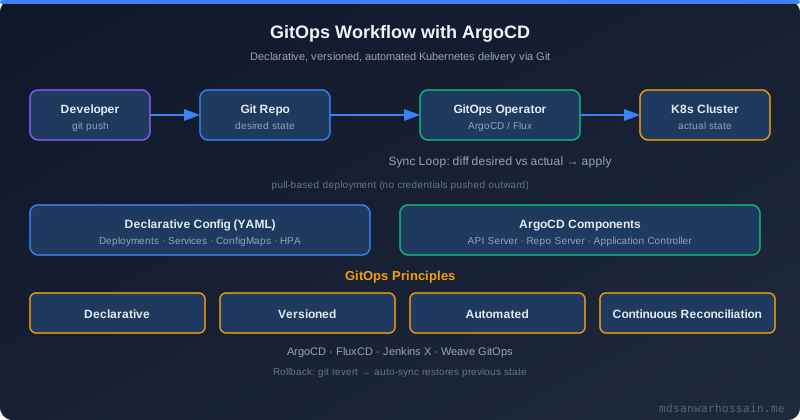
Table of Contents
- ArgoCD vs Flux CD: Choosing the Right GitOps Engine
- Flux Architecture: Sources, Kustomizations, and the Reconciliation Loop
- Multi-Cluster Fleet Management with Flux
- Image Update Automation: Eliminating Manual Deployment PRs
- Secrets Management with SOPS and Age Encryption
- Multi-Tenancy: Namespace-Scoped Flux Instances
- Progressive Reconciliation: Health Checks, Dependencies, and Rollback Hooks
- Production Failure Scenarios and Emergency Overrides
- Trade-offs and When NOT to Use Flux CD
- Key Takeaways
- Conclusion
1. ArgoCD vs Flux CD: Choosing the Right GitOps Engine
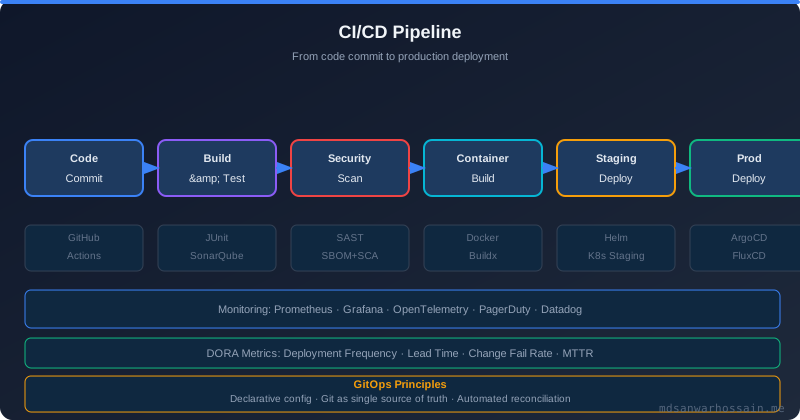
ArgoCD and Flux CD both implement the GitOps pattern — Git as the single source of truth, with automated reconciliation of cluster state — but they make fundamentally different architectural choices. ArgoCD takes a UI-first, centralised control-plane approach: a single ArgoCD server manages sync across all clusters, surfacing everything through a rich web dashboard and CLI. Flux takes a GitOps-native, decentralised approach: each cluster runs its own set of Flux controllers that independently pull from Git and reconcile local state, with no central server required.
For small teams managing one or two clusters, ArgoCD's centralised UI is a genuine productivity advantage — developers can see all application sync statuses on a single screen without querying kubectl. But the centralised model creates a critical dependency: if the ArgoCD server becomes unavailable, no cluster reconciles until it recovers. In a hub-and-spoke topology, the hub is also the blast radius.
The practical decision matrix is straightforward. Choose ArgoCD when your team prioritises a visual operations interface, you run a small cluster count (under 5), and you're comfortable managing ArgoCD HA for the control plane. Choose Flux when you need each cluster to be self-sufficient, you operate at scale (10+ clusters), you want deep integration with automated pipelines without UI dependencies, or you need fine-grained multi-tenancy where platform teams and application teams manage Flux installations independently at the namespace level.
2. Flux Architecture: Sources, Kustomizations, and the Reconciliation Loop
Flux is composed of six loosely coupled controllers, each owning a specific responsibility. source-controller watches Git repositories, Helm repositories, OCI registries, and S3 buckets — it fetches and caches their artifacts locally and exposes them as Kubernetes custom resources. kustomize-controller builds and applies Kustomize overlays from sources. helm-controller manages Helm release lifecycle from HelmRepository sources. image-reflector-controller scans container registries for new image tags and writes them to ImageRepository status. image-automation-controller commits updated image tags back to Git. notification-controller sends events to Slack, Teams, PagerDuty, and other providers.
The reconciliation loop works in two stages. First, source-controller polls Git on a configurable interval (typically 1 minute) and produces an immutable artifact — a tarball of the repository at that commit SHA — stored in a local cache. Second, kustomize-controller watches for new artifacts, builds the Kustomize output, applies it to the cluster via server-side apply, and records the result. This two-stage separation means heavy Git operations don't block the application of manifests, and the artifact cache survives short Git outages without halting reconciliation.
A minimal GitRepository source and Kustomization look like this:
# GitRepository source
apiVersion: source.toolkit.fluxcd.io/v1
kind: GitRepository
metadata:
  name: fleet-infra
  namespace: flux-system
spec:
  interval: 1m
  url: https://github.com/myorg/fleet-infra
  ref:
    branch: main
  secretRef:
    name: flux-system
# Kustomization applying the production overlay
apiVersion: kustomize.toolkit.fluxcd.io/v1
kind: Kustomization
metadata:
name: infrastructure
namespace: flux-system
spec:
interval: 10m
path: ./clusters/production/infrastructure
prune: true
sourceRef:
kind: GitRepository
name: fleet-infra
timeout: 5mThe prune: true field enables garbage collection — any Kubernetes resource previously created by this Kustomization that is no longer present in Git will be deleted on the next reconciliation cycle. This is the GitOps guarantee: the cluster state converges to what is in Git, removing the drift that accumulates in manually managed clusters. The interval: 10m means Flux re-applies the full overlay every 10 minutes regardless of whether Git changed — catching any manual kubectl edits that deviate from the desired state.
3. Multi-Cluster Fleet Management with Flux
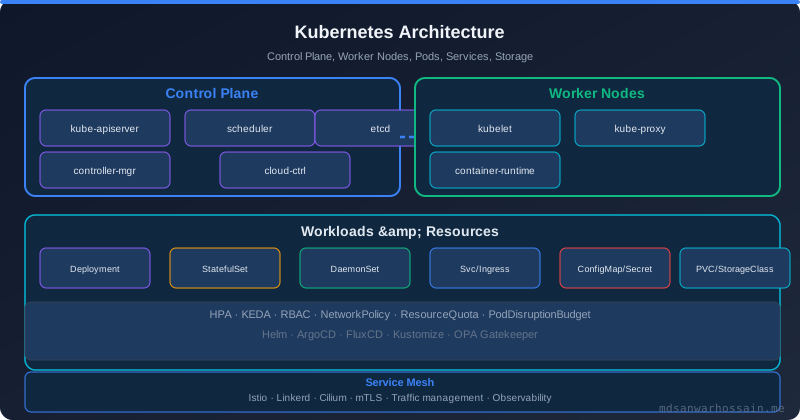
The recommended pattern for fleet management is a dedicated fleet-infra repository with a directory structure that mirrors your cluster topology. Each cluster has its own directory containing Kustomizations that point to shared base manifests layered with cluster-specific patches:
fleet-infra/
├── clusters/
│   ├── production/
│   │   ├── eu-west-1/        # AWS production cluster
│   │   │   ├── flux-system/
│   │   │   └── apps/
│   │   └── europe-west1/     # GCP production cluster
│   │       ├── flux-system/
│   │       └── apps/
│   └── staging/
│       └── eu-central-1/
│           ├── flux-system/
│           └── apps/
├── infrastructure/
│   ├── base/                 # Shared infrastructure manifests
│   └── overlays/
│       ├── production/
│       └── staging/
└── apps/
    ├── base/                 # Shared application manifests
    └── overlays/
        ├── production/
        └── staging/
Bootstrap a new cluster into the fleet using the Flux CLI. This command installs the Flux controllers, creates the flux-system namespace, and commits the cluster's initial Kustomization manifests back to the fleet-infra repository:
# Bootstrap the production eu-west-1 cluster
flux bootstrap github \
  --owner=myorg \
  --repository=fleet-infra \
  --branch=main \
  --path=clusters/production/eu-west-1 \
  --personal=false \
  --token-auth
For deployment ordering across a cluster — ensuring cert-manager is ready before ingress controllers, and ingress controllers are ready before application workloads — Kustomizations support explicit dependsOn references:
# apps/production Kustomization depends on infrastructure being healthy first
apiVersion: kustomize.toolkit.fluxcd.io/v1
kind: Kustomization
metadata:
  name: apps-production
  namespace: flux-system
spec:
  interval: 5m
  path: ./apps/overlays/production
  prune: true
  sourceRef:
    kind: GitRepository
    name: fleet-infra
  dependsOn:
    - name: infrastructure-production
  timeout: 10m
4. Image Update Automation: Eliminating Manual Deployment PRs
One of Flux's most powerful differentiators from ArgoCD is built-in image update automation. Rather than requiring a CI pipeline step that opens a pull request with an updated image tag, Flux's image-reflector-controller continuously scans your container registry for new tags matching a policy, and image-automation-controller commits the updated tag directly back to Git — the cluster then reconciles the new image automatically.
The setup requires three resources. An ImageRepository tells Flux which registry to scan. An ImagePolicy filters which tags are candidates. An ImageUpdateAutomation defines the Git commit strategy:
# ImageRepository — poll the registry every 5 minutes
apiVersion: image.toolkit.fluxcd.io/v1beta2
kind: ImageRepository
metadata:
  name: payment-service
  namespace: flux-system
spec:
  image: ghcr.io/myorg/payment-service
  interval: 5m
  secretRef:
    name: ghcr-credentials
# ImagePolicy — accept only semver releases >= 1.0.0
apiVersion: image.toolkit.fluxcd.io/v1beta2
kind: ImagePolicy
metadata:
name: payment-service
namespace: flux-system
spec:
imageRepositoryRef:
name: payment-service
policy:
semver:
range: ">=1.0.0"# ImageUpdateAutomation — commit new tags back to Git
apiVersion: image.toolkit.fluxcd.io/v1beta1
kind: ImageUpdateAutomation
metadata:
name: fleet-image-updates
namespace: flux-system
spec:
interval: 1m
sourceRef:
kind: GitRepository
name: fleet-infra
git:
checkout:
ref:
branch: main
commit:
author:
email: fluxcdbot@myorg.com
name: Flux CD Bot
messageTemplate: |
chore(image): update {{range .Updated.Images}}{{.Name}} to {{.NewTag}} {{end}}
Automated image update by Flux CD image-automation-controller.
[skip ci]
push:
branch: main
update:
path: ./apps
strategy: SettersIn your Kubernetes Deployment manifest, annotate the image field with a marker that tells Flux which ImagePolicy governs it:
containers:
  - name: payment-service
    image: ghcr.io/myorg/payment-service:1.3.2 # {"$imagepolicy": "flux-system:payment-service"}
When image-reflector-controller detects 1.4.0 in the registry, image-automation-controller updates the tag in-place in this YAML, commits with the template message, and pushes to Git. The Kustomization reconciliation loop picks up the change within its next interval and rolls out the new image — full GitOps traceability, zero human intervention.
5. Secrets Management with SOPS and Age Encryption
Storing Kubernetes Secrets in Git is the GitOps ideal but the operational security problem. The solution Flux recommends is SOPS (Secrets OPerationS) with Age encryption. SOPS encrypts only the values of YAML fields — the keys remain in plain text — making encrypted secret files fully reviewable in pull requests without leaking credentials.
First, generate an Age key pair and store the private key as a Kubernetes Secret in the flux-system namespace:
# Generate an Age key pair
age-keygen -o age.agekey

# Import the private key into the cluster so Flux can decrypt
kubectl create secret generic sops-age \
  --namespace=flux-system \
  --from-file=age.agekey=./age.agekey

# Record the public key for encrypting secrets (safe to commit)
# Public key: age1ql3z7hjy54pw3hyww5ayyfg7zqgvc7w3j2elw8zmrj2kg5sfn9aqmcac8p
Create a .sops.yaml config at the root of your fleet-infra repository to define which files SOPS should encrypt and with which key:
# .sops.yaml — encryption rules
creation_rules:
  - path_regex: .*/secrets/.*\.yaml
    age: age1ql3z7hjy54pw3hyww5ayyfg7zqgvc7w3j2elw8zmrj2kg5sfn9aqmcac8p
Encrypt a Secret manifest and commit it to Git:
# Encrypt the secret — values become ciphertext, keys remain readable
sops --encrypt \
  --age age1ql3z7hjy54pw3hyww5ayyfg7zqgvc7w3j2elw8zmrj2kg5sfn9aqmcac8p \
  payment-db-secret.yaml > payment-db-secret.enc.yaml

# The encrypted file looks like this in Git:
apiVersion: v1
kind: Secret
metadata:
    name: payment-db-credentials
    namespace: payment
type: Opaque
data:
    password: ENC[AES256_GCM,data:7k9P...truncated...,type:str]
    username: ENC[AES256_GCM,data:bQ2m...truncated...,type:str]
sops:
    age:
        - recipient: age1ql3z7hjy54pw3hyww5ayyfg7zqgvc7w3j2elw8zmrj2kg5sfn9aqmcac8p
          enc: |
            -----BEGIN AGE ENCRYPTED FILE-----
            ...
            -----END AGE ENCRYPTED FILE-----
Configure the Kustomization to decrypt SOPS secrets at reconciliation time using the private key stored in the cluster:
apiVersion: kustomize.toolkit.fluxcd.io/v1
kind: Kustomization
metadata:
  name: payment-secrets
  namespace: flux-system
spec:
  interval: 10m
  path: ./clusters/production/eu-west-1/secrets
  prune: true
  sourceRef:
    kind: GitRepository
    name: fleet-infra
  decryption:
    provider: sops
    secretRef:
name: sops-agepassword, api-key) without being able to read the actual credential values. Combined with branch protection and required reviews, this makes secret rotation a safe, fully auditable Git workflow.
6. Multi-Tenancy: Namespace-Scoped Flux Instances
In a shared cluster serving multiple product teams, you want to give each team GitOps autonomy over their own namespace without granting cluster-wide access. Flux supports this through namespace-scoped Kustomizations backed by a tenant-specific ServiceAccount. The platform team creates the ServiceAccount and RBAC, and the tenant team controls their own Git repository.
The platform team provisions a tenant by creating a GitRepository and Kustomization scoped to the tenant's namespace, referencing a ServiceAccount with only the permissions needed for that namespace:
# Tenant GitRepository — scoped to the tenant's app repo
apiVersion: source.toolkit.fluxcd.io/v1
kind: GitRepository
metadata:
  name: payments-team-app
  namespace: payments
spec:
  interval: 1m
  url: https://github.com/myorg/payments-app
  ref:
    branch: main
  secretRef:
    name: payments-team-git-credentials
# Tenant Kustomization — impersonates a namespace-scoped ServiceAccount
apiVersion: kustomize.toolkit.fluxcd.io/v1
kind: Kustomization
metadata:
name: payments-team-workloads
namespace: payments
spec:
interval: 5m
path: ./deploy/production
prune: true
sourceRef:
kind: GitRepository
name: payments-team-app
namespace: payments
serviceAccountName: payments-reconciler # namespace-scoped SA, not cluster-admin
targetNamespace: payments
timeout: 3mThe serviceAccountName: payments-reconciler field is the critical security boundary. kustomize-controller impersonates this ServiceAccount when applying manifests, meaning it can only create resources that the ServiceAccount has RBAC permission to manage. Even if a tenant's Git repository contains a ClusterRole binding or a resource in another namespace, the apply will fail with a permission error — the tenant's blast radius is bounded to their namespace.
The platform team creates the ServiceAccount and a RoleBinding granting it edit access within the payments namespace only:
apiVersion: v1
kind: ServiceAccount
metadata:
  name: payments-reconciler
  namespace: payments
---
apiVersion: rbac.authorization.k8s.io/v1
kind: RoleBinding
metadata:
  name: payments-reconciler
  namespace: payments
roleRef:
  apiGroup: rbac.authorization.k8s.io
  kind: ClusterRole
  name: edit
subjects:
  - kind: ServiceAccount
    name: payments-reconciler
    namespace: payments
7. Progressive Reconciliation: Health Checks, Dependencies, and Rollback Hooks
By default, Flux applies manifests and moves on — it doesn't wait to verify that the resulting Kubernetes resources are actually healthy before considering the Kustomization successful. For production deployments where one service's health affects downstream services, you want health checks that block reconciliation of dependent Kustomizations until the current one is fully operational.
# Kustomization with health checks
apiVersion: kustomize.toolkit.fluxcd.io/v1
kind: Kustomization
metadata:
  name: payment-service
  namespace: flux-system
spec:
  interval: 5m
  path: ./clusters/production/payment-service
  prune: true
  sourceRef:
    kind: GitRepository
    name: fleet-infra
  healthChecks:
    - apiVersion: apps/v1
      kind: Deployment
      name: payment-service
      namespace: payment
  timeout: 2m
With healthChecks defined, Flux waits up to the timeout duration for each listed resource to reach a healthy state — for a Deployment, that means all replicas are available and ready. Only when all health checks pass does the Kustomization move to Ready: True. Any Kustomization that declares dependsOn: payment-service will not reconcile until this condition is met.
This creates a progressive reconciliation chain: databases and infrastructure come up first, application services second, and ingress rules last — in the exact order your deployment dependencies require. If a payment-service Deployment rollout stalls (for example, a pod CrashLoopBackOff), the timeout fires, Flux marks the Kustomization as Ready: False, and all dependent Kustomizations halt. This prevents a degraded service from having its upstream dependencies updated while it is already broken.
For Helm releases managed by helm-controller, you can add rollback and remediation blocks to automatically roll back a failed Helm upgrade and retry:
apiVersion: helm.toolkit.fluxcd.io/v2
kind: HelmRelease
metadata:
  name: payment-service
  namespace: payment
spec:
  interval: 5m
  chart:
    spec:
      chart: payment-service
      version: ">=1.0.0"
      sourceRef:
        kind: HelmRepository
        name: myorg-charts
  upgrade:
    remediation:
      retries: 3
      remediateLastFailure: true
  rollback:
    timeout: 5m
    cleanupOnFail: true
8. Production Failure Scenarios and Emergency Overrides
GitOps does not eliminate production incidents — it changes their character. Instead of "who ran kubectl apply with the wrong manifest?", the incident becomes "which Git commit introduced a bad configuration, and how do we revert and recover quickly?" Understanding Flux's failure modes and override mechanisms is essential before going to production.
controller.config values schema. Flux's helm-controller attempted to upgrade all 8 clusters simultaneously since they all shared the same HelmRelease manifest path. The upgrade failed on all clusters, the remediation retries kept re-applying the broken chart, and the old Helm release was rolled back — but the ingress class annotation had changed, leaving all ingress resources in a broken state even after rollback. Within 4 minutes, all external HTTP traffic across the fleet was returning 503s.
The immediate emergency response is to suspend Flux reconciliation for the affected Kustomization or HelmRelease to stop the reconciliation loop from re-applying the broken state while the team investigates:
# Suspend reconciliation immediately — Flux stops touching this resource
flux suspend kustomization infrastructure-production

# Or suspend a specific HelmRelease
flux suspend helmrelease nginx-ingress -n ingress-nginx

# Manually apply a known-good manifest while suspended
kubectl apply -f ./known-good-ingress-values.yaml

# Once the Git fix is merged and you're ready to resume
flux resume kustomization infrastructure-production

# Force an immediate reconciliation without waiting for the next interval
flux reconcile kustomization infrastructure-production --with-source
Drift detection and forced reconciliation: Flux's default reconciliation interval means up to 10 minutes may pass before a Git commit reaches the cluster. In emergencies, flux reconcile kustomization <name> --with-source forces an immediate source fetch and apply. The --with-source flag is important — without it, Flux re-applies from the cached artifact, which may not include your latest Git push.
Drift detection: The interval on a Kustomization serves double duty — it's both the sync frequency and the drift detection frequency. Any manual kubectl edit or kubectl patch applied directly to a cluster will be overwritten on the next Flux reconciliation cycle. This is intentional and desirable in steady state, but operators sometimes need to make emergency patches that survive until a proper Git fix is merged. Use flux suspend to prevent drift correction during an incident response window.
9. Trade-offs and When NOT to Use Flux CD
Flux CD is a powerful production tool, but adopting it without understanding its trade-offs leads to frustration and misuse. These are the genuine friction points that teams encounter after moving beyond the happy path.
No built-in UI: Flux ships with no web dashboard. You operate it entirely through kubectl, the flux CLI, and Kubernetes events. For teams whose operators are accustomed to clicking through ArgoCD's sync graph, this is a significant adjustment. The Weave GitOps project (from Weaveworks, the originators of Flux) provides an open-source dashboard that surfaces Kustomization health, image policy status, and reconciliation history on top of Flux — add it as your first overlay if a UI is required.
Multi-tenant RBAC complexity: Setting up namespace-scoped ServiceAccounts, RoleBindings, and cross-namespace source references correctly is non-trivial. A misconfigured ServiceAccount that accidentally has cluster-admin privileges defeats the entire multi-tenancy model. Invest time in a Terraform or Helm-based platform provisioner that creates tenant RBAC consistently, and audit ServiceAccount permissions regularly.
Image automation adds machine commits to Git: When image-automation-controller commits updated image tags to your main branch, those commits appear in your Git history and trigger CI pipelines. Ensure those automated commits are signed (use git.commit.signingKey in ImageUpdateAutomation) and that your CI pipelines handle [skip ci] in commit messages to avoid infinite build loops. Some organisations prefer opening pull requests for image updates rather than committing directly to main — this is a deliberate trade-off between automation speed and change review.
When NOT to use Flux CD: Small teams managing a single cluster who primarily do application-level deployments will find ArgoCD's UI-driven workflow more productive and less operationally demanding. Flux's value scales with fleet size and automation requirements — below 3 clusters, the operational overhead of fleet-infra repo maintenance, SOPS key management, and Flux upgrades may outweigh the benefits. If your deployments are infrequent and your team doesn't have Kubernetes operators on-call, the lower cognitive overhead of ArgoCD's centralised model is a legitimate choice.
"GitOps is not about the tool — it is about the principle that the desired state of your system lives in Git, and the actual state continuously converges to it. Flux is the most faithful implementation of that principle for Kubernetes fleets at scale."
— Flux CD Community, CNCF Graduated Project
Key Takeaways
- Each cluster reconciles independently — Flux's decentralised operator model eliminates the single-point-of-failure risk of a centralised ArgoCD control plane during regional outages.
- image-automation-controller removes manual deployment PRs — Flux scans registries, selects tags by semver policy, and commits updated image references back to Git automatically, closing the GitOps loop end-to-end.
- SOPS + Age encrypts secrets at rest in Git — values are ciphertext but keys remain readable, enabling pull request review of secret metadata without exposing credentials.
- Namespace-scoped ServiceAccounts enforce tenant isolation — kustomize-controller impersonates a tenant's ServiceAccount, bounding their blast radius to their namespace even if they push cluster-wide resources to their Git repository.
- healthChecks + dependsOn enable progressive reconciliation — Flux waits for all health checks to pass before allowing dependent Kustomizations to proceed, preventing deployment cascades on top of degraded services.
flux suspendis your emergency brake — during incidents, suspending a Kustomization stops the reconciliation loop immediately, giving operators a safe window for manual intervention before a Git fix is merged.
Conclusion
Flux CD has matured into a production-grade GitOps engine that takes the "Git as source of truth" principle seriously at every layer — from source fetching and secret decryption to image automation and multi-tenant RBAC. Its decentralised architecture means your Kubernetes fleet is resilient to control-plane failures by construction: each cluster reconciles its own state independently, and the fleet-infra Git repository is the coordination point, not a central server. For organisations running Kubernetes at scale across multiple clouds or regions, this model is not just convenient — it is a reliability requirement.
The investment in a well-structured fleet-infra repository, a SOPS key management workflow, and namespace-scoped tenant provisioning pays dividends in operational confidence. Day-2 operations become predictable: every change is a Git commit, every deployment has a traceable author and timestamp, every secret rotation is a code review. Start with a single cluster bootstrap, add SOPS for secrets in week one, and progressively layer image automation and multi-tenancy as your team's comfort with the GitOps model grows. The result is an infrastructure that reads like documentation and drifts like a strongly consistent distributed system — back to what Git says it should be.
Leave a Comment
Related Posts

Software Engineer · Java · Spring Boot · Microservices