Java Foreign Function & Memory API (Project Panama): Zero-JNI Native Interop in Production
JNI — the Java Native Interface — has been the standard mechanism for calling native code from Java since JDK 1.1. It is also notoriously brittle: a JVM crash caused by a bad native pointer, hours lost to platform-specific build toolchains, and sun.misc.Unsafe workarounds haunting production codebases. Java 22 graduates the Foreign Function & Memory API (Project Panama, JEP 454) to a standard API, offering safe, structured, GC-aware native memory management and direct native function calls — no C glue code required.
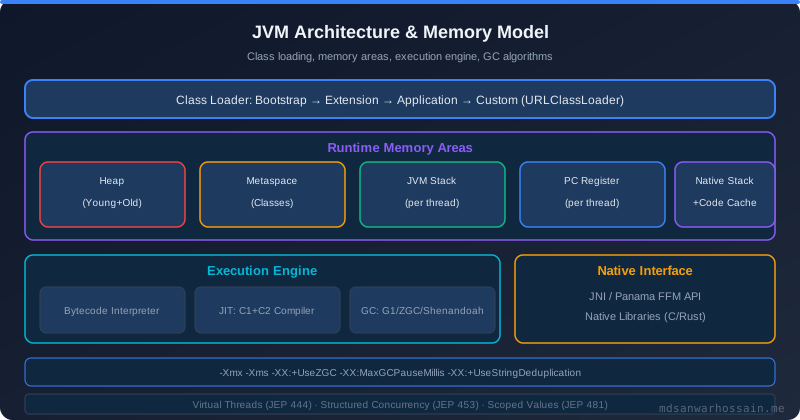
Table of Contents
- The Production Pain Points of JNI
- Panama's Core Abstractions: MemorySegment and Arena
- Calling Native Functions: Linker and MethodHandle
- Structured Off-Heap Memory with MemoryLayout
- Automating Bindings with jextract
- Production Failure Scenarios and Safety Guarantees
- Performance: Panama vs JNI vs Unsafe
- When to Use Panama and When Not To
- Key Takeaways
1. The Production Pain Points of JNI
Every team that has maintained a JNI-based integration knows the drill. Writing the Java interface is straightforward; the pain starts with the C glue layer. You need a platform-specific .so/.dll/.dylib, a javah-generated header, and a build pipeline that compiles for every target OS/arch combination. A single NULL pointer dereference in the native code causes an immediate JVM crash — no try-catch, no stack trace, just a core dump. Memory allocated with malloc in the native layer must be manually freed; leaks here are invisible to the Java heap profiler.
ByteBuffer parsing code was not updated. In production, incorrect field offsets caused silent data corruption in margin calculations for 72 hours before discrepancies triggered an alert. The JVM never crashed — bad data simply propagated through the pipeline.
The sun.misc.Unsafe alternative avoids the C glue code but is worse: direct memory access with no lifecycle management, no bounds checking, and an API that has been "deprecated" (but never removed) for years. Its behavior is not specified and changes across JVM releases. Codebases built on Unsafe for off-heap memory (common in high-frequency trading and embedded analytics) are maintenance liabilities.
2. Panama's Core Abstractions: MemorySegment and Arena
The two foundational Panama types are MemorySegment and Arena. A MemorySegment represents a contiguous region of memory — either on-heap, off-heap, or a native pointer returned by a C library. It carries spatial bounds (size and base address) and temporal bounds (the arena that controls its lifetime). Any access outside the spatial bounds throws IndexOutOfBoundsException. Any access after the arena is closed throws IllegalStateException. Both checks happen at Java level — no JVM crash.
import java.lang.foreign.*;

// Arena defines the lifetime of all segments allocated within it.
// AutoCloseable — use try-with-resources for deterministic deallocation.
try (Arena arena = Arena.ofConfined()) {

    // Allocate 1024 bytes of off-heap memory
    MemorySegment buffer = arena.allocate(1024);

    // Write a long at byte offset 0 — bounds-checked
    buffer.set(ValueLayout.JAVA_LONG, 0, 42L);

    // Read it back
    long value = buffer.get(ValueLayout.JAVA_LONG, 0);

    // Attempting buffer.get(ValueLayout.JAVA_LONG, 1020) throws
    // IndexOutOfBoundsException — safe by design
}
// Arena closed here: off-heap memory freed deterministically.
// Any attempt to access 'buffer' after this line throws IllegalStateException.
Arena comes in four flavors: Arena.ofConfined() (single-thread access, lowest overhead), Arena.ofShared() (multi-thread safe, uses stamped locking), Arena.ofAuto() (GC-managed lifetime, useful for small buffers where deterministic deallocation isn't critical), and Arena.global() (never freed, for truly static native resources like library handles). Choosing the right arena type is the single most important performance decision in Panama-based code.
3. Calling Native Functions: Linker and MethodHandle
Panama exposes native functions as Java MethodHandle instances via the Linker API. No C header files, no generated glue code. The call below invokes the standard C strlen function directly from Java:
import java.lang.foreign.*;
import java.lang.invoke.MethodHandle;

Linker linker = Linker.nativeLinker();
SymbolLookup stdlib = linker.defaultLookup();

// Look up 'strlen' in the C standard library
MethodHandle strlen = linker.downcallHandle(
    stdlib.find("strlen").orElseThrow(),
    FunctionDescriptor.of(
        ValueLayout.JAVA_LONG,   // return type: size_t (64-bit)
        ValueLayout.ADDRESS      // argument: const char*
    )
);

try (Arena arena = Arena.ofConfined()) {
    // Allocate a C string in off-heap memory
    MemorySegment cStr = arena.allocateFrom("Hello, Panama!");

    // Invoke the native strlen — type-safe, no glue code
    long len = (long) strlen.invoke(cStr);
    System.out.println("Length: " + len); // 14
}
The FunctionDescriptor is Panama's equivalent of a native function signature. It maps Java value layouts to C types. The Linker validates that the descriptor matches the number and types of arguments at the call site — catching type mismatches at binding time rather than at runtime. For the risk-calculation incident described earlier, this would have caught the struct layout change when rebinding the library, not 72 hours later in production data.
4. Structured Off-Heap Memory with MemoryLayout
MemoryLayout describes the structure of off-heap data — analogous to a C struct definition in Java. It encodes field sizes, alignment requirements, and padding. Combined with VarHandles derived from the layout, it provides type-safe structured access to off-heap memory without manual byte arithmetic.
// Model a C struct: { int id; double price; long timestamp; }
StructLayout tradeLayout = MemoryLayout.structLayout(
    ValueLayout.JAVA_INT.withName("id"),
    MemoryLayout.paddingLayout(4),          // C alignment padding
    ValueLayout.JAVA_DOUBLE.withName("price"),
    ValueLayout.JAVA_LONG.withName("timestamp")
);

// Derive type-safe VarHandles for field access
VarHandle idHandle        = tradeLayout.varHandle(PathElement.groupElement("id"));
VarHandle priceHandle     = tradeLayout.varHandle(PathElement.groupElement("price"));
VarHandle timestampHandle = tradeLayout.varHandle(PathElement.groupElement("timestamp"));

try (Arena arena = Arena.ofConfined()) {
    // Allocate an array of 10,000 trade structs — entirely off-heap
    MemorySegment trades = arena.allocate(tradeLayout, 10_000);

    // Write trade at index 0 — bounds-checked, no byte arithmetic
    idHandle.set(trades, 0L, 0L, 12345);
    priceHandle.set(trades, 0L, 0L, 99.95);
    timestampHandle.set(trades, 0L, 0L, System.currentTimeMillis());

    // Read back
    int id = (int) idHandle.get(trades, 0L, 0L);
}
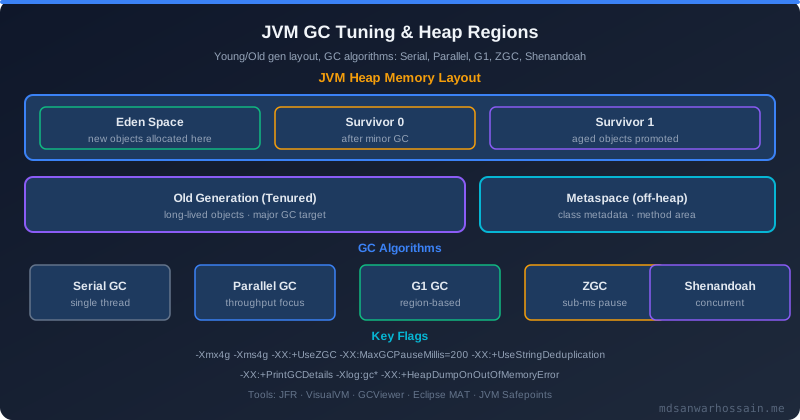
This pattern is critical for high-frequency trading systems and streaming analytics engines that need to process millions of records per second without heap allocation pressure. A 10,000-element trade array allocated off-heap via Panama is completely invisible to the garbage collector — no GC pauses, no TLAB pressure, and deterministic deallocation when the arena closes.
5. Automating Bindings with jextract
jextract is a companion tool (separate download from OpenJDK) that reads a C header file and generates Java bindings automatically. For a complex library with hundreds of functions and structs, hand-writing FunctionDescriptor and MemoryLayout definitions is error-prone. jextract eliminates this:
# Generate Java bindings from a C header
jextract \
  --output src/main/java \
  --target-package com.example.native.libssl \
  /usr/include/openssl/ssl.h

# Generated classes include:
# - ssl_h.java        (all functions as MethodHandles)
# - SSL_CTX.java      (struct layout + VarHandles)
# - SSL_METHOD.java
# Usage in Java:
try (Arena arena = Arena.ofConfined()) {
    MemorySegment ctx = ssl_h.SSL_CTX_new(ssl_h.TLS_client_method());
    // ... fully type-safe SSL calls without a single line of C
}
6. Production Failure Scenarios and Safety Guarantees
Out-of-bounds access: Accessing segment.get(ValueLayout.JAVA_LONG, segment.byteSize()) throws IndexOutOfBoundsException — the JVM does not crash. In JNI, the equivalent mistake causes a segfault and a core dump with no Java stack trace. This alone eliminates an entire class of production incidents.
Use-after-free: Accessing a MemorySegment whose arena has been closed throws IllegalStateException. The error includes the stack trace from the thread that closed the arena (in confined and shared arena modes), making debugging deterministic.
Thread safety: Arena.ofConfined() segments throw WrongThreadException if accessed from any thread other than the owning thread. Arena.ofShared() allows concurrent access at a small locking cost. Choosing the wrong arena type for your access pattern is detected immediately in testing, not in production under load.
7. Performance: Panama vs JNI vs Unsafe
JMH benchmarks from OpenJDK Panama team and independent analysis consistently show Panama downcalls within 5–15% of raw JNI performance for simple native calls, with the gap closing to within JIT noise for calls that take >1µs (i.e., virtually all real-world native library calls). The overhead is from the safety checks — bounds checking on MemorySegment access — which can be partially eliminated by the JIT through range-check elimination when access patterns are predictable.
For off-heap memory access throughput, Panama's MemorySegment with Arena.ofConfined() matches sun.misc.Unsafe performance while adding full safety guarantees. In synthetic benchmarks: sequential reads at ~15 GB/s (both Panama and Unsafe), random access latency ~10ns (confined arena), arena allocation ~50ns for <4KB regions.
8. When to Use Panama and When Not To
Use Panama when: Calling C/C++ libraries without C glue code. Managing large off-heap memory buffers (ML inference, message queues, memory-mapped files). Replacing sun.misc.Unsafe usage in library code. Integrating with OS-level APIs (POSIX, Windows API) directly from Java.
Avoid Panama when: A mature JNA/JNI binding library already exists and maintenance cost is low. The native code path is short-lived and JNI startup overhead is negligible. Team members don't have systems programming familiarity — misused MemoryLayout definitions can still cause subtle data corruption even without JVM crashes.
Key Takeaways
- Panama eliminates JVM crashes from native code — bounds and lifetime checks throw Java exceptions, not segfaults.
- Arena lifecycle management is explicit and deterministic: confined, shared, auto, or global — choose based on access pattern and thread model.
- MemoryLayout + VarHandle replaces manual byte arithmetic for structured off-heap data — catches layout mismatches at binding time.
- jextract automates bindings from C headers, eliminating entire categories of manual transcription errors.
- Performance matches Unsafe for off-heap access and comes within 15% of raw JNI for downcalls — safety is not expensive.
- Panama is now standard (JEP 454, Java 22) — JNI and Unsafe usage in new code is technical debt from day one.
Conclusion
Project Panama's Foreign Function & Memory API represents a fundamental shift in how Java interacts with native code. After nearly three decades of JNI — the production nightmare that launched a thousand workarounds — Java finally offers a safe, structured, performant path to native interoperability. The safety guarantees aren't theoretical niceties; they prevent the class of incidents where silent data corruption from struct layout mismatches propagates undetected through production pipelines.
For teams maintaining legacy JNI codebases, the migration path is incremental: start with jextract on your most critical header files, replace ByteBuffer-based struct parsing with MemoryLayout, and gradually move arena-allocated buffers off-heap. Each step delivers immediate safety and maintainability improvements without requiring a complete rewrite. The goal is to make your next native library integration the one where you don't have a post-mortem.
Frequently Asked Questions
What are the production considerations for The Production Pain Points of JNI?
Every team that has maintained a JNI-based integration knows the drill. Writing the Java interface is straightforward; the pain starts with the C glue layer. You need a platform-specific .so / .dll / .dylib , a javah -generated header, and a build pipeline that compiles for every target OS/arch combination. A single NULL pointer dereference in the native code causes an immediate JVM crash — no try-catch , no stack trace, just a core dump. Memory allocated with malloc in the native layer must be manually freed; leaks here are invisible to the Java heap profiler. The sun.misc.Unsafe alternative avoids the C glue code but is worse: direct memory access with no lifecycle management, no bounds checking, and an API that has been "deprecated" (but never removed) for years.
What is Panama's Core Abstractions and how does it work?
The two foundational Panama types are MemorySegment and Arena . A MemorySegment represents a contiguous region of memory — either on-heap, off-heap, or a native pointer returned by a C library. It carries spatial bounds (size and base address) and temporal bounds (the arena that controls its lifetime). Any access outside the spatial bounds throws IndexOutOfBoundsException . Any access after the arena is closed throws IllegalStateException . Both checks happen at Java level — no JVM crash. import java.lang.foreign.*; // Arena defines the lifetime of all segments allocated within it. // AutoCloseable — use try-with-resources for deterministic deallocation.
What is Calling Native Functions and how does it work?
Panama exposes native functions as Java MethodHandle instances via the Linker API. No C header files, no generated glue code. The call below invokes the standard C strlen function directly from Java: import java.lang.foreign.*; import java.lang.invoke.MethodHandle; Linker linker = Linker.nativeLinker(); SymbolLookup stdlib = linker.defaultLookup(); // Look up 'strlen' in the C standard library MethodHandle strlen = linker.downcallHandle( stdlib.find("strlen").orElseThrow(), FunctionDescriptor.of( ValueLayout.JAVA_LONG, // return type: size_t (64-bit) ValueLayout.ADDRESS // argument: const char* ) ); try (Arena arena = Arena.ofConfined()) { // Allocate a C string in off-heap memory MemorySegment cStr = arena.allocateFrom("Hello, Panama!"); // Invoke the native strlen — type-safe, no glue code long len = (long) strlen.invoke(cStr); System.out.println("Length: " + len); // 14 } The FunctionDescriptor is Panama's equivalent of a native function signature.
What is Structured Off-Heap Memory with MemoryLayout and how does it work?
MemoryLayout describes the structure of off-heap data — analogous to a C struct definition in Java. It encodes field sizes, alignment requirements, and padding. Combined with VarHandle s derived from the layout, it provides type-safe structured access to off-heap memory without manual byte arithmetic. // Model a C struct: { int id; double price; long timestamp; } StructLayout tradeLayout = MemoryLayout.structLayout( ValueLayout.JAVA_INT.withName("id"), MemoryLayout.paddingLayout(4), // C alignment padding ValueLayout.JAVA_DOUBLE.withName("price"), ValueLayout.JAVA_LONG.withName("timestamp") ); // Derive type-safe VarHandles for field access VarHandle idHandle = tradeLayout.varHandle(PathElement.groupElement("id")); VarHandle priceHandle = tradeLayout.varHandle(PathElement.groupElement("price")); VarHandle timestampHandle = tradeLayout.varHandle(PathElement.groupElement("timestamp")); try (Arena arena = Arena.ofConfined()) { // Allocate an array of 10,000 trade structs — entirely off-heap MemorySegment trades = arena.allocate(tradeLayout, 10_000); // Write trade at index 0 — bounds-checked, no byte arithmetic idHandle.set(trades, 0L, 0L, 12345); priceHandle.set(trades, 0L, 0L, 99.95);.
What is Automating Bindings with jextract and how does it work?
jextract is a companion tool (separate download from OpenJDK) that reads a C header file and generates Java bindings automatically. For a complex library with hundreds of functions and structs, hand-writing FunctionDescriptor and MemoryLayout definitions is error-prone. jextract eliminates this:
Leave a Comment
Related Posts

Software Engineer · Java · Spring Boot · Microservices