JVM Safepoint Pauses: The Hidden Latency Killer in Low-Latency Java Applications
You switched to ZGC. P50 latency is beautiful. But P99 still spikes to 400ms every few minutes and you cannot explain why. The answer is almost certainly not your garbage collector — it is JVM safepoints, the hidden stop-the-world mechanism that operates independently of GC and that most engineers have never heard of.
Table of Contents
- What Are JVM Safepoints?
- How Safepoint Pauses Work: The Time-to-Safepoint Problem
- The Production Incident: 400ms P99 With ZGC
- Diagnosing With JFR and async-profiler
- Code Patterns That Cause Excessive Safepoint Delays
- JVM Flags to Reduce Safepoint Frequency
- Virtual Threads and Safepoints in Java 21
- Architecture: Separating Latency-Sensitive from Throughput Workloads
- When to Escalate vs Optimize
- Conclusion
What Are JVM Safepoints?
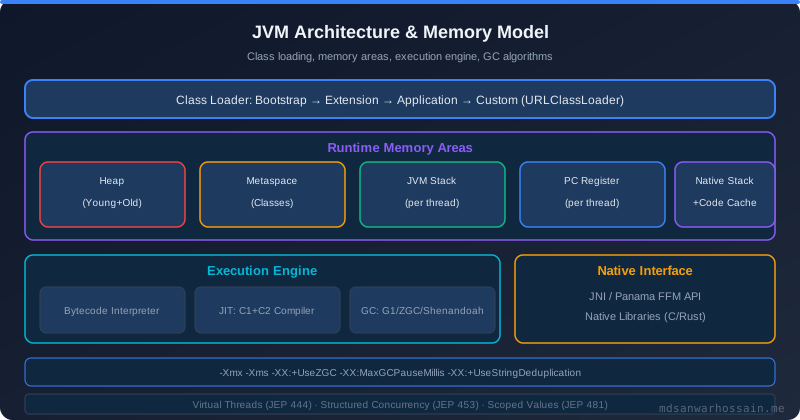
A safepoint is a moment in time when all Java application threads have been brought to a consistent, known state — specifically, a state where the JVM can safely inspect or modify the heap, method bytecode, and thread stacks. Safepoints are not just about garbage collection; they are required for a range of JVM operations:
- Garbage collection (GC root enumeration requires a consistent heap view)
- Biased locking revocation — when a thread that holds a biased lock needs to be revoked, all threads stop
- Deoptimization — the JIT compiler invalidates an optimised method (e.g., after a class is loaded that changes an inlining assumption)
- Class redefinition (JVMTI-based hot swapping in debuggers/agents)
- Thread stack dumps (e.g., triggered by
jstackor JFR) - Code cache flushing
- Monitor deflation (Java 21+ periodic cleanup of inflated monitors)
The key insight that surprises most engineers: safepoints are entirely separate from GC pauses. Even with ZGC or Shenandoah — collectors designed for sub-millisecond GC pauses — safepoints from non-GC operations can still freeze all threads for hundreds of milliseconds.
How Safepoint Pauses Work: The Time-to-Safepoint Problem
When the JVM needs a safepoint, it sets a flag and waits for all threads to reach a "safe" position. The total safepoint pause has two components:
- Time-to-safepoint (TTSP): the time from when the JVM requests the safepoint until the last thread checks in. This is the dangerous part.
- Safepoint operation time: the actual time spent performing the operation at safepoint (e.g., GC root scan).
A thread can only reach a safepoint at specific positions in its bytecode execution. The JIT compiler inserts safepoint polls at method entries, loop back-edges, and a few other locations. The notorious issue: counted loops with an integer counter do not have safepoint polls inserted by default in the JIT-compiled code, because the JIT assumes counted loops are short. If a thread is executing a tight loop with millions of iterations and never checks the safepoint flag, every other thread has to wait for it to finish — potentially for hundreds of milliseconds.
The Production Incident: 400ms P99 With ZGC
A fintech order-processing service running Java 17 with ZGC on 32-core Kubernetes pods. GC logs showed ZGC pauses consistently under 2ms. Yet Datadog P99 latency for order submission was spiking to 380–450ms every 4–7 minutes. The spike pattern was suspiciously regular.
First step: enable verbose safepoint logging with JVM flags:
# Add to JVM startup flags
-Xlog:safepoint*=debug:file=/var/log/jvm/safepoint.log:time,uptime,level,tags:filecount=5,filesize=50m
-Xlog:safepoint+stats=debug
The log revealed the culprit immediately:
[2026-03-15T14:23:07.441+0000][safepoint ] Safepoint "RevokeBias", Time since last: 247123 ns, Reaching safepoint: 412 ms, Cleanup: 1 ms, At safepoint: 3 ms, Total: 416 ms
[2026-03-15T14:23:07.443+0000][safepoint ] Safepoint "RevokeBias", Time since last: 249823 ns, Reaching safepoint: 389 ms, ...
[2026-03-15T14:27:11.103+0000][safepoint ] Safepoint "RevokeBias", Time since last: 243211 ns, Reaching safepoint: 401 ms, ...
Biased locking revocation. The service used a thread pool that was occasionally reassigned. Whenever a thread that held a biased lock needed to have that bias revoked — because a different thread wanted the same lock — the JVM had to stop the world. The "Reaching safepoint" time of 400ms indicated a thread stuck in a long counted loop that wasn't yielding to the safepoint poll.
Diagnosing With JFR and async-profiler
Java Flight Recorder provides the most reliable safepoint telemetry. Start a JFR recording with safepoint events:
// Programmatic JFR recording with safepoint statistics
import jdk.jfr.*;

Configuration config = Configuration.getConfiguration("default");
RecordingSettings settings = new RecordingSettings();
settings.enable("jdk.SafepointBegin").withPeriod(Duration.ofSeconds(1));
settings.enable("jdk.SafepointEnd").withPeriod(Duration.ofSeconds(1));
settings.enable("jdk.SafepointStateSynchronization");

try (Recording recording = new Recording(config)) {
    recording.start();
    Thread.sleep(60_000);
    recording.dump(Path.of("/tmp/safepoint-analysis.jfr"));
}
Parse the recording with JFR Event Streaming (Java 14+) to identify the worst offenders:
try (var es = new RecordingStream()) {
    es.enable("jdk.SafepointBegin");
    es.onEvent("jdk.SafepointBegin", event -> {
        Duration ttsp = event.getDuration("timeToSafepoint");
        if (ttsp.toMillis() > 50) {
            System.out.printf("SLOW SAFEPOINT: cause=%s ttsp=%dms at %s%n",
                event.getString("safepointId"),
                ttsp.toMillis(),
                event.getStartTime());
        }
    });
    es.start();
}
For identifying which thread is delaying safepoint entry, async-profiler's safepoint mode is invaluable:
# Profile for 30 seconds, show threads delaying safepoints
./profiler.sh -e wall -t -d 30 -f /tmp/flamegraph.html <PID>

# Or specifically for safepoint time-to-safepoint analysis
./profiler.sh --ttsp -d 60 -f /tmp/ttsp-flamegraph.html <PID>
Code Patterns That Cause Excessive Safepoint Delays
Pattern 1: Counted Integer Loops Over 64K Iterations
// DANGEROUS: JIT treats this as a counted loop, no safepoint polls inserted
public int processLargeDataset(int[] data) {
    int sum = 0;
    for (int i = 0; i < data.length; i++) {  // If data.length > 64K, this blocks safepoints
        sum += data[i] * data[i];
    }
    return sum;
}

// SAFER: Use long counter or stream to force safepoint poll insertion
public long processLargeDataset(long[] data) {
    long sum = 0;
    for (long i = 0; i < data.length; i++) {  // long-counted loops get polls
        sum += data[i] * data[i];
    }
    return sum;
}

// OR: Enable counted loop safepoints globally (Java 16+ flag)
// -XX:+UseCountedLoopSafepoints  (adds small overhead but eliminates TTSP spikes)
Pattern 2: Reflection in Tight Loops
// Repeated reflection calls can trigger deoptimization safepoints
// Each invocation after the inflation threshold triggers JIT recompilation
for (Object obj : objects) {
    Method m = obj.getClass().getDeclaredMethod("process"); // Cache this!
    m.invoke(obj);
}

// Fix: Cache the Method reference and use MethodHandle for performance
MethodHandle mh = MethodHandles.lookup()
    .findVirtual(ProcessableTask.class, "process", MethodType.methodType(void.class))
    .asType(MethodType.methodType(void.class, Object.class));

for (Object obj : objects) {
    mh.invokeExact(obj); // No reflection overhead, no deopt safepoints
}
JVM Flags to Reduce Safepoint Frequency
# Java 17+ recommended flags for low-latency applications
JAVA_OPTS="
  -XX:+UseZGC

  # Insert safepoint polls in counted loops (slight CPU overhead, eliminates TTSP spikes)
  -XX:+UseCountedLoopSafepoints

  # Disable biased locking entirely (deprecated Java 15, removed Java 21)
  # Use this on Java 15-20 to eliminate RevokeBias safepoints
  -XX:-UseBiasedLocking

  # On Java 21+, biased locking is already removed - no flag needed

  # Reduce safepoint polling interval
  -XX:GuaranteedSafepointInterval=0  # Disable periodic forced safepoints

  # JFR safepoint statistics
  -XX:+UnlockDiagnosticVMOptions
  -XX:+PrintSafepointStatistics
  -XX:PrintSafepointStatisticsCount=1
"
On Java 21 with Virtual Threads, the landscape changes significantly. Virtual threads are unmounted when they block on I/O, so they do not participate in safepoint coordination unless they are actively running on a carrier thread. This actually reduces safepoint-related TTSP for I/O-heavy workloads because fewer threads are actively executing at any given moment.
Virtual Threads and Safepoints in Java 21
Java 21's Virtual Threads (Project Loom) fundamentally change the safepoint picture for server workloads. A Virtual Thread that is blocked on a socket read is parked — it is not on any OS thread, so it cannot delay safepoints. Only Virtual Threads actively pinned to a carrier thread (e.g., inside a synchronized block) participate in safepoint synchronization.
// Virtual Thread pinning — avoid synchronized with blocking operations
// This WILL delay safepoints if the VT is in a synchronized block during IO
synchronized (lock) {
    byte[] data = socket.getInputStream().read(); // Pins carrier thread!
}

// Fix: Use ReentrantLock instead — allows VT to unmount while waiting
ReentrantLock lock = new ReentrantLock();
lock.lock();
try {
    byte[] data = socket.getInputStream().read(); // VT can unmount, no pinning
} finally {
    lock.unlock();
}
Monitor your Virtual Thread pinning with JFR:
-Djdk.tracePinnedThreads=full # Logs every carrier thread pin event to stdoutArchitecture: Separating Latency-Sensitive from Throughput Workloads
The most effective long-term solution is architectural: do not run latency-sensitive request processing on the same JVM as throughput-intensive batch work. Batch processors (large dataset aggregations, report generation, bulk imports) are the primary source of long counted loops. Isolate them:
- Run batch jobs in a separate Spring Batch JVM pod with
-XX:+UseParallelGCtuned for throughput - Run the request-serving JVM with ZGC +
-XX:+UseCountedLoopSafepoints+-XX:-UseBiasedLocking - Use Kubernetes resource isolation (CPU limits, QoS classes) to prevent noisy-neighbor safepoint delays from shared CPU
When to Escalate vs Optimize
Not every safepoint pause requires deep optimization. Escalate to architectural changes when:
- TTSP exceeds 100ms more than once per minute under normal load
- Safepoint pauses are the dominant contributor to P99 latency (verify with async-profiler)
- The root cause is unavoidable within the current design (e.g., mandatory use of a third-party library that performs reflection in hot paths)
Apply JVM flag tuning when TTSP is 10–50ms and the cause is identifiable and patchable (biased locking, counted loops). Flag changes are low-risk and often resolve the issue within a single deployment.
Key Takeaways
- Safepoint pauses are independent of GC pauses — ZGC does not protect you from safepoint-induced latency spikes
- The dangerous metric is Time-to-Safepoint (TTSP), not the safepoint operation duration — a thread in a long counted loop can make every other thread wait hundreds of milliseconds
- Enable
-Xlog:safepoint*=debugin production for all latency-sensitive services; the log overhead is negligible -XX:+UseCountedLoopSafepointsand-XX:-UseBiasedLockingare the two highest-impact, lowest-risk flags for eliminating safepoint spikes- Java 21 Virtual Threads reduce safepoint participation for blocked I/O threads, but pinned VTs inside
synchronizedblocks still contribute - JFR + async-profiler is the gold standard diagnostic stack for safepoint analysis — use both together
Conclusion
Safepoints are one of the JVM's most powerful but least understood mechanisms. They are the reason a perfectly tuned GC can coexist with catastrophic P99 latency. The diagnosis path is always the same: enable safepoint logging, identify the operation causing the pause (usually RevokeBias or Deoptimize), correlate the TTSP with the thread that delayed safepoint entry, fix the root cause in code or flags, and verify with JFR. This cycle — instrument, diagnose, fix, verify — is the engineering discipline that separates services with 400ms P99 from services with 4ms P99.
Frequently Asked Questions
What Are JVM Safepoints?
A safepoint is a moment in time when all Java application threads have been brought to a consistent, known state — specifically, a state where the JVM can safely inspect or modify the heap, method bytecode, and thread stacks. Safepoints are not just about garbage collection; they are required for a range of JVM operations: The key insight that surprises most engineers: safepoints are entirely separate from GC pauses . Even with ZGC or Shenandoah — collectors designed for sub-millisecond GC pauses — safepoints from non-GC operations can still freeze all threads for hundreds of milliseconds.
How Safepoint Pauses Work?
When the JVM needs a safepoint, it sets a flag and waits for all threads to reach a "safe" position. The total safepoint pause has two components: A thread can only reach a safepoint at specific positions in its bytecode execution. The JIT compiler inserts safepoint polls at method entries, loop back-edges, and a few other locations. The notorious issue: counted loops with an integer counter do not have safepoint polls inserted by default in the JIT-compiled code, because the JIT assumes counted loops are short. If a thread is executing a tight loop with millions of iterations and never checks the safepoint flag, every other thread has to wait for it to finish — potentially for hundreds of milliseconds.
What are the production considerations for The Production Incident?
A fintech order-processing service running Java 17 with ZGC on 32-core Kubernetes pods. GC logs showed ZGC pauses consistently under 2ms. Yet Datadog P99 latency for order submission was spiking to 380–450ms every 4–7 minutes. The spike pattern was suspiciously regular. First step: enable verbose safepoint logging with JVM flags: # Add to JVM startup flags -Xlog:safepoint*=debug:file=/var/log/jvm/safepoint.log:time,uptime,level,tags:filecount=5,filesize=50m -Xlog:safepoint+stats=debug The log revealed the culprit immediately:
What is Diagnosing With JFR and async-profiler and how does it work?
Java Flight Recorder provides the most reliable safepoint telemetry. Start a JFR recording with safepoint events: // Programmatic JFR recording with safepoint statistics import jdk.jfr.*; Configuration config = Configuration.getConfiguration("default"); RecordingSettings settings = new RecordingSettings(); settings.enable("jdk.SafepointBegin").withPeriod(Duration.ofSeconds(1)); settings.enable("jdk.SafepointEnd").withPeriod(Duration.ofSeconds(1)); settings.enable("jdk.SafepointStateSynchronization"); try (Recording recording = new Recording(config)) { recording.start(); Thread.sleep(60_000); recording.dump(Path.of("/tmp/safepoint-analysis.jfr")); } Parse the recording with JFR Event Streaming (Java 14+) to identify the worst offenders: try (var es = new RecordingStream()) { es.enable("jdk.SafepointBegin"); es.onEvent("jdk.SafepointBegin", event -> { Duration ttsp = event.getDuration("timeToSafepoint"); if (ttsp.toMillis() > 50) { System.out.printf("SLOW SAFEPOINT: cause=%s ttsp=%dms at %s%n", event.getString("safepointId"), ttsp.toMillis(), event.getStartTime()); } }); es.start(); } For identifying which thread is delaying safepoint entry, async-profiler's safepoint mode is invaluable:
What is JVM Flags to Reduce Safepoint Frequency and how does it work?
# Java 17+ recommended flags for low-latency applications JAVA_OPTS=" -XX:+UseZGC # Insert safepoint polls in counted loops (slight CPU overhead, eliminates TTSP spikes) -XX:+UseCountedLoopSafepoints # Disable biased locking entirely (deprecated Java 15, removed Java 21) # Use this on Java 15-20 to eliminate RevokeBias safepoints -XX:-UseBiasedLocking # On Java 21+, biased locking is already removed - no flag needed # Reduce safepoint polling interval -XX:GuaranteedSafepointInterval=0 # Disable periodic forced safepoints # JFR safepoint statistics -XX:+UnlockDiagnosticVMOptions -XX:+PrintSafepointStatistics -XX:PrintSafepointStatisticsCount=1 " On Java 21 with Virtual Threads, the landscape changes significantly. Virtual threads are unmounted when they block on I/O, so they do not participate in safepoint coordination unless they are actively running on a carrier thread.
Leave a Comment
Related Posts

Software Engineer · Java · Spring Boot · Microservices