LLMOps in Production: Operating AI Features with Reliability and Cost Control
Shipping an LLM demo is easy. Operating LLM features in production is a software engineering discipline that demands quality evaluation, observability, and relentless budget governance.
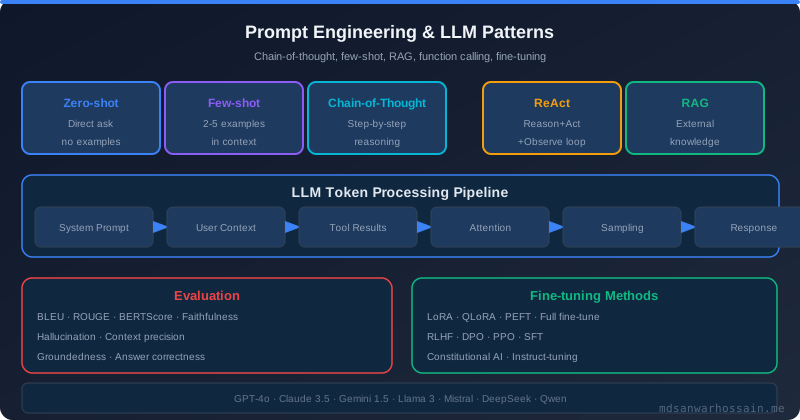
TL;DR
"LLMOps in production: practical patterns for prompt versioning, quality gates, token cost control, and reliable AI feature operations."
Every engineering team that has shipped an LLM-powered feature has experienced the same uncomfortable moment: the demo was flawless, stakeholders were excited, and then production arrived. Suddenly, answers that worked perfectly in testing started drifting. Token costs spiked unexpectedly. Latency became unpredictable. A prompt change broke six downstream behaviors nobody had documented. Welcome to the operational reality of LLM systems.
LLMOps—the discipline of operating large language model features in production—is rapidly maturing into a distinct engineering specialty. It combines elements of traditional MLOps, software reliability engineering, and product quality management. This guide covers the practices that distinguish teams who ship trustworthy, cost-efficient AI features from those who are perpetually firefighting.
Table of Contents
Why LLMOps Is Different from Traditional MLOps
Traditional MLOps deals with models that have deterministic, measurable outputs—classification scores, regression values, recommendations. LLMs produce natural-language outputs that are inherently probabilistic, context-dependent, and difficult to evaluate automatically. This creates three unique operational challenges:
- Quality drift — A new model version or prompt change can subtly degrade answer quality without triggering any traditional metric alert
- Cost unpredictability — Token usage scales with input length and conversation history; without governance, costs can spike 10x overnight
- Prompt fragility — LLM behavior is sensitive to wording, formatting, and context ordering in ways that are hard to test exhaustively
These challenges require purpose-built operational practices rather than simply adapting existing DevOps pipelines.
Real-World Use Cases
Customer support automation
Teams deploying LLMs for support ticket triage and first-response drafting need strict quality gates. A hallucinated policy statement or incorrect technical instruction can damage customer trust immediately. Production operations must include automated factuality checks, human escalation paths, and continuous sampling for quality review.
Internal knowledge assistant
Enterprise knowledge assistants powered by RAG and LLMs face freshness and accuracy challenges. Documents go stale, permissions change, and model behavior evolves. Operational maturity means monitoring retrieval quality, answer grounding, and user satisfaction signals continuously—not just at launch.
AI-assisted code generation in CI/CD
Teams integrating LLMs into development workflows—for test generation, code review, or documentation—must ensure that model updates do not break the quality or safety properties they depend on. Prompt versioning and evaluation suites are essential to prevent silent regressions.
Core LLMOps Practices
1) Treat prompts and model settings as versioned artifacts
Prompt templates, system instructions, few-shot examples, and model parameters belong in version control—not in application code strings or ad-hoc database fields. Every prompt change should go through a pull request with a documented rationale, evaluation results, and rollback path. Tie each prompt version to a release so regressions can be traced precisely. Teams that skip this step spend hours debugging production incidents trying to reconstruct what changed.
2) Build automated quality gates before every deployment
Before deploying a prompt or model change, run an offline evaluation suite. This suite should include representative task samples, known edge cases, and regression tests from previous incidents. Measure correctness, factuality, policy compliance, and output format adherence. Define minimum passing thresholds and block deployment automatically when quality drops. This is the LLMOps equivalent of a test suite in software engineering.
3) Add runtime telemetry to every AI request
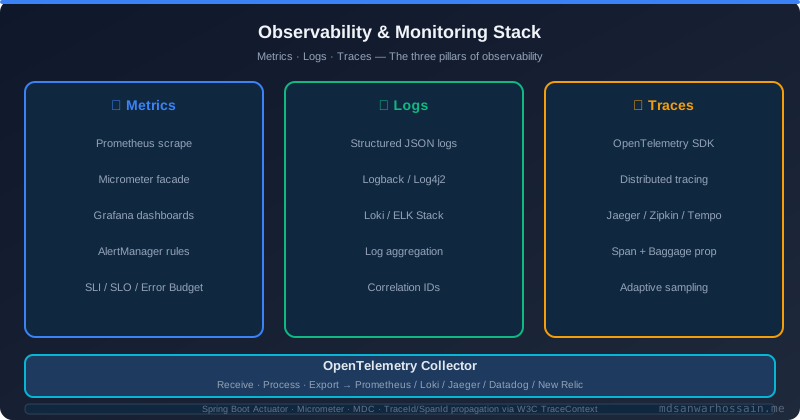
Observability is as critical for LLM features as for any backend service. Track: input and output token counts per request, latency percentiles by feature and model, cache hit rate, fallback rate when the primary model is unavailable, policy filter triggers, and user feedback signals (thumbs up/down, follow-up clarification requests). This data drives both reliability improvements and cost optimization.
4) Control spend with model routing and semantic caching
LLM costs are driven by token volume and model tier. Implement intelligent routing: route simple, deterministic queries to smaller, cheaper models (e.g., a fine-tuned or distilled model) and reserve frontier models for complex reasoning tasks. Use semantic caching to return cached responses for near-duplicate queries—a surprisingly high fraction of production requests are functionally identical. Set per-tenant and per-feature token quotas to prevent runaway costs from edge cases or abuse.
5) Implement graceful degradation and fallback chains
LLM APIs experience outages, rate limits, and latency spikes. Design fallback chains: if the primary model times out, route to a secondary model or a cached response. For non-critical features, consider returning a "try again shortly" message rather than an error. Graceful degradation protects user experience while your incident response team acts.
6) Monitor for quality drift in production
Model providers update their models continuously. The same prompt may behave differently after a silent model update. Implement continuous quality monitoring: sample production outputs periodically and run them through your evaluation pipeline. Define alert thresholds for quality metrics and page on-call when they degrade. Quality drift is silent until users start complaining—catching it proactively saves incident stress.
7) Redact and sanitize sensitive data in prompts
LLM inputs often contain user-provided data that may include PII, secrets, or confidential business information. Implement input sanitization pipelines that detect and redact sensitive patterns before they reach the model API. Maintain audit logs of prompt inputs (after redaction) for debugging and compliance. Never log raw user inputs that might contain credentials or health information.
8) Establish human-in-the-loop review for high-stakes outputs
Not all LLM outputs should be delivered directly to users. For high-stakes domains—legal guidance, medical information, financial recommendations, compliance-critical documents—route outputs through a human review step before delivery. Design the review interface so it is fast and low-friction; a cumbersome review workflow becomes a bottleneck and gets bypassed under pressure.
Tools & Technologies for LLMOps
- LangSmith — Tracing, evaluation, and prompt management for LangChain-based applications
- Weights & Biases (W&B) — Experiment tracking and evaluation for AI features
- Arize AI / Phoenix — LLM observability and drift monitoring in production
- Helicone — Proxy-based LLM request logging and cost analytics
- Braintrust — Eval framework for prompt and model comparison
- OpenTelemetry + custom spans — Standard observability integration for LLM request tracing
- LiteLLM — Multi-provider LLM routing with unified API and cost tracking
Agentic AI and LLMOps
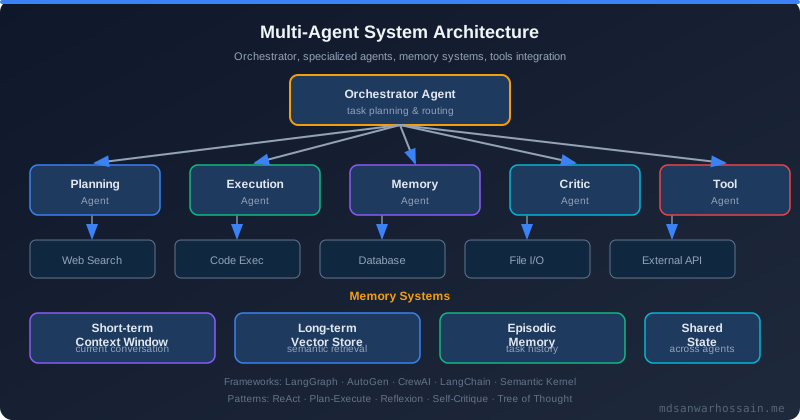
As teams move from single-turn LLM features to agentic workflows—where models plan, use tools, and execute multi-step tasks—LLMOps complexity multiplies. A single agentic workflow might make 15–30 model calls, each with its own quality and cost profile. Operational maturity for agentic systems requires per-step telemetry, workflow-level evaluation suites, cost budgets per task type, and explicit human approval gates for irreversible actions. Apply all the LLMOps practices above at the workflow level, not just the individual call level.
Future Trends in LLMOps
The discipline of LLMOps is evolving rapidly. Key trends to watch include: self-improving evaluation systems where models assist in generating and validating evaluation datasets; multimodal operations that handle images, audio, and structured data alongside text; tighter integration of LLMOps tooling with existing DevOps platforms; and regulatory compliance features that provide audit trails for AI decisions in regulated industries.
At BRAC IT: Our LLMOps Journey
We deployed our first LLM feature in Q2 2025: an intelligent document classifier that categorises loan application attachments into income proof, identity documents, property valuation reports, and bank statements. The initial deployment was "deploy and hope" — no monitoring, no evaluation framework, no feedback loop. We discovered it was misclassifying 11% of documents only when loan officers filed complaints two weeks later.
The LLMOps transformation took three months. We built: a golden evaluation dataset of 600 hand-labelled documents (updated monthly as new document types appear), a CI pipeline that runs all 600 examples on every prompt change and fails the build if accuracy drops below 89%, production monitoring that tracks the distribution of classifications daily (a sudden spike in "unknown" classifications signals a new document type the model hasn't seen), and a feedback interface where loan officers flag misclassifications in 2 clicks.
Six months after introducing the evaluation pipeline, our document classification accuracy improved from 89% to 96.3%. More importantly, we caught four regressions in that period that would have gone unnoticed — each was a prompt change that looked reasonable but degraded accuracy on a specific document sub-type.
Prompt Version Control and A/B Testing
Prompts are code. Store them in Git with semantic versioning, review them in pull requests, and deploy them through the same CI/CD pipeline as application code. This sounds obvious but most teams treat prompts as configuration — stored in a database, changed without review, impossible to rollback.
Our prompt management setup uses a dedicated prompts/ directory in each service repository with versioned YAML files:
# prompts/document-classifier/v2.1.0.yaml
version: "2.1.0"
model: gpt-4o-mini
temperature: 0.1
max_tokens: 50
system: |
  You are a document classifier for a microfinance institution.
  Classify the document into exactly one of these categories:
  INCOME_PROOF, IDENTITY, PROPERTY_VALUATION, BANK_STATEMENT, OTHER
  Respond with only the category name.
user_template: |
  Document text (first 500 chars): {document_excerpt}
  File name: {filename}
  Classify this document.
evaluation:
  dataset: "datasets/document-classifier-v2.jsonl"
  min_accuracy: 0.89
For A/B testing new prompts, use a feature flag to route a percentage of traffic to the new prompt version. Collect accuracy data for 48 hours before promoting. If the new version performs worse, rollback is a one-line config change — not an emergency SQL update at 2 AM.
Cost Monitoring and Token Optimisation
LLM API costs are invisible until they're not. Without monitoring, teams discover a $10,000 bill at month-end with no way to trace which feature caused it. Instrument every LLM call with cost metadata from day one:
@Component
public class InstrumentedLlmClient {

    private static final Map<String, Double> COST_PER_1K_TOKENS = Map.of(
        "gpt-4o",       0.005,   // $0.005 per 1K output tokens
        "gpt-4o-mini",  0.0006
    );

    public LlmResponse call(LlmRequest request) {
        long start = System.currentTimeMillis();
        LlmResponse response = llmClient.chat(request);

        double cost = (response.getTotalTokens() / 1000.0)
            * COST_PER_1K_TOKENS.get(request.getModel());

        meterRegistry.counter("llm.cost.usd",
            "model",   request.getModel(),
            "feature", request.getFeatureTag()
        ).increment(cost);

        meterRegistry.timer("llm.latency",
            "model", request.getModel()
        ).record(System.currentTimeMillis() - start, MILLISECONDS);

        return response;
    }
}
Track cost per feature and set budget alerts. Our document classifier costs $0.0004 per classification. At 8,000 classifications per day, that is $3.20/day — $96/month. Completely acceptable. But our early chatbot feature was spending $0.12 per conversation with no business case. We caught it in week 2 via cost monitoring and optimised the prompt to reduce token count by 60%.
LLMOps Anti-Patterns That Will Hurt You in Production
After shipping five LLM features to production at BRAC IT, these are the anti-patterns we hit and warn every team about:
Hardcoded prompts in application code. Prompts that live in Java string literals or properties files cannot be updated without a code deployment. When a prompt needs emergency adjustment (wrong tone, regulatory language required, security issue discovered), you cannot fix it in minutes. Store prompts in a versioned configuration system and hot-reload them without restarts.
No evaluation before deploying prompt changes. "I just reworded the prompt slightly" is the most common prelude to an accuracy regression. Every prompt change, however minor, must run against your golden evaluation dataset before deploying. A CI step that runs evaluations and blocks merge on accuracy drop takes 20 minutes to set up and will save you hours of incident response.
Single global model for all use cases. GPT-4o is expensive. Not every LLM task needs frontier model intelligence. Document classification needs a cheaper model. Simple intent detection can use an even smaller fine-tuned model. Build a model selection layer that routes tasks to the appropriate model by complexity and cost threshold.
No rate limiting on LLM-powered endpoints. LLM API calls are expensive and relatively slow (1–5 seconds). An unauthenticated endpoint that calls an LLM is a denial-of-wallet vulnerability — an attacker (or traffic spike) can exhaust your monthly LLM budget in hours. Rate limit aggressively, add request queuing, and set per-user monthly token limits.
Logging raw prompts without redaction. Prompts often include user data sent from request parameters. Logging them verbatim means personal data, financial information, and potentially credentials end up in your log aggregation system. Build a prompt logger that redacts PII fields before writing to logs.
Conclusion
LLMOps is software engineering applied to AI systems. The teams that ship reliable, cost-efficient LLM features are the ones who treat prompt management, evaluation, observability, and cost governance with the same rigor they apply to database migrations or API contracts. The tooling is maturing rapidly, but the fundamentals are the same as in any complex production system: version everything, test before deploying, monitor continuously, and design for failure. If your team builds these practices now, you will be well-positioned as LLM capabilities continue to advance.
Leave a Comment
Related Posts

Software Engineer · Java · Spring Boot · Microservices