Agentic AI for Real Products: Architecture, Guardrails, and Operational Playbooks
Agentic AI can automate meaningful work, but only if teams design clear boundaries for autonomy, safety, cost, and accountability. The core challenge is not model quality alone; it is system design.
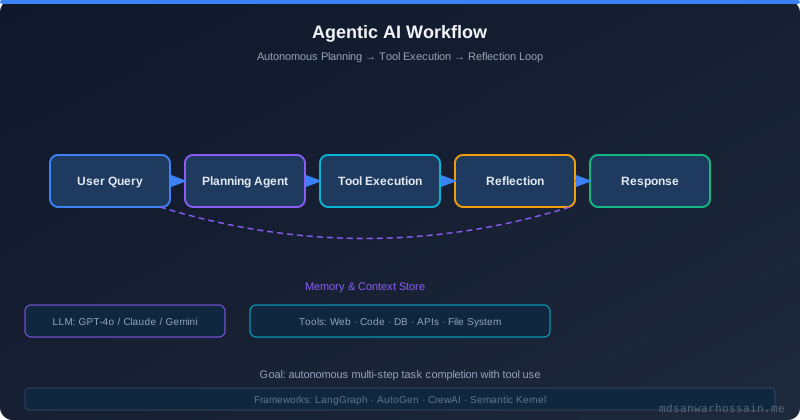
Agentic AI is one of the most discussed trends in modern software engineering. Teams are building agents that triage support tickets, draft technical documentation, analyze incidents, propose pull requests, and orchestrate multistep workflows. The promise is compelling: less repetitive work and faster execution of complex tasks. But many implementations fail in production because teams treat agents like chatbots with extra tools rather than software systems with strict reliability and governance requirements.
This guide focuses on practical engineering. If you are designing agentic systems for real users and business-critical operations, you need architecture patterns that balance autonomy with control. Below are the principles and tactics that consistently improve outcomes.
1) Define the job to be done before choosing autonomy level
Not all tasks need fully autonomous agents. Some need recommendation mode, where the system proposes actions but humans approve execution. Others support semi-autonomous loops with guardrails. Only a smaller subset should run fully autonomously. Start by mapping task risk, reversibility, and business impact. If a mistake can create legal or financial damage, default to human approval gates.
Autonomy should be a product decision informed by risk appetite. Teams that skip this step often over-automate and then roll back after incidents.
2) Build agents around explicit state machines
Production-grade agents should not rely on implicit conversational memory alone. Model workflow states explicitly: intake, planning, tool execution, validation, escalation, and completion. State machines reduce ambiguity and make debugging possible. They also support retries and recovery when a tool call fails or a dependency times out.
When state transitions are explicit, it becomes much easier to answer critical incident questions like why the agent did something and what failed before escalation.
3) Separate reasoning, tools, and policy enforcement
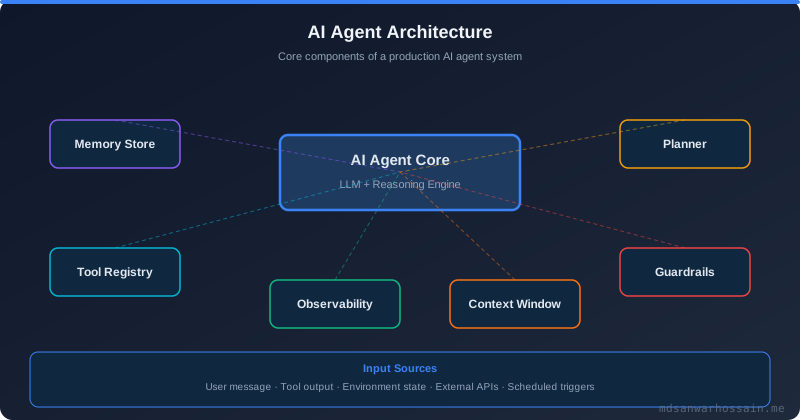
A robust architecture keeps three concerns distinct. Reasoning decides what to do next. Tooling performs actions such as database queries, API calls, or ticket updates. Policy enforcement checks whether an action is allowed. This separation is essential for security and auditing. If policy is embedded informally in prompts, control becomes fragile and easy to bypass under edge conditions.
Implement policy as code where possible: role-based permissions, environment constraints, sensitive-data filters, and explicit allowlists for executable actions.
4) Use constrained planning and verifiable execution
Unbounded planning can produce brittle or unsafe behavior. Constrain the planning horizon and require structured plans before action. For each planned step, require verification checks: schema validation, permission checks, and post-condition assertions. If verification fails, the agent should stop and request human intervention.
This turns agent behavior from creative but unpredictable to adaptive but controlled, which is what production environments require.
5) Introduce retrieval and grounding for domain accuracy
Many agent failures come from stale or invented knowledge. Ground decisions in trusted internal documentation, API schemas, and policy repositories using retrieval patterns. Include source attribution in outputs so users can inspect evidence. If confidence is low or sources conflict, escalate rather than guessing. High-trust systems optimize for correctness and traceability over stylistic fluency.
6) Design memory intentionally: short-term vs long-term
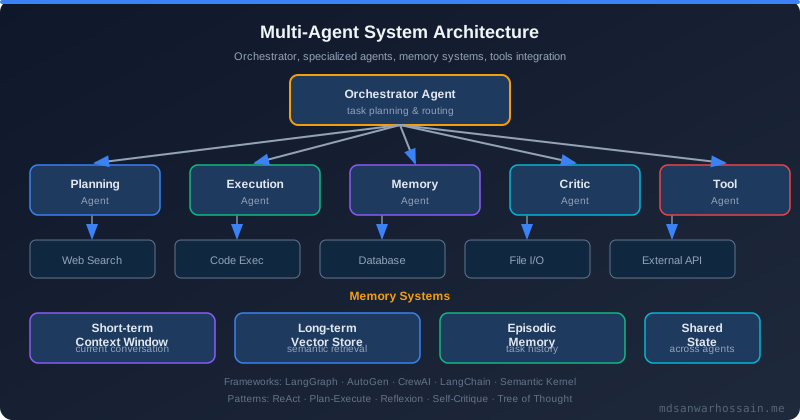
Agents need memory, but memory without governance creates risk. Use short-term memory for task context and long-term memory for approved preferences or stable facts. Define retention policies and deletion workflows, especially when memory could contain sensitive data. Memory updates should be explicit events with validation rules and audit logs.
Never treat memory as a blind append-only store. Curated memory is safer and more reliable.
7) Add robust evaluation before and after launch
Agent quality cannot be measured by anecdotal demos. Create evaluation suites with realistic tasks, edge cases, and failure injections. Track task completion quality, policy violation rate, escalation appropriateness, latency, and cost per successful task. In production, continuously sample outcomes for human review and root-cause analysis.
Strong evaluation loops prevent silent quality drift when prompts, tools, or models change.
8) Operate with cost and latency budgets
Agentic workflows often involve multiple model calls, tool invocations, and retries, which can increase cost quickly. Set explicit budgets: maximum tokens, maximum execution time, and maximum external calls per task. If limits are exceeded, degrade gracefully, return partial output, request clarification, or escalate. Budget enforcement keeps systems economically sustainable and protects user experience.
9) Treat observability as a first-class requirement
Without detailed traces, agent incidents are hard to diagnose. Capture structured telemetry for each step: plan decisions, tool arguments, tool responses, policy checks, and final outcomes. Redact sensitive data before logging. Build dashboards that highlight where tasks fail, where costs spike, and where escalations occur. Observability should answer what happened and why quickly.
10) Keep human-in-the-loop pathways simple and fast
Escalation is a strength, not a weakness. But escalation must be usable. Provide concise context packets to reviewers: attempted plan, evidence used, policy outcomes, and unresolved questions. If human review is slow or ambiguous, teams may disable it under pressure, increasing risk. Design approval UX as carefully as agent reasoning.
11) Secure the tool layer aggressively
Agentic systems become powerful through tools, which also expands attack surface. Secure tool interfaces with strict authentication, scoped authorization, parameter validation, and tamper-resistant audit logs. Protect against prompt injection by sanitizing untrusted inputs and isolating instructions from data payloads. Use allowlists for permissible operations and block destructive commands by default.
12) Launch in phases with narrow blast radius
Do not roll out broad autonomy on day one. Start with low-risk domains and limited user cohorts. Use feature flags, canary deployments, and emergency stop controls. Evaluate quality and policy compliance before expansion. Progressive rollout builds confidence while containing failures. It also gives teams time to improve runbooks, response processes, and operator training.
13) Create clear ownership and governance
Agentic AI touches product, security, legal, operations, and support. Define ownership explicitly: who approves policy changes, who handles incidents, who monitors drift, and who communicates with users when failures occur. Governance should not be bureaucratic overhead; it should be a lightweight decision system that keeps autonomy responsible and transparent.
Agentic AI can deliver real value when engineered like a critical platform rather than a novelty feature. Focus on stateful workflow design, policy enforcement, grounding, observability, and staged rollout. Keep humans in control of high-impact decisions. If you follow these principles, your agents can automate meaningful work while preserving trust, safety, and operational reliability.
Table of Contents
Real-World Problem: The Runaway Automation Incident
A fintech team deployed an agentic system to automatically triage and resolve payment reconciliation discrepancies. For six weeks it performed flawlessly in staging. On day three of production rollout, the agent encountered an edge case — a batch import with malformed transaction IDs — and entered a retry loop, creating 847 duplicate reconciliation records before a human noticed the anomaly. The issue was not model quality. It was absent loop detection, no idempotency keys on write operations, and an alert threshold set too high to catch the early phase of the incident.
Post-incident analysis identified three required guardrails that had been scoped out as "post-launch improvements": a maximum action count per task session, idempotent write operations using deterministic task IDs, and a real-time anomaly alert triggered when any single agent session exceeds 10 write operations per minute. After implementing these, the same edge case was caught and escalated cleanly with zero side effects.
Architecture: Production-Grade Agent System Design
A production agentic system is built from five distinct components that are independently deployable and testable. The orchestrator manages task lifecycle: accepting tasks, maintaining state, dispatching tool calls, and handling timeouts and retries. The tool registry provides a typed catalog of available tools with their schemas, permissions, and rate limits. The policy engine evaluates each proposed action against organizational rules before execution. The memory store maintains task context, session history, and long-term approved preferences with explicit TTLs. The audit log records every decision, tool call, and policy check with structured metadata for forensics and compliance.
Separate the orchestrator from the LLM inference layer. This separation allows you to swap models, update prompts, and roll back model versions without changing orchestration logic. Use a message queue between the orchestrator and tool executors to enable async execution, retries with backoff, and dead-letter queuing for failed tool calls.
Optimization: Token and Cost Management
Agentic workflows that involve multiple planning and reflection cycles can consume 10–50× more tokens than single-turn completions. Cost management requires both architectural and operational controls. Use tiered model routing: fast, cheap models for initial classification and triage; expensive, capable models only for complex reasoning steps. Cache embeddings and frequently-used retrieval results to reduce repeated vector search costs. Truncate context windows aggressively — pass only the relevant subset of tool results into the next planning step rather than the full accumulation of prior context.
Set hard token budgets per task type and surface cost telemetry in engineering dashboards. A spike in average tokens per task is often the first signal that a prompt regression or tool change has introduced unnecessary verbosity in model responses.
Key Takeaways
- Define autonomy level based on task risk and reversibility before writing any agent code.
- Model agent workflows as explicit state machines with defined transitions, not open-ended conversational loops.
- Implement idempotency on all write tool operations using deterministic task-scoped IDs.
- Separate reasoning (LLM), tooling (executors), and policy enforcement (rule engine) as independently deployable components.
- Set hard limits on actions per session, tokens per task, and external calls per minute — degrade gracefully when limits are hit.
- Observability is non-negotiable: trace every decision, tool call, and policy check with structured logs.
Conclusion
Agentic AI systems that survive production are not the most ambitious ones — they are the ones built with the same engineering discipline applied to any critical backend service. Bounded autonomy, idempotent operations, layered policy enforcement, and explicit escalation paths are not limitations on what agents can do. They are the foundation that makes agents trustworthy enough to do more. Every guardrail you add increases the scope of work you can safely delegate to automation. Start narrow, prove reliability, and expand. That is the engineering path to production-grade agentic AI.
Frequently Asked Questions
What is Define the job to be done before choosing autonomy level and how does it work?
Not all tasks need fully autonomous agents. Some need recommendation mode, where the system proposes actions but humans approve execution. Others support semi-autonomous loops with guardrails. Only a smaller subset should run fully autonomously. Start by mapping task risk, reversibility, and business impact. If a mistake can create legal or financial damage, default to human approval gates. Autonomy should be a product decision informed by risk appetite. Teams that skip this step often over-automate and then roll back after incidents.
What is Build agents around explicit state machines and how does it work?
Production-grade agents should not rely on implicit conversational memory alone. Model workflow states explicitly: intake, planning, tool execution, validation, escalation, and completion. State machines reduce ambiguity and make debugging possible. They also support retries and recovery when a tool call fails or a dependency times out. When state transitions are explicit, it becomes much easier to answer critical incident questions like why the agent did something and what failed before escalation.
What is Separate reasoning, tools, and policy enforcement and how does it work?
A robust architecture keeps three concerns distinct. Reasoning decides what to do next. Tooling performs actions such as database queries, API calls, or ticket updates. Policy enforcement checks whether an action is allowed. This separation is essential for security and auditing. If policy is embedded informally in prompts, control becomes fragile and easy to bypass under edge conditions. Implement policy as code where possible: role-based permissions, environment constraints, sensitive-data filters, and explicit allowlists for executable actions.
What is Use constrained planning and verifiable execution and how does it work?
Unbounded planning can produce brittle or unsafe behavior. Constrain the planning horizon and require structured plans before action. For each planned step, require verification checks: schema validation, permission checks, and post-condition assertions. If verification fails, the agent should stop and request human intervention. This turns agent behavior from creative but unpredictable to adaptive but controlled, which is what production environments require.
What is Introduce retrieval and grounding for domain accuracy and how does it work?
Many agent failures come from stale or invented knowledge. Ground decisions in trusted internal documentation, API schemas, and policy repositories using retrieval patterns. Include source attribution in outputs so users can inspect evidence. If confidence is low or sources conflict, escalate rather than guessing. High-trust systems optimize for correctness and traceability over stylistic fluency.
Leave a Comment

Software Engineer · Java · Spring Boot · Microservices