Microservices Testing Strategies: Unit, Integration, Component, Contract & E2E Testing
Testing microservices is a fundamentally different challenge from testing a monolith. Distributed state, asynchronous boundaries, independent deployments, and dozens of moving parts conspire to make traditional test strategies fragile, slow, and expensive. This guide walks through every level of the microservices test strategy — from fast unit tests with Mockito and JUnit 5, through realistic integration tests with Testcontainers, isolated component tests with WireMock, consumer-driven contract tests with Pact, and selective end-to-end tests — with production-grade Java code for each layer.
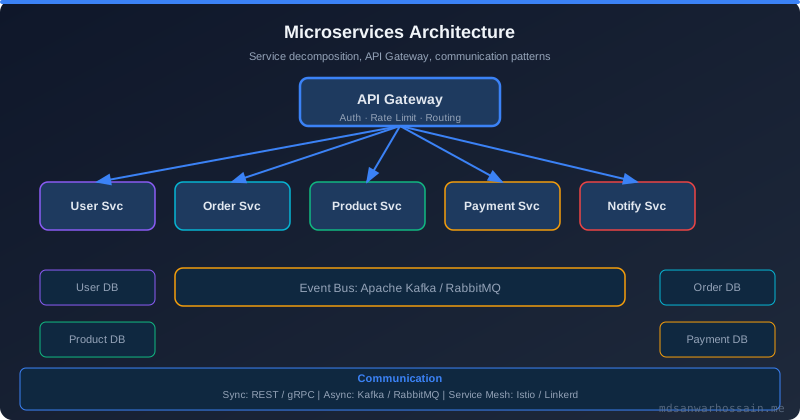
Table of Contents
- The Microservices Testing Challenge
- The Test Pyramid vs Honeycomb Model
- Unit Testing Microservice Business Logic: Mockito & JUnit 5
- Integration Testing with Testcontainers
- Component Testing: Testing a Single Service in Isolation
- Consumer-Driven Contract Testing with Pact
- Event-Driven Testing: Kafka Producers and Consumers
- End-to-End Testing: When and How
- Test Data Management in Microservices
- CI/CD Test Pipeline Optimization
- Key Takeaways
- Conclusion
1. The Microservices Testing Challenge
When you split a monolith into 30 independent services, you don't eliminate complexity — you redistribute it. Testing a single Order Service that depends on Inventory Service, Pricing Service, Payment Gateway, a PostgreSQL database, a Redis cache, and a Kafka topic requires you to answer a deceptively hard question: how much of that dependency graph do you actually need running to get meaningful test signal?
The three most painful microservices testing problems in production engineering teams are distributed state management, flaky integration tests, and slow feedback loops. Distributed state means that a test for the Order Service might fail because the Inventory Service's database has stale fixture data from a previous test run. Flakiness compounds when network timeouts, container startup races, and Kafka consumer lag all become sources of non-determinism. And slow feedback loops — suites that take 40 minutes to run because every test spins up a full Docker Compose stack — destroy developer productivity and push engineers to skip tests entirely.
The solution is a deliberately layered strategy where each level of the hierarchy provides a specific type of confidence at a specific cost. The goal is not 100% coverage at every level — it is maximum confidence per unit of CI time.
2. The Microservices Test Pyramid vs Honeycomb Model
The classic test pyramid — many unit tests, some integration tests, few E2E tests — was designed for monoliths. In a microservices world, it breaks down. A unit test that mocks every dependency gives you fast feedback but zero confidence that services can actually talk to each other. An E2E test that orchestrates 15 services gives you high confidence but takes 20 minutes and fails for 10 different reasons simultaneously.
The Honeycomb model, popularized by Spotify's engineering blog, adds two critical intermediate layers — component tests and contract tests — that together provide high confidence without the brittleness of full E2E suites. Here is the full hierarchy:
  Microservices Testing Hierarchy (Honeycomb Model)

  ┌─────────────────────────────────────────────┐
  │              E2E Tests (few)                │  ← Full stack, real env
  │         Slow · Expensive · High confidence │
  ├─────────────────────────────────────────────┤
  │         Contract Tests (per API boundary)   │  ← Pact, Spring Cloud Contract
  │      Fast · Isolated · Deployment safety   │
  ├─────────────────────────────────────────────┤
  │      Component Tests (per service)          │  ← WireMock stubs, real DB
  │     Medium speed · Realistic · High signal │
  ├─────────────────────────────────────────────┤
  │      Integration Tests (per adapter)        │  ← Testcontainers, real infra
  │      Medium speed · Infra confidence       │
  ├─────────────────────────────────────────────┤
  │         Unit Tests (many)                   │  ← JUnit 5, Mockito
  │      Fast · Cheap · Business logic focus   │
  └─────────────────────────────────────────────┘
The table below shows how each layer compares across the dimensions that matter in a CI/CD pipeline:
3. Unit Testing Microservice Business Logic: Mockito & JUnit 5
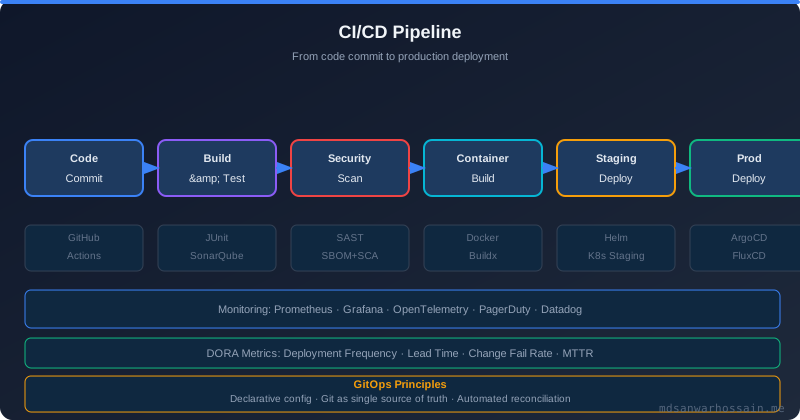
Unit tests in microservices should target pure business logic in domain services, value objects, domain events, and mappers. They must run in milliseconds, require no Spring context, and mock only the immediate collaborators of the class under test. The most common mistake is over-mocking — mocking everything including value objects, simple helpers, and even the domain model itself, which produces tests that verify mock interactions rather than actual business rules.
Here is a realistic domain service unit test for an Order Service that applies a discount policy:
// Domain service — no Spring annotations, no framework coupling
public class OrderPricingService {
    private final DiscountRepository discountRepository;
    private final PricingRuleEngine ruleEngine;

    public OrderPricingService(DiscountRepository discountRepository,
                               PricingRuleEngine ruleEngine) {
        this.discountRepository = discountRepository;
        this.ruleEngine         = ruleEngine;
    }

    public PricedOrder applyPricing(Order order, CustomerId customerId) {
        List<DiscountRule> rules = discountRepository.findActiveRules(customerId);
        Money baseTotal  = order.calculateBaseTotal();
        Money discounted = ruleEngine.apply(baseTotal, rules, order);
        return PricedOrder.of(order, discounted);
    }
}
// JUnit 5 + Mockito unit test — no Spring context, runs in < 10ms
@ExtendWith(MockitoExtension.class)
class OrderPricingServiceTest {
@Mock DiscountRepository discountRepository;
@Mock PricingRuleEngine ruleEngine;
@InjectMocks OrderPricingService pricingService;
@Test
void applyPricing_withActiveLoyaltyDiscount_reducesTotal() {
// Arrange — real domain objects, only external ports are mocked
CustomerId customerId = CustomerId.of("cust-42");
Order order = OrderFixture.anOrder()
.withItem("PROD-1", Quantity.of(3), Money.of(100, "USD"))
.build();
DiscountRule loyaltyDiscount = DiscountRule.percentage(10, "LOYALTY");
Money expectedTotal = Money.of(270, "USD"); // 300 - 10%
given(discountRepository.findActiveRules(customerId))
.willReturn(List.of(loyaltyDiscount));
given(ruleEngine.apply(Money.of(300, "USD"), List.of(loyaltyDiscount), order))
.willReturn(expectedTotal);
// Act
PricedOrder result = pricingService.applyPricing(order, customerId);
// Assert — verify behaviour, not mock interactions
assertThat(result.total()).isEqualTo(expectedTotal);
assertThat(result.appliedDiscounts()).containsExactly("LOYALTY");
verify(discountRepository).findActiveRules(customerId);
}
@Test
void applyPricing_withNoActiveRules_returnsBaseTotal() {
CustomerId customerId = CustomerId.of("cust-99");
Order order = OrderFixture.anOrder()
.withItem("PROD-2", Quantity.of(1), Money.of(50, "USD"))
.build();
given(discountRepository.findActiveRules(customerId)).willReturn(List.of());
given(ruleEngine.apply(Money.of(50, "USD"), List.of(), order))
.willReturn(Money.of(50, "USD"));
PricedOrder result = pricingService.applyPricing(order, customerId);
assertThat(result.total()).isEqualTo(Money.of(50, "USD"));
assertThat(result.appliedDiscounts()).isEmpty();
}
}Notice that Order, Money, Quantity, and DiscountRule are real domain objects — not mocked. Mocking value objects produces tests that break on every refactor and provide no actual safety. Only the two external ports (DiscountRepository and PricingRuleEngine) are mocked, because those are the boundaries the unit test should isolate.
4. Integration Testing with Testcontainers
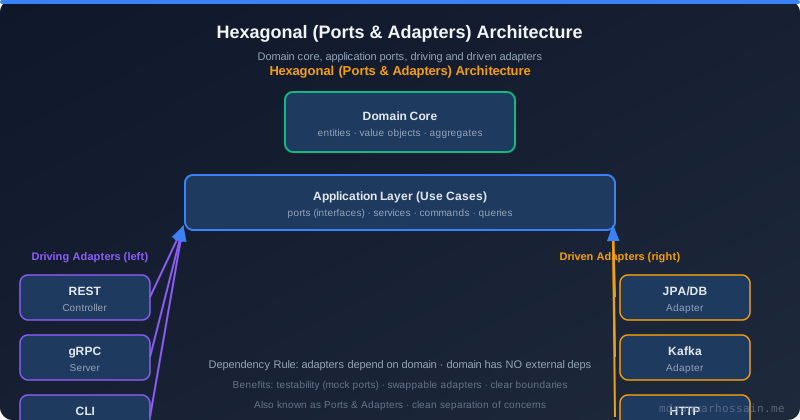
Integration tests verify that your service's adapters — JPA repositories, Kafka producers, Redis caches — work correctly with the real infrastructure they depend on. Testcontainers starts real Docker containers for PostgreSQL, Kafka, Redis, etc., wiring them into your Spring Boot test context automatically. This eliminates the in-memory H2 database fiction that masked countless production bugs caused by PostgreSQL-specific SQL dialects, constraints, and locking behaviour.
// Base class for all Testcontainers integration tests — shared container lifecycle
@SpringBootTest
@Testcontainers
@ActiveProfiles("integration-test")
public abstract class AbstractIntegrationTest {

    @Container
    static final PostgreSQLContainer<?> postgres =
        new PostgreSQLContainer<>("postgres:16-alpine")
            .withDatabaseName("orders_test")
            .withUsername("test")
            .withPassword("test")
            .withReuse(true); // reuse across test runs in dev mode

    @Container
    static final KafkaContainer kafka =
        new KafkaContainer(DockerImageName.parse("confluentinc/cp-kafka:7.6.0"))
            .withReuse(true);

    @Container
    static final GenericContainer<?> redis =
        new GenericContainer<>(DockerImageName.parse("redis:7.2-alpine"))
            .withExposedPorts(6379)
            .withReuse(true);

    @DynamicPropertySource
    static void overrideProperties(DynamicPropertyRegistry registry) {
        registry.add("spring.datasource.url",         postgres::getJdbcUrl);
        registry.add("spring.datasource.username",    postgres::getUsername);
        registry.add("spring.datasource.password",    postgres::getPassword);
        registry.add("spring.kafka.bootstrap-servers",kafka::getBootstrapServers);
        registry.add("spring.data.redis.host",        redis::getHost);
        registry.add("spring.data.redis.port",
            () -> redis.getMappedPort(6379));
    }
}.withReuse(true) on containers and adding testcontainers.reuse.enable=true to ~/.testcontainers.properties keeps containers alive across test runs during local development. Cold starts only happen on the first run per machine. This reduces local integration test cycle time from 45 seconds to under 5 seconds for subsequent runs.
// JPA repository integration test with real PostgreSQL
@DataJpaTest
@AutoConfigureTestDatabase(replace = Replace.NONE)
@Testcontainers
class OrderRepositoryIntegrationTest extends AbstractIntegrationTest {

    @Autowired OrderRepository orderRepository;

    @Test
    @Transactional
    void save_andFindByCustomerId_returnsPersistedOrder() {
        // Arrange
        Order order = Order.builder()
            .customerId(CustomerId.of("cust-123"))
            .status(OrderStatus.PENDING)
            .items(List.of(
                OrderItem.of(ProductId.of("prod-1"), Quantity.of(2), Money.of(50, "USD"))
            ))
            .build();

        // Act
        Order saved = orderRepository.save(order);
        List<Order> found = orderRepository.findByCustomerId(CustomerId.of("cust-123"));

        // Assert
        assertThat(saved.id()).isNotNull();
        assertThat(found).hasSize(1);
        assertThat(found.get(0).status()).isEqualTo(OrderStatus.PENDING);
        assertThat(found.get(0).items()).hasSize(1);
    }

    @Test
    void findPendingOrdersOlderThan_withExpiredOrder_returnsIt() {
        Order staleOrder = Order.builder()
            .customerId(CustomerId.of("cust-456"))
            .status(OrderStatus.PENDING)
            .createdAt(Instant.now().minus(Duration.ofHours(25)))
            .build();
        orderRepository.save(staleOrder);

        List<Order> expired =
            orderRepository.findPendingOrdersOlderThan(Instant.now().minus(Duration.ofHours(24)));

        assertThat(expired).hasSize(1);
        assertThat(expired.get(0).customerId()).isEqualTo(CustomerId.of("cust-456"));
    }
}.waitingFor(Wait.forListeningPort()) combined with a Wait.forLogMessage strategy matching the database's "ready to accept connections" log line. For Kafka, wait for the broker to become fully elected before producing test events — use AdminClient.describeTopics() in a @BeforeAll to confirm topic availability rather than relying on container startup alone.
5. Component Testing: Testing a Single Service in Isolation
A component test starts the entire service under test with its real database (via Testcontainers) but stubs all downstream HTTP dependencies using WireMock. This gives you realistic end-to-end coverage of a single service's behaviour — from the HTTP controller through the application layer, domain, and persistence — without requiring other services to be running. It is the highest-value test in the microservices toolkit: realistic enough to catch integration bugs, isolated enough to run in CI in under two minutes.
// Component test: full Order Service with WireMock for downstream stubs
@SpringBootTest(webEnvironment = SpringBootTest.WebEnvironment.RANDOM_PORT)
@Testcontainers
@AutoConfigureWireMock(port = 0) // WireMock on a random port
@ActiveProfiles("component-test")
class OrderServiceComponentTest extends AbstractIntegrationTest {

    @Autowired TestRestTemplate restTemplate;
    @LocalServerPort int port;

    @BeforeEach
    void resetWireMock() {
        WireMock.reset();
    }

    @Test
    void createOrder_withValidItems_returns201AndPersistsOrder() {
        // Stub the Inventory Service
        stubFor(get(urlPathEqualTo("/api/v1/inventory/availability"))
            .withQueryParam("productId", equalTo("prod-abc"))
            .willReturn(aResponse()
                .withStatus(200)
                .withHeader("Content-Type", "application/json")
                .withBody("""
                    {"productId":"prod-abc","available":true,"stock":50}
                """)));

        // Stub the Pricing Service
        stubFor(post(urlPathEqualTo("/api/v1/pricing/calculate"))
            .willReturn(aResponse()
                .withStatus(200)
                .withHeader("Content-Type", "application/json")
                .withBody("""
                    {"totalAmount":149.99,"currency":"USD","discounts":[]}
                """)));

        // Call the Order Service directly
        CreateOrderRequest request = new CreateOrderRequest(
            "cust-789",
            List.of(new OrderItemRequest("prod-abc", 2))
        );

        ResponseEntity<OrderResponse> response = restTemplate.postForEntity(
            "/api/v1/orders", request, OrderResponse.class);

        assertThat(response.getStatusCode()).isEqualTo(HttpStatus.CREATED);
        assertThat(response.getBody()).isNotNull();
        assertThat(response.getBody().status()).isEqualTo("PENDING");
        assertThat(response.getBody().totalAmount()).isEqualByComparingTo("149.99");

        // Verify WireMock received the expected calls
        verify(getRequestedFor(urlPathEqualTo("/api/v1/inventory/availability")));
        verify(postRequestedFor(urlPathEqualTo("/api/v1/pricing/calculate")));
    }

    @Test
    void createOrder_whenInventoryUnavailable_returns409() {
        stubFor(get(urlPathEqualTo("/api/v1/inventory/availability"))
            .willReturn(aResponse()
                .withStatus(200)
                .withBody("""
                    {"productId":"prod-abc","available":false,"stock":0}
                """)));

        CreateOrderRequest request = new CreateOrderRequest(
            "cust-789",
            List.of(new OrderItemRequest("prod-abc", 5))
        );

        ResponseEntity<ProblemDetail> response = restTemplate.postForEntity(
            "/api/v1/orders", request, ProblemDetail.class);

        assertThat(response.getStatusCode()).isEqualTo(HttpStatus.CONFLICT);
        assertThat(response.getBody().getDetail()).contains("out of stock");
    }
}
6. Consumer-Driven Contract Testing with Pact
Component tests with WireMock solve one half of the API compatibility problem: they verify that the Order Service behaves correctly when it receives the responses it expects. But they do not verify that the Inventory Service actually provides those responses. If the Inventory team renames the available field to inStock, your WireMock stubs are silently out of date and your component tests still pass — until you deploy to production and things break.
Consumer-Driven Contract Testing with Pact closes this gap. The consumer (Order Service) writes a Pact — a formal description of the interactions it expects from the provider (Inventory Service). The Pact is published to a Pact Broker. The provider then verifies the Pact against its actual implementation in its own test suite. If the provider breaks the contract, its CI pipeline fails before deployment.
// Consumer side — Order Service writes the Pact
@ExtendWith(PactConsumerTestExt.class)
@PactTestFor(providerName = "inventory-service", port = "8080")
class OrderServiceInventoryPactConsumerTest {

    @Pact(consumer = "order-service")
    public RequestResponsePact availableProductPact(PactDslWithProvider builder) {
        return builder
            .given("product prod-abc is available with stock 50")
            .uponReceiving("a request for product availability")
                .path("/api/v1/inventory/availability")
                .method("GET")
                .query("productId=prod-abc")
            .willRespondWith()
                .status(200)
                .headers(Map.of("Content-Type", "application/json"))
                .body(new PactDslJsonBody()
                    .stringValue("productId", "prod-abc")
                    .booleanValue("available", true)
                    .integerType("stock", 50))
            .toPact();
    }

    @Test
    @PactTestFor(pactMethod = "availableProductPact")
    void whenProductIsAvailable_inventoryClientReturnsAvailability(MockServer mockServer) {
        InventoryClient client = new InventoryClient(mockServer.getUrl());
        InventoryAvailability result = client.checkAvailability("prod-abc");

        assertThat(result.isAvailable()).isTrue();
        assertThat(result.stock()).isEqualTo(50);
    }
}
// Provider side — Inventory Service verifies the Pact
@SpringBootTest(webEnvironment = SpringBootTest.WebEnvironment.RANDOM_PORT)
@Provider("inventory-service")
@PactBroker(url = "${PACT_BROKER_URL}",
authentication = @PactBrokerAuth(token = "${PACT_BROKER_TOKEN}"))
@Testcontainers
class InventoryServicePactProviderTest extends AbstractIntegrationTest {
@LocalServerPort int port;
@BeforeEach
void configurePact(PactVerificationContext context) {
context.setTarget(new HttpTestTarget("localhost", port));
}
@TestTemplate
@ExtendWith(PactVerificationInvocationContextProvider.class)
void verifyPact(PactVerificationContext context) {
context.verifyInteraction();
}
// Provider state setup — matches the "given" clause in the consumer Pact
@State("product prod-abc is available with stock 50")
void productIsAvailable() {
// Insert test data into the real PostgreSQL container
inventoryRepository.save(InventoryItem.builder()
.productId("prod-abc")
.stock(50)
.reserved(0)
.build());
}
}7. Event-Driven Testing: Testing Kafka Producers and Consumers
Event-driven architectures introduce asynchronous boundaries that are particularly hard to test. When the Order Service publishes an OrderCreatedEvent to Kafka and the Notification Service consumes it, you need to verify both the shape of the event (producer side) and the behaviour triggered by the event (consumer side) without coupling the two test suites. Spring's @EmbeddedKafka is fast for unit-level event tests; Testcontainers Kafka is more realistic for integration tests.
// Testing Kafka producer with EmbeddedKafka — fast, no Docker required
@SpringBootTest
@EmbeddedKafka(
    partitions = 1,
    topics = {"order.events"},
    brokerProperties = {"listeners=PLAINTEXT://localhost:9092", "port=9092"}
)
@TestPropertySource(properties = {
    "spring.kafka.bootstrap-servers=${spring.embedded.kafka.brokers}",
    "spring.kafka.producer.value-serializer=org.apache.kafka.common.serialization.StringSerializer"
})
class OrderEventProducerTest {

    @Autowired KafkaTemplate<String, String> kafkaTemplate;
    @Autowired OrderEventPublisher eventPublisher;
    @Autowired ObjectMapper objectMapper;

    @Test
    void publishOrderCreatedEvent_writesCorrectEventToKafka() throws Exception {
        Order order = OrderFixture.aConfirmedOrder("ord-999", "cust-123");
        Consumer<String, String> consumer = createTestConsumer("order.events");

        eventPublisher.publishOrderCreated(order);

        ConsumerRecords<String, String> records =
            KafkaTestUtils.getRecords(consumer, Duration.ofSeconds(5));

        assertThat(records.count()).isEqualTo(1);
        ConsumerRecord<String, String> record = records.iterator().next();
        assertThat(record.key()).isEqualTo("ord-999");

        OrderCreatedEvent event =
            objectMapper.readValue(record.value(), OrderCreatedEvent.class);
        assertThat(event.orderId()).isEqualTo("ord-999");
        assertThat(event.customerId()).isEqualTo("cust-123");
        assertThat(event.eventType()).isEqualTo("ORDER_CREATED");
        assertThat(event.occurredAt()).isNotNull();
    }

    private Consumer<String, String> createTestConsumer(String topic) {
        Map<String, Object> consumerProps =
            KafkaTestUtils.consumerProps("test-group", "true",
                embeddedKafka.getEmbeddedKafka());
        Consumer<String, String> consumer =
            new DefaultKafkaConsumerFactory<>(consumerProps).createConsumer();
        consumer.subscribe(List.of(topic));
        return consumer;
    }
}
// Testing Kafka consumer with Testcontainers Kafka — realistic broker behaviour
@SpringBootTest
@Testcontainers
class NotificationConsumerIntegrationTest extends AbstractIntegrationTest {
@Autowired KafkaTemplate<String, String> kafkaTemplate;
@Autowired NotificationRepository notificationRepository;
@Autowired ObjectMapper objectMapper;
@Test
void onOrderCreatedEvent_notificationIsPersistedInDatabase() throws Exception {
OrderCreatedEvent event = new OrderCreatedEvent(
"ord-777", "cust-321", Instant.now(), "ORDER_CREATED");
String payload = objectMapper.writeValueAsString(event);
kafkaTemplate.send("order.events", "ord-777", payload).get(5, TimeUnit.SECONDS);
// Poll with Awaitility — account for consumer lag
await()
.atMost(Duration.ofSeconds(15))
.pollInterval(Duration.ofMillis(500))
.untilAsserted(() -> {
Optional<Notification> notification =
notificationRepository.findByOrderId("ord-777");
assertThat(notification).isPresent();
assertThat(notification.get().customerId()).isEqualTo("cust-321");
assertThat(notification.get().type()).isEqualTo(NotificationType.ORDER_CREATED);
});
}
}8. End-to-End Testing: When and How
End-to-end tests in a microservices system exercise a complete user journey across multiple deployed services. They provide the highest confidence but are the most expensive to write, maintain, and run. The key discipline is selectivity: only test the top 5–10 business-critical user journeys with E2E tests. Everything else should be covered at the component or contract level.
Test environment parity is critical for E2E test reliability. The E2E environment should use the same container images, infrastructure-as-code, and configuration as production — not a simplified stack. Differences in environment configuration are a major source of false positives and false negatives. Use Helm chart overrides to point services at test databases and external service mocks rather than maintaining a separate manually configured environment.
Synthetic monitoring extends E2E tests into production: critical user journey tests are run on a schedule against the live system with dedicated test accounts. When a synthetic test fails in production, it triggers an on-call alert before real users notice. This is the production-safety complement to pre-deployment E2E tests in staging.
// E2E test for the critical "place order" journey — runs in staging only
@Tag("e2e")
@SpringBootTest
class PlaceOrderEndToEndTest {

    // RestAssured pointing at the deployed API Gateway in staging
    private static final String API_BASE = System.getenv("STAGING_API_URL");

    @Test
    void completeOrderJourney_fromCartToConfirmation() {
        String authToken = AuthFixture.getTestUserToken();

        // Step 1: Add item to cart
        String cartId =
            given()
                .header("Authorization", "Bearer " + authToken)
                .contentType(ContentType.JSON)
                .body("""
                    {"productId":"PROD-PERF-1","quantity":2}
                """)
            .when()
                .post(API_BASE + "/api/v1/cart/items")
            .then()
                .statusCode(200)
                .extract().path("cartId");

        // Step 2: Checkout
        String orderId =
            given()
                .header("Authorization", "Bearer " + authToken)
                .contentType(ContentType.JSON)
                .body("""
                    {"cartId":"%s","paymentMethodId":"pm-test-visa"}
                """.formatted(cartId))
            .when()
                .post(API_BASE + "/api/v1/orders")
            .then()
                .statusCode(201)
                .body("status", equalTo("PENDING"))
                .extract().path("orderId");

        // Step 3: Confirm order reaches CONFIRMED state (async payment processing)
        await()
            .atMost(Duration.ofSeconds(30))
            .untilAsserted(() ->
                given()
                    .header("Authorization", "Bearer " + authToken)
                .when()
                    .get(API_BASE + "/api/v1/orders/" + orderId)
                .then()
                    .statusCode(200)
                    .body("status", equalTo("CONFIRMED")));
    }
}
9. Test Data Management in Microservices
Test data management is the silent killer of microservices test reliability. When integration and component tests share a database, test isolation breaks down: test A inserts data, test B reads it unexpectedly, and the test suite becomes order-dependent. The solution is a combination of database cleanup strategies, fixture factories, and tenant-scoped isolation.
// Database cleaner — truncates all tables before each test
@Component
@Profile("integration-test")
public class DatabaseCleaner {
    @Autowired DataSource dataSource;

    @BeforeEach
    public void clean() throws SQLException {
        try (Connection conn = dataSource.getConnection();
             Statement stmt = conn.createStatement()) {
            stmt.execute("SET session_replication_role = 'replica'"); // disable FK checks
            ResultSet tables = conn.getMetaData().getTables(
                null, "public", "%", new String[]{"TABLE"});
            while (tables.next()) {
                String tableName = tables.getString("TABLE_NAME");
                if (!tableName.startsWith("flyway_")) {
                    stmt.execute("TRUNCATE TABLE " + tableName + " CASCADE");
                }
            }
            stmt.execute("SET session_replication_role = 'origin'");
        }
    }
}

// Fluent fixture factory — readable test data construction
public class OrderFixture {
    public static OrderBuilder anOrder() { return new OrderBuilder(); }
    public static Order aConfirmedOrder(String orderId, String customerId) {
        return anOrder()
            .withId(orderId)
            .withCustomerId(customerId)
            .withStatus(OrderStatus.CONFIRMED)
            .withItem("PROD-DEFAULT", Quantity.of(1), Money.of(99, "USD"))
            .build();
    }

    public static class OrderBuilder {
        private String id = UUID.randomUUID().toString();
        private String customerId = "cust-default";
        private OrderStatus status = OrderStatus.PENDING;
        private List<OrderItem> items = new ArrayList<>();
        private Instant createdAt = Instant.now();

        public OrderBuilder withId(String id)               { this.id = id; return this; }
        public OrderBuilder withCustomerId(String cid)      { this.customerId = cid; return this; }
        public OrderBuilder withStatus(OrderStatus status)  { this.status = status; return this; }
        public OrderBuilder withItem(String pid, Quantity q, Money p) {
            this.items.add(OrderItem.of(ProductId.of(pid), q, p)); return this;
        }
        public OrderBuilder createdAt(Instant t)            { this.createdAt = t; return this; }
        public Order build() {
            return Order.builder().id(id).customerId(CustomerId.of(customerId))
                .status(status).items(items).createdAt(createdAt).build();
        }
    }
}
10. CI/CD Test Pipeline Optimization
A well-designed CI pipeline executes the right tests at the right speed at every stage of the delivery pipeline. The goal is fail fast, fail cheap: the fastest tests run first and prevent slow tests from running when there is already a known failure.
Parallel test execution is the single highest-leverage optimization for slow CI pipelines. JUnit 5 supports parallel execution natively with junit.jupiter.execution.parallel.enabled=true in junit-platform.properties. For Testcontainers-based suites, use a static container per test class (not per test method) and annotate with @TestMethodOrder(MethodOrderer.Random.class) to catch order-dependent failures early.
# GitHub Actions CI pipeline with staged test execution
name: Order Service CI

on: [push, pull_request]

jobs:
  unit-tests:
    runs-on: ubuntu-latest
    steps:
      - uses: actions/checkout@v4
      - uses: actions/setup-java@v4
        with: { java-version: '21', distribution: 'temurin' }
      - name: Run unit tests
        run: ./mvnw test -Dgroups="unit" -T 4 # 4 parallel forks

  integration-tests:
    runs-on: ubuntu-latest
    needs: unit-tests
    steps:
      - uses: actions/checkout@v4
      - uses: actions/setup-java@v4
        with: { java-version: '21', distribution: 'temurin' }
      - name: Run integration tests
        run: ./mvnw test -Dgroups="integration" -Dtestcontainers.reuse.enable=false
      - name: Upload test reports
        uses: actions/upload-artifact@v4
        if: failure()
        with:
          name: integration-test-reports
          path: target/surefire-reports/

  component-and-contract-tests:
    runs-on: ubuntu-latest
    needs: integration-tests
    steps:
      - uses: actions/checkout@v4
      - uses: actions/setup-java@v4
        with: { java-version: '21', distribution: 'temurin' }
      - name: Run component tests
        run: ./mvnw test -Dgroups="component"
      - name: Publish Pact contracts
        run: ./mvnw pact:publish -Dpact.broker.url=${{ secrets.PACT_BROKER_URL }}
        env:
          PACT_BROKER_TOKEN: ${{ secrets.PACT_BROKER_TOKEN }}

  e2e-tests:
    runs-on: ubuntu-latest
    needs: component-and-contract-tests
    if: github.ref == 'refs/heads/main'
    steps:
      - uses: actions/checkout@v4
      - name: Run E2E smoke tests
        run: ./mvnw test -Dgroups="e2e"
        env:
          STAGING_API_URL: ${{ secrets.STAGING_API_URL }}
Test tagging is the mechanism that makes staged pipelines work. Annotate every test class or method with @Tag("unit"), @Tag("integration"), @Tag("component"), or @Tag("e2e") and configure Maven Surefire or Gradle to include/exclude tags per pipeline stage. This prevents slow Testcontainers tests from running on every commit and reserves component tests for pre-merge validation.
Flaky test quarantine is a non-negotiable practice for maintaining CI confidence. When a test fails intermittently more than twice in a 7-day window, move it to a dedicated @Tag("flaky") suite that runs in a separate non-blocking pipeline. Track flaky tests in a backlog and prioritise their fix within the next sprint. A flaky test in the main pipeline is worse than no test: it trains developers to ignore failing builds.
Key Takeaways
- Use the Honeycomb model, not the pyramid — add component tests and contract tests as first-class citizens alongside unit and integration tests in microservices.
- Unit test pure domain logic without Spring context — mock only external ports (repositories, API clients), never value objects or domain models.
- Testcontainers replaces in-memory fakes — use real PostgreSQL, Kafka, and Redis containers to catch database-specific bugs that H2 silently hides.
- Component tests are your highest-value investment — a full service HTTP test with WireMock stubs catches integration bugs without requiring other services to be running.
- Pact contract tests prevent API breakage across service boundaries — publish contracts to a Pact Broker and verify them in provider CI pipelines before deployment.
- Use Awaitility for all asynchronous assertions — never use
Thread.sleep()in tests; Awaitility's polling approach makes tests faster and more reliable. - Quarantine flaky tests immediately — a flaky test in the main CI pipeline destroys team confidence faster than no test at all.
- Staged pipelines with test tagging minimise CI time — run unit tests on every push, integration and component tests on every PR, E2E tests only on merge to main.
Conclusion
Testing microservices effectively is less about choosing the right framework and more about choosing the right level of the stack for each type of risk. Unit tests with Mockito and JUnit 5 give you fast, cheap business logic coverage. Testcontainers integration tests verify your adapters against real infrastructure. Component tests with WireMock validate the full service behaviour in isolation. Pact contract tests enforce API compatibility across team boundaries. And selective E2E tests confirm that user journeys work end-to-end without the brittleness of testing everything through the full stack.
The investment in a well-structured test strategy pays compound dividends: faster onboarding for new engineers who can explore service behaviour through tests, confident refactoring without fear of silent regressions, and deployment pipelines that catch the right bugs at the right cost. Start with a single component test and a single Pact contract for your most critical service boundary — the discipline of writing those tests will reshape how your team thinks about service ownership and API design.
Leave a Comment
Related Posts

Software Engineer · Java · Spring Boot · Microservices