Multi-Agent Orchestration Failures: Deadlocks, Infinite Loops & Recovery Strategies
Multi-agent systems promise the dream of specialized AI agents collaborating to solve complex problems. The reality? Agents that deadlock waiting for each other, infinite loops of planning without execution, context windows that overflow mid-task, and state corruption that cascades across the entire system. In this guide, we'll dissect the taxonomy of multi-agent failures and build robust recovery architectures that keep your agent systems running in production.
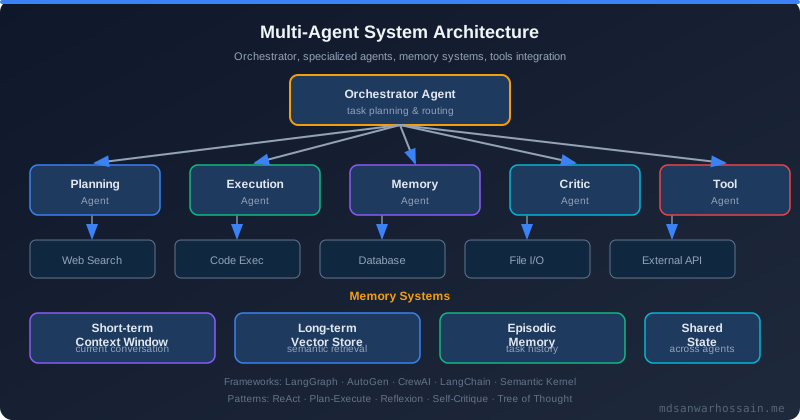
Table of Contents
- The Production Disaster: An Agent That Wouldn't Stop
- Taxonomy of Multi-Agent Failures
- Deadlocks Between Cooperative Agents
- Infinite Planning and Retry Loops
- Context Window Overflow Cascades
- State Corruption in Shared Memory
- Recovery Architecture: Circuit Breakers for Agents
- Observability for Multi-Agent Debugging
- Key Takeaways
- Conclusion
1. The Production Disaster: An Agent That Wouldn't Stop
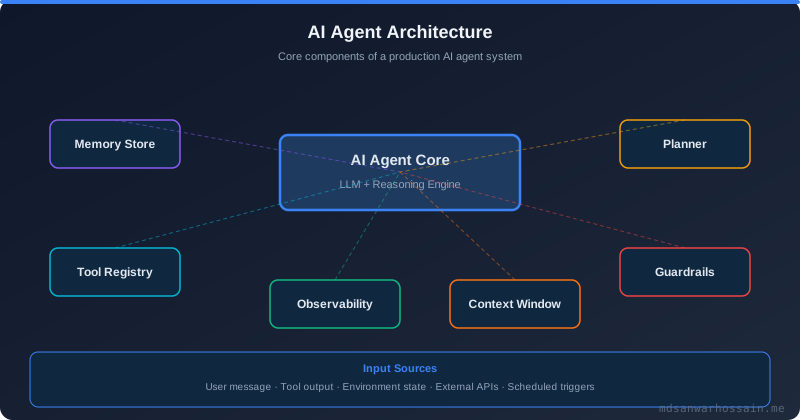
A SaaS company deployed a multi-agent system for automated code review. A "Planner" agent broke down review tasks, a "Reviewer" agent analyzed code, and a "Reporter" agent compiled findings. The system worked flawlessly in testing. Then it met a 15,000-line pull request.
The Planner agent kept breaking the review into smaller chunks because each chunk was "too complex" for the Reviewer. The Reviewer kept requesting "more context" from surrounding files. The Reporter kept waiting for reviews that never finalized. After 4 hours and $2,300 in API costs, an engineer manually killed the process — which had generated 847 partial review attempts without completing a single one.
2. Taxonomy of Multi-Agent Failures
Multi-agent failures fall into distinct categories, each requiring different mitigation strategies:
Coordination failures: Agents can't agree on who does what. Deadlocks, race conditions, duplicate work.
Communication failures: Messages lost, misinterpreted, or delayed. Stale state, conflicting instructions.
Resource failures: Context windows exhausted, rate limits hit, memory overflow.
Logic failures: Infinite loops, circular dependencies, goal conflicts between agents.
# Failure classification for multi-agent systems
class FailureType(Enum):
    # Coordination failures
    DEADLOCK = "agents_waiting_for_each_other"
    RACE_CONDITION = "concurrent_state_modification"
    DUPLICATE_WORK = "multiple_agents_same_task"

    # Communication failures
    MESSAGE_LOST = "inter_agent_message_dropped"
    STALE_STATE = "agent_operating_on_outdated_info"
    MISINTERPRETATION = "agent_misunderstood_instruction"

    # Resource failures
    CONTEXT_OVERFLOW = "context_window_exceeded"
    RATE_LIMITED = "api_throttling"
    MEMORY_EXHAUSTED = "shared_memory_full"

    # Logic failures
    INFINITE_LOOP = "unbounded_iteration"
    CIRCULAR_DEPENDENCY = "agents_blocking_each_other"
    GOAL_CONFLICT = "agents_with_incompatible_objectives"
3. Deadlocks Between Cooperative Agents
Deadlocks occur when agents form circular wait dependencies. Agent A waits for Agent B's output, Agent B waits for Agent C, and Agent C waits for Agent A. Unlike software deadlocks with explicit locks, agent deadlocks are semantic — they arise from task dependencies.
# Deadlock detection in LangGraph
class DeadlockDetector:
    def __init__(self, timeout_seconds=60):
        self.timeout = timeout_seconds
        self.agent_states = {}  # agent_id -> last_progress_timestamp

    def check_for_deadlock(self, agents):
        current_time = time.time()
        stalled_agents = []

        for agent in agents:
            last_progress = self.agent_states.get(agent.id, current_time)
            if current_time - last_progress > self.timeout:
                stalled_agents.append(agent)

        if len(stalled_agents) >= 2:
            # Check if stalled agents are waiting for each other
            wait_graph = self.build_wait_graph(stalled_agents)
            if self.has_cycle(wait_graph):
                return DeadlockDetected(
                    agents=stalled_agents,
                    cycle=self.find_cycle(wait_graph)
                )
        return None

    def resolve_deadlock(self, deadlock):
        # Strategy 1: Kill the youngest agent in the cycle
        youngest = min(deadlock.agents, key=lambda a: a.start_time)
        youngest.terminate(reason="deadlock_resolution")

        # Strategy 2: Inject external resolution
        for agent in deadlock.agents:
agent.inject_message("DEADLOCK_DETECTED: Abandon current task and reset")4. Infinite Planning and Retry Loops
The most insidious multi-agent failure is the infinite planning loop. An agent believes it needs "more information" before acting, requests that information, receives it, then believes it needs "even more information." The agent is technically making progress — each iteration is different — but it never converges to action.
# Anti-pattern: Unbounded planning loop
def bad_planning_loop(task):
    plan = initial_plan(task)
    while not is_complete(plan):
        feedback = evaluate_plan(plan)  # Always finds something to improve
        plan = refine_plan(plan, feedback)  # Never terminates
    return plan
# Solution: Bounded iteration with forced convergence
def bounded_planning_loop(task, max_iterations=5, min_confidence=0.7):
    plan = initial_plan(task)

    for i in range(max_iterations):
        confidence = evaluate_plan_confidence(plan)

        if confidence >= min_confidence:
            return plan  # Good enough, execute

        if i == max_iterations - 1:
            # Last iteration: force a decision
            logger.warning(f"Planning loop forced termination at confidence {confidence}")
            return plan  # Execute best effort

        plan = refine_plan(plan, get_specific_feedback(plan))

    return plan
Retry loops are similar: an agent fails, retries with slightly different parameters, fails again, retries again — forever. The fix is exponential backoff with jitter and a hard cap: each retry waits longer, randomness prevents thundering herds, and after N retries the system escalates or fails gracefully.
5. Context Window Overflow Cascades
Multi-agent systems accumulate context rapidly. Each agent interaction adds to the conversation history. When one agent's context overflows, it starts dropping information — often the information other agents depend on. This triggers requests for "missing" data, which generates more context, accelerating the overflow cascade.
class ContextManager:
    def __init__(self, max_tokens=100000, reserve_tokens=10000):
        self.max_tokens = max_tokens
        self.reserve = reserve_tokens  # Always keep room for response

    def manage_context(self, messages, new_message):
        current_tokens = count_tokens(messages)
        new_tokens = count_tokens(new_message)
        available = self.max_tokens - self.reserve

        if current_tokens + new_tokens <= available:
            return messages + [new_message]

        # Context overflow imminent - apply compression strategies
        compressed = self.compress_context(messages, target=available - new_tokens)

        if count_tokens(compressed) + new_tokens > available:
            # Still too large - summarize aggressively
            summary = self.summarize_context(compressed)
            return [summary, new_message]

        return compressed + [new_message]

    def compress_context(self, messages, target):
        # Strategy 1: Remove tool call details, keep results
        # Strategy 2: Summarize old conversation rounds
        # Strategy 3: Drop low-relevance messages
pass6. State Corruption in Shared Memory
When multiple agents share state — a common pattern in orchestration frameworks — concurrent modifications can corrupt data. Agent A reads the customer record, Agent B updates it, Agent A writes its (now stale) modifications, overwriting B's changes.
# Safe shared state with optimistic locking
class SharedState:
    def __init__(self):
        self.data = {}
        self.versions = {}
        self.lock = asyncio.Lock()

    async def read(self, key):
        async with self.lock:
            return {
                "value": self.data.get(key),
                "version": self.versions.get(key, 0)
            }

    async def write(self, key, value, expected_version):
        async with self.lock:
            current_version = self.versions.get(key, 0)

            if current_version != expected_version:
                raise OptimisticLockException(
                    f"State conflict: expected v{expected_version}, found v{current_version}"
                )

            self.data[key] = value
            self.versions[key] = current_version + 1
            return self.versions[key]
For multi-agent systems, prefer event-sourced state where agents emit events rather than mutating shared state directly. A central state manager applies events in order, ensuring consistency and providing an audit trail for debugging.
7. Recovery Architecture: Circuit Breakers for Agents
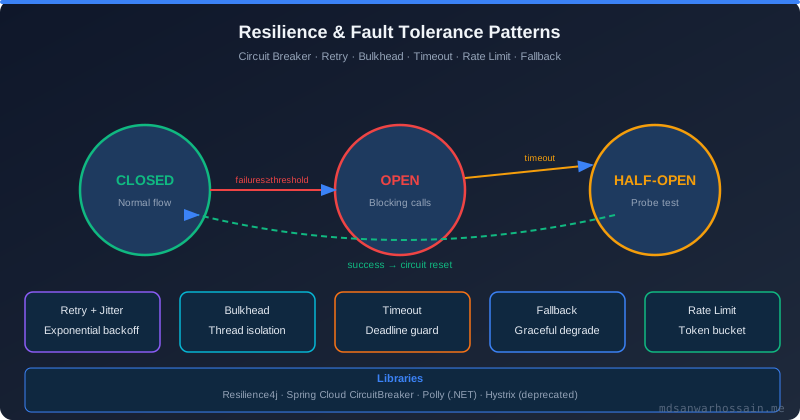
Circuit breakers are essential for production multi-agent systems. When an agent or agent interaction repeatedly fails, the circuit breaker "trips" — temporarily disabling that path and routing around it.
class AgentCircuitBreaker:
    def __init__(self, failure_threshold=5, reset_timeout=60):
        self.failure_threshold = failure_threshold
        self.reset_timeout = reset_timeout
        self.failures = 0
        self.state = "CLOSED"  # CLOSED, OPEN, HALF_OPEN
        self.last_failure_time = None

    async def call(self, agent, task):
        if self.state == "OPEN":
            if time.time() - self.last_failure_time > self.reset_timeout:
                self.state = "HALF_OPEN"
            else:
                raise CircuitOpenException(f"Agent {agent.id} circuit is open")

        try:
            result = await agent.execute(task)
            if self.state == "HALF_OPEN":
                self.state = "CLOSED"
                self.failures = 0
            return result
        except Exception as e:
            self.failures += 1
            self.last_failure_time = time.time()

            if self.failures >= self.failure_threshold:
                self.state = "OPEN"
                logger.error(f"Circuit opened for agent {agent.id}")
            raise
"In distributed systems, partial failure is the norm, not the exception. Design your multi-agent systems to degrade gracefully — a system that does 60% of its job is infinitely better than one that crashes trying to do 100%."
— Werner Vogels, AWS CTO
8. Observability for Multi-Agent Debugging
Debugging multi-agent failures requires specialized observability. Standard logging isn't enough — you need to trace interactions across agents and visualize the flow of tasks and messages.
Distributed tracing: Assign a trace ID to each user request and propagate it through all agent interactions. OpenTelemetry works well for this.
Agent state snapshots: Periodically capture each agent's internal state — context window contents, pending tasks, waiting dependencies. Essential for post-mortem analysis.
Interaction graphs: Visualize which agents are talking to which, with edge weights showing message volume and latency. Deadlocks and bottlenecks become visually obvious.
9. Key Takeaways
- Multi-agent failures are emergent — they arise from interactions, not individual agent bugs.
- Bound all loops and retries — every iteration must have a maximum count and timeout.
- Detect and resolve deadlocks proactively — use timeout-based detection and hierarchical resolution.
- Manage context windows actively — never let silent truncation corrupt agent reasoning.
- Use optimistic locking or event sourcing — prevent state corruption in shared memory.
- Implement circuit breakers — isolate failures and prevent cascades.
- Build observability from day one — distributed tracing and interaction graphs are essential.
10. Conclusion
Multi-agent orchestration is powerful but fragile. The same emergent behavior that makes agent collaboration valuable also makes failure modes unpredictable and cascading. The systems that succeed in production are the ones designed with failure as the default assumption — bounded loops, circuit breakers, comprehensive observability, and graceful degradation.
Start simple: add iteration limits to every loop, timeouts to every inter-agent call, and budget caps to every API-consuming operation. Then build up: deadlock detection, context management, and circuit breakers. The goal isn't to prevent all failures — that's impossible — but to detect them quickly, contain their blast radius, and recover automatically. That's what separates production multi-agent systems from expensive demos.
Explore More Articles
Discover more in-depth technical guides on AI agents, distributed systems, and production engineering.
Read Full Blog HereFrequently Asked Questions
What are the production considerations for The Production Disaster?
A SaaS company deployed a multi-agent system for automated code review. A "Planner" agent broke down review tasks, a "Reviewer" agent analyzed code, and a "Reporter" agent compiled findings. The system worked flawlessly in testing. Then it met a 15,000-line pull request. The Planner agent kept breaking the review into smaller chunks because each chunk was "too complex" for the Reviewer. The Reviewer kept requesting "more context" from surrounding files. The Reporter kept waiting for reviews that never finalized. After 4 hours and $2,300 in API costs, an engineer manually killed the process — which had generated 847 partial review attempts without completing a single one.
What is Taxonomy of Multi-Agent Failures and how does it work?
Multi-agent failures fall into distinct categories, each requiring different mitigation strategies: Coordination failures: Agents can't agree on who does what. Deadlocks, race conditions, duplicate work. Communication failures: Messages lost, misinterpreted, or delayed. Stale state, conflicting instructions.
What is Deadlocks Between Cooperative Agents and how does it work?
Deadlocks occur when agents form circular wait dependencies. Agent A waits for Agent B's output, Agent B waits for Agent C, and Agent C waits for Agent A. Unlike software deadlocks with explicit locks, agent deadlocks are semantic — they arise from task dependencies.
What is Infinite Planning and Retry Loops and how does it work?
The most insidious multi-agent failure is the infinite planning loop. An agent believes it needs "more information" before acting, requests that information, receives it, then believes it needs "even more information." The agent is technically making progress — each iteration is different — but it never converges to action. # Anti-pattern: Unbounded planning loop def bad_planning_loop(task): plan = initial_plan(task) while not is_complete(plan): feedback = evaluate_plan(plan) # Always finds something to improve plan = refine_plan(plan, feedback) # Never terminates return plan # Solution: Bounded iteration with forced convergence def bounded_planning_loop(task, max_iterations=5, min_confidence=0.7): plan = initial_plan(task) for i in range(max_iterations): confidence = evaluate_plan_confidence(plan) if confidence >= min_confidence: return plan # Good enough, execute if i == max_iterations - 1: # Last iteration: force a decision logger.warning(f"Planning loop forced termination at confidence {confidence}").
What is Context Window Overflow Cascades and how does it work?
Multi-agent systems accumulate context rapidly. Each agent interaction adds to the conversation history. When one agent's context overflows, it starts dropping information — often the information other agents depend on. This triggers requests for "missing" data, which generates more context, accelerating the overflow cascade.
Leave a Comment
Related Posts

Software Engineer · Java · Spring Boot · Microservices