Multi-Agent Systems in Software Engineering: Coordination, Orchestration, and Real-World Patterns
Single-agent systems hit practical limits when tasks are too large, too multi-disciplinary, or require independent verification. Multi-agent systems solve these problems through specialization, parallelization, and mutual checking — but only when coordination is designed carefully.
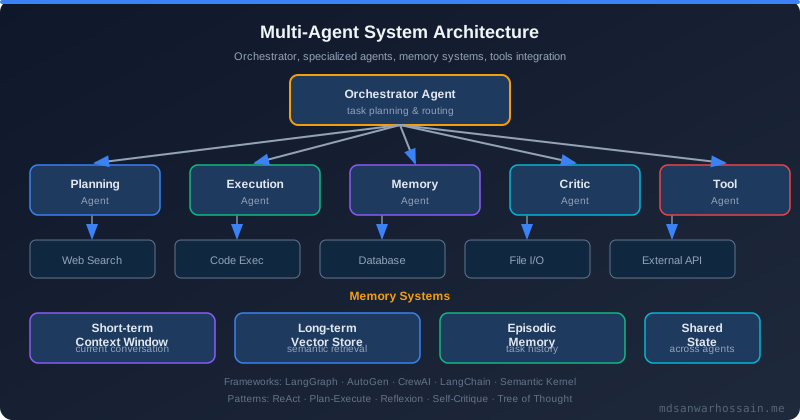
Table of Contents
Why Multiple Agents?
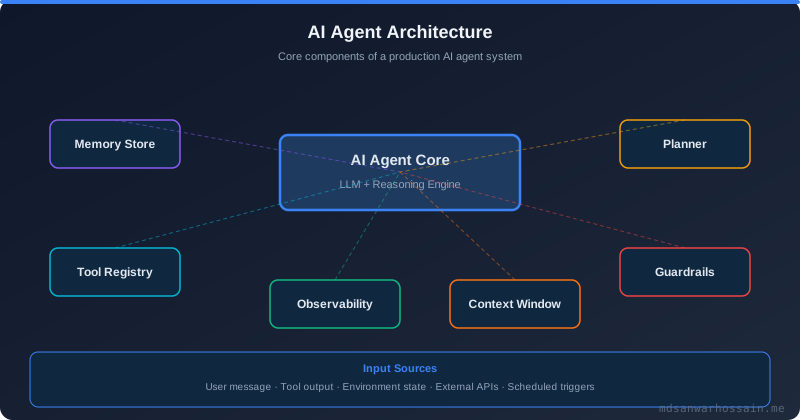
A single large language model reasoning through an entire software development task — requirements analysis, architecture design, implementation, testing, documentation, security review — will degrade in quality as the context grows, as it tries to hold too many concerns simultaneously, and as it lacks the specialization required to reason deeply in each domain. Multi-agent systems address this by decomposing the work across specialized agents, each focused on a narrower problem space with purpose-built tools and context.
The second motivation is independent verification. Having one agent generate code and a separate agent review it for bugs, security vulnerabilities, and compliance with architectural conventions is significantly more reliable than asking a single agent to both write and review its own output. This mirrors the human software development practice of separating author and reviewer roles.
The third motivation is parallelization. Agents can work on independent subtasks simultaneously. An architecture agent designs the data model while an implementation agent writes the business logic and a documentation agent drafts the API specification in parallel, reducing total latency for complex tasks.
Core Coordination Patterns
1. Orchestrator-Worker Pattern
A central orchestrator agent decomposes a high-level task into subtasks, assigns each to a specialized worker agent, collects results, resolves conflicts, and synthesizes the final output. The orchestrator does not perform implementation work itself — its job is planning, delegation, and integration. This pattern is clean and auditable because all task flow passes through a central coordinator, making it easy to trace decisions and debug failures.
// Orchestrator dispatching tasks to specialist agents
public class FeatureOrchestrator {
    private final ArchitectureAgent architectureAgent;
    private final ImplementationAgent implementationAgent;
    private final TestAgent testAgent;
    private final SecurityReviewAgent securityAgent;
    public FeatureResult buildFeature(FeatureRequirement req) {
        // Step 1: Design
        ArchitectureDecision design = architectureAgent.design(req);
        // Step 2: Parallel implementation and test generation
        CompletableFuture<CodeResult> impl =
            CompletableFuture.supplyAsync(() -> implementationAgent.implement(design));
        CompletableFuture<TestSuite> tests =
            CompletableFuture.supplyAsync(() -> testAgent.generateTests(design));
        CodeResult code = impl.join();
        TestSuite suite = tests.join();
        // Step 3: Security review
        SecurityReport security = securityAgent.review(code);
        return new FeatureResult(design, code, suite, security);
    }
}
2. Peer Collaboration Pattern
In the peer collaboration pattern, agents communicate as equals through a shared message channel. Agent A produces output, posts it to the channel, Agent B reads it, adds its contribution, and posts back. This is less structured than orchestration but enables emergent collaboration — the most natural fit for open-ended tasks like brainstorming architecture options or refining a technical specification through discussion.
The risk of peer collaboration is coherence drift: without a central coordinator, agents can talk past each other, duplicate work, or produce outputs that do not integrate cleanly. Mitigate this with explicit turn-taking rules, shared artifact schemas, and a moderator agent whose sole job is to detect and resolve conflicts.
3. Pipeline Pattern
Agents are arranged in a linear or DAG (directed acyclic graph) pipeline where each agent's output becomes the next agent's input. This is the simplest coordination pattern and ideal for tasks with a natural sequential structure: requirements agent → design agent → implementation agent → review agent → documentation agent. Each agent can be optimized independently for its stage in the pipeline, and the pipeline can be restarted from any stage if an upstream agent's output changes.
4. Debate and Critique Pattern
Two or more agents are given the same problem and independently produce solutions. A judge agent (or human reviewer) evaluates the alternatives and selects the best, or the agents engage in structured debate where each critiques the other's solution and refines their own in response. This pattern produces higher-quality outputs for high-stakes decisions — architecture choices, security-critical code, or API contract design — at the cost of increased compute and latency.
Real-World Use Case: Automated Code Review Pipeline
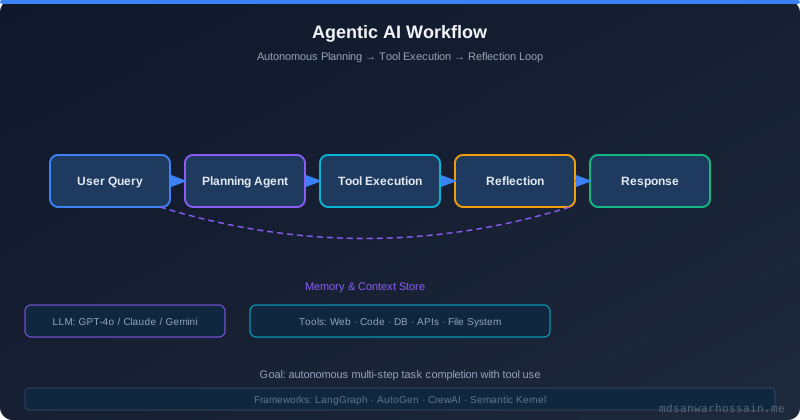
One of the highest-value multi-agent applications in software engineering is automated code review. The pipeline consists of four agents running in parallel after a pull request is created:
- Static Analysis Agent: runs existing lint and SAST tools, interprets results, and annotates the PR with specific feedback at file and line level.
- Architecture Review Agent: evaluates whether the change adheres to architectural conventions, identifies layer violations, and checks for dependency direction violations.
- Security Review Agent: looks for OWASP Top 10 vulnerabilities, insecure dependency versions, secrets in code, and improper authorization checks.
- Test Coverage Agent: checks whether new code paths have corresponding tests, identifies missing edge cases, and suggests additional test scenarios.
A synthesis agent aggregates the findings, deduplicates overlapping comments, assigns severity levels, and posts a structured review summary. Human engineers review the summary and approve or request changes. Studies in 2025 found that multi-agent code review catches 40–60% more issues than single-agent review on complex codebases.
Failure Modes in Multi-Agent Systems
Coordination overhead exceeds value: For simple tasks, multi-agent coordination adds latency and cost without proportional quality improvement. Always benchmark whether a single agent with a well-crafted prompt performs comparably for a given task class before investing in multi-agent architecture.
Cascading hallucinations: If Agent A produces incorrect output and Agent B treats it as ground truth, errors amplify downstream. Implement verification checkpoints between agents and use grounding tools to validate factual claims before passing them forward.
Conflicting outputs: Two agents that independently analyze a problem may reach different conclusions. Design explicit conflict resolution rules: which agent has authority in which domain, and what constitutes a conflict requiring human escalation.
Cost explosion: Multi-agent pipelines can make many more model calls than single agents. Budget each agent task explicitly. Use cheaper models for lower-stakes subtasks. Cache identical sub-computations across parallel agents.
Observability and Debugging
Multi-agent systems require more sophisticated observability than single agents. Assign unique trace IDs to each orchestrated task and propagate them through all agent calls. Log every inter-agent message, tool call, and state transition. Build dashboards that visualize the task DAG — which agents have completed, which are running, and where failures occurred. When debugging a bad output, you need to trace backwards through the agent chain to identify which agent introduced the error and why.
"Multi-agent systems don't solve the AI reliability problem — they distribute it. Each agent boundary is a potential failure point. Design coordination as carefully as you design individual agent behavior."
Key Takeaways
- Multi-agent systems solve the specialization, verification, and parallelization limitations of single agents.
- Four core coordination patterns: orchestrator-worker, peer collaboration, pipeline, and debate/critique.
- Automated code review is one of the highest-ROI multi-agent applications for engineering teams today.
- Cascading hallucinations, conflicting outputs, and cost explosion are the primary failure modes to design against.
- Full observability — trace IDs, message logging, task DAG visualization — is essential for debugging multi-agent failures.
Coordination Architecture at a Glance
Code: Minimal Orchestrator-Worker in Python
The following pattern shows how to implement a simple orchestrator that dispatches tasks to specialised worker agents and aggregates their results:
import asyncio, uuid
from dataclasses import dataclass, field
from typing import Any

@dataclass
class AgentTask:
    task_id: str = field(default_factory=lambda: str(uuid.uuid4()))
    name: str = ""
    payload: dict = field(default_factory=dict)
    result: Any = None

class WorkerAgent:
    def __init__(self, name: str, llm_client):
        self.name = name
        self.llm  = llm_client

    async def execute(self, task: AgentTask) -> AgentTask:
        # Each worker receives structured payload, calls LLM, returns result
        response = await self.llm.complete(
            system=f"You are the {self.name} specialist agent.",
            user=str(task.payload)
        )
        task.result = response.text
        return task

class Orchestrator:
    def __init__(self, workers: list[WorkerAgent]):
        self.workers = {w.name: w for w in workers}

    async def run(self, tasks: list[AgentTask]) -> list[AgentTask]:
        return await asyncio.gather(*[
            self.workers[t.name].execute(t)
            for t in tasks if t.name in self.workers
        ])
State Management and Memory in Multi-Agent Systems
One of the most underestimated engineering challenges in multi-agent systems is shared state. When multiple agents operate concurrently — each reading from and writing to a shared task context — you face classic distributed systems problems: race conditions, stale reads, and conflicting updates. The patterns from distributed systems design apply directly here.
Shared State Approaches
The simplest approach is a centralized state store: a Redis instance, a PostgreSQL table, or an in-memory map guarded by a coordinator. Each agent reads its task context at the start of execution and writes its result at the end. The orchestrator merges results and updates state atomically. This works well for orchestrator-worker patterns where agents are not updating state concurrently.
For peer collaboration patterns where multiple agents may update state simultaneously, use an event-sourced state model: agents emit structured events (CompletedSubtask, ProposedRevision, RaisedConflict) that are appended to an immutable log. The current state is derived by replaying the event log. This gives you a full audit trail of how shared state evolved and makes conflict resolution deterministic rather than dependent on timing.
Vector Memory for Semantic Retrieval
Long-running agent workflows need memory that survives context window limits. Vector memory stores embeddings of past interactions, decisions, and retrieved artifacts in a vector database (Weaviate, Qdrant, pgvector). Each agent retrieves the most semantically relevant memories at the start of its turn, loading only the context it needs rather than the full task history:
@Service
public class AgentMemoryService {
    private final EmbeddingModel embeddingModel;
    private final VectorStore vectorStore;

    public void store(String agentId, String content, Map<String, Object> metadata) {
        Document doc = new Document(content, metadata);
        doc.getMetadata().put("agent_id", agentId);
        doc.getMetadata().put("timestamp", Instant.now().toString());
        vectorStore.add(List.of(doc));
    }

    public List<Document> recall(String agentId, String query, int topK) {
        SearchRequest request = SearchRequest.query(query)
            .withTopK(topK)
            .withFilterExpression("agent_id == '" + agentId + "'");
        return vectorStore.similaritySearch(request);
    }
}
Episodic Memory Pattern
Episodic memory mimics how humans remember events: rather than storing raw text, you store structured episodes — a summary of what happened, what decision was made, and what the outcome was. Each new agent execution retrieves its most relevant past episodes, allowing it to learn from previous successes and failures without re-reading full transcripts. Implement a background summarization step that compresses finished task episodes into compact, retrievable memories at task completion.
Designing Agent Communication Protocols
Undisciplined message formats between agents are one of the most common sources of multi-agent failures. When Agent A sends free-form text to Agent B, the interpretation of that text becomes a runtime decision made by the LLM — and that interpretation will be wrong in edge cases. Structured, schema-validated message formats transform agent communication from probabilistic to deterministic.
Structured Message Schema
Every inter-agent message should be a typed, validated object. Define a canonical message envelope that wraps all agent-to-agent communication:
/**
 * Canonical envelope for all inter-agent messages.
 * Agents must produce and consume this format exclusively.
 */
@Data
@Builder
public class AgentMessage {
    /** Globally unique message ID for deduplication and tracing */
    private String messageId;
    /** The sending agent's registered name */
    private String fromAgent;
    /** Target agent or broadcast topic */
    private String toAgent;
    /** ISO-8601 timestamp of message creation */
    private Instant createdAt;
    /** Message type discriminator for deserialization routing */
    private MessageType type;
    /** Correlation ID ties all messages in one task together */
    private String correlationId;
    /** The typed payload — validated against schema for MessageType */
    private Object payload;
    /** Agents reject messages with retryCount > 3 */
    private int retryCount;

    public enum MessageType {
        TASK_ASSIGNMENT,    // Orchestrator assigns work to worker
        TASK_RESULT,        // Worker returns completed result
        CLARIFICATION_REQ,  // Agent needs clarification before proceeding
        CONFLICT_SIGNAL,    // Agent reports conflicting inputs from peers
        ABORT_REQUEST       // Orchestrator signals agent to stop current work
    }
}

// Example: typed payload for TASK_ASSIGNMENT
@Data
@Builder
public class TaskAssignmentPayload {
    private String taskId;
    private String description;
    private Map<String, Object> parameters;
    private List<String> requiredOutputFields;
    private int timeoutSeconds;
    private String priority;  // LOW, NORMAL, HIGH, CRITICAL
}
With typed envelopes, the orchestrator routes messages based on type without parsing payload content, agents validate messages at ingestion time rather than discovering schema mismatches mid-execution, and the retry logic in retryCount prevents infinite retry loops from misrouted messages. Schema validation with Jackson and Jakarta Validation enforces these contracts at runtime.
Testing Multi-Agent Systems: Simulation and Evaluation Frameworks
Testing multi-agent systems is fundamentally different from testing conventional software. LLM outputs are probabilistic, inter-agent interactions produce emergent behavior, and end-to-end tests take seconds to minutes and cost real money. A multi-layered testing strategy covering individual agents, coordination logic, and end-to-end scenarios is essential.
Mock LLMs for Deterministic Unit Tests
Unit tests for agent logic must not call real LLMs — they must use deterministic mock LLMs that return scripted responses. This makes tests fast, free, and repeatable:
// Deterministic mock LLM for unit testing agent logic
public class ScriptedLlmClient implements LlmClient {
    private final Map<String, String> responseMap = new LinkedHashMap<>();

    public ScriptedLlmClient when(String promptContains, String response) {
        responseMap.put(promptContains, response);
        return this;
    }

    @Override
    public String complete(String prompt) {
        return responseMap.entrySet().stream()
            .filter(e -> prompt.contains(e.getKey()))
            .map(Map.Entry::getValue)
            .findFirst()
            .orElseThrow(() -> new AssertionError(
                "No scripted response for prompt: " + prompt.substring(0, 100)));
    }
}

// Usage in unit test
@Test
void orchestratorRoutesSecurityFindingsToSecurityAgent() {
    ScriptedLlmClient mockLlm = new ScriptedLlmClient()
        .when("SQL injection", """
            {"severity": "HIGH", "type": "SQL_INJECTION",
             "line": 42, "recommendation": "Use parameterized queries"}
            """);
    SecurityReviewAgent agent = new SecurityReviewAgent(mockLlm);
    SecurityReport report = agent.review(CodeSnippet.of(SQL_INJECTION_SAMPLE));
    assertThat(report.getSeverity()).isEqualTo(Severity.HIGH);
    assertThat(report.getType()).isEqualTo("SQL_INJECTION");
}
Evaluation Metrics for Multi-Agent Systems
Beyond unit tests, you need evaluation metrics that capture the quality of agent outputs over a labeled test dataset. Track these metrics on every significant code change to the agent coordination logic:
| Metric | Definition | Target | How to Measure |
|---|---|---|---|
| Task Success Rate | % of tasks completed without abort | >95% | Automated assertion on task outcome |
| Output Correctness | % of outputs matching labeled ground truth | >85% | Judge LLM or human-labeled eval set |
| Agent Agreement Rate | % of cases where peer agents agree | >80% | Log conflict signals, track resolutions |
| Mean Tokens Per Task | Avg. LLM tokens consumed per workflow | Track & budget | Token usage from LLM API responses |
| Coordination Latency | Time from task dispatch to all results received | <30s P95 | Span timing via OpenTelemetry |
Production Deployment Patterns for Multi-Agent Systems
Running multi-agent systems in production on Kubernetes requires thoughtful resource allocation, autoscaling, and cost controls. Unlike stateless microservices, agent workers have highly variable resource profiles — LLM API calls block threads waiting for external responses, and memory usage spikes during long context window operations.
Kubernetes Deployment for Agent Workers
apiVersion: apps/v1
kind: Deployment
metadata:
  name: code-review-agent-worker
  namespace: ai-agents
spec:
  replicas: 3
  selector:
    matchLabels:
      app: code-review-agent
  template:
    metadata:
      labels:
        app: code-review-agent
    spec:
      containers:
        - name: agent
          image: myregistry/code-review-agent:1.4.2
          resources:
            requests:
              cpu: "500m"
              memory: "512Mi"
            limits:
              cpu: "2000m"
              memory: "2Gi"
          env:
            - name: LLM_API_KEY
              valueFrom:
                secretKeyRef:
                  name: llm-secrets
                  key: api-key
            - name: MAX_CONCURRENT_TASKS
              value: "4"    # LLM I/O bound — higher concurrency is safe
            - name: TASK_QUEUE_URL
              value: "redis://redis-service:6379"
---
apiVersion: autoscaling/v2
kind: HorizontalPodAutoscaler
metadata:
  name: code-review-agent-hpa
  namespace: ai-agents
spec:
  scaleTargetRef:
    apiVersion: apps/v1
    kind: Deployment
    name: code-review-agent-worker
  minReplicas: 2
  maxReplicas: 20
  metrics:
    - type: External
      external:
        metric:
          name: task_queue_depth
          selector:
            matchLabels:
              queue: code-review-tasks
        target:
          type: AverageValue
          averageValue: "10"   # Scale up when avg queue depth exceeds 10 per pod
Cost Optimization Strategies
LLM API costs dominate multi-agent system budgets. Apply these patterns to keep costs proportional to delivered value:
- Tiered model routing: Use a cheap, fast model (GPT-4o-mini or Claude Haiku) for classification and routing tasks; use frontier models only for generation and judgment tasks where quality matters
- Semantic caching: Cache LLM responses for semantically similar inputs using a vector similarity threshold (cosine similarity >0.97). For repeating workflow patterns — code style reviews on similar code — cache hit rates of 20–40% are achievable
- Prompt compression: Compress retrieved context and conversation history with extractive summarization before including in prompts. This reduces token counts by 30–60% for long-context tasks with no measurable quality drop
- Spot instance scheduling: Agent worker pods processing non-urgent tasks can run on Kubernetes spot/preemptible nodes. Use task priority queues so urgent tasks run on on-demand nodes while best-effort tasks use spot capacity
Observability for Cost Control
Track per-workflow token consumption using structured logging and export to your cost management dashboard. Log workflow_id, model_used, prompt_tokens, completion_tokens, and estimated_cost_usd for every LLM call. Set per-workflow token budgets with hard circuit breakers that abort a workflow if token consumption exceeds 10x the expected baseline — this prevents runaway agentic loops from generating surprise API bills. Alert the on-call team when aggregate daily spend exceeds a configured threshold, well before the monthly billing cycle closes. Teams that treat LLM cost as an afterthought consistently face unexpected budget overruns once their multi-agent workflows move beyond prototype scale. Building cost observability into your agent framework from the start, rather than retrofitting it, is significantly cheaper in the long run.
Conclusion
Multi-agent systems are becoming the standard architecture for complex AI automation. The power comes from specialisation and parallelism — but so does the risk. Cascading hallucinations, conflicting outputs, and runaway costs are predictable failure modes when coordination is treated as an afterthought. Design your agent topology with the same rigour you apply to distributed microservices: explicit contracts between agents, bounded retry budgets, full observability with propagated trace IDs, and human-in-the-loop checkpoints for high-stakes decisions.
Start with one well-understood workflow — an automated code review pipeline is often a high-ROI first target — instrument it thoroughly, and expand from there as you build confidence in your coordination patterns.
Leave a Comment
Related Posts

Software Engineer · Java · Spring Boot · Microservices