Multi-Region Active-Active Architecture: Designing Globally Distributed Systems
Multi-region active-active architecture is the pinnacle of distributed systems design — it is how the world's most reliable platforms serve billions of users across six continents with sub-100ms latency and five-nines availability. It is also one of the most operationally complex systems you will ever build. This deep dive covers data replication strategies, conflict resolution, global load balancing, failure scenarios, and the real trade-offs that every architect must understand before committing to multi-region active-active. Part of the System Design Deep Dive Series.
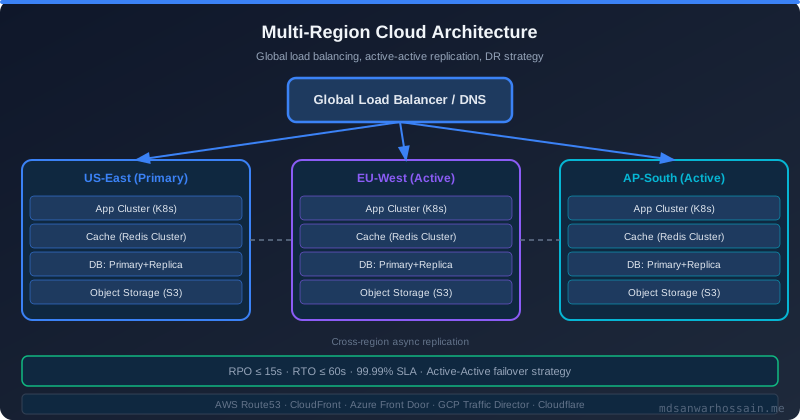
Table of Contents
- The Real-World Problem: The Region Outage That Wasn't Survivable
- Active-Active vs Active-Passive vs Multi-Active
- Data Replication Strategies
- Conflict Resolution Patterns
- Global Load Balancing and DNS
- Database Options for Multi-Region
- State Management and Caching
- Architecture Diagram
- Failure Scenarios
- Testing Multi-Region Systems
- Trade-offs: The Cost of Global Availability
- When NOT to Build Active-Active
The Real-World Problem: The Region Outage That Wasn't Survivable
In 2021, a major SaaS company serving over 150,000 business customers had every single one of those customers routed to a single AWS region — us-east-1. The architecture was textbook monolith-to-microservices: clean service boundaries, Kubernetes orchestration, RDS Multi-AZ, read replicas. The team was proud of it. Multi-AZ meant they had survived multiple availability zone failures without incident. They considered themselves resilient.
At 9:17 AM on a Tuesday, an unrelated networking change at AWS caused prolonged connectivity issues within us-east-1. Internal VPC routing between services degraded. RDS Multi-AZ failover completed, but the new primary was in an availability zone that was itself experiencing elevated packet loss. The Kubernetes control plane became unstable. Pod scheduling stalled. Health checks failed in cascades. By 9:35 AM — eighteen minutes after the first alert — the entire platform was serving 503s to every customer worldwide.
The outage lasted four hours and twelve minutes. By the end of the incident, the company had lost an estimated $4.2 million in direct revenue, was facing SLA credit claims from 40% of its enterprise customer base, and had lost two major contract renewals to competitors that had demonstrated higher availability. The CEO sent a personal apology email to all enterprise customers. The engineering team spent the next eight months building multi-region active-active — a project that would have taken four months if it had been planned from the start.
Contrast this with how Netflix handled an us-east-1 incident in December 2012. Netflix ran active-active across multiple AWS regions and had invested heavily in Chaos Engineering (they invented Chaos Monkey in that same region). When us-east-1 suffered a multi-hour outage, Netflix automatically shed traffic to us-west-2 and eu-west-1. Customers in North America experienced slightly elevated latency. There were no widespread outages, no customer-facing 503s, no SLA breach communications. Cloudflare, which operates an anycast network spanning over 300 cities globally, routinely absorbs region-level outages completely invisibly to end users — traffic is rerouted in under one second via BGP reconvergence.
The architectural difference between these outcomes is not magic — it is a deliberate set of patterns: active-active deployment, asynchronous cross-region replication, global load balancing with health-aware failover, and conflict resolution strategies that handle the replication lag that is physically unavoidable when data travels at the speed of light between continents.
Active-Active vs Active-Passive vs Multi-Active
These three terms are frequently confused and inconsistently defined in vendor documentation. A precise understanding matters because the choice determines your RTO, RPO, cost, and operational complexity.
Active-Passive (Hot Standby): One region serves all production traffic. A second region runs an identical copy of the infrastructure but receives no production traffic — it only receives replicated data. On failure, a human (or automated system) triggers failover, promoting the passive region to active. RTO is typically 5–30 minutes depending on DNS TTL propagation, database promotion time, and health check intervals. RPO depends on replication lag, typically 1–30 seconds for asynchronous replication. Cost is high: you pay for two full production environments but only use one. This is where most companies start.
Active-Active: Two or more regions simultaneously serve production traffic. Each region handles a geographic subset of users (e.g., Region A handles US users, Region B handles EU users). Data written in one region is asynchronously replicated to others. If one region fails, the global load balancer automatically shifts its traffic to healthy regions. RTO is under 60 seconds (often under 10 seconds with DNS TTL pre-configured and health-check-aware routing). RPO depends on replication lag, typically sub-second to a few seconds. Cost is approximately 2× a single-region setup (you need full capacity in both regions to handle failover load), but you get improved latency for geographically distributed users during normal operation.
Multi-Active (Full Mesh): Three or more regions all serve traffic and all accept writes. Any region can accept any write for any user. Data is replicated in a full mesh across all regions. Conflict resolution is mandatory since two regions might receive concurrent writes to the same record. This is what CockroachDB, Google Spanner, and DynamoDB Global Tables enable at the database layer. RTO approaches zero — there is no "failover" because there is no single active region to fail over from. Cost is 3× or more. This is what Netflix, Cloudflare, and Google Search run at full scale.
| Model | RTO | RPO | Cost Factor | Complexity |
|---|---|---|---|---|
| Active-Passive | 5–30 min | 1–30 sec | 1.5–2× | Low |
| Active-Active | <60 sec | <5 sec | 2× | High |
| Multi-Active | ~0 sec | ~0 sec | 3×+ | Very High |
Data Replication Strategies
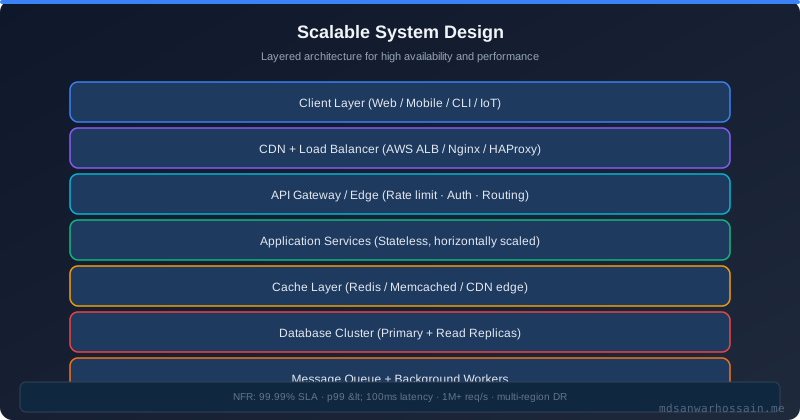
Data replication is the core technical challenge in multi-region architecture. How you replicate data determines your consistency guarantees, your latency profile, and the kinds of failures you will face.
Synchronous Replication
A write is not acknowledged to the client until it has been durably committed in all participating regions. This provides strong consistency: any read from any region immediately sees the latest write. The cost is latency: a write from a user in New York to a primary in us-east-1 must wait for the write to propagate to eu-west-1 (Dublin) — roughly 80ms round-trip — before returning a 200 OK. For a database write that normally takes 2ms, you have added 80ms of mandatory wait time. This is why Google Spanner, which offers synchronous multi-region replication with external consistency, has a write latency floor of ~100ms across continents. Most OLTP workloads cannot tolerate this. Synchronous replication is primarily used for financial systems where data loss is unacceptable (RPO = 0) and users can tolerate slightly elevated latency.
Asynchronous Replication
A write is acknowledged to the client as soon as it commits in the local region. Replication to other regions happens in the background. This provides eventual consistency: reads from other regions may see slightly stale data (replication lag). The write latency is the same as a local write — 2ms is 2ms regardless of how many regions you are replicating to. Replication lag in practice ranges from sub-second (on well-connected AWS inter-region links) to several seconds under high write load or network degradation. This is how AWS Aurora Global Database, DynamoDB Global Tables (in most configurations), and Cassandra multi-datacenter replication work. The challenge is that replication lag creates a window where different regions see different data — and concurrent writes to the same record from different regions produce conflicts.
Multi-Master with Conflict Resolution
When all regions accept writes (multi-active), two regions can independently mutate the same record before replication propagates. This produces write conflicts that must be resolved deterministically. Three strategies are in common use: last-write-wins (LWW) using timestamps, Conflict-free Replicated Data Types (CRDTs), and application-level merge. Each has different trade-offs for different data access patterns, covered in detail in the next section.
Conflict Resolution Patterns
Conflict resolution is the part of multi-region architecture that most system design books gloss over. It is also the part that produces the most production bugs.
Last-Write-Wins with Vector Clocks: The simplest strategy — when two concurrent writes conflict, the one with the later timestamp wins and the earlier write is discarded. The problem is clock skew: physical clocks across distributed systems can drift by milliseconds to seconds, causing the "wrong" write to win. Vector clocks (or their optimization, version vectors) solve this by tracking causal relationships between writes rather than relying on wall clock time. Each node maintains a vector of logical timestamps, one per region. A write from Region A at vector clock [A:5, B:3] causally follows any write with vector [A:4, B:3] or lower. If two writes have incomparable vector clocks ([A:5, B:3] and [A:4, B:4]), they are truly concurrent and require explicit resolution. DynamoDB uses a variant of this approach internally for Global Tables conflict detection.
CRDTs for Counters and Sets: Conflict-free Replicated Data Types are data structures mathematically designed so that concurrent updates from any number of replicas always converge to the same result when merged, without any coordination. A G-Counter (grow-only counter) maintains a separate counter per replica; the global count is the sum of all replica counters. Two concurrent increments in different regions automatically merge to the correct total without conflict. A 2P-Set (two-phase set) tracks both additions and removals in separate G-Sets; removals always win over additions for the same element. CRDTs are used extensively in Redis Enterprise's active-active geo-replication, in Riak, and in systems that require counters, shopping carts, or collaborative document editing without coordination overhead.
Application-Level Merge: For domain objects where LWW or CRDTs are semantically incorrect, application-level merge functions define exactly how conflicting versions are reconciled. Amazon DynamoDB's Global Tables exposes conflicting versions to a Lambda-based conflict resolution function. Apache Cassandra uses lightweight transactions (LWT) with Paxos for conditional writes that require coordination. Application-level merge is the most flexible and the most expensive — it requires your domain logic to be conflict-aware from the ground up.
Operational Transformation: Used in collaborative editing systems (Google Docs, Notion), OT transforms concurrent operations so they commute — applying them in any order produces the same final document state. OT is highly specialized and rarely needed outside collaborative editing contexts.
Global Load Balancing and DNS
Getting traffic to the right region efficiently is as important as what happens inside the region. Global load balancing has several layers.
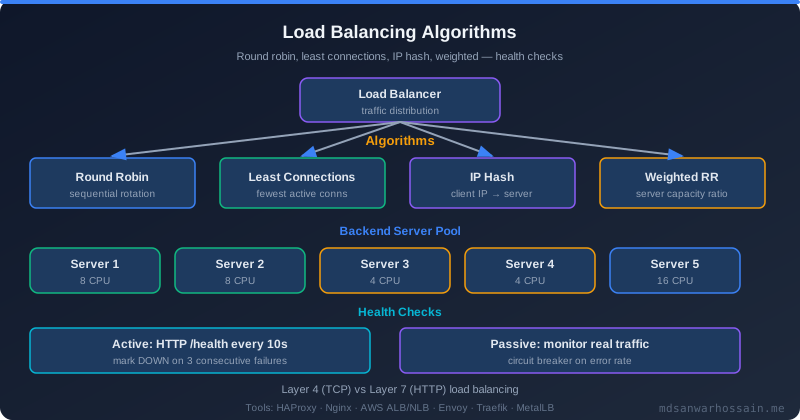
Anycast Routing: The same IP address is announced from multiple geographic locations via BGP. Client DNS resolvers receive the same IP regardless of where they are, but BGP routing directs their packets to the topologically nearest announcement point. Cloudflare and Google's 8.8.8.8 DNS use anycast. The advantage is sub-second failover (BGP reconvergence, not DNS TTL propagation). The limitation is that anycast is an IP-layer mechanism — it routes to the nearest BGP announcement, not necessarily the least-loaded or healthiest region.
GeoDNS: DNS resolvers return different A records based on the geographic origin of the DNS query. A user in Tokyo receives the IP of the ap-northeast-1 load balancer; a user in Frankfurt receives the IP of the eu-central-1 load balancer. GeoDNS is simple and widely supported but depends on DNS TTL for failover — a TTL of 60 seconds means up to 60 seconds of continued traffic to a failing region after health checks detect failure.
AWS Route 53 Latency-Based Routing: Route 53 measures round-trip latency from the resolving DNS server to each configured AWS region and returns the record for the region with the lowest measured latency. This is dynamic — it adapts to actual network conditions, not just static geographic mapping. Combined with health checks, Route 53 automatically removes unhealthy endpoints from the rotation and shifts traffic to the next-best region.
# AWS Route 53 latency-based routing with health checks (Terraform)
resource "aws_route53_health_check" "us_east_1" {
  fqdn              = "api-us-east-1.internal.example.com"
  port              = 443
  type              = "HTTPS"
  resource_path     = "/health"
  failure_threshold = 3
  request_interval  = 10

  tags = { Name = "api-us-east-1-health" }
}

resource "aws_route53_record" "api_us_east_1" {
  zone_id         = aws_route53_zone.primary.zone_id
  name            = "api.example.com"
  type            = "A"
  set_identifier  = "us-east-1"
  health_check_id = aws_route53_health_check.us_east_1.id

  latency_routing_policy {
    region = "us-east-1"
  }

  alias {
    name                   = aws_lb.us_east_1.dns_name
    zone_id                = aws_lb.us_east_1.zone_id
    evaluate_target_health = true
  }
}

resource "aws_route53_record" "api_eu_west_1" {
  zone_id         = aws_route53_zone.primary.zone_id
  name            = "api.example.com"
  type            = "A"
  set_identifier  = "eu-west-1"
  health_check_id = aws_route53_health_check.eu_west_1.id

  latency_routing_policy {
    region = "eu-west-1"
  }

  alias {
    name                   = aws_lb.eu_west_1.dns_name
    zone_id                = aws_lb.eu_west_1.zone_id
    evaluate_target_health = true
  }
}
With failure_threshold: 3 and request_interval: 10, Route 53 marks a region unhealthy after 3 consecutive failed health checks — a 30-second detection window. After detection, Route 53 stops returning that region's record for new DNS queries within its next TTL cycle. Set your DNS TTL to 60 seconds or less for production active-active deployments. A TTL of 300 seconds means five minutes of continued traffic to a dead region — an eternity during an incident.
Sticky Sessions vs Stateless: Active-active is dramatically simpler when your application tier is stateless. If your API servers hold session state in memory, a user whose request is rerouted to a different region mid-session loses their session. The solution is to externalize session state to a distributed store (e.g., Redis active-active, DynamoDB Global Tables) accessible from all regions. Design your services stateless-first; push session, cart, and transient state to the distributed data layer from the beginning.
Database Options for Multi-Region
Database choice is the most consequential architectural decision in multi-region design. No single database is optimal for all workloads — here is an honest comparison.
| Database | Consistency | Write Latency | Cost | Complexity |
|---|---|---|---|---|
| Aurora Global DB | Strong (local region), Eventual (cross-region) | <1 sec replication | High | Medium |
| Google Spanner | External consistency (global) | 100–200 ms (cross-continent) | Very High | Low (managed) |
| CockroachDB | Serializable (global) | 50–150 ms (cross-region) | Medium–High | Medium |
| Cassandra | Tunable (ONE to ALL) | Local write speed | Medium | High |
| DynamoDB Global Tables | Eventual (async replication) | Single-digit ms (local) | Medium | Low (managed) |
Aurora Global Database is the best starting point for teams already on MySQL or PostgreSQL. A single primary region accepts writes; up to 5 secondary regions receive replicated read replicas with typically under 1 second lag. Promoting a secondary to primary (for planned failover or disaster recovery) takes under 1 minute. For true active-active writes, Aurora alone is insufficient — you need application-layer routing to ensure conflicting writes do not go to different regions simultaneously.
DynamoDB Global Tables is the simplest path to true multi-active for key-value and document workloads. Each region has a full copy of every table. Writes to any region are replicated to all others asynchronously (typically under 1 second). Last-write-wins conflict resolution is used by default, with optional Lambda-based custom conflict handlers. Enabling Global Tables is a single CLI command:
# Enable DynamoDB Global Tables across regions
aws dynamodb create-global-table \
  --global-table-name UserSessions \
  --replication-group \
    RegionName=us-east-1 \
    RegionName=eu-west-1 \
    RegionName=ap-northeast-1

# Or update an existing table to add a region replica
aws dynamodb update-table \
  --table-name UserSessions \
  --replica-updates '[{"Create": {"RegionName": "ap-southeast-1"}}]'

# Verify global table status
aws dynamodb describe-global-table \
  --global-table-name UserSessions \
  --query 'GlobalTableDescription.ReplicationGroup[*].{Region:RegionName,Status:ReplicaStatus}'
CockroachDB uses the Raft consensus protocol across regions to achieve serializable isolation globally — every transaction sees a globally consistent snapshot. The trade-off is that writes must achieve Raft quorum across regions, adding 50–150ms latency depending on region placement. CockroachDB's "home region" concept lets you pin rows to specific regions to keep read-modify-write cycles local for the users most likely to access them.
State Management and Caching
The application tier is stateless; the caching tier is not. Redis is the most common distributed cache in multi-region architectures, and it has two distinct multi-region modes with very different trade-offs.
Redis Cluster with Cross-Region Sync: Run independent Redis clusters per region. Use application-level or CDC-based replication to propagate invalidations across regions asynchronously. This is simple to operate but means a cache miss in Region B after a write in Region A — the invalidation message may not have arrived yet. Suitable for workloads where serving slightly stale data from cache is acceptable (product catalog, public content, configuration data).
Redis Enterprise Active-Active Geo-Distribution: Redis Enterprise (the commercial offering) supports CRDT-based active-active replication across regions. Each region maintains a fully independent Redis instance that accepts all operations. Writes are replicated asynchronously via a conflict-free merge stream. Counters use G-Counter CRDTs (concurrent increments always merge correctly). Sets use observed-remove semantics (deletions win over concurrent additions for the same element). The conceptual configuration looks like this:
# Redis Enterprise Active-Active database config (conceptual REST API payload)
{
  "name": "session-store-geo",
  "memory_size": 10737418240,
  "replication": true,
  "active_active": {
    "enabled": true,
    "crdt_sync_seconds": 1,
    "instances": [
      {
        "cluster_fqdn": "redis-cluster-us-east-1.internal",
        "region": "us-east-1"
      },
      {
        "cluster_fqdn": "redis-cluster-eu-west-1.internal",
        "region": "eu-west-1"
      },
      {
        "cluster_fqdn": "redis-cluster-ap-northeast-1.internal",
        "region": "ap-northeast-1"
      }
    ]
  },
  "conflict_resolution": "CRDT",
  "data_persistence": "aof"
}
Cache Invalidation in Multi-Region: The hardest problem in distributed caching is not replication — it is invalidation. When a user updates their profile in Region A, the cached profile in Region B's Redis must be invalidated before the next read. The safest strategy is to use short TTLs (30–60 seconds) for cross-region-replicated data, combined with event-driven invalidation via a global message bus (Kafka MirrorMaker 2 or Amazon EventBridge global endpoints). The event bus carries invalidation events; each region's cache consumer listens and deletes the key on receipt. Short TTLs guarantee eventual eviction even if the invalidation event is lost.
Architecture Diagram
The following ASCII diagram represents a two-region active-active deployment. Each region is self-sufficient and capable of handling 100% of traffic during a failure of the other region.
┌─────────────────────────────────────────────────────┐
│                  Global Layer                        │
│  ┌──────────────────────────────────────────────┐   │
│  │   CDN Edge (CloudFront / Cloudflare)          │   │
│  │   Static assets, TLS termination, WAF         │   │
│  └──────────────────┬───────────────────────────┘   │
│                     │                                │
│  ┌──────────────────▼───────────────────────────┐   │
│  │   Global Load Balancer (Route 53 / Anycast)   │   │
│  │   Latency-based routing + health-check aware  │   │
│  └──────┬──────────────────────────┬────────────┘   │
└─────────┼──────────────────────────┼────────────────┘
          │                          │
┌─────────▼──────────┐    ┌──────────▼─────────────┐
│    REGION A         │    │    REGION B             │
│   (us-east-1)       │    │   (eu-west-1)           │
│                     │    │                         │
│  ┌───────────────┐  │    │  ┌───────────────┐      │
│  │  API Gateway  │  │    │  │  API Gateway  │      │
│  └──────┬────────┘  │    │  └──────┬────────┘      │
│         │           │    │         │                │
│  ┌──────▼────────┐  │    │  ┌──────▼────────┐      │
│  │  App Servers  │  │    │  │  App Servers  │      │
│  │  (ECS/EKS)    │  │    │  │  (ECS/EKS)    │      │
│  └──────┬────────┘  │    │  └──────┬────────┘      │
│         │           │    │         │                │
│  ┌──────▼────────┐  │    │  ┌──────▼────────┐      │
│  │  Redis Cache  │  │    │  │  Redis Cache  │      │
│  │  (primary)    │◄─┼────┼─►│  (replica)    │      │
│  └───────────────┘  │    │  └───────────────┘      │
│                     │    │                         │
│  ┌──────────────┐   │    │  ┌──────────────┐       │
│  │  DB Primary  │   │    │  │  DB Replica  │       │
│  │  (RDS/Aurora)│◄──┼────┼──│ (promoted on │       │
│  └──────────────┘   │    │  │  failover)   │       │
│                     │    │  └──────────────┘       │
│                     │    │                         │
│       Replication stream (async, <1 sec lag)        │
└─────────────────────┘    └─────────────────────────┘
Failure Scenarios
Designing for multi-region requires explicitly reasoning through every failure mode before they occur in production.
Split-Brain: The most feared multi-region failure. A network partition between Region A and Region B makes each region unable to communicate with the other, but both regions continue operating independently. Both regions accept writes for the same records, creating conflicts that will need resolution when the partition heals. Mitigation: use odd-numbered quorums (3 regions) so one partition always has majority quorum and the minority partition can be instructed to reject writes (fencing). CockroachDB and Spanner handle this automatically via Raft consensus. For active-active with 2 regions, accept the split-brain risk and rely on conflict resolution, or use a tiebreaker (a lightweight arbiter in a third region that determines which region has quorum).
Replication Lag Causing Stale Reads: User writes in Region A, then reads from Region B before replication completes. They see their own write disappear — a "read-your-writes" consistency violation that is deeply confusing to users. Mitigation: route a user's reads and writes to the same region (session affinity), or use a version token (write returns a version identifier; subsequent reads can check if they have seen at least that version and wait or re-read if not).
Network Partition Between Regions: Replication traffic between regions uses dedicated inter-region bandwidth (AWS PrivateLink, Direct Connect, or VPN). A saturated cross-region link causes replication lag to grow from sub-second to minutes, widening the inconsistency window. Monitor cross-region replication lag as a first-class metric. Alert when lag exceeds your SLA threshold (e.g., 5 seconds for eventual consistency guarantees).
Clock Skew Issues: Last-write-wins conflict resolution depends on timestamps. If Region A's servers have clocks running 500ms ahead of Region B's due to NTP drift, Region A's writes will always win in conflicts regardless of true write order. Use NTP with multiple sources, and consider logical clocks (Lamport timestamps, Hybrid Logical Clocks) for any system where LWW is your conflict resolution strategy. AWS Time Sync Service provides microsecond-accurate time to EC2 instances using GPS and atomic clock sources.
Testing Multi-Region Systems
A multi-region architecture that has never been tested under real failure conditions is a liability, not an asset. Netflix's foundational insight was that if you do not deliberately inject failures in production, failures will find you at the worst possible time under the worst possible conditions.
The core test for any active-active system is the region kill: terminate all traffic to Region A and validate that Route 53 health checks detect the failure, traffic shifts to Region B within your RTO target, Region B's database handles the additional write load without degradation, and replication resumes correctly once Region A is restored. Run this test quarterly at minimum, and annually under full production load if possible.
Beyond full region kills, test partial failures: introduce replication lag artificially (use traffic shaping tools like tc netem on the replication network path) and verify that your application handles stale reads gracefully. Test clock skew by manually advancing the system clock on a canary node and verifying that LWW conflict resolution produces the expected winner. Test split-brain by dropping the cross-region network link entirely and verifying both regions continue operating and reconcile correctly on reconnect.
Tools for multi-region chaos engineering include AWS Fault Injection Simulator (FIS), which can target specific regions, availability zones, and network paths with deterministic failure injection. Combine FIS with your observability stack to verify that your runbooks, automated failover, and alerting all trigger as expected. Document every test in a "Game Day" runbook so the same scenario can be reproduced by any on-call engineer.
Trade-offs: The Cost of Global Availability
No architecture discussion is honest without a frank accounting of what multi-region active-active costs.
Cost: Running two identical regions means your infrastructure bill approximately doubles. Every RDS instance, every EKS node, every NAT Gateway, every load balancer — all duplicated. For a system spending $50,000/month on AWS in a single region, active-active across two regions costs approximately $100,000–120,000/month (the premium comes from cross-region data transfer and replication overhead). Three regions approach $180,000/month. Organizations that build multi-region often discover, post-launch, that they underestimated the data transfer costs — cross-region replication traffic is billed at $0.02/GB on AWS, and a system with high write throughput can generate substantial replication data volumes.
Operational Complexity: Multi-region deployments require multi-region deployment pipelines. A bad deployment that is rolled back in Region A must also be rolled back in Region B before it processes traffic that was written by the rolled-back version. Blue-green deployments must coordinate across regions. Database schema migrations must be backward compatible across all regions simultaneously — you cannot run a migration in Region A while Region B is still running the old schema. This forces strict database schema versioning discipline (expand-migrate-contract pattern) that many teams are not practiced in.
Eventual Consistency Challenges: Building application logic on eventual consistency requires a fundamentally different mental model from building on ACID transactions. A shopping cart that can be modified from two regions simultaneously requires explicit conflict resolution logic that most developers have never written. Idempotency keys, optimistic locking with version vectors, and CRDT-based data structures must become first-class concepts in your engineering culture, not afterthoughts.
Debugging Across Regions: Distributed tracing must span regions. A request that enters in Region A, partially processes, then triggers a replicated event that a consumer in Region B handles is a single logical transaction — but your logs are in two different CloudWatch log groups, two different Datadog workspaces, or two different Jaeger backends. Centralized observability (cross-region log aggregation, trace context propagation via W3C TraceContext headers) is not optional in a multi-region system.
When NOT to Build Active-Active
Multi-region active-active is not the right architecture for every system. Building it prematurely is a mistake that has derailed engineering teams and burned startup runways.
Small applications and low traffic: If your system serves under 10,000 daily active users and your revenue impact from a 4-hour outage is under $10,000, the cost of building and operating active-active (in engineering time alone, typically 3–9 months of senior engineering effort) exceeds the expected loss from rare outages. Start with Multi-AZ active-passive and plan for multi-region if and when your scale justifies it.
Regulatory data residency restrictions: GDPR (EU), LGPD (Brazil), PIPL (China), and other data protection regulations may prohibit replicating personal data across geographic boundaries. Before designing cross-region replication, audit your data classification — PII, health data, and financial records may have jurisdictional restrictions that make multi-region replication legally impossible for certain data categories. Some architectures solve this with per-region data siloing (EU users' data never leaves EU), but this significantly constrains the active-active design.
Team not ready for the complexity: Active-active without strong distributed systems expertise in your team produces a system that fails in subtle, unpredictable ways. Split-brain handling, CRDT semantics, vector clocks, and multi-region deployment pipelines are advanced topics. If your team does not deeply understand these concepts, the system you build will have hidden consistency bugs that surface under production load six months after launch. Invest in team capability first — run a multi-region proof of concept, game days, and chaos engineering experiments before committing the full platform to this architecture.
Key Takeaways
- Active-Active requires stateless application tiers: Push all session, cart, and transient state to distributed data stores (DynamoDB Global Tables, Redis Enterprise active-active) accessible from every region before anything else.
- Set DNS TTL to 60 seconds or less: Higher TTLs mean continued traffic to a failed region long after health checks detect failure. Route 53 latency-based routing with health checks and 60-second TTLs gives you sub-2-minute automatic failover.
- Choose the right database for your consistency needs: DynamoDB Global Tables for key-value/document with eventual consistency; CockroachDB or Spanner for global serializable transactions; Aurora Global DB for relational workloads tolerating active-passive writes.
- Design for conflict resolution from day one: Do not add multi-region as an afterthought to a system built on implicit single-region ACID guarantees. Identify every write pattern and its conflict resolution strategy before writing any replication code.
- Kill a region in staging every sprint: Automated region failover that has never been tested is not a feature — it is a false sense of security. Make region kill tests part of your regular game day cadence.
- Account for the full cost: Infrastructure cost, operational complexity, and the cross-region data transfer charges. Multi-region active-active is worth the investment at scale; it is premature optimization at small scale.
Leave a Comment
Related Posts

Software Engineer · Java · Spring Boot · Microservices