Python FastAPI vs Django vs Flask: Complete Framework Comparison Guide 2026
Engineers choosing a Python web framework face real tradeoffs that affect performance, developer velocity, and long-term maintenance costs. FastAPI, Django, and Flask each have distinct strengths — and picking the wrong one for your use case can cost your team months of painful refactoring. This comprehensive guide covers benchmarks, async support, ORM patterns, authentication, testing, deployment strategies, and AI/ML integration so you can make the right call for your next project.
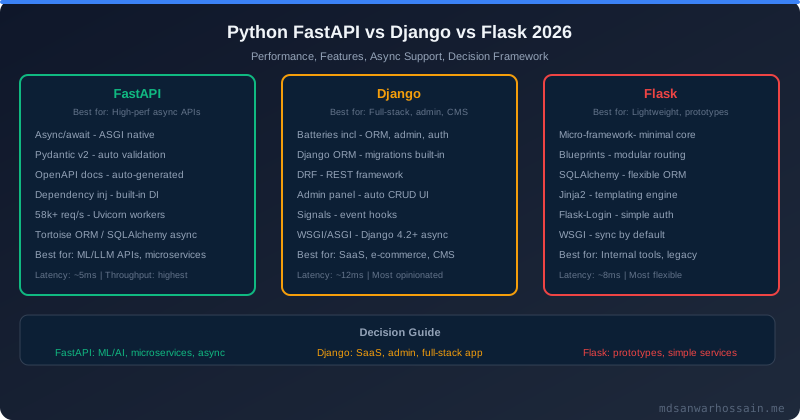
TL;DR — Decision Rule in One Sentence
Use FastAPI for high-performance async APIs, AI/ML serving, and microservices. Choose Django for full-stack apps needing admin, ORM, and rapid prototyping. Reach for Flask for simple APIs, legacy Python codebases, or when you need full control over every component.
Table of Contents
- Framework Overview: Philosophy & Design Goals
- Performance Benchmarks: FastAPI vs Django vs Flask
- FastAPI Deep Dive: Async, Pydantic v2 & Auto-Docs
- Django Deep Dive: DRF, ORM & Admin
- Flask Deep Dive: Blueprints & Extensions
- Async Support: ASGI vs WSGI
- ORM & Database Patterns
- Authentication & Security
- Testing Strategies
- Deployment & Containerization
- AI/ML Integration: Which Framework Wins?
- Decision Framework: When to Choose Each
- Migration Paths Between Frameworks
1. Framework Overview: Philosophy & Design Goals
Understanding why each framework was built — and what tradeoffs its authors consciously made — is the fastest path to picking the right tool. Let's examine each framework's DNA.
FastAPI — Fast to Code, Fast to Run
Created by Sebastián Ramírez in 2018, FastAPI is built on Starlette (the ASGI toolkit) and Pydantic (data validation via type hints). It is ASGI-native from the ground up, automatically generates OpenAPI (Swagger) documentation, and embraces Python's type system as a first-class citizen. Its philosophy: "fast to code, fast to run." FastAPI reached 70k+ GitHub stars faster than almost any Python library in history — evidence that developers were hungry for exactly this combination of performance and developer ergonomics.
- Born: 2018, by Sebastián Ramírez
- Built on: Starlette (ASGI) + Pydantic (validation)
- Concurrency model: Async/await (ASGI), event-loop driven
- Auto-docs: /docs (Swagger UI) and /redoc — zero extra code
- Philosophy: Type-hint driven development, fast iteration, production performance
- Best for: REST APIs, microservices, AI/ML serving, high-concurrency workloads
Django — Batteries Included, Convention Over Configuration
Django is the "batteries included" web framework created in 2005 at the Lawrence Journal-World newspaper. It ships with a built-in ORM, admin interface, authentication system, form handling, migrations, and a templating engine — everything you need to build a full-stack web application without touching a third-party library. Django's philosophy is convention over configuration: it makes opinionated choices so you don't have to, enabling rapid prototyping while enforcing project structure that scales with team size.
- Born: 2005, originally at Lawrence Journal-World
- Built on: WSGI (with optional ASGI support since 3.0)
- Concurrency model: Thread-per-request (sync), async views since 3.1
- Killer features: Admin, ORM, migrations, auth, DRF ecosystem
- Philosophy: Batteries included, rapid development, DRY, security-first
- Best for: Full-stack web apps, CMS, admin dashboards, e-commerce, complex business logic
Flask — Simplicity, Flexibility, Full Control
Flask is a micro-framework created by Armin Ronacher in 2010 as part of the Werkzeug/Jinja2 ecosystem. It has a minimal core — routing, request/response, and a development server — and lets you bring your own ORM, auth system, migration tool, and everything else. Flask's philosophy is radical simplicity: you assemble exactly what you need, nothing more. This makes Flask incredibly lightweight and flexible, but it requires more architectural decisions from the developer.
- Born: 2010, by Armin Ronacher (Pallets Project)
- Built on: Werkzeug (WSGI) + Jinja2
- Concurrency model: Thread-per-request (sync); Quart for async
- Killer features: Minimal core, Blueprint modularity, huge extension ecosystem
- Philosophy: Micro-framework, bring-your-own-everything, simplicity first
- Best for: Simple REST APIs, legacy codebases, prototypes, when full control is required
2. Performance Benchmarks: FastAPI vs Django vs Flask
Raw performance matters most in microservices, high-concurrency APIs, and AI inference endpoints. These benchmarks reflect TechEmpower Round 22 results for simple JSON serialization on an 8-core server.
| Framework | Req/sec (async) | Req/sec (sync) | Latency p99 | Memory/instance |
|---|---|---|---|---|
| FastAPI (uvicorn) | ~45,000 | ~28,000 | 2.1ms | 45MB |
| Django (gunicorn) | N/A | ~8,500 | 12.4ms | 85MB |
| Flask (gunicorn) | N/A | ~9,200 | 11.8ms | 38MB |
| Django (uvicorn/async) | ~14,000 | ~8,500 | 8.2ms | 88MB |
Note: Benchmarks from TechEmpower Round 22, simple JSON serialization, 8-core server. Real-world differences depend heavily on I/O patterns, database queries, and middleware chain.
- FastAPI is 3–5x faster than Django/Flask for I/O-bound workloads thanks to async/await and Uvicorn's event loop
- Flask wins on memory vs Django (38MB vs 85MB per instance) due to its minimal core — matters at scale with dozens of pods
- Django async views close some of the gap but the ORM remains partially synchronous, limiting gains
- For CPU-bound workloads (e.g., image processing), all three perform similarly — the bottleneck is Python's GIL, not the framework
- FastAPI + uvicorn with 4 workers handles thousands of concurrent WebSocket connections; Django/Flask require careful threading configuration
3. FastAPI Deep Dive: Async, Pydantic v2 & Auto-Docs
FastAPI's killer combination is automatic data validation via Pydantic v2, a powerful dependency injection system, and native async support — all generating OpenAPI documentation for free from your type hints.
Pydantic v2 Data Validation
Pydantic v2 (rewritten in Rust) is up to 50× faster than v1 for serialization/validation. FastAPI uses it to validate request bodies, path parameters, query parameters, and response models automatically:
from fastapi import FastAPI, HTTPException
from pydantic import BaseModel, Field, EmailStr
from typing import Optional
import uuid

app = FastAPI(title="User API", version="1.0.0")

class UserCreate(BaseModel):
    name: str = Field(..., min_length=2, max_length=100)
    email: EmailStr
    age: Optional[int] = Field(None, ge=0, le=150)

class UserResponse(BaseModel):
    id: str
    name: str
    email: str

@app.post("/users", response_model=UserResponse, status_code=201)
async def create_user(user: UserCreate):
    # Pydantic v2 validates automatically — 422 if invalid
    return UserResponse(
        id=str(uuid.uuid4()),
        name=user.name,
        email=user.email
    )
Auto-Generated OpenAPI Docs
FastAPI auto-generates /docs (Swagger UI) and /redoc from your type hints and Pydantic models — zero extra code required. Every endpoint, request schema, response schema, and validation rule is automatically documented. You can customize the OpenAPI schema by overriding generate_custom_openapi(). This is a massive productivity win for teams following API-first design principles.
Dependency Injection System
FastAPI's Depends() system is one of its most powerful features — it enables composable, testable dependency graphs for database sessions, auth tokens, config, and more:
from fastapi import Depends, HTTPException
from sqlalchemy.ext.asyncio import AsyncSession
from sqlalchemy import select

async def get_db() -> AsyncSession:
    async with async_session() as session:
        yield session

@app.get("/users/{user_id}")
async def get_user(user_id: int, db: AsyncSession = Depends(get_db)):
    result = await db.execute(select(User).where(User.id == user_id))
    user = result.scalar_one_or_none()
    if not user:
        raise HTTPException(status_code=404, detail="User not found")
    return user
Background Tasks & WebSockets
FastAPI provides BackgroundTasks for fire-and-forget operations (sending emails, writing audit logs) that run after the response is sent. Native WebSocket support is built-in via Starlette, making FastAPI the natural choice for real-time features like chat, live dashboards, and AI streaming responses.
- Use
BackgroundTasksfor lightweight async side effects (email, notifications) - For heavy async jobs, prefer Celery + Redis or ARQ over BackgroundTasks
- WebSocket endpoints:
@app.websocket("/ws")withawait websocket.receive_text() - Server-Sent Events (SSE) for one-way streaming — perfect for LLM token streaming
4. Django Deep Dive: DRF, ORM & Admin
Django's strength lies in its comprehensive built-in tooling — the ORM, migrations, admin, auth system, and form validation mean you ship full-featured applications in days, not weeks.
Django REST Framework (DRF)
DRF is the de facto standard for building REST APIs with Django. Its ModelViewSet, serializers, and permissions system drastically reduce boilerplate:
from rest_framework import serializers, viewsets, permissions
from rest_framework.decorators import action
from rest_framework.response import Response

class UserSerializer(serializers.ModelSerializer):
    class Meta:
        model = User
        fields = ['id', 'username', 'email', 'date_joined']
        read_only_fields = ['id', 'date_joined']

class UserViewSet(viewsets.ModelViewSet):
    queryset = User.objects.select_related('profile').all()
    serializer_class = UserSerializer
    permission_classes = [permissions.IsAuthenticated]

    @action(detail=True, methods=['post'])
    def activate(self, request, pk=None):
        user = self.get_object()
        user.is_active = True
        user.save()
        return Response({'status': 'activated'})
Django ORM
Django's ORM is Pythonic, highly readable, and handles most query patterns without touching SQL. Key features and best practices:
- QuerySet chaining:
User.objects.filter(active=True).order_by('-created_at')[:20] - N+1 prevention:
select_related()for ForeignKey joins,prefetch_related()for M2M - Aggregations:
annotate(),aggregate(),Count,Sum,Avg - Migrations:
makemigrations,migrate,showmigrations— built-in schema evolution - Raw SQL escape hatch:
Model.objects.raw()orconnection.cursor()when needed
Django Admin
The auto-generated Django Admin is arguably the framework's most underrated feature. Register a model and you immediately get a searchable, paginated CRUD interface with user authentication — a huge productivity win for internal tooling, content management, and operations dashboards. Customization via ModelAdmin allows list_display, search_fields, list_filter, inline models, and bulk actions.
Django Signals
Django's signal system provides decoupled event handling without explicit pub/sub infrastructure. Common patterns: post_save to trigger email on user registration, pre_delete to clean up S3 files before record deletion, m2m_changed for many-to-many mutations. Use signals for cross-cutting concerns but avoid overusing them — they can make code flow hard to trace.
5. Flask Deep Dive: Blueprints & Extensions
Flask's minimal surface area is its greatest strength and its biggest challenge. You get total freedom over architecture — which means you're responsible for every architectural decision.
Application Factory & Blueprints
The application factory pattern and Blueprints are the backbone of scalable Flask codebases:
from flask import Flask, Blueprint, jsonify, request
from flask_sqlalchemy import SQLAlchemy

db = SQLAlchemy()

def create_app(config_name='default'):
    app = Flask(__name__)
    app.config.from_object(config[config_name])
    db.init_app(app)

    from .api.users import users_bp
    app.register_blueprint(users_bp, url_prefix='/api/v1')
    return app

users_bp = Blueprint('users', __name__)

@users_bp.route('/users', methods=['GET'])
def get_users():
    users = User.query.filter_by(active=True).all()
    return jsonify([u.to_dict() for u in users])
Flask Extensions Ecosystem
Flask's extension ecosystem is rich but deliberately fragmented — you choose exactly what you need:
- flask-sqlalchemy — SQLAlchemy ORM integration
- flask-migrate — Alembic-based database migrations
- flask-jwt-extended — JWT authentication with refresh tokens
- flask-login — Session-based user authentication
- flask-marshmallow — Object serialization/deserialization
- flask-caching — Redis/Memcached caching integration
- flask-limiter — Rate limiting per route or user
- flask-cors — Cross-Origin Resource Sharing configuration
Lightweight API Design
Flask shines for small APIs, internal microservices, or cases where you need to integrate into an existing Python codebase with minimal disruption. No ORM is forced on you — use SQLAlchemy, Peewee, or raw SQL. Flask's low memory footprint (38MB baseline) makes it an excellent choice for high-density containerized environments where you run dozens of small service instances per node.
6. Async Support: ASGI vs WSGI
The ASGI/WSGI split is the most significant architectural difference between these frameworks. WSGI processes one request per worker synchronously; ASGI handles many concurrent requests with a single event loop worker.
| Feature | FastAPI (ASGI) | Django (ASGI) | Flask (WSGI/ASGI) |
|---|---|---|---|
| Native async | ✅ Full | ✅ Partial (3.1+) | ⚠️ Limited |
| WebSockets | ✅ Native | ✅ Channels | ❌ Needs extension |
| Recommended server | Uvicorn/Hypercorn | Uvicorn/Daphne | Gunicorn |
| Concurrency model | Async event loop | Threaded + async | Threaded |
| SSE streaming | ✅ Native | ⚠️ Manual | ⚠️ Manual |
- WSGI is synchronous — one request blocks the worker thread until complete. Fine for low-to-medium traffic with fast database queries.
- ASGI handles many concurrent requests on a single event loop worker using async/await. Critical for WebSockets, long-polling, and I/O-heavy services.
- FastAPI + Uvicorn with 4 workers handles thousands of concurrent connections efficiently
- Django async views work since 3.1 (
async defin views.py), but the Django ORM is still partially synchronous — usesync_to_async()wrapper for ORM calls in async contexts - Flask + Quart: Quart is an async Flask-compatible micro-framework (same API, ASGI runtime) for full async Flask support
7. ORM & Database Patterns
Database access patterns are where framework choice has the most lasting architectural impact. Each framework pairs naturally with different ORM solutions.
| Feature | Django ORM | SQLAlchemy | Tortoise ORM |
|---|---|---|---|
| Async support | Partial | ✅ (2.0+) | ✅ Full |
| Migrations | Built-in | Alembic | aerich |
| Query API | Pythonic | Expressive/SQL-like | Django-like |
| Complexity | Low | High | Medium |
| Best with | Django | Flask/FastAPI | FastAPI |
| Learning curve | Gentle | Steep | Moderate |
Async SQLAlchemy 2.0 with FastAPI
from sqlalchemy.ext.asyncio import create_async_engine, AsyncSession
from sqlalchemy.orm import DeclarativeBase, Mapped, mapped_column
from sqlalchemy import String

engine = create_async_engine(
    "postgresql+asyncpg://user:pass@localhost/db",
    pool_size=20,
    max_overflow=10
)

class Base(DeclarativeBase):
    pass

class User(Base):
    __tablename__ = "users"
    id: Mapped[int] = mapped_column(primary_key=True)
    email: Mapped[str] = mapped_column(String(255), unique=True, index=True)
    name: Mapped[str] = mapped_column(String(100))
SQLAlchemy 2.0's Mapped type annotation system (powered by Python type hints) provides excellent IDE support and catches schema mismatches at development time, not runtime. Combined with asyncpg, this delivers near-native PostgreSQL performance in async FastAPI applications.
8. Authentication & Security
Authentication is a cross-cutting concern handled differently by each framework. Here's how to implement secure auth in each.
FastAPI — OAuth2 + JWT
from fastapi import Depends, HTTPException, status
from fastapi.security import OAuth2PasswordBearer, OAuth2PasswordRequestForm
import jwt

oauth2_scheme = OAuth2PasswordBearer(tokenUrl="token")

async def get_current_user(token: str = Depends(oauth2_scheme)):
    try:
        payload = jwt.decode(token, SECRET_KEY, algorithms=["HS256"])
        user_id = payload.get("sub")
        if user_id is None:
            raise HTTPException(status_code=401, detail="Invalid token")
        return await get_user(user_id)
    except jwt.PyJWTError:
        raise HTTPException(
            status_code=status.HTTP_401_UNAUTHORIZED,
            detail="Invalid token",
            headers={"WWW-Authenticate": "Bearer"}
        )

@app.get("/me")
async def read_me(current_user = Depends(get_current_user)):
    return current_user
Django — AllAuth & DRF JWT
Django ships with session-based authentication and CSRF protection by default — the most secure baseline of any Python framework. For API authentication:
- djangorestframework-simplejwt — JWT access + refresh token rotation, token blacklisting
- django-allauth — Social OAuth (Google, GitHub, etc.), email verification, password reset
- django-oauth-toolkit — Full OAuth2 provider implementation
- Built-in
@login_required, permissions, groups — zero library setup needed for session auth
Flask — Flask-Login & Flask-JWT-Extended
from flask_jwt_extended import (
    jwt_required, get_jwt_identity, create_access_token,
    create_refresh_token, JWTManager
)

@users_bp.route('/login', methods=['POST'])
def login():
    username = request.json.get('username')
    password = request.json.get('password')
    user = authenticate(username, password)
    if not user:
        return jsonify(error="Invalid credentials"), 401
    return jsonify(
        access_token=create_access_token(identity=user.id),
        refresh_token=create_refresh_token(identity=user.id)
    )

@users_bp.route('/protected')
@jwt_required()
def protected():
    current_user_id = get_jwt_identity()
    return jsonify(user_id=current_user_id)
Security Best Practices (All Frameworks)
- ✅ Always hash passwords with bcrypt or argon2 — never MD5 or SHA1
- ✅ Rate limiting:
slowapifor FastAPI,django-ratelimit,flask-limiter - ✅ Configure CORS explicitly — never use wildcard
*in production - ✅ Parameterized queries prevent SQL injection in all three frameworks' ORM layers
- ✅ Set security headers: HSTS, X-Content-Type-Options, X-Frame-Options, CSP
- ✅ Rotate JWT secret keys and set short expiry (15min access, 7-day refresh)
- ✅ Use HTTPS exclusively — enforce with
SECURE_SSL_REDIRECT(Django) or nginx-level redirect
9. Testing Strategies
Each framework provides excellent testing support, but the tooling and patterns differ. Here's production-grade testing for all three.
FastAPI — TestClient & Async Testing
from fastapi.testclient import TestClient
import pytest

@pytest.fixture
def client():
    return TestClient(app)

def test_create_user(client):
    response = client.post("/users", json={
        "name": "Alice",
        "email": "alice@example.com"
    })
    assert response.status_code == 201
    data = response.json()
    assert data["email"] == "alice@example.com"
    assert "id" in data

def test_create_user_invalid_email(client):
    response = client.post("/users", json={
        "name": "Bob",
        "email": "not-an-email"
    })
    assert response.status_code == 422  # Pydantic validation error

# Async test with httpx
import pytest_asyncio
from httpx import AsyncClient

@pytest.mark.asyncio
async def test_get_user_async():
    async with AsyncClient(app=app, base_url="http://test") as ac:
        response = await ac.get("/users/1")
    assert response.status_code in [200, 404]
Django — Test Client & TestCase
from django.test import TestCase, Client
from django.contrib.auth import get_user_model

User = get_user_model()

class UserAPITest(TestCase):
    def setUp(self):
        self.client = Client()
        self.user = User.objects.create_user(
            username='testuser',
            password='testpass123'
        )

    def test_user_list_requires_auth(self):
        response = self.client.get('/api/users/')
        self.assertEqual(response.status_code, 401)

    def test_user_list_authenticated(self):
        self.client.force_login(self.user)
        response = self.client.get('/api/users/')
        self.assertEqual(response.status_code, 200)
        self.assertIn('results', response.json())

    def test_user_create(self):
        self.client.force_login(self.user)
        response = self.client.post('/api/users/', {
            'username': 'newuser',
            'email': 'new@example.com'
        }, content_type='application/json')
        self.assertEqual(response.status_code, 201)
Flask — pytest with App Context
import pytest
from myapp import create_app, db

@pytest.fixture
def app():
    app = create_app('testing')
    with app.app_context():
        db.create_all()
        yield app
        db.drop_all()

@pytest.fixture
def client(app):
    return app.test_client()

@pytest.fixture
def auth_headers(client):
    response = client.post('/api/v1/login', json={
        'username': 'testuser',
        'password': 'testpass'
    })
    token = response.json['access_token']
    return {'Authorization': f'Bearer {token}'}

def test_get_users(client, auth_headers):
    response = client.get('/api/v1/users', headers=auth_headers)
    assert response.status_code == 200
    assert isinstance(response.json, list)
10. Deployment & Containerization
All three frameworks containerize cleanly with Docker and deploy on Kubernetes, but worker configuration and server choices differ significantly.
Multi-Stage Dockerfile for FastAPI
FROM python:3.12-slim AS builder
WORKDIR /app
COPY requirements.txt .
RUN pip install --no-cache-dir -r requirements.txt

FROM python:3.12-slim
WORKDIR /app
COPY --from=builder /usr/local/lib/python3.12/site-packages \
     /usr/local/lib/python3.12/site-packages
COPY . .
EXPOSE 8000
CMD ["uvicorn", "main:app", "--host", "0.0.0.0", "--port", "8000", "--workers", "4"]
Worker Configuration Best Practices
- FastAPI:
uvicorn main:app --workers 4— use(2*CPU)+1workers as a starting point for I/O-bound APIs - Django:
gunicorn myproject.wsgi:application -w 4 -b 0.0.0.0:8000 - Flask:
gunicorn "app:create_app()" -w 4 -b 0.0.0.0:5000 - For Django/Flask with heavy async needs, pair with Celery + Redis for background job processing
- Configure Kubernetes HPA (Horizontal Pod Autoscaler) based on CPU utilization or custom metrics (requests/second via Prometheus)
Kubernetes Deployment
apiVersion: apps/v1
kind: Deployment
metadata:
  name: fastapi-app
spec:
  replicas: 3
  selector:
    matchLabels:
      app: fastapi-app
  template:
    metadata:
      labels:
        app: fastapi-app
    spec:
      containers:
      - name: fastapi-app
        image: myregistry/fastapi-app:latest
        ports:
        - containerPort: 8000
        resources:
          requests:
            memory: "128Mi"
            cpu: "250m"
          limits:
            memory: "512Mi"
            cpu: "1000m"
        livenessProbe:
          httpGet:
            path: /health
            port: 8000
          initialDelaySeconds: 30
          periodSeconds: 10
        readinessProbe:
          httpGet:
            path: /ready
            port: 8000
          initialDelaySeconds: 5
          periodSeconds: 5
11. AI/ML Integration: Which Framework Wins?
AI/ML integration is where FastAPI's design choices pay off most dramatically. Native async, streaming responses, and Pydantic validation align perfectly with how modern AI/ML workloads operate.
LLM Streaming with FastAPI + OpenAI
from fastapi import FastAPI
from fastapi.responses import StreamingResponse
from openai import AsyncOpenAI
from pydantic import BaseModel

client = AsyncOpenAI()
app = FastAPI()

class ChatRequest(BaseModel):
    message: str
    model: str = "gpt-4o"

@app.post("/chat/stream")
async def chat_stream(req: ChatRequest):
    async def generate():
        stream = await client.chat.completions.create(
            model=req.model,
            messages=[{"role": "user", "content": req.message}],
            stream=True
        )
        async for chunk in stream:
            content = chunk.choices[0].delta.content
            if content:
                yield f"data: {content}\n\n"
        yield "data: [DONE]\n\n"

    return StreamingResponse(generate(), media_type="text/event-stream")
LangChain, HuggingFace Transformers, and the OpenAI SDK all use FastAPI in their primary code examples. FastAPI's async generators make token streaming natural and efficient — the browser receives tokens as they're generated with no buffering overhead.
Framework for AI/ML Use Cases
| Use Case | Best Framework | Why |
|---|---|---|
| LLM API serving | FastAPI | Native async, SSE streaming, Pydantic validation |
| ML inference endpoint | FastAPI | Speed, auto-docs, concurrency for batching |
| AI admin dashboard | Django | Admin UI, auth built-in, ORM for data management |
| Legacy ML pipeline API | Flask | Simple, low overhead, easy to wrap existing code |
| Real-time AI agent | FastAPI | WebSockets, async, event-driven agent loops |
| Async ML job queue | Flask + Celery | Mature Celery ecosystem, flexible task routing |
Django Ninja (an alternative to DRF inspired by FastAPI) is rapidly maturing — it brings type hints, Pydantic validation, and auto-docs to Django. Worth watching for teams invested in Django who want FastAPI-style DX without migrating.
12. Decision Framework: When to Choose Each
Use this comprehensive comparison table as your primary decision aid. Then validate with the decision flowchart below.
| Criterion | FastAPI | Django | Flask |
|---|---|---|---|
| New microservice | ✅ Best | ⚠️ Overkill | ✅ Good |
| Full-stack web app | ❌ Frontend DIY | ✅ Best | ⚠️ Possible |
| Admin / CMS | ❌ No admin | ✅ Best | ❌ No admin |
| REST API | ✅ Best | ✅ DRF | ✅ Good |
| High concurrency | ✅ Best | ⚠️ Limited | ⚠️ Limited |
| AI/ML serving | ✅ Best | ❌ Poor | ⚠️ OK |
| Rapid prototype | ✅ Fast | ✅ Fast | ✅ Fastest |
| Complex business logic | ⚠️ Manual | ✅ DDD patterns | ⚠️ Manual |
| WebSockets | ✅ Native | ⚠️ Channels | ❌ Extension |
| Auto API docs | ✅ Native | ⚠️ drf-spectacular | ⚠️ flask-openapi |
Decision Flowchart — 5 Questions
- Need admin UI or full-stack with server-side templates? → Django
- Need high-performance async API or AI/ML inference serving? → FastAPI
- Have existing Flask codebase or need minimalism & full architectural control? → Flask
- Starting greenfield microservice in 2026? → FastAPI (default choice)
- Team has deep Django expertise and no performance bottlenecks? → Stick with Django
13. Migration Paths Between Frameworks
Migrations between Python frameworks are common as applications evolve. Here are proven strategies for each direction.
Flask to FastAPI
The most common migration in 2026 as teams hit Flask's performance ceiling for async workloads:
- Rewrite routes:
@app.route('/users', methods=['GET'])→@app.get('/users') - Replace Marshmallow schemas with Pydantic models (similar concept, better ergonomics)
- Replace
request.jsonwith typed function parameters validated by Pydantic - Switch from Gunicorn/WSGI to Uvicorn/ASGI — update your Dockerfile CMD
- Migrate Flask-SQLAlchemy to async SQLAlchemy 2.0 (same models, different session management)
- Convert Flask-JWT-Extended to FastAPI's OAuth2PasswordBearer pattern
- Migrate incrementally route-by-route, not big-bang rewrite
Django to FastAPI (Strangler Fig Pattern)
When performance bottlenecks appear in specific Django endpoints, use the Strangler Fig pattern to migrate incrementally:
- Deploy FastAPI as a separate service alongside Django — share the same database
- Route high-traffic or async endpoints to FastAPI via nginx or API gateway
- Keep Django Admin running while migrating the API layer to FastAPI
- Migrate Django ORM models to SQLAlchemy gradually, table by table
- Share session data via Redis for hybrid auth during transition period
- Use Django Ninja as an intermediate step — FastAPI-style DX on top of Django
FastAPI to Django (Less Common)
This migration usually happens when a team grows and needs Django's built-in admin, complex ORM relations, or the conventions that reduce cognitive load on large teams:
- Wrap FastAPI with a Django proxy, migrating endpoints one by one
- Port Pydantic models to Django Model + DRF Serializer pairs
- Replace SQLAlchemy models with Django ORM equivalents
- Leverage Django Ninja to retain FastAPI-like ergonomics within Django's architecture
Conclusion
In 2026, Python's web framework landscape is more mature than ever. FastAPI has emerged as the default choice for new microservices, APIs, and AI/ML serving — its combination of async performance, type safety, automatic documentation, and AI ecosystem alignment is hard to beat for greenfield projects. Django remains the gold standard for full-stack applications, admin-heavy tools, and teams that value convention over configuration. Flask stays relevant for its simplicity, minimal footprint, and the massive body of Flask-based code running in production.
The framework you choose matters less than understanding its constraints and designing around them. A well-architected Flask app outperforms a poorly designed FastAPI service every time. Invest in understanding the framework you choose deeply before switching.
Framework Selection Checklist
- ✅ New async microservice or AI/ML API in 2026 → FastAPI
- ✅ Need admin UI, Django ORM, or full-stack templates → Django
- ✅ Minimal footprint, legacy codebase, full architectural control → Flask
- ✅ Benchmark your specific workload — don't rely solely on synthetic benchmarks
- ✅ Consider team expertise — a known framework outperforms an unknown one in practice
- ✅ Plan for async from day one — retrofitting async into a sync codebase is painful
- ✅ Use Docker multi-stage builds to minimize image size across all three frameworks
- ✅ Configure Kubernetes HPA with both CPU and custom metrics for production deployments
- ✅ For Django: always use
select_related/prefetch_relatedto prevent N+1 queries - ✅ For FastAPI: use
Depends()for all cross-cutting concerns (db, auth, config)
Leave a Comment
Related Posts

Software Engineer · Java · Spring Boot · Microservices · AI/LLM Systems. Passionate about building scalable backend systems and helping engineers navigate complex technology decisions.
Last updated: April 8, 2026