Senior Java Engineer Career Growth: From Mid-Level to Staff Engineer in 2026
Most Java engineers plateau at mid-level not because they lack technical skills, but because they haven't made the identity shift that promotions require. The rules change at each level: mid-level engineers ship features; senior engineers own systems; staff engineers multiply the effectiveness of entire teams. This guide breaks down exactly what changes at each level, the specific skills and visibility strategies that accelerate progression, and the mindset shifts that distinguish staff engineers from experienced senior engineers in 2026.
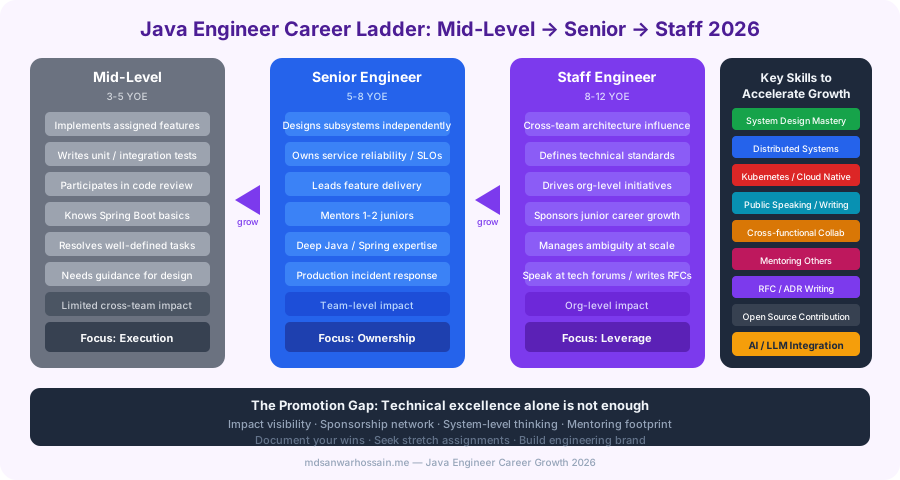
Table of Contents
- Understanding the Career Ladder: What Changes at Each Level
- Mid-Level to Senior: The Ownership Shift
- Technical Skills That Accelerate Promotion
- Senior to Staff: The Leverage Shift
- Building Visibility Without Self-Promotion
- Mentoring as a Promotion Multiplier
- The AI Era: How LLMs Change the Career Equation
- Your 12-Month Action Plan
1. Understanding the Career Ladder: What Changes at Each Level
The single most important mental model for career progression is understanding the scope of impact expected at each level. Many engineers try to get promoted by doing the same things they do now, just more of them. That doesn't work. Each level requires a different kind of contribution:
| Level | Scope | Primary Value | How Promotion Happens |
|---|---|---|---|
| Mid-Level | Feature / Task | Reliable execution | Consistent delivery + quality |
| Senior | Component / Service | Independent ownership | Ownership + mentoring + design quality |
| Staff | Team / Domain | Multiplied team output | Cross-team impact + technical leadership |
| Principal | Organisation | Engineering strategy | Org-wide direction + industry influence |
2. Mid-Level to Senior: The Ownership Shift
The gap between mid-level and senior is fundamentally about ownership and ambiguity tolerance. Mid-level engineers are given a defined task with a known solution path. Senior engineers are given a goal and must define the path themselves — and then own the result.
What Mid-Level Engineers Do That Holds Them Back
- Wait for tasks to be assigned instead of identifying what needs to be done. Senior engineers proactively find and fix the right problem, not just the assigned problem.
- Only see the happy path — building features without thinking about failure modes, edge cases, observability, and operational impact.
- Skip the "why" — implementing exactly what was asked without pushing back when the requirement has a better solution.
- Avoid on-call or escalate too quickly. Senior engineers own their service's reliability, which means understanding incidents deeply enough to prevent recurrence.
- Code in isolation — not communicating technical decisions, not writing design docs, not making trade-offs visible to the team.
The Three Ownership Practices That Signal Senior Readiness
1. Write Your First Design Document
Before you write any code for a significant change, write a 1-2 page design doc. It should cover: problem statement, proposed solution, alternatives considered (and why they were rejected), trade-offs, operational concerns (how will you monitor this, what alerts are needed, how do you roll back), and open questions. Send it to your team for feedback before you start coding.
This single practice accomplishes three things: it forces you to think before you code, it makes your technical reasoning visible to your manager and senior colleagues, and it creates a paper trail of your design contribution — critical evidence for promotion reviews.
2. Own Incidents End-to-End
When an incident occurs in a service you work on, don't just fix the immediate issue — own the post-mortem. Write a blameless post-mortem that covers: timeline of events, root cause (not just symptoms), immediate fix, and — most importantly — the follow-up action items that prevent recurrence. Track those action items to completion.
Incident ownership is one of the highest-signal activities for senior promotion. It demonstrates: deep system knowledge, reliability mindset, and the ability to follow through beyond the immediate crisis. In your 1:1 with your manager, reference your post-mortems when discussing your promotion case.
3. Lead a Feature From Problem to Production
The clearest signal of senior readiness is driving a significant feature or technical initiative from ambiguous requirements through design, implementation, code review, testing, deployment, and monitoring setup — without being told what to do at each step. You don't need formal authority to do this; you need to proactively take it on and ask your manager to reduce the guardrails.
3. Technical Skills That Accelerate Promotion
Not all technical skills are equally valuable for career progression. Focus on skills with high leverage — skills that other engineers don't have and that make difficult problems tractable:
System Design
Design for 10M+ RPS. Understand sharding, consistent hashing, read/write split, CAP theorem, and distributed transactions. Practice weekly on paper: design a URL shortener, a notification system, a rate limiter.
Performance Engineering
Profile Java applications with async-profiler and JFR. Diagnose GC pressure, CPU hotspots, JDBC slow queries. Reduce p99 latency, not just average. Understand JVM heap sizing for containers.
Distributed Systems
Deep understanding of consensus (Raft), replication lag, idempotency, eventual consistency, and failure modes. Read "Designing Data-Intensive Applications" (Kleppmann) — it's the required reading for staff+ engineers.
Observability & SRE
Define SLOs and error budgets for services you own. Set up Prometheus alerts for SLO breaches. Write runbooks for common failure modes. Know how to read traces and correlate with logs in Jaeger/Grafana.
Kubernetes & Cloud Native
Kubernetes is now the baseline deployment platform at most companies. Know HPA, KEDA, pod disruption budgets, RBAC, and network policies. CKA certification validates this skill publicly.
AI/LLM Integration
In 2026, Java engineers who can integrate LLMs (Spring AI, LangChain4j, function calling, RAG pipelines) into backend services have a significant competitive advantage. This skill is still rare and highly valued.
4. Senior to Staff: The Leverage Shift
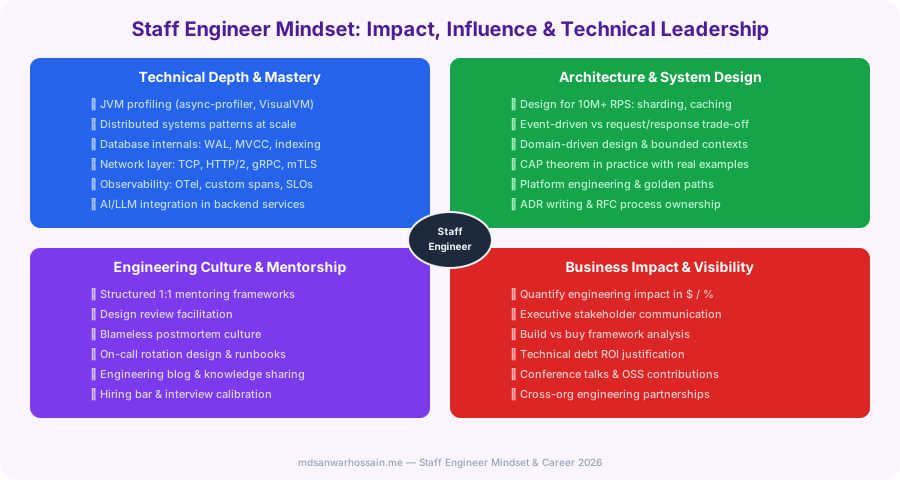
The jump from senior to staff is the hardest in the engineering career ladder because it requires a fundamentally different operating model. Senior engineers are the best individual contributors on their team. Staff engineers make their entire team better — and often multiple teams. The key mental model is leverage: how do you amplify the output of 5 engineers instead of just your own?
What Staff Engineers Actually Do (That Senior Engineers Don't)
- Define technical standards: Write RFCs and ADRs (Architecture Decision Records) that set the convention for how all teams solve a particular problem. A staff engineer's good RFC prevents 10 teams from independently making the same mistake.
- Identify the right problem: While a senior engineer solves the stated problem, a staff engineer frequently identifies that the stated problem is a symptom of a deeper architectural issue — and addresses the root cause.
- Unblock other engineers: Staff engineers spend significant time in code reviews, design reviews, and 1:1 conversations helping other engineers make better decisions. Their time is most valuable when multiplied through others.
- Connect business context to technical decisions: Staff engineers understand why the business needs a feature and can evaluate technical decisions through that lens. They say "we could build this the right way in 3 months or a working version in 2 weeks — here's the trade-off for the business."
- Grow technical leaders: Staff engineers actively mentor senior engineers to grow into future staff engineers. They sponsor others, create opportunities, and share credit.
5. Building Visibility Without Self-Promotion
The uncomfortable truth: technical excellence is necessary but insufficient for promotion. You must also be visible — your manager and their peers need evidence of your impact. But "visibility" is not self-promotion. It's structured evidence-building through natural work artifacts:
The Brag Document Strategy
Keep a running Brag Document (private note or doc) where you record significant achievements weekly: features shipped, incidents resolved, designs reviewed, engineers mentored, metrics improved. Before performance review season, turn this into a structured impact document. Format: Situation → Action → Result (quantified).
Example entry: "Identified that our HikariCP pool size was causing 200ms p99 latency spikes during peak traffic. Tuned pool size from 10 to 25 and added connection monitoring. Reduced p99 from 420ms to 95ms — a 77% improvement at zero infrastructure cost."
Technical Writing as Career Leverage
Writing is the highest-leverage activity in engineering because written content is asynchronous and scalable. A good internal design document shared with 50 engineers is 50× more impactful than a conversation with one person. External writing (this blog, LinkedIn articles, Medium, dev.to) compounds over years — each post is a permanent asset that demonstrates expertise to future employers, hiring managers, and conference organizers.
Aim for: one internal technical post per month (team wiki, Confluence, Notion), one external post per quarter. Start by turning a post-mortem into a blog post, or documenting an internal library decision as a public article.
Conference Talks and Community Visibility
Speaking at tech meetups or conferences (JavaOne, Spring I/O, KubeCon) establishes external authority that reflects back positively on you internally. Start with local meetups (30-50 person audiences) before targeting major conferences. Your talk topic doesn't have to be groundbreaking — a production case study ("How we reduced our service latency by 60% with these 5 Spring Boot tuning changes") is more compelling than academic theory.
6. Mentoring as a Promotion Multiplier
Mentoring is not optional for senior and staff engineers — it's a core job responsibility at those levels. But effective mentoring has a specific structure that many engineers miss:
Structured Mentoring: The Growth Conversation Framework
- Set explicit goals together: Ask your mentee: "Where do you want to be in 12 months? What skills do you want to develop?" Define 2-3 specific, measurable growth goals.
- Create stretch opportunities: Assign tasks that are 10-20% beyond their current comfort zone. Don't just give them tasks you don't want — give them tasks that will grow them.
- Review code with explanations, not corrections: Instead of "change this to X", say "I'd consider X here because of Y — what's your thinking on this?" Ask questions that develop their judgment, not their compliance.
- Sponsor, not just mentor: Mentoring is private advice. Sponsoring is public advocacy. When a decision is being made about who leads a project, say "I think [name] would do a great job with this and here's why." Sponsorship is the fastest career accelerator.
7. The AI Era: How LLMs Change the Career Equation
2026 is the year where LLM coding assistants (GitHub Copilot, Cursor, Devin) move from experiment to standard tooling at most companies. This has important implications for Java engineer career progression:
What AI Automates vs What It Can't
| AI Can Accelerate | AI Cannot Replace |
|---|---|
| Boilerplate code generation | Architecture judgment and trade-off decisions |
| Unit test scaffolding | Production incident diagnosis with context |
| Documentation first drafts | Stakeholder communication and negotiation |
| CRUD API scaffolding | System design for novel business problems |
| Bug fixes in isolated functions | Cross-team technical leadership and influence |
Career implication: AI raises the floor for junior and mid-level work. The skills that remain irreplaceable — system design, production judgment, architectural thinking, communication, and technical leadership — are exactly the skills required at senior and staff levels. The AI era makes senior+ skills more valuable, not less.
8. Your 12-Month Action Plan
Months 1-3: Foundation
- Start your Brag Document. Record every meaningful contribution weekly.
- Have an explicit career conversation with your manager: "I want to grow toward senior/staff. What does that look like here? What do I need to demonstrate?"
- Identify one technical area where you are not yet confident (system design, distributed systems, observability) and begin structured study (book, online course, or internal project).
- Write your first design document for an upcoming feature.
Months 4-6: Expand Scope
- Lead a feature or technical initiative end-to-end, without being assigned each step.
- Own your first on-call rotation and write a post-mortem for at least one incident.
- Start mentoring a junior or mid-level engineer with weekly 1:1s and a shared growth goal.
- Publish your first external technical post (blog, LinkedIn article, or dev.to).
Months 7-9: Build Influence
- Drive a cross-team technical decision or RFC that affects more than your immediate team.
- Present a technical topic at an internal tech talk or team demo.
- Apply for a relevant certification (CKA, AWS Solutions Architect, or Spring Professional) to validate your expertise externally.
- Schedule a mid-year career check-in with your manager — review the promotion evidence you've been building.
Months 10-12: Close the Gap
- Compile your Brag Document into a structured impact summary for your performance review.
- Have a direct conversation with your manager: "Based on what we discussed 12 months ago, I believe I've demonstrated [specific things]. When can we discuss a formal promotion?"
- If the answer is no, get a specific list of gaps and a timeline. If gaps are vague, that's a signal about whether this company has a clear path for your growth.
- If the answer is "not here", start exploring external opportunities. External moves often result in both a promotion and a significant salary increase.
Key Takeaways
- Promotion is documentation of what you're already doing, not a reward for past performance — operate at the next level first.
- Mid-to-senior shift: from task execution to system ownership, design documentation, and incident ownership.
- Senior-to-staff shift: from best individual contributor to team multiplier through RFCs, mentoring, and cross-team influence.
- Visibility is built through design docs, post-mortems, technical writing, and talks — not self-promotion.
- The AI era makes senior+ skills (system design, production judgment, technical leadership) more valuable, not less.
- Have explicit career conversations with your manager every quarter — vague promotion criteria is a red flag.
Leave a Comment
Related Posts

Software Engineer · Java · Spring Boot · Microservices