Java Interview Questions 2026: Senior Engineer Level with Detailed Answers
Senior Java engineer interviews in 2026 go far beyond syntax and basic data structures. Interviewers at top-tier companies probe JVM internals, production concurrency pitfalls, distributed system design tradeoffs, and the ability to reason about performance under realistic load. This guide compiles 30+ questions with detailed, production-grounded answers across all the domains you'll face — from heap memory areas to saga orchestration.
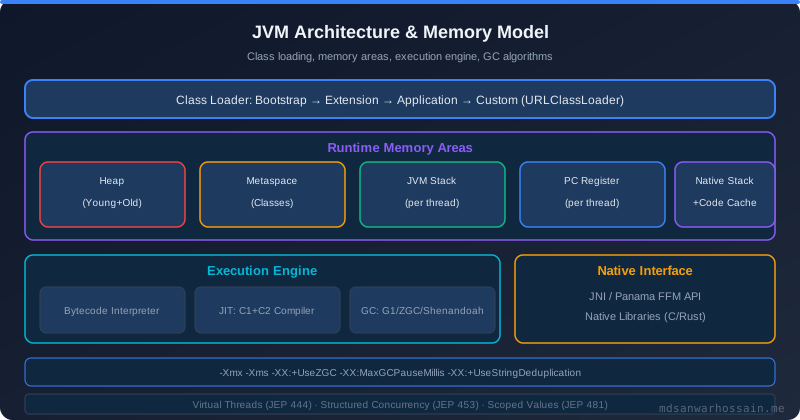
Table of Contents
How to Approach Senior Java Interviews in 2026
Senior engineering interviews evaluate three qualities that junior interviews do not: depth over breadth, production experience, and tradeoff reasoning. An interviewer asking "what is the difference between volatile and synchronized" does not want a textbook definition — they want to know whether you've debugged a visibility bug in a production concurrent system, whether you understand the happens-before relationship at the memory model level, and whether you can articulate exactly when each tool is the right choice. Generic answers from memorized lists fail this standard.
The most effective preparation strategy combines three activities. First, read the source code of the JDK classes you use daily — HashMap, ConcurrentHashMap, ReentrantLock, ForkJoinPool. The implementation reveals design decisions that generate excellent interview answers. Second, set up a test environment and reproduce classic concurrency bugs — double-checked locking without volatile, HashMap corruption under concurrent access, ThreadLocal memory leaks in thread pools. Third, practice system design problems with explicit tradeoff discussion — interviewers at senior level want to hear "I'd choose X because Y tradeoff, but X has Z downside that we'd mitigate by..." rather than "X is the best approach."
In 2026, expect questions about Java 21 features — Virtual Threads (Project Loom), Sequenced Collections, Record Patterns, and Pattern Matching for switch. These are now standard at senior interviews, not "bonus" topics.
Core Java & JVM Questions
Q1: What is the difference between volatile and synchronized, and when should you use each?
A: volatile guarantees two things: visibility (writes to a volatile variable are immediately visible to all threads) and ordering (it prevents reordering of instructions around the volatile access via a memory barrier). It does NOT guarantee atomicity for compound operations like i++. Use volatile for single-variable state flags: volatile boolean shutdown = false. synchronized provides mutual exclusion (atomicity) plus the same visibility and ordering guarantees of volatile. Use it for compound check-then-act operations, guarding invariants across multiple variables, or when you need a condition variable. The rule: if your concurrent operation is a single read or write, volatile suffices; if it involves multiple steps or multiple variables, use synchronized or java.util.concurrent atomics.
Q2: Explain the happens-before relationship in the Java Memory Model.
A: The Java Memory Model (JMM) does not guarantee that all threads see the same memory state at all times — CPUs have local caches and compilers reorder instructions for optimization. The happens-before relationship is a formal guarantee: if action A happens-before action B, then A's effects are visible to B. Key happens-before edges include: a thread's actions happen-before every action in that thread (program order); a monitor unlock happens-before every subsequent lock of the same monitor; a write to a volatile variable happens-before every subsequent read of that variable; Thread.start() happens-before every action in the started thread; every action in a thread happens-before Thread.join() returns. Without a happens-before edge between a write and a read of the same variable on different threads, the read may see a stale value — this is the source of most visibility bugs.
Q3: Describe the JVM memory areas: Heap, Metaspace, Stack, and Native Memory.
A: The Heap stores all object instances and arrays. It is divided into Young generation (Eden + two Survivor spaces) and Old generation. GC operates on the heap. The Metaspace (replaced PermGen in JDK 8) stores class metadata, method bytecode, and constant pools. It uses native memory (not heap) and grows dynamically by default — unbounded Metaspace growth from classloader leaks causes OOM in native memory rather than heap. The Stack is per-thread and stores stack frames: local variables, method parameters, and partial results. Stack frames are created on method entry and destroyed on return. Stack overflow occurs when recursion depth exceeds the stack size. Native Memory covers everything outside heap and stack: NIO direct buffers, JIT compiled code cache, JVM internal structures, and Metaspace. Monitor all four areas — an OOM in native memory is not visible in heap utilization graphs.
Q4: Explain the classloader hierarchy and delegation model.
A: The JVM uses a parent delegation model with three built-in classloaders. The Bootstrap ClassLoader (implemented in C++) loads core JDK classes from java.base module. The Platform ClassLoader (JDK 9+, formerly Extension ClassLoader) loads platform/extension modules. The Application ClassLoader loads classes from the application classpath. When any classloader is asked to load a class, it first delegates to its parent — only if the parent cannot find the class does the child attempt loading itself. This prevents application code from replacing core JDK classes (e.g., a malicious java.lang.String on the classpath would be ignored since Bootstrap ClassLoader loads the real one first). ClassLoader leaks in frameworks that create dynamic classloaders (e.g., application servers, OSGi containers) occur when live references in static fields or thread locals prevent the classloader from being GC'd after the application is undeployed.
Q5: How does the JVM garbage collector determine object liveness?
A: Modern JVMs use tracing GC — they trace a graph of object references starting from GC roots (stack variables, static fields, JNI references, monitor locks). Any object reachable from a GC root is alive; anything unreachable is eligible for collection. Reference counting (used by Python, Swift) is not used because it cannot handle cycles. Java's four reference strength levels — Strong, Soft, Weak, Phantom — allow controlled reachability: SoftReferences are cleared only under memory pressure (useful for caches), WeakReferences are cleared at any GC (useful for canonicalizing maps like WeakHashMap), PhantomReferences are enqueued after finalization for cleanup actions. The classic object lifecycle is Eden allocation → minor GC survival → Survivor space promotion → major GC promotion to Old generation → Old generation GC collection.
Concurrency & Multithreading Questions
Q6: What is the difference between ReentrantLock and synchronized?
A: Both provide mutual exclusion, but ReentrantLock offers capabilities synchronized cannot: interruptible lock acquisition (lockInterruptibly() can be interrupted while waiting, avoiding deadlock scenarios); timed lock attempts (tryLock(timeout, unit) returns false instead of blocking indefinitely); fairness (new ReentrantLock(true) grants lock to the longest-waiting thread, preventing starvation — not available with synchronized); multiple condition variables (lock.newCondition() creates separate wait sets for different conditions, whereas synchronized has a single wait()/notifyAll() wait set). Use synchronized for simple critical sections — it's less error-prone (lock is always released when block exits). Use ReentrantLock when you need timed acquisition, interruptibility, or multiple conditions.
Q7: Compare CountDownLatch and CyclicBarrier.
A: CountDownLatch is a one-shot countdown: one or more threads wait on await() until other threads call countDown() a fixed number of times. It cannot be reset. Use it for "wait for N services to initialize before starting." CyclicBarrier is reusable: a fixed number of threads all call await() and block until all have arrived, then all proceed simultaneously. It has an optional barrier action executed by the last thread to arrive. Use it for iterative parallel algorithms where all workers must complete each phase before any proceeds to the next. The critical difference: CountDownLatch separates counters from waiters; CyclicBarrier requires all participants to both wait and release.
// CountDownLatch: main thread waits for 3 services to start
CountDownLatch latch = new CountDownLatch(3);
executorService.submit(() -> { startServiceA(); latch.countDown(); });
executorService.submit(() -> { startServiceB(); latch.countDown(); });
executorService.submit(() -> { startServiceC(); latch.countDown(); });
latch.await();  // Blocks until all 3 have called countDown()

// CyclicBarrier: 4 workers synchronize at end of each batch
CyclicBarrier barrier = new CyclicBarrier(4, () ->
    System.out.println("All workers done with phase " + phase));
// Each worker calls barrier.await() at end of each phase
// All 4 must arrive before any proceeds
Q8: How do ThreadLocal memory leaks occur in thread pools?
A: ThreadLocal stores a value per thread. In a thread pool where threads are reused across requests, ThreadLocal values set in one request persist to the next request handled by the same thread — leaking data between requests and accumulating memory. The classic example: an HTTP filter sets a user context in ThreadLocal for a request, but forgets to call remove() when the request completes. The thread returns to the pool with the stale user context. The next request handled by that thread reads the previous user's context. Additionally, if the value held in the ThreadLocal references a classloader (e.g., in application servers), it prevents classloader GC during application undeploy, causing Metaspace OOM over time. Fix: always call threadLocal.remove() in a finally block after use, or use try-with-resources wrappers.
Q9: Explain ForkJoinPool internals and work-stealing.
A: ForkJoinPool is designed for divide-and-conquer recursive tasks. Each worker thread has its own double-ended work queue (deque). Tasks are pushed to and popped from the local thread's deque in LIFO order (like a stack) — this maximizes cache locality since the most recently forked subtask is likely in CPU cache. When a thread's local queue is empty, it steals from the tail (FIFO end) of a randomly chosen other thread's deque — this distributes load without contention at the head of the deque. The commonPool() is shared across all CompletableFuture, parallel streams, and explicit ForkJoinTask submissions. The pool size defaults to Runtime.availableProcessors() - 1. Avoid using commonPool() for blocking tasks — a single blocking operation can starve all parallel stream and CompletableFuture operations across the JVM.
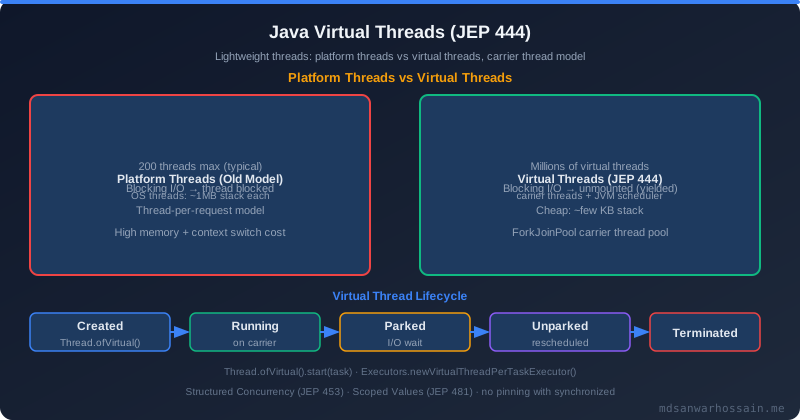
Q10: How do Virtual Threads in Java 21 change concurrency programming?
A: Virtual Threads (JEP 444, Java 21) are lightweight, JVM-managed threads that are not mapped 1:1 to OS threads. Millions of virtual threads can be created with low overhead (each starts at ~1KB stack). When a virtual thread blocks on I/O, the JVM unmounts it from its carrier OS thread, allowing the carrier to run other virtual threads — eliminating the fundamental problem of blocking I/O consuming OS threads. For Spring Boot, enable with spring.threads.virtual.enabled=true. The programming model is identical to platform threads — synchronized, Thread.sleep(), blocking JDBC calls all work correctly. The key limitation in Java 21: virtual threads pin to their carrier thread when inside a synchronized block — replace synchronized with ReentrantLock in hot paths to avoid pinning. Java 24 resolves most pinning cases.
// Java 21: create thousands of virtual threads cheaply
try (var executor = Executors.newVirtualThreadPerTaskExecutor()) {
    IntStream.range(0, 10_000).forEach(i ->
        executor.submit(() -> {
            Thread.sleep(Duration.ofSeconds(1));  // Doesn't block OS thread
            return fetchDataFromDb(i);
        }));
} // executor.close() waits for all tasks
Java Collections & Data Structures
Q11: How does HashMap handle collisions, and what changed in Java 8?
A: HashMap uses an array of buckets. When two keys hash to the same bucket, they are stored in a linked list at that bucket — O(1) average, O(n) worst-case. In Java 8, when a bucket's linked list reaches 8 entries (and the table has at least 64 buckets), the list is converted to a red-black tree (treeified), reducing worst-case lookup from O(n) to O(log n). When entries fall below 6, the tree is converted back to a linked list. This prevents HashDoS attacks where an adversary sends many keys with the same hash code to degrade a HashMap to O(n). The treeification threshold of 8 is chosen because the Poisson probability of 8 collisions in a well-distributed map is approximately 0.00000006 — treeification almost never occurs under normal usage.
Q12: How does ConcurrentHashMap achieve thread safety without a global lock?
A: ConcurrentHashMap in Java 8+ uses a fundamentally different approach from its Java 7 segmented-lock predecessor. It uses CAS (Compare-And-Swap) for inserting into empty buckets, and synchronized on individual bucket heads for operations on non-empty buckets. This means only writes to the same bucket contend — reads are fully lock-free using volatile reads of the array. The entire map never has a single global lock. size() uses a distributed counter (CounterCell array) to avoid contention on a single counter. This makes ConcurrentHashMap scale to hundreds of concurrent threads with near-linear throughput scaling up to the number of distinct buckets being modified.
Q13: ArrayDeque vs LinkedList — when does the choice matter?
A: Both implement Deque, but ArrayDeque is faster in almost all use cases. LinkedList allocates a Node object for every element — this means GC pressure, pointer chasing (cache-unfriendly), and ~40 bytes overhead per element. ArrayDeque stores elements in a circular array — cache-friendly sequential memory access, zero per-element object overhead. ArrayDeque is 2–5× faster for typical push/pop operations. Prefer ArrayDeque as a stack, queue, or deque. The only time LinkedList has an advantage is when you need O(1) insertion/deletion at a known iterator position in the middle of a large list — but this use case is uncommon and usually indicates the wrong data structure choice.
Q14: How is LinkedHashMap used to implement an LRU cache?
A: LinkedHashMap maintains insertion order (or access order if constructed with accessOrder=true) via a doubly-linked list connecting all entries in addition to the hash table. With accessOrder=true, any get() or put() moves the accessed entry to the tail of the linked list, making the head always the least recently used entry. Override removeEldestEntry() to automatically evict the oldest entry when the map exceeds capacity:
public class LRUCache<K, V> extends LinkedHashMap<K, V> {
    private final int capacity;

    public LRUCache(int capacity) {
        super(capacity, 0.75f, true);  // accessOrder = true
        this.capacity = capacity;
    }

    @Override
    protected boolean removeEldestEntry(Map.Entry<K, V> eldest) {
        return size() > capacity;
    }

    public synchronized V get(K key) { return super.get(key); }
    public synchronized void put(K key, V value) { super.put(key, value); }
}
Spring Boot & Microservices Questions
Q15: Describe the complete Spring bean lifecycle.
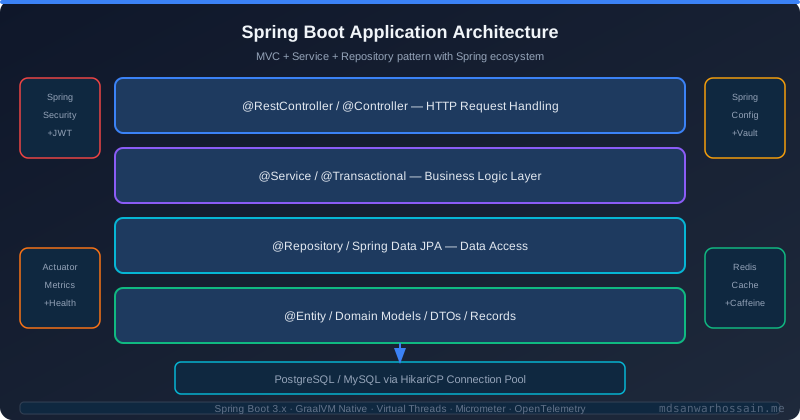
A: Spring bean lifecycle phases: (1) Instantiation — constructor called; (2) Dependency injection — @Autowired fields/setters populated; (3) BeanNameAware/BeanFactoryAware callbacks — bean receives its name and factory reference; (4) BeanPostProcessor.postProcessBeforeInitialization() — called on all beans, used by AOP proxying; (5) @PostConstruct / InitializingBean.afterPropertiesSet() — custom initialization logic; (6) BeanPostProcessor.postProcessAfterInitialization() — AOP proxies are applied here; (7) Bean is ready — used by the application; (8) @PreDestroy / DisposableBean.destroy() — cleanup on context close. AOP proxies wrap the target bean at step 6, which is why calling a @Transactional method from within the same bean bypasses the transaction proxy — the proxy is only invoked on calls from outside the bean.
Q16: What are the @Transactional propagation levels and when do they matter?
A: REQUIRED (default): joins an existing transaction or creates a new one. REQUIRES_NEW: always creates a new transaction, suspending the existing one — use for audit logging that must commit even if the outer transaction rolls back. NESTED: executes within a savepoint of the outer transaction — if the nested method rolls back, only the savepoint is rolled back, not the entire outer transaction (only supported with JDBC, not JPA). MANDATORY: must execute within an existing transaction, throws if none exists. NOT_SUPPORTED: executes without a transaction, suspending any existing one. NEVER: throws if a transaction exists. SUPPORTS: joins existing transaction if present, otherwise non-transactional. The most common production bug: using REQUIRED when an outbox event insert must commit independently of the main transaction — use REQUIRES_NEW for outbox insertions.
Q17: How does the Spring Security filter chain work?
A: Spring Security inserts a FilterChainProxy into the servlet filter chain at a specific position. FilterChainProxy holds multiple SecurityFilterChain instances, each matching a specific URL pattern. For a matched chain, it delegates to an ordered list of security filters. Key filters in order: SecurityContextPersistenceFilter (loads SecurityContext from session), UsernamePasswordAuthenticationFilter or BearerTokenAuthenticationFilter (extracts credentials), ExceptionTranslationFilter (converts AccessDeniedException to 403, AuthenticationException to 401), FilterSecurityInterceptor (authorization decision). Authentication sets a SecurityContext in SecurityContextHolder (backed by a ThreadLocal). Method security (@PreAuthorize) is enforced via AOP after the filter chain, on the actual bean method invocation.
System Design & Architecture Questions
Q18: Design a URL shortener at scale (1 billion URLs).
A: Core design: generate a 7-character Base62 ID (62^7 = 3.5 trillion unique URLs) using a distributed ID generator (Snowflake or pre-generated ID ranges). Store (short_id → long_url) in a distributed database — Cassandra for write-heavy workloads or PostgreSQL with horizontal read replicas for read-heavy. Cache hot short URLs in Redis with a 24-hour TTL — 80% of traffic hits 20% of URLs, so a 100GB Redis cluster caches the hot set effectively. Redirect service returns HTTP 301 (permanent, browser-cached) for static URLs or 302 (temporary, no browser cache) for analytics-tracked URLs. For analytics, write click events to Kafka asynchronously — never block the redirect on analytics writes. Shard the database by hash of the short ID for even distribution. The redirect P99 latency target: <5ms for cache hits.
Q19: Design a distributed rate limiter.
A: Use the sliding window log algorithm for accuracy or token bucket for burst tolerance. For distributed implementation, use Redis with a Lua script to atomically check and decrement the counter — Lua scripts execute atomically in Redis, preventing race conditions: INCR counter → check limit → SET TTL in a single atomic operation. The key is rate_limit:{user_id}:{window} where window is the current minute (for per-minute limits). For very high throughput, use local in-memory token buckets per pod with periodic synchronization to Redis — this trades perfect accuracy for reduced Redis load. Google's Doorman and Lyft's RateLimit service use distributed token buckets with a central controller allocating quota to each instance.
Q20: What are the tradeoffs of CQRS?
A: CQRS (Command Query Responsibility Segregation) separates write models (commands) from read models (queries). Benefits: read models can be optimized for query patterns independently (denormalized, pre-aggregated); write models are optimized for consistency; different scaling strategies for reads and writes. Costs: eventual consistency between write and read models introduces latency before changes are visible in queries; significantly higher implementation complexity (event sourcing, projections, idempotent projectors); debugging requires correlating commands with resulting events and projections across multiple stores. Use CQRS when: read and write workloads are dramatically different in volume or structure; queries require complex joins that do not map to the write model; the write side requires strict domain invariants that would be complicated by query optimization concerns.
Coding Challenges: Live Problem Solving
Senior Java interviews often include a 30–45 minute live coding exercise. Interviewers assess algorithmic thinking, code cleanliness, and how you handle edge cases. Three high-frequency patterns:
Sliding Window — find the maximum sum subarray of size k:
public int maxSubarraySum(int[] nums, int k) {
    if (nums.length < k) return -1;
    int windowSum = 0;
    for (int i = 0; i < k; i++) windowSum += nums[i];
    int maxSum = windowSum;
    for (int i = k; i < nums.length; i++) {
        windowSum += nums[i] - nums[i - k];
        maxSum = Math.max(maxSum, windowSum);
    }
    return maxSum;
}
Two Pointers — find a pair summing to target in a sorted array:
public int[] twoSum(int[] sorted, int target) {
    int left = 0, right = sorted.length - 1;
    while (left < right) {
        int sum = sorted[left] + sorted[right];
        if (sum == target) return new int[]{left, right};
        else if (sum < target) left++;
        else right--;
    }
    return new int[]{-1, -1};
}
Dynamic Programming — longest common subsequence:
public int lcs(String a, String b) {
    int m = a.length(), n = b.length();
    int[][] dp = new int[m + 1][n + 1];
    for (int i = 1; i <= m; i++) {
        for (int j = 1; j <= n; j++) {
            if (a.charAt(i-1) == b.charAt(j-1))
                dp[i][j] = 1 + dp[i-1][j-1];
            else
                dp[i][j] = Math.max(dp[i-1][j], dp[i][j-1]);
        }
    }
    return dp[m][n];
}
FAQs: Java Interview Process
Q: How many interview rounds should I expect at a top-tier company?
A: Typically 5–6 rounds: a recruiter screen, a technical phone screen (30–45 min coding), two system design rounds (60 min each), and 1–2 behavioral rounds (leadership principles or culture fit). Some companies add a take-home exercise. The most critical round for senior engineers is system design — invest the most preparation time here.
Q: Should I focus on LeetCode hard problems?
A: Solve at least 50 medium problems thoroughly before attempting hard. For senior roles, the bar is medium-to-hard, but interviewers weight clean code, edge case handling, and complexity analysis equally with the algorithm choice. A well-reasoned O(n log n) solution beats a poorly explained O(n) solution.
Q: How should I prepare for system design questions?
A: Study the canonical systems: URL shortener, Twitter feed, Uber surge pricing, Netflix video delivery, Google Search indexing. For each, practice: (1) requirements clarification, (2) back-of-envelope capacity math, (3) high-level component diagram, (4) deep-dive on 2–3 components, (5) failure modes and mitigations. Read "Designing Data-Intensive Applications" by Martin Kleppmann — it is the single best resource for senior-level system design preparation.
Q: What Java 21 features are most commonly asked about?
A: Virtual Threads (JEP 444), Record Patterns (JEP 440), Pattern Matching for switch (JEP 441), and Sequenced Collections (JEP 431). Understand the motivation for each feature — interviewers ask "why was this added?" as much as "how does it work?"
Q: How do I handle questions I don't know the answer to?
A: Never bluff. Say "I don't have direct experience with that, but reasoning from first principles..." and then reason aloud. Interviewers at senior level respect intellectual honesty and the ability to reason under uncertainty far more than a memorized answer. Bluffing is immediately detectable and disqualifying.
Key Takeaways
- Depth signals seniority: Know JVM internals, GC algorithms, and JMM at a mechanistic level — not just what they do, but why they're designed that way.
- Concurrency requires production experience: Study classic concurrency bugs (
ThreadLocalleaks,volatilevisibility failures, double-checked locking) and be able to reproduce and explain them. - System design is a structured conversation: Use the requirements → capacity → high-level design → deep-dive → failure modes framework consistently. Communicate tradeoffs explicitly.
- Java 21 features are now expected: Understand Virtual Threads, Record Patterns, and Pattern Matching — these are standard interview topics, not advanced bonuses.
- Coding cleanliness matters as much as correctness: Use descriptive variable names, handle edge cases explicitly, and analyze time/space complexity unprompted.
Leave a Comment
Related Posts

Software Engineer · Java · Spring Boot · Microservices