Service Discovery in Microservices: Client-Side vs Server-Side, Eureka, Consul & DNS Patterns
In a world where microservices spin up and tear down in seconds, static IP configuration is a recipe for disaster. Service discovery is the mechanism that allows services to find each other dynamically — no hardcoded addresses, no manual configuration updates, no downtime during deployments. This deep-dive covers every production-grade pattern from Netflix Eureka to Kubernetes CoreDNS, equipping you to choose the right strategy for your architecture.
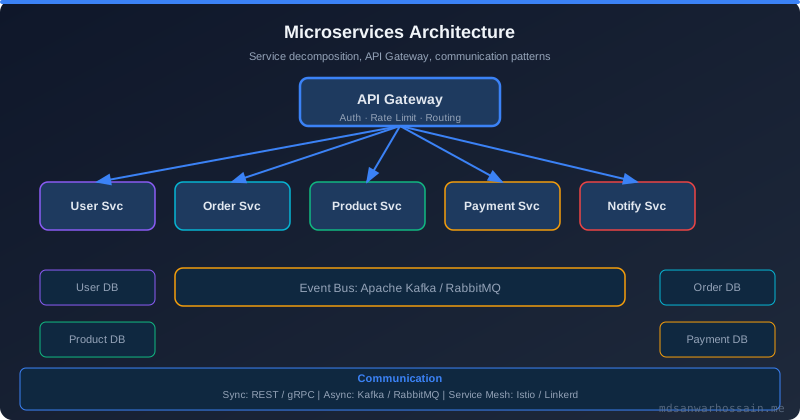
Table of Contents
- Why Static Configuration Fails at Scale
- Service Registry: The Source of Truth
- Client-Side Discovery: Eureka & Ribbon
- Server-Side Discovery: AWS ALB, NGINX, Envoy
- DNS-Based Service Discovery: CoreDNS & Kubernetes
- Consul: Multi-Datacenter Service Discovery
- Health Checks and Deregistration Strategies
- Production Failure Patterns
- Key Takeaways
- Conclusion
1. Why Static Configuration Fails at Scale
In the monolithic era, deploying your application meant pointing a load balancer at a fixed set of server IPs. That list changed infrequently — perhaps once per quarter during a planned maintenance window — and the operations team updated firewall rules, configuration files, and DNS entries manually. It was tedious but manageable. The microservices revolution shattered this model.
Consider a modern cloud-native deployment: your order-service auto-scales from 3 to 47 instances in response to a flash sale. Kubernetes reschedules pods onto new nodes, assigning entirely new IP addresses. A canary deployment of payment-service runs alongside the stable version, both needing to receive traffic in a 10/90 split. Meanwhile, a rolling update of inventory-service cycles through instances one at a time. Every single one of these events changes the effective address of a service endpoint.
Hardcoding IPs in configuration files creates a cascade of operational nightmares. The configuration must be updated and redeployed to every dependent service whenever an instance changes. There is no mechanism to detect that a configured endpoint has become unhealthy. Auto-scaling is effectively impossible because the scaling mechanism has no way to inform callers of the new instances. Container orchestration becomes unworkable since container IPs are assigned dynamically from ephemeral address pools.
# The anti-pattern: hardcoded service addresses in application.yml
# This breaks with auto-scaling, rolling deploys, or any container restart
services:
  payment-service:
    url: http://10.0.1.45:8080   # dies when container restarts
  inventory-service:
    url: http://10.0.1.67:8082   # wrong after a rolling deploy
  notification-service:
    url: http://10.0.1.89:8083   # missing all new scale-out instances

# With 40 microservices and 10+ instances each, maintaining
# this configuration is a full-time job — and still always wrong.
Beyond manual maintenance, static configuration creates a tight coupling between the consumer and the physical topology of the provider. This violates the core microservices principle of independent deployability. You cannot scale a service without coordinating a configuration change in every one of its consumers. The infrastructure becomes a dependency graph that blocks autonomous team deployment cycles.
The solution is a service registry — a dedicated system that dynamically tracks which instances of each service are live, healthy, and ready to accept traffic. Services register themselves on startup and deregister on shutdown. Consumers query the registry to obtain a current list of healthy endpoints before making any call. This decouples the consumer from the physical topology entirely.
2. Service Registry: The Source of Truth
A service registry is a distributed database whose sole purpose is maintaining the current set of available service instances. Every service instance registers its network location (host, port, protocol), along with metadata such as version, datacenter, health check endpoint, and custom tags. The registry continuously monitors the health of registered instances and removes stale or unhealthy entries.
The CAP theorem is directly relevant to the design of service registries, and the choice between AP (availability + partition tolerance) and CP (consistency + partition tolerance) registries has significant operational consequences.
AP registries (Netflix Eureka, AWS Cloud Map) prioritize availability. During a network partition, each Eureka server continues to serve its locally cached registry data even if it cannot sync with peers. This means clients may temporarily see stale entries — perhaps routing to an instance that has since been deregistered — but calls will generally succeed rather than fail with a "registry unavailable" error. Eureka's self-preservation mode even suppresses deregistrations when heartbeat loss exceeds a threshold, on the assumption that network issues (rather than instance failures) are the root cause.
CP registries (HashiCorp Consul with Raft consensus, etcd) prioritize consistency. Every write (registration, deregistration) must be committed to a quorum of server nodes before it is acknowledged. During a partition that isolates the leader or prevents quorum, the registry returns errors rather than stale data. This is appropriate when routing to a stale endpoint is more dangerous than failing fast — for example, in security-sensitive or payment workflows.
Both types of registry support the same fundamental operations: register (service instance comes online), deregister (service instance goes offline), heartbeat (periodic proof-of-life signal), query (retrieve healthy instances of a named service), and watch (receive push notifications when the instance list changes). The registration lifecycle must be tightly integrated with the service startup and graceful shutdown process to prevent stale entries from accumulating in the registry.
3. Client-Side Discovery: Eureka & Ribbon
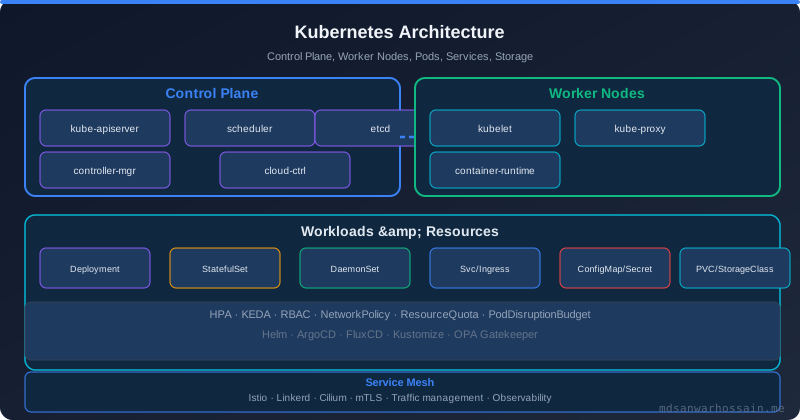
In the client-side discovery pattern, the service consumer is responsible for the entire discovery and load-balancing process. The client queries the service registry to retrieve the full list of available instances for the target service, applies a load-balancing algorithm of its own choosing (round-robin, weighted, zone-affinity, etc.), and makes the HTTP or gRPC call directly to the selected instance. No intermediary proxy is involved in the data path.
Netflix pioneered this approach with the combination of Eureka (the AP service registry) and Ribbon (the client-side load balancer). Spring Cloud wraps both into a cohesive developer experience. The @EnableDiscoveryClient annotation triggers registration with Eureka on startup, and a @LoadBalanced RestTemplate transparently resolves service names to instance URLs using Ribbon.
// Eureka Server — standalone Spring Boot application
@SpringBootApplication
@EnableEurekaServer
public class ServiceRegistryApplication {
    public static void main(String[] args) {
        SpringApplication.run(ServiceRegistryApplication.class, args);
    }
}

// application.yml for Eureka Server
server:
  port: 8761
eureka:
  instance:
    hostname: localhost
  client:
    registerWithEureka: false   # server does not register itself
    fetchRegistry: false
  server:
    enableSelfPreservation: true
    renewalPercentThreshold: 0.85
    waitTimeInMsWhenSyncEmpty: 0
// Eureka Client — order-service registering with the registry
@SpringBootApplication
@EnableDiscoveryClient
public class OrderServiceApplication {
public static void main(String[] args) {
SpringApplication.run(OrderServiceApplication.class, args);
}
// @LoadBalanced RestTemplate: resolves "payment-service" via Eureka + Ribbon
@Bean
@LoadBalanced
public RestTemplate restTemplate() {
return new RestTemplate();
}
}
// Calling payment-service by logical name — Ribbon resolves to a healthy instance
@Service
public class PaymentClient {
private final RestTemplate restTemplate;
public PaymentClient(@LoadBalanced RestTemplate restTemplate) {
this.restTemplate = restTemplate;
}
public PaymentResponse charge(PaymentRequest request) {
// "payment-service" is resolved to http://10.0.1.45:8080 automatically
return restTemplate.postForObject(
"http://payment-service/api/v1/payments",
request,
PaymentResponse.class
);
}
}# application.yml for order-service (Eureka client)
spring:
application:
name: order-service
eureka:
client:
serviceUrl:
defaultZone: http://eureka1:8761/eureka/,http://eureka2:8762/eureka/
fetchRegistry: true
registryFetchIntervalSeconds: 10 # how often to refresh local cache
instanceInfoReplicationIntervalSeconds: 30
instance:
preferIpAddress: true
leaseRenewalIntervalInSeconds: 10 # heartbeat interval
leaseExpirationDurationInSeconds: 30 # deregister after 3 missed heartbeats
# Ribbon load-balancing configuration per service
payment-service:
ribbon:
NFLoadBalancerRuleClassName: com.netflix.loadbalancer.WeightedResponseTimeRule
ConnectTimeout: 2000
ReadTimeout: 5000
MaxAutoRetries: 1
MaxAutoRetriesNextServer: 2
OkToRetryOnAllOperations: falseClient-side discovery offers fine-grained control: each client can apply different load-balancing strategies, zone affinity (preferring instances in the same availability zone to reduce latency and cross-AZ data transfer costs), and instance-level filtering based on metadata tags (e.g., routing canary traffic only to instances tagged version=v2). The downside is coupling: every language ecosystem needs its own registry client library. If your polyglot architecture includes Node.js, Python, and Go services alongside Java, each requires a separate, maintained client implementation. Modern stacks often use the Spring Cloud LoadBalancer abstraction with WebClient for reactive applications, replacing the deprecated Ribbon.
@LoadBalanced WebClient.Builder for reactive services. The same logical service name resolution applies, but with a non-blocking I/O model suited to high-concurrency workloads.
4. Server-Side Discovery: AWS ALB, NGINX, Envoy
In the server-side discovery pattern, the consumer delegates all discovery and load-balancing responsibility to an intermediary — a load balancer or proxy that sits between the caller and the callee. The consumer simply makes a request to a well-known stable address (the address of the proxy), and the proxy consults the service registry, selects a healthy instance, and forwards the request. The consumer remains completely unaware of how many instances exist or where they are running.
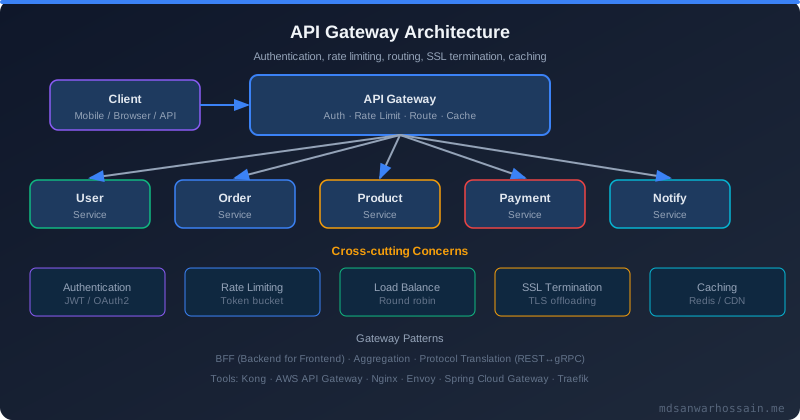
AWS Application Load Balancer (ALB) integrates natively with ECS and EKS. When a new task or pod registers with the ECS service or Kubernetes deployment, ALB's target group is automatically updated via the AWS ECS Service Discovery or the ALB Ingress Controller. Target health checks run from the ALB directly, and unhealthy targets are removed from rotation without any consumer involvement.
# NGINX upstream with dynamic DNS resolution (server-side discovery)
# Using nginx-plus or OpenResty with Consul DNS backend

upstream payment_service {
    zone payment_upstream 64k;
    # Consul DNS resolves payment-service.service.consul to healthy IPs
    server payment-service.service.consul:8080 resolve;
    # NGINX re-resolves DNS every 10 seconds to pick up new instances
    resolver 10.0.0.2 valid=10s;
    keepalive 32;
}

server {
    listen 80;
    location /api/payments/ {
        proxy_pass http://payment_service;
        proxy_http_version 1.1;
        proxy_set_header Connection "";
        proxy_set_header X-Real-IP $remote_addr;
        proxy_connect_timeout 2s;
        proxy_read_timeout 10s;
        # Retry on connection failure to next upstream
        proxy_next_upstream error timeout http_503;
        proxy_next_upstream_tries 3;
    }
}
Envoy Proxy is the de facto sidecar and edge proxy in service mesh architectures (Istio, AWS App Mesh). Envoy's xDS (discovery service) API allows a control plane to push dynamic cluster (upstream service) configuration without restarting the proxy. The Cluster Discovery Service (CDS) provides the list of clusters, the Endpoint Discovery Service (EDS) provides the healthy endpoints for each cluster, and the Route Discovery Service (RDS) provides routing rules. This architecture cleanly separates the data plane (Envoy) from the control plane (Pilot/istiod).
# Envoy static cluster config (simplified) — in production, this comes via EDS/CDS
static_resources:
  clusters:
  - name: payment_service
    connect_timeout: 2s
    type: EDS                        # dynamic endpoint discovery
    lb_policy: LEAST_REQUEST         # server-side load balancing policy
    health_checks:
    - timeout: 1s
      interval: 5s
      unhealthy_threshold: 2
      healthy_threshold: 1
      http_health_check:
        path: /actuator/health
    circuit_breakers:
      thresholds:
      - max_connections: 1024
        max_pending_requests: 512
        max_requests: 1024
        max_retries: 3
    eds_cluster_config:
      eds_config:
        api_config_source:
          api_type: GRPC
          grpc_services:
          - envoy_grpc:
              cluster_name: xds_cluster   # points to Istio Pilot
Server-side discovery is language-agnostic: any client that can make an HTTP request benefits from the load balancing, without any library integration. It is the natural choice for polyglot architectures and for external-facing APIs where you don't control the client. The trade-off is an additional network hop (through the proxy) and a potential single point of failure if the proxy is not deployed with sufficient redundancy.
5. DNS-Based Service Discovery: CoreDNS & Kubernetes
Kubernetes makes DNS-based service discovery the default experience for all workloads. When you create a Kubernetes Service object, the cluster's DNS resolver (CoreDNS, running as a Deployment in kube-system) automatically creates DNS A records and SRV records for that service. Any pod in the cluster can resolve payment-service.payments.svc.cluster.local to the ClusterIP of the service, without any registry client library or configuration.
The DNS name follows a predictable convention: <service-name>.<namespace>.svc.cluster.local. Within the same namespace, you can use just the short name payment-service. The ndots:5 search path in /etc/resolv.conf (injected into every pod) ensures that short names are expanded to the full qualified name automatically.
# Standard Kubernetes Service — creates a stable ClusterIP with DNS entry
apiVersion: v1
kind: Service
metadata:
  name: payment-service
  namespace: payments
  labels:
    app: payment-service
    version: v2
spec:
  selector:
    app: payment-service          # routes to all pods with this label
  ports:
  - name: http
    protocol: TCP
    port: 80                      # ClusterIP port
    targetPort: 8080              # container port
  - name: grpc
    protocol: TCP
    port: 9090
    targetPort: 9090
  type: ClusterIP
  sessionAffinity: None

# DNS resolution from any pod in the cluster:
# payment-service                                 → 10.96.45.23 (ClusterIP)
# payment-service.payments                        → 10.96.45.23
# payment-service.payments.svc.cluster.local      → 10.96.45.23
# _http._tcp.payment-service.payments.svc.cluster.local (SRV) → port 80
Headless Services (setting clusterIP: None) bypass the virtual IP entirely. Instead of a single ClusterIP, CoreDNS returns A records for each individual pod IP. This is essential for stateful workloads (databases, Kafka brokers) where the client needs to connect to a specific pod by stable identity, not a random healthy instance. StatefulSets combine headless services with stable pod hostnames (kafka-0.kafka-headless.kafka.svc.cluster.local) to give each pod a permanent DNS identity even as it restarts on different nodes.
# Headless Service for StatefulSet — each pod gets its own DNS A record
apiVersion: v1
kind: Service
metadata:
  name: kafka-headless
  namespace: kafka
spec:
  clusterIP: None               # headless — no virtual IP
  selector:
    app: kafka
  ports:
  - name: broker
    port: 9092
    targetPort: 9092
  publishNotReadyAddresses: true  # include pods during rollout

# Individual pod DNS names (stable across restarts):
# kafka-0.kafka-headless.kafka.svc.cluster.local → 10.0.1.45
# kafka-1.kafka-headless.kafka.svc.cluster.local → 10.0.1.67
# kafka-2.kafka-headless.kafka.svc.cluster.local → 10.0.1.89

# Kafka client bootstrap.servers configuration:
# kafka-0.kafka-headless.kafka.svc.cluster.local:9092,
# kafka-1.kafka-headless.kafka.svc.cluster.local:9092,
# kafka-2.kafka-headless.kafka.svc.cluster.local:9092kube-system. At high QPS, this becomes a bottleneck. Mitigate with ndots:2 (reducing unnecessary search path expansions), NodeLocal DNSCache (a per-node DNS cache), or configuring dnsPolicy: ClusterFirstWithHostNet for latency-sensitive pods.
6. Consul: Multi-Datacenter Service Discovery
HashiCorp Consul is a full-featured service mesh platform built around a CP-consistent service registry. It offers service discovery, distributed key-value storage, health checking, ACL-based access control, and a built-in service mesh with mTLS — making it a compelling choice for multi-datacenter and hybrid cloud deployments where Kubernetes DNS alone is insufficient.
Consul's architecture consists of server agents (which form a Raft cluster and hold authoritative registry state) and client agents (which run on every compute node, handle local health checks, and forward registry queries to servers). The client agent model means that health check traffic does not traverse the network to a central registry — it runs locally on the same host as the service, reducing network overhead and improving check latency.
// Consul service registration via HTTP API (from Java using OkHttp)
// PUT http://localhost:8500/v1/agent/service/register

{
  "ID": "payment-service-10-0-1-45-8080",
  "Name": "payment-service",
  "Tags": ["v2", "primary", "us-east-1a"],
  "Address": "10.0.1.45",
  "Port": 8080,
  "Meta": {
    "version": "2.3.1",
    "environment": "production",
    "team": "payments"
  },
  "Check": {
    "HTTP": "http://10.0.1.45:8080/actuator/health",
    "Interval": "10s",
    "Timeout": "3s",
    "DeregisterCriticalServiceAfter": "60s"
  },
  "EnableTagOverride": false
}
// Spring Cloud Consul integration — auto-registration and discovery
// pom.xml dependency: spring-cloud-starter-consul-discovery
// application.yml
spring:
application:
name: order-service
cloud:
consul:
host: consul.service.consul # resolved via Consul DNS
port: 8500
discovery:
register: true
instance-id: ${spring.application.name}-${random.value}
health-check-path: /actuator/health
health-check-interval: 10s
health-check-timeout: 3s
health-check-critical-timeout: 60s # deregister after 60s critical
tags: version=2.3.1,env=production
prefer-agent-address: true
// Cross-datacenter service lookup via Consul DNS:
// payment-service.service.dc2.consul → instances in datacenter "dc2"
// This enables transparent cross-datacenter failover when dc1 instances go downConsul's prepared queries enable sophisticated failover logic at the DNS level: query dc1 first; if no healthy instances are found in dc1, automatically fall back to dc2. This cross-datacenter failover happens transparently to the consumer — a simple DNS lookup returns the nearest healthy instance regardless of datacenter boundaries. This feature alone makes Consul indispensable for multi-region active-active architectures.
Consul Connect (the service mesh component) extends this with automatic mTLS between services, intention-based access control (service A is allowed to call service B), and a certificate authority for managing short-lived TLS certificates. It integrates with Envoy as the sidecar proxy, forming a complete observability and security layer without changing application code.
7. Health Checks and Deregistration Strategies
A service registry is only as useful as its health data is accurate. Stale registry entries — instances that are registered but actually dead — lead to failed requests, increased tail latency, and circuit breaker trips. A robust health check and deregistration strategy is as important as the discovery mechanism itself.
Spring Boot Actuator exposes a /actuator/health endpoint that aggregates the health of all configured health indicators: database connectivity, message broker reachability, disk space, and any custom checks. Registries like Eureka and Consul are configured to poll this endpoint and mark the instance as DOWN or critical when it fails to respond or returns a non-2xx status.
// Custom health indicator — checks downstream dependency
@Component
public class PaymentGatewayHealthIndicator implements HealthIndicator {

    private final PaymentGatewayClient client;

    public PaymentGatewayHealthIndicator(PaymentGatewayClient client) {
        this.client = client;
    }

    @Override
    public Health health() {
        try {
            boolean reachable = client.ping();
            if (reachable) {
                return Health.up()
                    .withDetail("gateway", "reachable")
                    .withDetail("latencyMs", client.lastPingLatency())
                    .build();
            }
            return Health.down()
                .withDetail("gateway", "unreachable")
                .build();
        } catch (Exception ex) {
            return Health.down(ex).build();
        }
    }
}

// Graceful shutdown deregistration hook — ensures clean removal before JVM exit
@Component
public class ServiceDeregistrationHook {

    private final EurekaAutoServiceRegistration registration;

    public ServiceDeregistrationHook(EurekaAutoServiceRegistration registration) {
        this.registration = registration;
    }

    @PreDestroy
    public void deregister() {
        // Actively deregister before JVM shuts down, rather than waiting for TTL
        registration.stop();
        // Sleep briefly to allow in-flight requests to complete
        try { Thread.sleep(5000); } catch (InterruptedException e) { Thread.currentThread().interrupt(); }
    }
}
The TTL-based deregistration strategy (used by Consul's DeregisterCriticalServiceAfter and Eureka's leaseExpirationDurationInSeconds) provides a safety net for ungraceful shutdowns: if the health check fails for the configured duration, the registry automatically removes the entry. For Kubernetes, the preStop hook combined with a terminationGracePeriodSeconds ensures the pod is removed from Service endpoints before the container is killed, preventing any new traffic from being routed to a terminating pod.
@PreDestroy) and TTL-based deregistration (registry-side timeout). The TTL handles crash scenarios where the JVM never reaches shutdown hooks. Without it, dead instances can linger in the registry for minutes, silently absorbing traffic that will all result in errors.
8. Production Failure Patterns
Service discovery adds a new layer of infrastructure that can fail in unexpected ways. Understanding these failure modes before they hit production is the difference between a 5-minute incident and a multi-hour outage.
Stale registry entries are the most common failure mode. When an instance crashes without triggering its shutdown hook (OOM kill, kill -9, kernel panic), the registry retains the dead entry until the TTL expires. During this window, roughly 1-in-N requests (where N is the instance count) will be routed to the dead instance and fail. Mitigation: short TTLs (30s), combined with client-side retry logic and circuit breakers. Never rely on TTL alone for health gate-keeping.
Thundering herd on registry restart is a cascade failure where all service instances simultaneously attempt to re-register and all clients simultaneously attempt to re-fetch the registry state when an Eureka/Consul server restarts. This can overwhelm both the registry and dependent services with a burst of registration and query traffic. Mitigation: staggered registration jitter (random.nextInt(30) second delay on startup), client-side registry caching (clients use their last known good state while the registry is unavailable), and running a registry cluster (3 or 5 nodes) with load balancing.
Network partition between service and registry is a subtle failure where the service instance is healthy and reachable by consumers, but the registry considers it dead because heartbeats cannot reach the registry server. In Eureka's self-preservation mode, the registry will refuse to deregister instances if more than 15% of expected heartbeats are missing — assuming a network issue rather than mass instance failure. In Consul, a failed heartbeat over Raft causes the leader to consider the agent unreachable. Mitigation: deploy registry server agents in the same network zone as services, use Consul client agents (local heartbeat, not network-crossing), and monitor registry heartbeat success rates as a key SRE signal.
"Service discovery is infrastructure that must be more reliable than the services it discovers. An unavailable registry doesn't just break one service — it breaks every service that needs to find another service."
— Adrian Cockcroft, former Netflix Cloud Architect
Client-Side vs Server-Side Discovery: At a Glance
| Aspect | Client-Side Discovery | Server-Side Discovery |
|---|---|---|
| Who does load balancing | The service consumer (client library) | The load balancer / proxy |
| Client library dependency | Required (language-specific) | None — any HTTP client works |
| Registry coupling | Client queries registry directly | Only the proxy queries registry |
| Language support | Limited (library must exist) | Universal |
| Horizontal scaling of LB | Automatic (distributed in each client) | Requires separate LB scaling strategy |
| Examples | Eureka + Ribbon, Spring Cloud LoadBalancer | AWS ALB, NGINX, Envoy, Istio |
| Kubernetes fit | Possible but redundant with kube-proxy | Natural fit (Services + Ingress) |
Key Takeaways
- Static IP configuration is fundamentally incompatible with auto-scaling, rolling deployments, and container orchestration. Service discovery is a non-negotiable requirement for microservices at scale.
- Choose an AP registry (Eureka) when availability is more important than consistency. Choose a CP registry (Consul, etcd) when you need guaranteed consistency, multi-datacenter routing, or integrated service mesh features.
- Client-side discovery (Eureka + Spring Cloud LoadBalancer) gives consumers fine-grained control over load balancing and zone affinity, but requires a registry client library in every language you use.
- Server-side discovery (AWS ALB, Envoy, NGINX with Consul DNS) is language-agnostic and centralizes routing logic, at the cost of an additional network hop and an infrastructure component to operate and scale.
- Kubernetes Services with CoreDNS provide DNS-based discovery out of the box. Use headless Services with StatefulSets for stateful workloads that require direct pod addressing.
- Consul excels in multi-datacenter and hybrid cloud environments with its prepared query failover, KV store, and Connect service mesh for mTLS between services.
- Health checks and TTL-based deregistration are mandatory. Always implement both active deregistration on shutdown and passive TTL expiry for crash scenarios.
- Monitor registry heartbeat success rates, stale entry counts, and registration lag as first-class SRE signals. Registry health is a direct multiplier on the health of every service in your architecture.
Conclusion
Service discovery is the connective tissue of a microservices architecture. Without it, every deployment becomes a coordination exercise, every auto-scaling event a configuration emergency, and every network topology change a potential outage. With it, services become true autonomous units that find each other dynamically, health-checked routing eliminates dead endpoints, and the operational burden of managing service addresses disappears.
The right pattern depends on your constraints. If you're running on Kubernetes, the built-in Service DNS discovery and kube-proxy handle the vast majority of use cases without additional infrastructure. If you're operating across multiple datacenters or cloud providers, Consul's multi-datacenter federation and cross-datacenter prepared queries provide capabilities that Kubernetes DNS cannot. If your teams are polyglot and moving toward a service mesh, server-side discovery with Envoy sidecars centralizes the concern away from application code entirely.
Whichever pattern you adopt, invest equally in health check quality, TTL-based deregistration, and registry monitoring. The most sophisticated discovery mechanism is only as good as the accuracy of the health data it maintains. Build discovery infrastructure with the same rigor as the services it supports, and it will silently enable the scale and resilience your architecture demands.
Leave a Comment
Related Posts

Software Engineer · Java · Spring Boot · Microservices