Service Mesh with Istio: Traffic Management at Scale in Production
Kubernetes handles container orchestration — it schedules pods, manages replicas, and exposes services. But it has no opinion on how traffic flows between those services: no retries, no circuit breaking, no mutual TLS, no canary routing, no request-level observability. Istio's sidecar-based service mesh injects these capabilities transparently into every pod, giving platform teams L7 traffic control without touching application code.
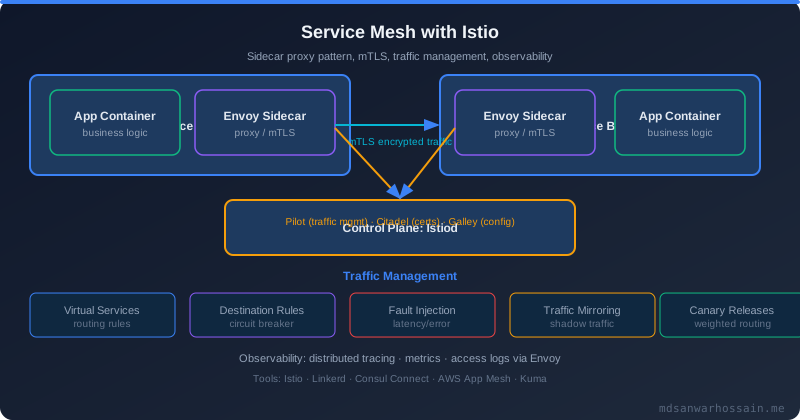
Table of Contents
- Real-World Problem: Cascading Failures Without Traffic Control
- Istio Architecture: Control Plane and Envoy Sidecar
- Traffic Management: VirtualService and DestinationRule
- Canary Deployments and A/B Testing with Weighted Routing
- Resilience Patterns: Retries, Timeouts, and Circuit Breaking
- Zero-Trust Security with mTLS and AuthorizationPolicies
- Observability: Distributed Tracing and Service Topology
- Production Failure Scenarios and Debugging
- Trade-offs and When NOT to Use Istio
- Key Takeaways
1. Real-World Problem: Cascading Failures Without Traffic Control
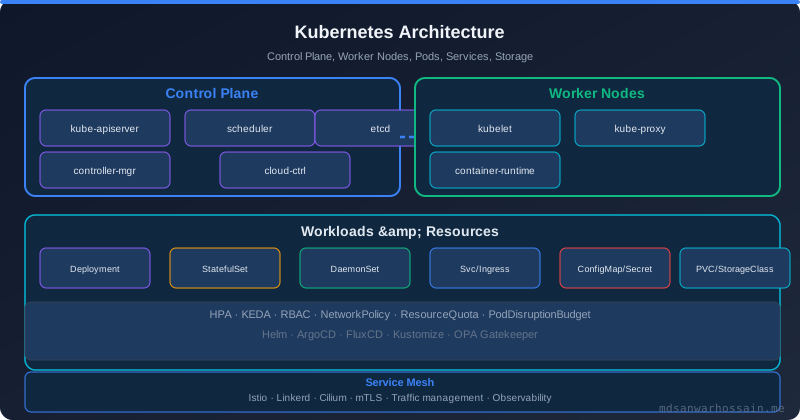
A large e-commerce platform ran 60 Spring Boot microservices on Kubernetes. Each service used RestTemplate or WebClient for inter-service calls with application-level retry logic. During a Black Friday traffic peak, the inventory service became slow (p99 latency spiked to 4 seconds due to a slow database query). Services calling inventory — order-service, cart-service, search-service — all had 3-retry logic with 2-second timeouts per attempt. Instead of failing fast, they held open connections for 6 seconds per request, exhausted their thread pools, and became unavailable themselves. The cascade took down 12 services in 90 seconds.
Application-level resilience had three fatal flaws: (1) different teams configured retries inconsistently, (2) retry storms amplified load on the already-degraded inventory service, (3) there was no automatic circuit breaker to stop retries once failures reached a threshold. Istio solves all three at the infrastructure layer, uniformly, without modifying application code.
2. Istio Architecture: Control Plane and Envoy Sidecar
Istio consists of two planes:
- Control Plane (istiod): A single binary that consolidates Pilot (service discovery and traffic policy), Citadel (certificate authority for mTLS), and Galley (configuration validation). It pushes xDS (Envoy's discovery service protocol) configuration to all proxies.
- Data Plane (Envoy sidecar): An Envoy proxy injected as a sidecar into every pod in namespaces with the
istio-injection: enabledlabel. All inbound and outbound traffic from the pod flows through the sidecar — the application is unaware.
↕ xDS
[istiod]
↙ ↘
[ServiceEntry/VirtualService] [DestinationRule/PeerAuth]
Traffic flow: App → Envoy sidecar → mTLS → Peer Envoy → App
Policy enforcement: retries, timeouts, circuit-break, authz at Envoy layer
iptables interception: The Istio init container (or CNI plugin) configures iptables rules in the pod's network namespace to redirect all inbound traffic to port 15006 (Envoy inbound listener) and all outbound traffic to port 15001 (Envoy outbound listener). The application binds to its normal port and is unaware of the proxy.
3. Traffic Management: VirtualService and DestinationRule
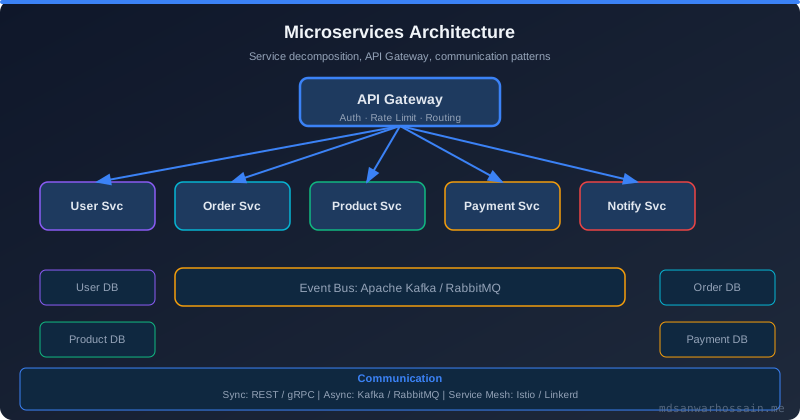
Istio's traffic management model separates where traffic goes (VirtualService — routing rules) from how traffic is treated at the destination (DestinationRule — load balancing, connection pool, outlier detection).
# DestinationRule: defines subsets (versions) and connection behaviour
apiVersion: networking.istio.io/v1beta1
kind: DestinationRule
metadata:
  name: inventory-service
  namespace: production
spec:
  host: inventory-service
  trafficPolicy:
    connectionPool:
      tcp:
        maxConnections: 100
      http:
        http1MaxPendingRequests: 50
        http2MaxRequests: 1000
        maxRequestsPerConnection: 10
    outlierDetection:           # Circuit breaking
      consecutive5xxErrors: 5
      interval: 10s
      baseEjectionTime: 30s
      maxEjectionPercent: 50
    loadBalancer:
      simple: LEAST_CONN
  subsets:
    - name: v1
      labels:
        version: v1
    - name: v2
      labels:
        version: v2
# VirtualService: routing rules with header matching and weights
apiVersion: networking.istio.io/v1beta1
kind: VirtualService
metadata:
name: inventory-service
namespace: production
spec:
hosts:
- inventory-service
http:
# Internal beta testers get v2
- match:
- headers:
x-beta-user:
exact: "true"
route:
- destination:
host: inventory-service
subset: v2
# Default: 95% v1, 5% v2 canary
- route:
- destination:
host: inventory-service
subset: v1
weight: 95
- destination:
host: inventory-service
subset: v2
weight: 5
timeout: 3s
retries:
attempts: 3
perTryTimeout: 1s
retryOn: "5xx,reset,connect-failure,retriable-4xx"4. Canary Deployments and A/B Testing with Weighted Routing
Kubernetes native rolling deployments are binary — you shift pod counts, not traffic percentages. 10% canary in Kubernetes requires exactly 1 in 10 pods running the new version, and you can't route specific user segments to it. Istio decouples traffic weight from pod count entirely.
A production canary workflow with Istio: (1) Deploy v2 Deployment with 1 replica alongside v1 (10 replicas). (2) Set VirtualService weight to 5% for v2 subset. (3) Monitor error rates and p99 latency on the destination_workload="v2" metric label. (4) Increment weight in 10% steps every 15 minutes if SLO metrics remain healthy. (5) Rollback by setting v2 weight to 0 — no pod restarts required, instant effect at the Envoy layer.
5. Resilience Patterns: Retries, Timeouts, and Circuit Breaking
Retry Strategy
Istio retries happen at the Envoy layer before the failure ever reaches the application. The critical production consideration: only retry idempotent operations. The retryOn: "retriable-4xx" condition matches only HTTP 409 (Conflict) and 429 (Too Many Requests) in retriable-4xx mode. Never set retryOn: "4xx" — this retries 401 and 403 responses, creating confusion and security audit noise.
Circuit Breaking with Outlier Detection
Istio's circuit breaking is implemented via Envoy's outlier detection — it ejects individual endpoints (pods) from the load balancing pool when they exceed error thresholds, rather than breaking the entire service. This is more granular than traditional circuit breakers: if 2 of 10 inventory pods have OOMKill loops causing 5xx responses, only those 2 pods are ejected; the other 8 continue serving traffic normally.
outlierDetection:
  consecutive5xxErrors: 5     # Eject after 5 consecutive 5xx
  interval: 10s               # Check every 10 seconds
  baseEjectionTime: 30s       # Ejected for at least 30s
  maxEjectionPercent: 50      # Never eject more than 50% of pool
  minHealthPercent: 0         # Allow ejection even if pool is small
Connection Pool Limits
Connection pool settings in DestinationRule implement bulkhead isolation at the Envoy level. Setting http1MaxPendingRequests: 50 means Envoy queues at most 50 requests when all connections are busy — additional requests receive 503 immediately rather than queuing indefinitely. This prevents slow dependencies from exhausting caller thread pools.
6. Zero-Trust Security with mTLS and AuthorizationPolicies
Istio's Citadel CA issues X.509 certificates to every sidecar (SPIFFE-compliant identity: spiffe://cluster.local/ns/<namespace>/sa/<service-account>). Mutual TLS is negotiated automatically between sidecars — the application communicates in plain HTTP to its local sidecar, and the sidecar handles TLS termination and origin.
# Enforce strict mTLS across the entire mesh
apiVersion: security.istio.io/v1beta1
kind: PeerAuthentication
metadata:
  name: default
  namespace: production
spec:
  mtls:
    mode: STRICT   # Reject plain-text connections; require mTLS

---
# Fine-grained authorization: order-service can only call inventory
# on GET /items/* — no other paths or methods allowed
apiVersion: security.istio.io/v1beta1
kind: AuthorizationPolicy
metadata:
  name: inventory-authz
  namespace: production
spec:
  selector:
    matchLabels:
      app: inventory-service
  action: ALLOW
  rules:
    - from:
        - source:
            principals:
              - "cluster.local/ns/production/sa/order-service"
              - "cluster.local/ns/production/sa/cart-service"
      to:
        - operation:
            methods: ["GET"]
            paths: ["/items/*", "/items"]
Migration from PERMISSIVE to STRICT: Never switch a production namespace directly to STRICT mTLS. First set mode: PERMISSIVE (allows both plain-text and mTLS), deploy sidecars to all pods, verify that mTLS is negotiated for all service-to-service traffic via Kiali or istioctl x authz check, then switch to STRICT. Direct switch to STRICT breaks any pod without a sidecar (monitoring agents, init containers, external integrations).
7. Observability: Distributed Tracing and Service Topology
Istio's Envoy sidecars automatically emit telemetry for every request — without application code changes. This includes: (1) Prometheus metrics (istio_requests_total, istio_request_duration_milliseconds, istio_tcp_connections_opened_total), (2) distributed trace spans forwarded to Jaeger/Zipkin/Tempo if the application propagates the x-b3-traceid header, (3) access logs with full request/response metadata.
# Critical Prometheus queries for Istio service health

# Request error rate per service (5xx percentage)
sum(rate(istio_requests_total{
  destination_service_namespace="production",
  response_code=~"5.*"
}[5m])) by (destination_service_name)
/
sum(rate(istio_requests_total{
  destination_service_namespace="production"
}[5m])) by (destination_service_name)

# P99 latency by source/destination pair
histogram_quantile(0.99,
  sum(rate(istio_request_duration_milliseconds_bucket{
    destination_service_namespace="production"
  }[5m])) by (le, source_workload, destination_service_name)
)
Kiali for service graph: Kiali visualises the live service dependency graph with real-time error rates and latency overlaid on each edge. During an incident, this is the fastest way to identify which service-to-service call is the root failure — minutes faster than log-correlation in a 50-service graph.
8. Production Failure Scenarios and Debugging
Failure: 503 UF (Upstream Connection Failure) After mTLS Migration
After migrating to STRICT mTLS, a monitoring agent (Prometheus scraper) without a sidecar begins receiving 503 errors from its scrape targets. Envoy on the target pod now requires mTLS, but the Prometheus pod communicates in plain HTTP. Fix: either inject a sidecar into the Prometheus namespace, or create a PeerAuthentication exception for the monitoring namespace with mode: PERMISSIVE.
Failure: Traffic Not Matching VirtualService Rules
VirtualService header matching fails silently when the header name case doesn't match exactly (HTTP/2 headers are lowercase; gRPC uses lowercase canonically). Use istioctl proxy-config route <pod> --name 80 -o json to inspect the compiled Envoy routing config and verify header match conditions as Envoy received them from istiod.
Failure: Envoy Sidecar Memory Growth Under High RPS
Envoy's access log buffer and stats counters grow with cardinality of routes, clusters, and upstream hosts. In a large mesh (100+ services), a single Envoy sidecar can consume 300–500 MB RAM. Mitigation: enable proxyConfig.concurrency to limit Envoy worker threads, reduce log sampling rate with accessLogFile: /dev/null for non-critical namespaces, and set memory limits on the sidecar container via MeshConfig.
Debugging Toolkit
# Check xDS sync status — are Envoy configs up to date?
istioctl proxy-status

# Inspect Envoy listener config for a pod
istioctl proxy-config listeners <pod>.<namespace>

# Verify AuthorizationPolicy is enforced correctly
istioctl x authz check <pod>.<namespace>

# Enable debug logging on a specific Envoy sidecar temporarily
istioctl proxy-config log <pod>.<namespace> --level debug

# Check pilot's view of service endpoints
istioctl proxy-config endpoint <pod>.<namespace> --cluster "outbound|8080||inventory-service.production.svc.cluster.local"
9. Trade-offs and When NOT to Use Istio
- Latency overhead: Each Envoy sidecar adds 1–5 ms to every service call (iptables redirect + TLS negotiation + proxy processing). For services with sub-10ms SLOs, this overhead is significant. Evaluate Envoy's ambient mode (no sidecar injection) as a lower-overhead alternative.
- Operational complexity: Istio adds ~6 CRD types, a control plane, and sidecar management to every cluster. For teams without dedicated platform engineering, the operational burden exceeds the benefit. Consider Linkerd (simpler, lower overhead) for teams that need mTLS and basic observability without advanced traffic management.
- Small clusters: Fewer than 10 services with low RPS don't justify the operational complexity. Application-level resilience (Spring Cloud Gateway, Resilience4j) is sufficient and simpler to debug.
- sidecar injection timing issues: Init containers and Jobs that run before the sidecar is ready will fail if they make network calls. Use
holdApplicationUntilProxyStarts: truein MeshConfig to delay application container startup until Envoy is ready — at the cost of slightly longer pod startup times.
10. Key Takeaways
- VirtualService controls routing rules (where traffic goes); DestinationRule controls load balancing, connection pool, and outlier detection (how endpoints are treated).
- Istio canary deployments decouple traffic weight from pod replica count — 1% canary traffic requires only 1 additional pod regardless of the v1 fleet size.
- Outlier detection (Envoy circuit breaking) ejects individual unhealthy pods from the load balancing pool, not the entire service.
- Migrate to STRICT mTLS via PERMISSIVE mode first — never switch directly to STRICT in a cluster with non-sidecar workloads.
- AuthorizationPolicy with SPIFFE identities provides cryptographically verified service-to-service authorization — stronger than network-level controls.
- Use
istioctl proxy-configandistioctl proxy-statusas the primary debugging tools — they expose exactly what Envoy has received from istiod.
Conclusion
Istio is not a panacea — it is a powerful tool that adds significant operational complexity. For platforms with 20+ microservices where different teams need consistent resilience, security, and observability without modifying application code, the investment is justified. For smaller platforms, the complexity may outweigh the benefits.
Start with observability only (install Istio, enable telemetry collection, deploy Kiali/Grafana dashboards) before adding traffic management. Understand your service graph before layering routing rules on top of it. And always test mTLS migration in a staging environment before promoting to production — the failure modes are subtle and the debugging can be time-consuming without familiarity with Envoy's xDS configuration model.
Leave a Comment
Related Posts

Software Engineer · Java · Spring Boot · Microservices