Service Mesh Deep Dive: Istio vs Linkerd vs Cilium in Production Kubernetes
A service mesh solves the cross-cutting concerns that every microservices platform must address — mutual TLS, observability, traffic management, and resilience — without requiring application code changes. But choosing the wrong mesh for your workload means paying a significant performance and operational overhead for capabilities you either do not use or could have gotten more cheaply. Istio, Linkerd, and Cilium represent three fundamentally different architectural approaches to the same problem.
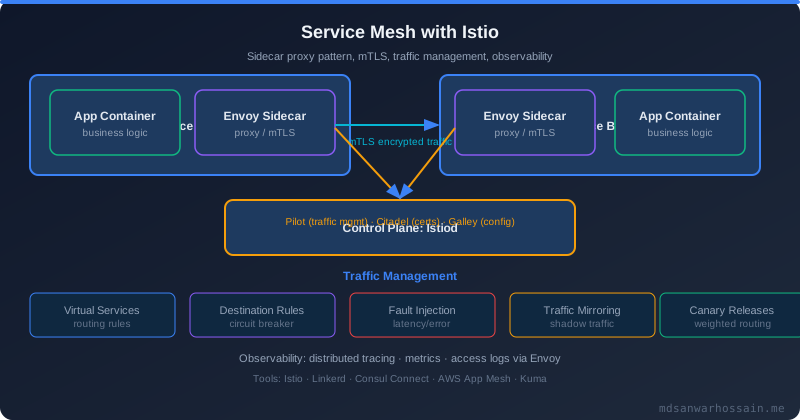
Table of Contents
What Problem Does a Service Mesh Actually Solve?
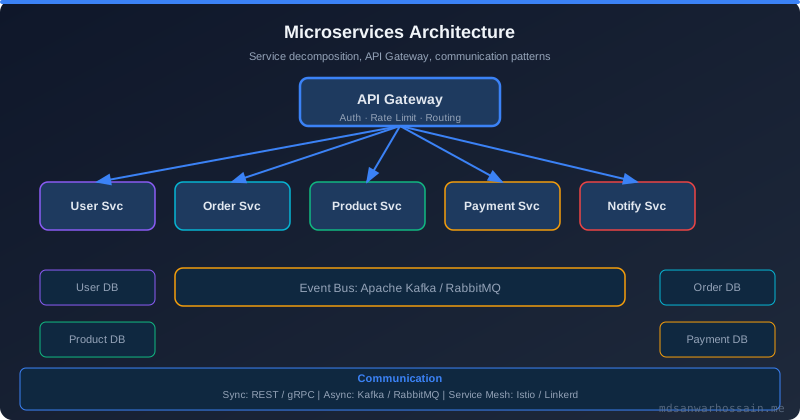
In a microservices platform with 50+ services, several cross-cutting concerns apply uniformly to every service: all inter-service communication should be encrypted (mTLS), all requests should be traced for observability, all services should have circuit breaking and retry behavior, and all service-to-service authorization should be enforced by policy. Without a service mesh, these concerns are implemented in library code — either a custom internal framework or a shared library like Hystrix/Resilience4j for resilience and Zipkin for tracing.
Library-based cross-cutting concerns have a fundamental flaw: they are language-specific. A polyglot microservices platform with services in Java, Go, Python, and Node.js requires maintaining four separate implementations of the same circuit breaker, retry, and observability logic — each with subtly different behaviors, each requiring separate upgrades, each potentially introducing language-specific bugs. When you need to rotate TLS certificates or update the circuit breaker timeout policy across all 50 services simultaneously, you need 50 library upgrades and 50 deployments.
A service mesh solves this by moving the cross-cutting concerns from library code into infrastructure. Each service gets a network proxy (in the sidecar model) or the kernel handles it (in the eBPF model), and all inter-service communication flows through that proxy. The proxy handles TLS, observability, retries, and load balancing transparently — regardless of the service's programming language. Policy changes are applied to the mesh control plane and propagate to all proxies without service restarts or code changes.
Istio: The Feature-Complete Enterprise Choice
Istio is the most mature, feature-complete service mesh available for Kubernetes. Originally developed by Google and IBM, it uses the Envoy proxy as its data plane — a high-performance C++ proxy that processes all service communication. The Istio control plane (istiod) distributes configuration to Envoy proxies via the xDS API, enabling dynamic policy updates without proxy restarts.
Istio's traditional architecture injects an Envoy sidecar container into every pod — an additional container running alongside your application container, intercepting all network traffic via iptables rules. In 2022, Istio introduced ambient mode as an alternative: instead of per-pod sidecars, ambient uses a per-node "ztunnel" (zero-trust tunnel) for Layer 4 operations (mTLS, basic L4 authorization) and a per-namespace "waypoint proxy" for Layer 7 operations (HTTP routing, authorization, observability). Ambient mode eliminates the per-pod sidecar overhead while preserving the full Istio feature set.
# Install Istio with ambient mode
istioctl install --set profile=ambient

# Enable ambient mesh for a namespace (no pod restarts required)
kubectl label namespace production istio.io/dataplane-mode=ambient

# Deploy a waypoint proxy for L7 traffic management in the namespace
kubectl apply -f - <<EOF
apiVersion: gateway.networking.k8s.io/v1
kind: Gateway
metadata:
  name: waypoint
  namespace: production
  annotations:
    istio.io/waypoint-for: service
spec:
  gatewayClassName: istio-waypoint
  listeners:
    - name: mesh
      port: 15008
      protocol: HBONE
EOF

# Apply mTLS strict mode — all communication must use mTLS
apiVersion: security.istio.io/v1beta1
kind: PeerAuthentication
metadata:
  name: default
  namespace: production
spec:
  mtls:
    mode: STRICT
Istio's traffic management capabilities through VirtualService and DestinationRule are the most powerful in the ecosystem. Fine-grained traffic routing by header, URI prefix, user identity, or request weight; sophisticated load balancing algorithms (least request, random, round-robin, consistent hashing); automatic retry with configurable conditions and backoff; and fault injection for chaos engineering — all configured declaratively in Kubernetes CRDs.
# Sophisticated traffic management with Istio VirtualService
apiVersion: networking.istio.io/v1alpha3
kind: VirtualService
metadata:
  name: order-service
  namespace: production
spec:
  hosts:
    - order-service
  http:
    # Route internal users to canary
    - match:
        - headers:
            x-user-type:
              exact: internal
      route:
        - destination:
            host: order-service
            subset: canary
    # Route 10% of external traffic to canary
    - route:
        - destination:
            host: order-service
            subset: stable
          weight: 90
        - destination:
            host: order-service
            subset: canary
          weight: 10
      retries:
        attempts: 3
        perTryTimeout: 2s
        retryOn: "5xx,reset,connect-failure,retriable-4xx"
      timeout: 10s
---
apiVersion: networking.istio.io/v1alpha3
kind: DestinationRule
metadata:
  name: order-service
spec:
  host: order-service
  trafficPolicy:
    connectionPool:
      tcp:
        maxConnections: 100
      http:
        h2UpgradePolicy: UPGRADE
    outlierDetection:
      consecutive5xxErrors: 5
      interval: 10s
      baseEjectionTime: 30s
      maxEjectionPercent: 50
  subsets:
    - name: stable
      labels:
        track: stable
    - name: canary
      labels:
        track: canary
Istio performance overhead: In sidecar mode, Istio adds approximately 2–3ms per hop of additional latency (one sidecar at the source, one at the destination = ~4–6ms round-trip overhead). CPU overhead is approximately 0.5 vCPU per 1,000 requests/second per sidecar. Memory overhead is approximately 50MB per Envoy sidecar. Ambient mode reduces this significantly — ztunnel adds ~0.5ms per hop, and waypoint proxies are deployed only for services that need L7 features.
Linkerd: The Simplicity-First Mesh
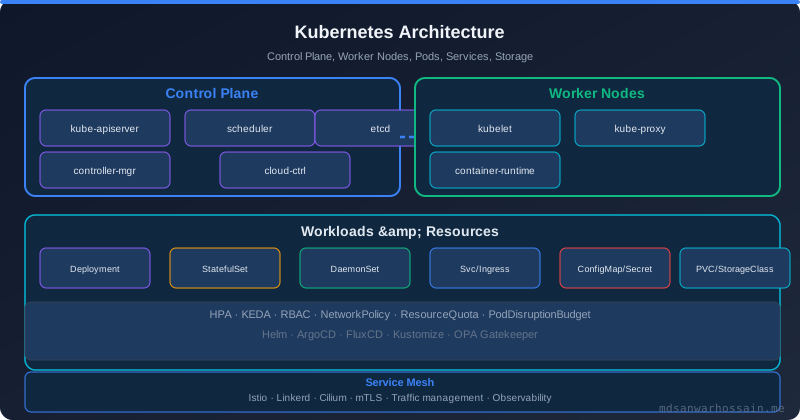
Linkerd (maintained by Buoyant) takes a deliberately simpler approach than Istio. Where Istio uses Envoy (a general-purpose, configurable proxy), Linkerd uses its own Rust-based micro-proxy — a lean, purpose-built proxy designed specifically for Kubernetes service mesh operations. The Linkerd micro-proxy has a significantly smaller memory footprint (~10MB vs Envoy's ~50MB per sidecar) and lower CPU overhead.
Linkerd's philosophy is "just enough mesh" — it provides mTLS, observability (golden metrics: success rate, request rate, latency percentiles), load balancing, and automatic retries for safe (idempotent) requests. What it does not provide is the full richness of Istio's traffic management: no fault injection, no traffic shifting by header value, no circuit breaker configuration, and fewer customization options. For teams that need exactly the core mesh features and want minimal operational complexity, Linkerd's simplicity is a feature, not a limitation.
# Install Linkerd
linkerd install --crds | kubectl apply -f -
linkerd install | kubectl apply -f -

# Verify installation
linkerd check

# Inject Linkerd into a namespace (or individual deployments)
kubectl annotate namespace production linkerd.io/inject=enabled

# Verify mesh injection
linkerd -n production check --proxy

# ServiceProfile for per-route observability and retry policies
apiVersion: linkerd.io/v1alpha2
kind: ServiceProfile
metadata:
  name: order-service.production.svc.cluster.local
  namespace: production
spec:
  routes:
    - name: POST /orders
      condition:
        method: POST
        pathRegex: /orders
      isRetryable: false      # POST is not safe to retry
      timeout: 5s
    - name: GET /orders/{id}
      condition:
        method: GET
        pathRegex: /orders/[^/]*
      isRetryable: true       # GET is idempotent — safe to retry
      timeout: 2s
Linkerd's per-route retry policy through ServiceProfile is particularly thoughtful: it forces you to declare which routes are retryable (idempotent) rather than blindly retrying all failures. This avoids the double-charge and duplicate-write bugs that come from blindly retrying POST requests.
Linkerd performance overhead: Linkerd's Rust micro-proxy adds approximately 1ms per hop and ~0.2–0.3 vCPU per 1,000 RPS — roughly half the overhead of Istio's Envoy sidecar. Memory is approximately 10–15MB per proxy. For latency-sensitive workloads where every millisecond counts, Linkerd's lower overhead is a compelling advantage.
Cilium: The eBPF Revolution
Cilium takes a fundamentally different architectural approach: instead of userspace proxies, it uses eBPF (extended Berkeley Packet Filter) — a kernel-level technology that allows custom programs to run in the Linux kernel without modifying kernel source code. Cilium functions simultaneously as a CNI (Container Network Interface — the Kubernetes networking plugin) and as a service mesh, processing network traffic at the kernel level rather than routing it through userspace proxies.
The implications are significant. No sidecar containers means no per-pod memory overhead for proxies, no sidecar injection complexity, and no iptables rules that add latency to every packet. eBPF programs execute directly in kernel space with JIT compilation, achieving near-native network performance. For high-throughput services processing hundreds of thousands of requests per second, the performance difference versus sidecar-based meshes is measurable.
# Install Cilium with service mesh features enabled
helm repo add cilium https://helm.cilium.io/
helm install cilium cilium/cilium --version 1.15.0 \
  --namespace kube-system \
  --set kubeProxyReplacement=true \
  --set envoy.enabled=true \
  --set l7Proxy=true

# CiliumNetworkPolicy — L4 and L7 network policy with identity awareness
apiVersion: cilium.io/v2
kind: CiliumNetworkPolicy
metadata:
  name: order-service-policy
  namespace: production
spec:
  endpointSelector:
    matchLabels:
      app: order-service
  ingress:
    - fromEndpoints:
        - matchLabels:
            app: api-gateway
      toPorts:
        - ports:
            - port: "8080"
              protocol: TCP
          rules:
            http:
              - method: POST
                path: /orders
              - method: GET
                path: /orders/[^/]*
    - fromEndpoints:
        - matchLabels:
            app: fulfillment-service
      toPorts:
        - ports:
            - port: "8080"
              protocol: TCP
          rules:
            http:
              - method: PATCH
                path: /orders/[^/]*/status

# Mutual TLS with Cilium — identity-based mTLS using SPIFFE/SPIRE
apiVersion: cilium.io/v2
kind: CiliumClusterwideNetworkPolicy
metadata:
  name: require-mtls
spec:
  endpointSelector: {}
  egress:
    - toEndpoints:
        - matchLabels:
            "k8s:io.kubernetes.pod.namespace": production
      toPorts:
        - ports:
            - port: "0"
              protocol: ANY
          authentication:
            mode: required     # Require mutual authentication
Cilium's network policy model is identity-based rather than IP-based. Policies match on Kubernetes labels (pod identity), not on IP addresses that change with pod restarts. This eliminates the stale IP rule problem that makes traditional iptables-based network policies fragile in dynamic Kubernetes environments.
Cilium performance overhead: eBPF processing in kernel space adds sub-microsecond overhead per packet — orders of magnitude less than userspace proxy round-trips. For raw throughput, Cilium can process millions of packets per second with minimal CPU overhead. The tradeoff is operational complexity: eBPF requires Linux kernel 5.10+ (most modern distributions), and debugging eBPF programs requires specialized tooling (bpftool, Hubble).
Observability Integration: Golden Signals Across All Three
All three meshes provide the RED metrics (Rate, Error rate, Duration) for every service-to-service call, but their integration approaches differ. All three integrate with Prometheus for metrics scraping, but the specific metrics and cardinality vary.
Istio exposes the most detailed telemetry via Envoy's stats API — per-route metrics, per-cluster health, connection pool stats, and circuit breaker state. Linkerd provides clean golden metrics via ServiceProfiles with per-route breakdown. Cilium integrates with Hubble for flow-level observability — you can query the exact network flows (source identity, destination, protocol, verdict) that occurred at any point in time, which is invaluable for debugging network policy denials.
# Istio: Kiali dashboard integration
kubectl apply -f https://raw.githubusercontent.com/istio/istio/release-1.20/samples/addons/kiali.yaml

# Linkerd: Viz extension for built-in dashboard
linkerd viz install | kubectl apply -f -
linkerd viz dashboard &

# Cilium: Hubble UI for network flow observability
helm upgrade cilium cilium/cilium --set hubble.ui.enabled=true \
  --set hubble.relay.enabled=true --reuse-values
cilium hubble ui &

# Query live flows with Hubble CLI
hubble observe --namespace production --follow \
  --verdict DROPPED \
  --output json | jq '.flow | {src: .source.labels, dst: .destination.labels, reason: .drop_reason}'
When to Choose Which Mesh
Choose Istio when you need the full feature set: sophisticated traffic management (A/B testing by user segment, fault injection for chaos engineering, traffic mirroring), JWT-based end-user authentication at the mesh layer, external authorization integration, or multi-cluster mesh federation. Istio's ambient mode has significantly reduced its operational overhead, making it viable for teams that previously avoided it due to sidecar complexity. Best for enterprises with dedicated platform teams and complex security requirements.
Choose Linkerd when you want zero-drama mesh operations with minimal overhead. Linkerd's operational simplicity — straightforward installation, sensible defaults, clear upgrade paths — means your platform team spends less time managing the mesh and more time building platform features. The Rust micro-proxy's lower resource consumption matters for cost-sensitive environments with hundreds of pods. Best for teams that want mTLS and golden metrics without the complexity budget of Istio.
Choose Cilium when performance is paramount, when you are already deploying a new cluster (CNI replacement is disruptive on existing clusters), or when your security requirements need identity-based network policy with L7 HTTP enforcement. Cilium's eBPF foundation also makes it the right choice for teams operating at very high packet rates — gaming backends, high-frequency trading infrastructure, or media streaming platforms where userspace proxy overhead is unacceptable. Best for performance-critical, greenfield Kubernetes deployments with Linux 5.10+ nodes.
Migration Strategies
Migrating an existing Kubernetes cluster to a service mesh is a significant operational event. For sidecar-based meshes (Istio, Linkerd), the migration path is incremental: inject the mesh into one namespace at a time, starting with non-critical workloads, and validate behavior before proceeding. The mesh is transparent to the applications — no code changes required — but the initial sidecar injection causes pod restarts that must be scheduled during maintenance windows for stateful services.
For Cilium, replacing an existing CNI (typically Flannel, Calico, or AWS VPC CNI) is more disruptive — it typically requires a full cluster rebuild or a careful node-by-node migration. Plan for this as a cluster migration project, not a hot-swap. The performance and operational benefits of Cilium are worth the migration cost for new platforms, but retrofitting Cilium onto an existing production cluster requires careful planning.
Key Takeaways
- All three meshes provide mTLS, observability, and load balancing — the differences are in performance overhead, operational complexity, and advanced traffic management features.
- Istio ambient mode has eliminated the primary objection to Istio (sidecar overhead) — evaluate ambient mode rather than sidecar mode for new Istio deployments.
- Linkerd wins on simplicity — if your requirements are covered by core mesh features (mTLS, golden metrics, basic retries), Linkerd's operational simplicity and lower resource overhead are compelling advantages.
- Cilium's eBPF approach provides the lowest latency overhead but requires kernel 5.10+ and is best suited for greenfield clusters where CNI selection has not yet been made.
- Use Hubble for Cilium debugging — flow-level observability is uniquely powerful for diagnosing network policy denials and unexpected traffic patterns.
- Do not underestimate migration cost — service mesh adoption is a platform-level investment. Budget for training, gradual rollout, observability dashboard setup, and runbook updates alongside the technical implementation.
Leave a Comment
Related Posts

Software Engineer · Java · Spring Boot · Microservices