System Design for Modern Backends: Practical Patterns for Scale, Resilience, and Speed
Good system design is not about choosing fashionable tools. It is about making explicit trade-offs so your architecture can survive real traffic, real incidents, and real team constraints.
TL;DR
"System design patterns for modern backends: scaling APIs, resilience, data strategies, and practical architecture decisions for production teams."
Most backend failures are not caused by one dramatic bug. They are caused by small design shortcuts that compound under growth: chatty synchronous dependencies, unclear ownership, fragile data boundaries, and observability gaps. System design gives you a way to make better decisions before those shortcuts become production incidents. In this guide, I focus on practical patterns that help teams ship quickly while maintaining reliability and long-term maintainability.
1) Start with user-facing reliability goals
Before drawing architecture diagrams, define service level objectives (SLOs): latency, availability, and error budget. If your checkout API has a 99.9% availability target and strict latency expectations, your design choices should optimize for graceful degradation, not perfect feature completeness in every request path. Reliability targets create shared language across product and engineering, and they prevent over-engineering in low-risk areas.
Translate business outcomes into technical budgets. For instance, if end-to-end P95 latency must stay under 300ms, each internal hop might get 60–80ms budget. This forces clarity around timeout values, caching strategy, and synchronous fan-out limits.
2) Design bounded contexts to reduce coupling
Service boundaries should map to business capabilities, not organizational politics. When one service owns many unrelated domains, every change becomes risky and deployment velocity drops. When too many tiny services are created without clear boundaries, operational complexity explodes. Use bounded contexts with clear ownership of data and APIs. Keep the number of synchronous dependencies per request path intentionally small.
A useful test: can a team deploy and evolve its service without coordinating weekly with three other teams? If not, boundaries likely need redesign.
3) Choose synchronous vs asynchronous flow intentionally
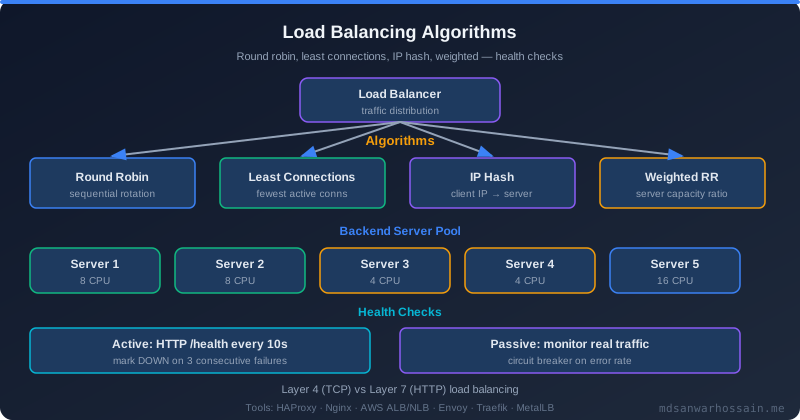
Synchronous calls are appropriate when users need immediate confirmation. Asynchronous workflows are better for long-running or non-critical tasks: notifications, enrichment, indexing, and analytics pipelines. The anti-pattern is chaining too many synchronous calls for convenience. Each new hop adds latency and failure risk. For critical user requests, keep the core path short and deterministic, then publish events for secondary processing.
When adopting event-driven architecture, define event contracts clearly and version them. Include idempotency keys so consumers can safely handle retries and duplicate deliveries.
4) Implement resilience primitives by default
Timeouts, retries with exponential backoff, circuit breakers, and bulkheads should be standard defaults, not optional add-ons. Without timeouts, threads and connection pools can saturate during downstream degradation. Without bounded retries, transient failures become self-inflicted denial-of-service events. Circuit breakers prevent repeated expensive failures and give systems time to recover.
Pair retries with idempotency semantics. A retry policy without idempotent operations can create data corruption and billing incidents. System design must treat correctness as a first-class reliability concern.
5) Model data ownership and consistency level
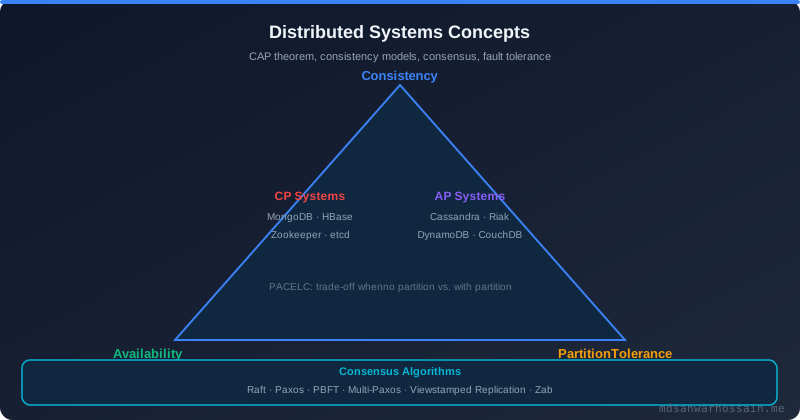
Every cross-service query has a hidden cost. If services directly query each other’s databases, ownership is broken and migrations become dangerous. Prefer API contracts and event-based replication patterns. Then choose consistency level per business need. Inventory reservation may need strong guarantees; recommendation feeds can accept eventual consistency.
Document consistency promises in API contracts so product teams know what users can expect. Ambiguous consistency leads to bugs that are hard to reproduce and even harder to explain.
6) Apply caching where it protects user experience
Caching is powerful but dangerous when used blindly. Define explicit goals: reduce read latency, protect expensive dependencies, or absorb traffic spikes. Choose cache strategy by workload: read-through for frequent lookups, write-through for strong freshness requirements, or cache-aside where occasional staleness is acceptable. Always set TTL intentionally and monitor hit ratio, eviction rate, and stale read impact.
Never let cache become the only source of truth for critical state. Cache should improve experience, not define correctness.
7) Build observability into architecture, not dashboards later
Many teams discover design flaws only during incidents because they cannot trace request flows or correlate errors across services. Instrument every service with structured logs, RED metrics (rate, errors, duration), and distributed tracing. Include request IDs and business context fields so failures can be triaged quickly. Observability is a design decision that determines incident recovery speed.
Link alerts to runbooks with first-response steps. High-quality observability is not just data collection; it is actionable response guidance.
8) Plan deployment and rollback as part of design
Architecture is incomplete if it ignores release strategy. Use backward-compatible contracts, feature flags, and phased rollouts. For database migrations, prefer expand-and-contract pattern: add new schema first, dual-write or dual-read during transition, then remove deprecated fields after validation. Design for safe rollback paths before the first deploy.
Teams often optimize for shipping features fast, then discover rollback is impossible when issues emerge. A resilient design assumes failure and keeps recovery simple.
9) Keep platform and team topology aligned
A technically elegant architecture can still fail if team ownership is unclear. Align service ownership, on-call responsibility, and deployment permissions. If nobody owns a dependency, incident response slows dramatically. Platform engineering should provide paved roads: CI templates, secure defaults, observability bootstrap, and deployment guardrails that reduce cognitive load for product teams.
10) Evolve architecture with measurable feedback loops
System design is not a one-time document. Review architecture decisions quarterly against real telemetry: latency trends, incident categories, scaling costs, and developer cycle time. Retire patterns that no longer fit current constraints. Keep an architecture decision record (ADR) so teams can understand why choices were made and when they should be revisited.
Great backend systems are designed iteratively. They grow through small, validated improvements, not perfect upfront plans.
11) Use agentic AI as an architectural copilot
Agentic AI tools can draft ADRs, compare architecture options, and simulate failure scenarios based on production topology. Feed the agent sanitized service metadata—SLOs, dependency graphs, cost per request, and historical incident tags—so its recommendations stay grounded in your reality. Keep humans in the loop for any change that alters data boundaries or security posture. AI is most valuable when it accelerates exploration while your team retains accountability for the decision.
During design reviews, let the AI generate checklists tailored to the proposal: rollback approach, blast radius, data retention, privacy, and compliance. Store those checklists with the ADR so future engineers can see which trade-offs were explicitly considered. This approach keeps architecture quality high without slowing down delivery cadence.
In practice, robust system design means balancing six concerns continuously: user experience, reliability, delivery speed, cost, security, and team cognitive load. When teams make these trade-offs explicit and measurable, architecture stops being abstract theory and becomes an operational advantage. Use the patterns above as defaults, adapt them to your domain, and validate with production feedback. That is how modern backend platforms stay fast, stable, and scalable over time.
Table of Contents
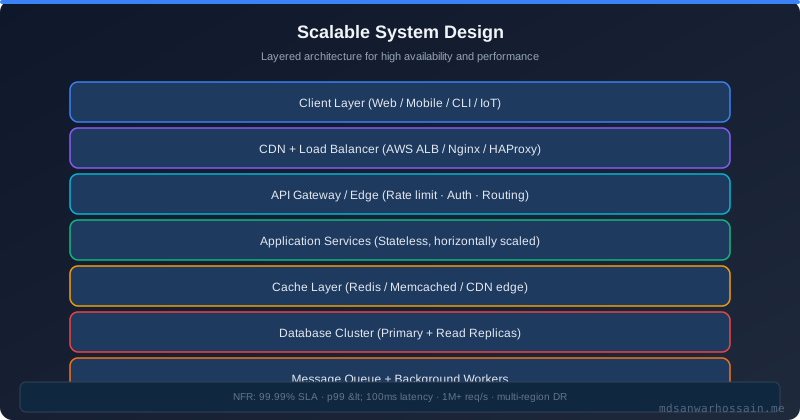
Architecture Reference: Layered Request Path
The following diagram shows how a typical user request flows through a well-designed backend, applying the patterns above at each layer:
Code: Resilience Primitives with Resilience4j + Spring Boot
The snippet below shows a production-ready service client that combines timeout, retry with exponential backoff, and circuit breaker — all three primitives discussed in pattern #4:
// build.gradle: io.github.resilience4j:resilience4j-spring-boot3
@Service
public class CatalogClient {

    private final CircuitBreaker cb;
    private final Retry retry;
    private final RestTemplate http;

    public CatalogClient(CircuitBreakerRegistry cbr, RetryRegistry rr,
                         RestTemplate http) {
        this.cb    = cbr.circuitBreaker("catalog");   // config in application.yml
        this.retry = rr.retry("catalog");
        this.http  = http;
    }

    public ProductDto getProduct(String id) {
        return Decorators.ofSupplier(() ->
                    http.getForObject("/products/{id}", ProductDto.class, id))
                .withCircuitBreaker(cb)
                .withRetry(retry)                     // 3 attempts, exp backoff
                .withFallback(List.of(CallNotPermittedException.class,
                                      ResourceAccessException.class),
                              ex -> ProductDto.unavailable(id))
                .get();
    }
}

# application.yml
resilience4j:
  circuitbreaker:
    instances:
      catalog:
        slidingWindowSize: 20
        failureRateThreshold: 50
        waitDurationInOpenState: 10s
        permittedNumberOfCallsInHalfOpenState: 5
  retry:
    instances:
      catalog:
        maxAttempts: 3
        waitDuration: 300ms
        enableExponentialBackoff: true
        exponentialBackoffMultiplier: 2
System Design Review Checklist
Before committing to an architecture, run through this checklist during design reviews:
- ✅ Are SLOs defined for every user-facing service?
- ✅ Does each service own its own data store — no direct cross-service DB access?
- ✅ Are all synchronous call chains bounded by explicit timeouts?
- ✅ Are circuit breakers and retry budgets in place for every downstream dependency?
- ✅ Is the caching strategy documented with TTL and invalidation rationale?
- ✅ Does every service emit structured logs, RED metrics, and distributed traces?
- ✅ Is there a documented rollback plan for the next deployment?
- ✅ Is team ownership and on-call responsibility mapped to each service?
- ✅ Are event schemas versioned and backward-compatible?
- ✅ Has an Architecture Decision Record (ADR) been created for this change?
Conclusion
System design is not a one-time artifact — it is a continuous practice of making trade-offs explicit, validating them with production telemetry, and iterating. The eleven patterns above address the most common failure modes in modern backend systems: tight coupling, unclear data ownership, uncontrolled failure propagation, insufficient observability, and brittle deployments.
Start by locking down reliability goals and bounded contexts. Layer in resilience primitives, caching strategy, and observability. Keep deployment and rollback in the design from day one. Review quarterly against real SLO data, and use agentic AI tools to speed up the exploration phase while your team stays accountable for every decision. Systems built this way remain fast, stable, and maintainable as they scale.
Frequently Asked Questions
What is Start with user-facing reliability goals and how does it work?
Before drawing architecture diagrams, define service level objectives (SLOs): latency, availability, and error budget. If your checkout API has a 99.9% availability target and strict latency expectations, your design choices should optimize for graceful degradation, not perfect feature completeness in every request path. Reliability targets create shared language across product and engineering, and they prevent over-engineering in low-risk areas. Translate business outcomes into technical budgets. For instance, if end-to-end P95 latency must stay under 300ms, each internal hop might get 60–80ms budget. This forces clarity around timeout values, caching strategy, and synchronous fan-out limits.
What is Design bounded contexts to reduce coupling and how does it work?
Service boundaries should map to business capabilities, not organizational politics. When one service owns many unrelated domains, every change becomes risky and deployment velocity drops. When too many tiny services are created without clear boundaries, operational complexity explodes. Use bounded contexts with clear ownership of data and APIs. Keep the number of synchronous dependencies per request path intentionally small. A useful test: can a team deploy and evolve its service without coordinating weekly with three other teams? If not, boundaries likely need redesign.
What is the difference between Choose synchronous vs asynchronous flow intentionally?
Synchronous calls are appropriate when users need immediate confirmation. Asynchronous workflows are better for long-running or non-critical tasks: notifications, enrichment, indexing, and analytics pipelines. The anti-pattern is chaining too many synchronous calls for convenience. Each new hop adds latency and failure risk. For critical user requests, keep the core path short and deterministic, then publish events for secondary processing. When adopting event-driven architecture, define event contracts clearly and version them. Include idempotency keys so consumers can safely handle retries and duplicate deliveries.
What is Implement resilience primitives by default and how does it work?
Timeouts, retries with exponential backoff, circuit breakers, and bulkheads should be standard defaults, not optional add-ons. Without timeouts, threads and connection pools can saturate during downstream degradation. Without bounded retries, transient failures become self-inflicted denial-of-service events. Circuit breakers prevent repeated expensive failures and give systems time to recover. Pair retries with idempotency semantics. A retry policy without idempotent operations can create data corruption and billing incidents. System design must treat correctness as a first-class reliability concern.
What is Model data ownership and consistency level and how does it work?
Every cross-service query has a hidden cost. If services directly query each other’s databases, ownership is broken and migrations become dangerous. Prefer API contracts and event-based replication patterns. Then choose consistency level per business need. Inventory reservation may need strong guarantees; recommendation feeds can accept eventual consistency. Document consistency promises in API contracts so product teams know what users can expect. Ambiguous consistency leads to bugs that are hard to reproduce and even harder to explain.
Leave a Comment

Software Engineer · Java · Spring Boot · Microservices