Automated Technical Debt Management: Using AI to Detect, Prioritize, and Refactor Legacy Code
Technical debt compounds like financial debt, but unlike financial debt, it is invisible to stakeholders until it becomes catastrophic. A 5% debt ratio is manageable background noise. At 30%, feature velocity slows to a crawl. At 50%, your engineering team spends more time managing the debt than building new capabilities — and your best engineers start leaving.
Table of Contents
- The Wrong Approach: The Big-Bang Debt Sprint
- Technical Debt Taxonomy
- Automated Detection Toolchain
- Quantification Using the SQALE Model
- Prioritization Matrix
- AI-Assisted Refactoring in Practice
- Strangler Fig Pattern for Legacy Modernization
- Continuous Debt Prevention
- Failure Scenarios in Debt Remediation
The Wrong Approach: The Big-Bang Debt Sprint
Consider a real scenario: a $200M ARR SaaS company, 800,000 lines of Java monolith, SonarQube debt ratio sitting at 38%. The Engineering VP declares a 6-month feature freeze to "pay down tech debt." The results after those 6 months are devastating on every axis.
The sales pipeline stalls because no new capabilities ship during the freeze. Three senior engineers — the ones who cared most deeply about code quality — resign out of boredom from doing pure maintenance work with no creative latitude. Competitors use the 6-month window to release features the company had been promising. And at the end of the freeze, the debt ratio has moved from 38% to 31%. Still unacceptably high, with a demoralized team and lost ground in the market.
The failure mode here is not laziness or lack of effort. The problem is the fundamental strategy: big-bang, isolated debt remediation. Technical debt is not a project with a finish line. It is a continuous property of a living codebase. Treating it as a sprint item creates the illusion of progress while destroying team morale and competitive position. The right approach is continuous, automated, incremental debt reduction embedded invisibly into the normal development workflow — where every PR leaves the codebase slightly cleaner than it found it, and automated tooling catches new debt before it merges.
Technical Debt Taxonomy
Debt is not monolithic. Each category requires a different detection tool and a different remediation strategy. Conflating them leads to unfocused efforts with poor ROI.
Code debt is the most visible category. It includes duplication — copy-paste code that requires the same bug fix in five places (shotgun surgery). It includes high cognitive complexity: methods with deeply nested conditionals (more than 4 levels of nesting), 200-line methods that do ten different things, and magic numbers or strings scattered throughout the logic with no named constants to explain their meaning. Missing error handling — swallowed exceptions, unchecked null returns — also falls here.
Design debt lives at the architectural level. Anemic domain models (entities with no behavior, all logic in bloated service classes) represent a violation of object-oriented design that makes every feature addition require changes across multiple layers. God classes with 3,000 lines of code are the classic symptom of missing abstraction boundaries. Tight coupling — direct instantiation of concrete classes instead of constructor injection — makes unit testing impossible and forces integration tests where unit tests would suffice, slowing the entire CI pipeline.
Test debt is the most dangerous category because it amplifies all other forms of debt. Without unit tests, no refactoring can be done safely — every change is a high-risk operation. Flaky tests are worse than no tests: they train engineers to ignore CI failures, which eventually means real failures go unnoticed. Coverage gaps on critical paths (payment processing, authentication, data migration) are where production incidents come from.
Dependency debt includes outdated libraries with known CVEs, deprecated APIs (the javax.* to jakarta.* migration in Spring Boot 3 is a concrete example that affected thousands of codebases), and transitive dependency conflicts where two direct dependencies pull in incompatible versions of the same library.
Documentation debt is invisible but compounds catastrophically during on-call incidents and onboarding. Missing Architecture Decision Records (ADRs) mean that architectural constraints exist in engineers' heads, not in version control — and when those engineers leave, the constraints are invisible to their successors. Outdated API documentation causes integration failures at partner boundaries. Missing runbooks mean that the on-call engineer is making decisions under pressure without guidance, producing inconsistent outcomes.
Automated Detection Toolchain
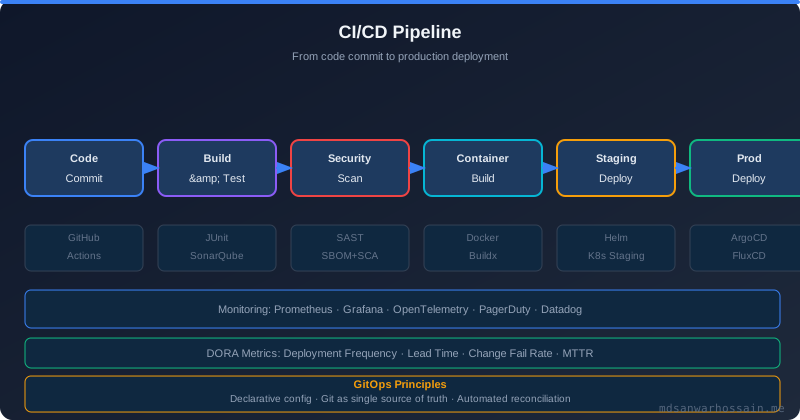
Manual code review cannot systematically detect technical debt at scale. A PR reviewer under time pressure will catch obvious issues but will miss the fact that this is the 47th copy of this data transformation pattern across the codebase. Automated static analysis runs in milliseconds and never has a bad day.
SonarQube / SonarCloud is the standard for Java, TypeScript, and Python codebases. It detects code smells (cognitive complexity above 15, duplicate code above 3%), security hotspots (SQL injection patterns, insecure random number usage, hardcoded credentials), and enforces coverage thresholds. The quality gate feature is the key: configure SonarQube to fail any PR that increases the debt ratio, even if it does not introduce new bugs. This is the critical lever that makes debt management continuous rather than periodic.
# .sonarcloud.properties — project-level configuration
sonar.projectKey=mycompany_order-service
sonar.sources=src/main/java
sonar.tests=src/test/java
sonar.java.coveragePlugin=jacoco
sonar.coverage.jacoco.xmlReportPaths=target/site/jacoco/jacoco.xml
sonar.qualitygate.wait=true
sonar.coverage.exclusions=**/generated/**,**/config/**
Integrate the quality gate directly into GitHub Actions so that the PR check fails and blocks merge if debt increases:
# .github/workflows/quality-gate.yml
jobs:
  sonar:
    runs-on: ubuntu-latest
    steps:
      - uses: actions/checkout@v4
        with:
          fetch-depth: 0
      - name: Set up JDK 21
        uses: actions/setup-java@v4
        with:
          java-version: '21'
          distribution: 'temurin'
      - name: Build and run tests with coverage
        run: mvn verify -B
      - name: SonarCloud Scan
        uses: SonarSource/sonarcloud-github-action@master
        env:
          GITHUB_TOKEN: ${{ secrets.GITHUB_TOKEN }}
          SONAR_TOKEN: ${{ secrets.SONAR_TOKEN }}
CodeClimate provides a maintainability rating (A through F) at the function level and tracks the issue trend over successive PRs. This makes it easy to see whether a particular subsystem's maintainability is improving or degrading over time.
Semgrep enables custom rules for codebase-specific anti-patterns — patterns that generic tools would not flag. Examples: "never call this deprecated internal utility class directly, use the facade instead"; "all SQL queries must use the query builder, not raw string concatenation." These rules encode your team's architectural decisions and enforce them automatically on every PR.
Renovate Bot or GitHub Dependabot automates dependency debt detection by monitoring the dependency graph against the NVD and GitHub Advisory Database, automatically creating PRs when libraries have updates or CVEs. Configured correctly, Renovate groups minor/patch updates into weekly PRs (low review burden) and creates individual urgent PRs for security updates with CVE severity ratings.
Quantification Using the SQALE Model
Technical debt becomes actionable when it is expressed in terms business stakeholders can reason about. "We have 1,400 SonarQube issues" is meaningless to an Engineering VP. "We have an estimated 340 engineering hours of remediation cost, equivalent to $85,000 at loaded engineering cost" is a number that can be budgeted, prioritized, and tracked on an OKR.
The SQALE model (Software Quality Assessment based on Lifecycle Expectations) formalizes this. Each issue type has an associated remediation cost: fixing a cognitive complexity violation costs 30 minutes; removing a code duplicate costs 20 minutes; adding a missing unit test costs 45 minutes. Summing these costs across all issues gives total remediation cost in hours. The debt ratio is remediation cost / development cost — if it would take 340 hours to fix all debt, and the codebase represents 10,000 hours of development effort, the debt ratio is 3.4%. SonarQube implements this model natively and displays the ratio on the project dashboard.
Debt aging is a critical metric that SQALE does not capture natively. An issue that has been open for 18 months in a high-churn file has accumulated significant hidden cost: the code around it has changed 40 times, making the fix harder and riskier. Debt that is not addressed grows in remediation cost even when the issue count stays flat.
Debt interest — the ongoing productivity tax paid every sprint because the debt exists — is harder to measure but the most important number for business cases. A team that spends 3 hours per sprint navigating a particularly convoluted service class is paying debt interest. Multiply 3 hours × 26 sprints × 5 engineers × $150/hour = $58,500/year in productivity lost to a single debt item that might take 20 hours to fix.
Make debt visible at the engineering leadership level with a monthly dashboard: debt ratio trend (goal: consistently decreasing), top 10 most indebted files by debt ratio, debt introduced vs. debt paid per sprint (this ratio tells you whether the team is net paying down or net accumulating debt), and CVE count by severity in the dependency graph.
Prioritization Matrix
Not all debt should be fixed. The decision framework is a two-dimensional priority matrix plotted on business impact (how much does this debt slow feature delivery or create risk?) versus fix effort (how many engineering hours to remediate?). The four quadrants produce clear prescriptions.
Quadrant 1 — High impact, low effort (quick wins): fix in the current sprint as part of normal development work. These are the 20-minute extractions and variable renames that make a real difference to the next developer who reads the code. Schedule these as part of the "Boy Scout Rule" — any engineer who touches a file improves it slightly.
Quadrant 2 — High impact, high effort (strategic investments): plan for dedicated time in the next quarter. These are the god class decompositions and the architectural boundary corrections that require two or three days of focused work. They cannot be done as a side task during feature sprints but need to be explicitly scheduled and tracked on the engineering roadmap.
Quadrant 3 — Low impact, low effort: automate with IDE formatting rules and linters where possible; accept as-is where not. These are style issues and minor naming inconsistencies — real debt, but not worth manual engineering time when the impact is minimal.
Quadrant 4 — Low impact, high effort: document explicitly and deprioritize indefinitely. Some legacy code is stable, rarely touched, and works correctly despite being ugly. The cost of refactoring it exceeds the benefit. Document this decision in an ADR so future engineers do not rediscover it.
The matrix gains a third dimension for security vulnerabilities: CVEs always jump to the top of the queue regardless of the 2×2 placement. A zero-day CVE in a transitive dependency must be addressed within 48 hours even if the fix is complex. Risk overrides the effort dimension for security issues. High-churn files — those changed most frequently, or those with a high correlation to production bug reports — are better candidates for proactive refactoring than stable, rarely-touched legacy code even when both have the same debt ratio.
AI-Assisted Refactoring in Practice
AI coding assistants — GitHub Copilot, Amazon CodeWhisperer, Cursor — have matured to the point where they provide genuinely useful refactoring assistance beyond autocomplete. The key is knowing which refactoring patterns to delegate to AI and which require human judgment.
Effective AI refactoring tasks: method extraction from long functions (AI identifies cohesive groups of lines and suggests extraction with a well-named method); guard clause introduction to invert nested conditionals into early returns; dead code identification across large files; Repository pattern extraction from service classes that contain direct database access.
Consider a concrete example of cognitive complexity reduction — one of the highest-ROI refactoring patterns because SonarQube flags it prominently and it directly correlates with bug rate:
// BEFORE: Cognitive complexity score 24 — flagged by SonarQube as critical
public OrderResult processOrder(Order order) {
    if (order != null) {
        if (order.getItems() != null && !order.getItems().isEmpty()) {
            if (order.getCustomer() != null) {
                if (isValidCustomer(order.getCustomer())) {
                    if (hasInventory(order.getItems())) {
                        // ... 60 more lines of nested logic
                        return OrderResult.success();
                    } else {
                        return OrderResult.failed("Insufficient inventory");
                    }
                }
            }
        }
    }
    return OrderResult.failed("Invalid order");
}

// AFTER: AI-assisted refactoring using the Guard Clauses pattern
// Cognitive complexity score: 4
public OrderResult processOrder(Order order) {
    if (!isValidOrder(order))            return OrderResult.failed("Invalid order");
    if (!isValidCustomer(order.getCustomer())) return OrderResult.failed("Invalid customer");
    if (!hasInventory(order.getItems()))  return OrderResult.failed("Insufficient inventory");
    return processValidOrder(order);
}

private boolean isValidOrder(Order order) {
    return order != null
        && order.getItems() != null
        && !order.getItems().isEmpty()
        && order.getCustomer() != null;
}
The guard clause transformation is mechanical enough that Copilot Edits (multi-file refactoring mode) can apply it consistently across an entire module given the right prompt. The key prompt pattern: "Refactor all methods in this service class that have cognitive complexity above 10 using guard clauses. Extract private validation methods for each condition group. Preserve all existing behavior including exception throwing."
The critical anti-pattern: blindly accepting AI suggestions. AI refactoring assistants are excellent at mechanical transformations but can introduce subtle behavioral changes, particularly around exception propagation, null handling, and early return semantics in methods with side effects. Treat every AI-generated diff with the same scrutiny you would apply to a junior engineer's PR. Always run the full test suite after AI-assisted refactoring. Never auto-merge. The value of AI refactoring is speed and consistency, not reduced review burden.
Strangler Fig Pattern for Legacy Modernization
The Strangler Fig pattern — named after a tree that grows around and eventually replaces its host — is the proven technique for incrementally replacing a legacy monolith without a big-bang rewrite. It allows feature delivery to continue uninterrupted throughout the modernization effort.
The process follows a repeatable cycle for each bounded context:
- Identify a bounded context within the monolith — a cohesive cluster of functionality with clear inputs and outputs. Good candidates: user authentication, notification delivery, report generation, payment processing.
- Build the new implementation as a separate module or microservice alongside the old one. The new implementation starts with no production traffic.
- Route traffic gradually using feature flags: start at 1% of requests to the new implementation. Monitor error rates, latency p99, and correctness metrics against the old implementation's baseline. Increment: 1% → 5% → 10% → 25% → 50% → 100%.
- Once 100% of traffic is on the new implementation and it has run stably for a week, delete the old implementation from the monolith.
- Repeat for the next bounded context.
Applied to a 500,000-line monolith with 15–20 bounded contexts, this process typically takes 12–18 months. But crucially, feature delivery never stops. New features are built in the new implementation while the migration is in progress. The monolith continues serving traffic throughout.
The Anti-Corruption Layer (ACL) is a companion pattern essential for preventing legacy data model concepts from bleeding into new services. The ACL is an adapter layer that translates between the old monolith's data model (which may have accumulated decades of naming conventions, implicit nullability assumptions, and domain model mistakes) and the new service's clean domain model. The ACL sits at the boundary between the two systems and is discarded when the migration is complete. Without an ACL, the new service gradually inherits the same conceptual problems as the old one.
Continuous Debt Prevention
Fixing existing debt is only half the problem. The harder discipline is preventing new debt from entering the codebase at the same rate you are removing it. Without prevention, remediation is running on a treadmill.
PR quality gates are the most effective prevention mechanism. SonarQube, CodeClimate, or a custom script must check as part of CI that: the new code's debt ratio does not exceed the existing average, new methods do not exceed the cognitive complexity threshold (typically 15), and new code is covered by tests at or above the project's baseline coverage. PRs that fail the quality gate cannot merge until the author addresses the issues. This makes debt prevention automatic rather than dependent on reviewer attention.
ADR requirements for new architectural patterns prevent design debt at the decision point. When an engineer proposes a new pattern (a new framework, a new way of handling authentication, a new data access strategy), requiring an ADR forces the team to articulate the decision, its alternatives, and its trade-offs. Six months later, when a new engineer asks "why is this done this way?", the answer is in version control rather than in someone's memory.
Renovate Bot (or Dependabot) configured with auto-merge for patch updates eliminates dependency debt accumulation almost entirely. The bot monitors the dependency graph continuously, groups minor/patch updates into a weekly batch PR (low review burden), and creates urgent individual PRs for CVE patches. Teams that run Renovate typically have a dependency debt ratio near zero — their libraries are always within one or two minor versions of current.
Coverage ratchet in CI: store the current test coverage percentage as a baseline artifact at the end of each successful main branch build. The CI pipeline for PRs reads this baseline and fails if the PR's coverage is below it. Coverage can only stay flat or increase — it can never decrease. This prevents the silent erosion of test coverage that happens when features are added without accompanying tests.
The Boy Scout Rule as team culture: every engineer who opens a file commits to leaving it at least marginally cleaner — extract one method, rename one confusing variable, add one missing null check, delete one dead code block. Applied across 1,000 PRs per year, this compounds into a meaningful reduction in overall debt ratio without any additional engineering time allocation. The rule transforms debt reduction from a project into a habit.
"Debt prevention is an order of magnitude cheaper than debt remediation. A quality gate that blocks a complex method from merging costs 20 minutes of refactoring. The same complexity, once merged and built upon for 6 months, costs 3 days to safely remove."
Failure Scenarios in Debt Remediation
Rushed refactor introduces silent regression: a controller is refactored to use a new service interface, but the null-handling behavior for an optional field changes subtly. The existing tests do not cover this edge case. The regression reaches production and causes data corruption for a small percentage of records before being detected. Prevention: write characterization tests (Golden Master pattern) before refactoring any legacy code. Feed the existing implementation a comprehensive set of inputs and record all outputs. The characterization tests capture current behavior — including bugs — and detect any behavioral change during refactoring. Once the refactoring is complete and reviewed, you can decide which captured behaviors were bugs to fix and which were intentional.
Dependency upgrade breaks transitive dependencies: upgrading Spring Boot from 2.7 to 3.2 is an example that affected thousands of Java codebases. Spring Boot 3 migrated from javax.* to jakarta.* namespace, and many third-party libraries that depend on the old namespace broke silently — they compiled but produced incorrect behavior at runtime. Prevention: always perform major dependency upgrades in an isolated feature branch. Run the complete integration test suite, not just unit tests. Test against a production-representative data sample. Plan for a 2–3 sprint window for major framework upgrades in large codebases.
AI-generated refactoring changes edge case behavior: an AI model asked to extract a method from a long function may change how a checked exception propagates, converting a checked exception into an unchecked one, or swallowing an exception that was previously visible to the caller. The code compiles, the unit tests pass, but the calling code's error handling silently stops working. Prevention: review all AI refactoring suggestions with the same attention you would give to any code change. Pay particular attention to exception handling, return type nullability, and loop boundary conditions — the areas where AI models most commonly introduce subtle behavioral changes. The principle: AI provides the mechanical labor of refactoring; human judgment provides the correctness guarantee.
Key Takeaways
- Automate detection — don't rely on manual code review for debt discovery. SonarQube, CodeClimate, and Semgrep run on every PR and catch issues that even careful reviewers miss. Make quality gates block merges that increase debt.
- Make debt visible with SQALE metrics. Express debt in engineering hours and dollar cost, not issue counts. A debt ratio trend visible to engineering leadership creates accountability and budget justification.
- Prioritize by impact × effort matrix. Not all debt should be fixed. Quick wins (high impact, low effort) go into the current sprint. Strategic investments (high impact, high effort) go on the quarterly roadmap. CVEs override all other priorities.
- Use Strangler Fig, not big-bang rewrites. Incremental bounded-context migration allows feature delivery to continue throughout modernization and reduces the risk of a catastrophic failed rewrite.
- Prevent new debt with quality gates, Renovate Bot, and ADRs. Prevention is dramatically cheaper than remediation. A gate that blocks a complex method from merging costs 20 minutes; removing the same complexity 6 months later can cost 3 days.
- AI assists but humans must review. AI refactoring tools dramatically accelerate mechanical transformations — guard clauses, method extraction, dead code removal — but can introduce subtle behavioral changes. Treat every AI-generated diff as carefully as any other code change.
Leave a Comment
Related Posts

Software Engineer · Java · Spring Boot · Microservices