AI Agents vs Traditional Automation: A Developer's Guide to the Paradigm Shift
Traditional automation follows rigid scripts. AI agents reason, adapt, and make decisions in real time. Understanding the boundary between these two paradigms — and knowing when to use which — is now a core skill for every software engineer.
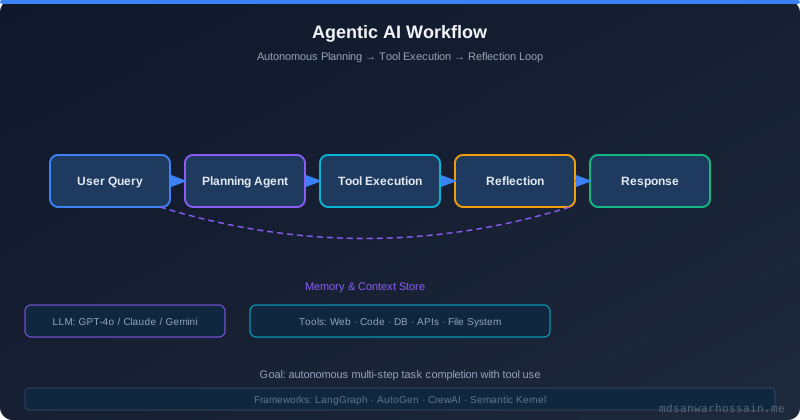
Table of Contents
The Fundamental Distinction
For decades, software automation meant writing explicit rules: if X then do Y, loop through Z records, call this API on a schedule. This deterministic, rule-based approach powers most enterprise systems today — cron jobs, RPA bots, ETL pipelines, and workflow orchestrators. It works reliably when inputs are predictable and the required logic can be fully specified in advance.
AI agents are fundamentally different. An agent observes its environment, reasons about what to do next, selects from available tools, executes actions, observes the results, and iterates until a goal is achieved. The key shift is from executing a predetermined script to dynamically planning a path to an objective. This gives agents the ability to handle novelty, ambiguity, and multi-step problems that rule-based automation cannot address without extensive manual scripting.
This does not mean AI agents are always superior. They are probabilistic, more expensive to run, harder to test exhaustively, and can fail in unexpected ways. The decision about which approach to use must be grounded in the nature of the problem, not enthusiasm for new technology.
How Traditional Automation Works
Traditional automation tools — from shell scripts to enterprise RPA platforms like UiPath and Automation Anywhere — share a common architecture. A developer encodes a sequence of steps: click this button, extract this field, POST to this endpoint, write to this database. The automation executes the steps faithfully every time.
Strengths of Traditional Automation
Determinism is the primary advantage. Given the same inputs, a script produces the same outputs every time. This makes traditional automation highly testable, auditable, and compliant with regulatory requirements. It is also fast — no LLM inference latency — and cheap at scale. A cron job processing a million records costs cents in compute. Running a million tokens through an LLM costs significantly more.
Traditional automation excels at high-volume, repetitive tasks with well-defined structure: invoice processing where the format is fixed, data migration following a defined schema, nightly report generation from a database, or UI automation against a stable interface. If you can fully specify the logic, rule-based automation is the right tool.
Weaknesses of Traditional Automation
The brittleness of traditional automation under change is its greatest liability. A single UI element rename breaks an RPA bot. A new exception case not covered by the rules causes failure or silent incorrect output. Maintaining large rule sets becomes increasingly expensive as edge cases multiply. More critically, traditional automation cannot handle tasks that require judgment: reading an unstructured email and determining the appropriate routing, diagnosing an ambiguous error based on context, or adapting a response based on the semantics of a customer's inquiry.
How AI Agents Work
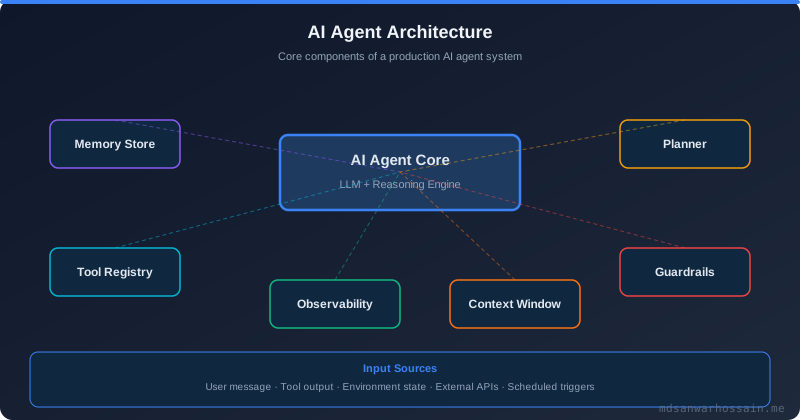
An AI agent consists of three core components: a language model (the reasoning engine), a set of tools (functions the agent can invoke), and a loop that connects observation to action to observation. The agent receives a goal, reasons about what steps are required, invokes tools to gather information or take actions, and uses the results to inform the next reasoning step.
The ReAct Pattern
The dominant agent reasoning pattern in 2026 is ReAct (Reasoning + Acting). The agent alternates between reasoning steps (thinking out loud about what it knows and what it needs to do) and action steps (invoking a tool and observing the result). This cycle continues until the agent produces a final answer or the task is complete.
// Simplified ReAct agent loop in Java using Spring AI
@Service
public class SupportAgent {
    private final ChatClient chatClient;
    private final List<FunctionCallback> tools;
    public String handleTicket(String ticketDescription) {
        return chatClient.prompt()
            .system("""
                You are a support triage agent. Use the available tools to:
                1. Look up the customer's account history
                2. Search the knowledge base for relevant solutions
                3. Create a support ticket with priority and routing
                Always verify your findings before taking action.
                """)
            .user(ticketDescription)
            .functions(tools)  // getAccountHistory, searchKnowledgeBase, createTicket
            .call()
            .content();
    }
}
Tool Use and Grounding
The power of agents comes from tool use. Tools connect the reasoning model to real-world systems: databases, APIs, file systems, browsers, code executors. Each tool call grounds the agent's reasoning in real data, preventing hallucination on facts that can be looked up. Well-designed tool interfaces have clear names, explicit parameter schemas, and predictable error responses so the agent can reason about failures and retry or escalate appropriately.
Side-by-Side Comparison
To make the distinction concrete, consider the task of responding to customer support emails. A traditional automation approach would parse the email for known keywords, match against a routing table, and send a templated reply or assign to a queue. This works for common, well-categorized requests. An AI agent would read the email, understand the customer's intent and emotional tone, look up their account history, search the knowledge base for relevant solutions, draft a personalized response, and either send it (autonomous mode) or present it for human approval (supervised mode).
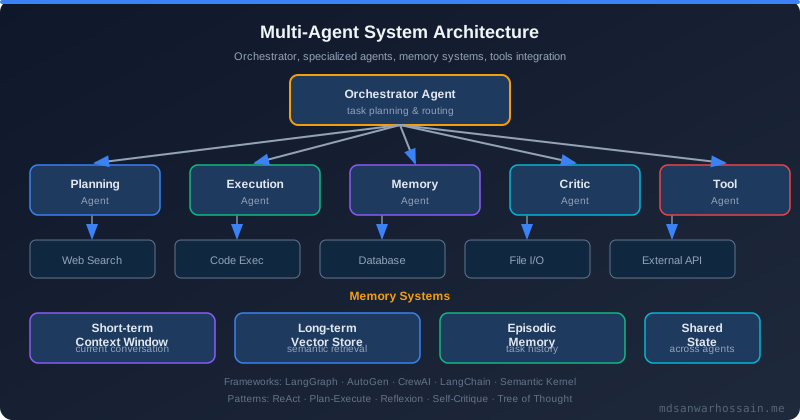
The agent handles novel requests, implicit context, and nuanced situations that would require hundreds of rules to encode explicitly. The trade-off is latency (seconds vs milliseconds), cost (inference cost per request), and reliability (probabilistic reasoning vs deterministic execution).
When to Choose Traditional Automation
Use traditional automation when: the task is fully specifiable as a deterministic sequence of steps; inputs are structured and predictable; throughput is high and cost-per-transaction matters; auditability and regulatory compliance require deterministic, explainable outputs; latency is critical and LLM inference overhead is unacceptable. Examples: ETL pipelines, database migrations, scheduled reports, UI testing automation, infrastructure provisioning scripts.
When to Choose AI Agents
Use AI agents when: the task requires judgment, interpretation, or handling of unstructured inputs; the problem space is too large or dynamic to enumerate all rules; the task involves multi-step reasoning where later steps depend on earlier results; the cost of human involvement (time, error rate) exceeds the cost of agent inference. Examples: support ticket triage and drafting, code review assistance, incident analysis, research synthesis, and onboarding workflow automation.
The Hybrid Architecture: The Practical Sweetspot
Most production systems in 2026 use both paradigms together. The backbone is traditional automation — reliable, cheap, fast pipelines handling high-volume structured work. AI agents are inserted at decision points that require judgment or interpretation. This hybrid approach maximizes cost efficiency while extending automation to tasks that were previously human-only.
A practical example: an order fulfilment pipeline processes 99% of orders through traditional automation (validate, reserve stock, charge payment, trigger shipment). The 1% that fail validation or trigger edge cases are routed to an AI agent that reasons about the failure, looks up customer history, and either resolves autonomously or escalates with a structured context packet for a human agent.
Evaluating Agent Performance
Traditional automation succeeds or fails deterministically and is easy to test. Agent evaluation is more complex. Build evaluation datasets with realistic tasks and expected outcomes. Track task completion rate, tool call accuracy, escalation appropriateness, latency, and cost per successful outcome. In production, sample a percentage of agent outputs for human review. Establish baselines before deploying updates to prompts or models, and A/B test changes to measure impact rigorously.
Security Considerations
Agents that can take actions — send emails, update databases, call APIs — must be secured carefully. Apply the principle of least privilege: agents should only have access to the tools and data they genuinely need. Validate and sanitize all inputs to prevent prompt injection, where malicious content in a tool response attempts to hijack the agent's behavior. Log all tool calls with their arguments and responses for audit purposes. Require human approval gates for irreversible or high-impact actions.
"The question is not whether AI agents are better than traditional automation. It is whether the problem at hand requires determinism or judgment — and building the right hybrid for your specific context."
Key Takeaways
- Traditional automation is deterministic, fast, cheap, and ideal for structured, high-volume tasks.
- AI agents are adaptive, judgment-capable, and suited for ambiguous multi-step problems.
- The hybrid architecture — traditional automation for the backbone, agents at decision points — is the production-ready pattern for 2026.
- Agent evaluation requires purpose-built datasets, baseline tracking, and continuous production monitoring.
- Security, observability, and human oversight are non-negotiable for production agents.
Real-World Migration Stories: From Automation to Agents
Theoretical comparisons between AI agents and traditional automation only go so far. The clearest picture of when and how to make the transition comes from organizations that have navigated it in production. These migration stories share a common pattern: a well-functioning automation system encounters a class of exception it cannot handle gracefully, the cost of manual exception handling grows to the point where it is worth investing in intelligent automation, and the team introduces agents at those specific decision points while preserving the automation backbone.
A large e-commerce company's returns processing system provides a representative example. For several years, the system handled standard return requests — wrong size, changed mind — through deterministic automation: validate the claim, check return policy, issue refund, update inventory. The automation handled 87% of returns reliably. The remaining 13% — involving damaged goods, disputed charges, fraud signals, and unusual circumstances — required human agents at a cost of $12 per ticket. With return volume at two million tickets per year, this 13% represented significant operational cost.
The team introduced an AI agent layer for the exception cases. The agent reads the return ticket description, examines the customer's purchase and return history, checks the product's damage reports, reviews the relevant return policy clauses, and either resolves the case autonomously (71% of exceptions) or escalates with a fully prepared context packet that reduces human agent handling time from 8 minutes to 2 minutes. The agent-handled exceptions cost $0.15 per ticket in inference costs. The remaining escalations, now faster to resolve, cost $3 per ticket. The net saving on the 260,000 exception tickets per year was substantial enough to fund the agent development cost within the first quarter of deployment.
A financial services firm migrated their regulatory report generation workflow in a different direction — cautiously. Their existing Python automation reliably generated standard reports, but the business needed to respond to ad-hoc regulatory queries that fell outside the templated report formats. Initially, these queries went to a team of three analysts who spent four to six hours per query researching data sources, writing SQL, and formatting responses. The firm piloted an AI agent that could take natural-language queries, generate appropriate SQL against the data warehouse, validate the results for completeness, and draft the narrative sections of the response.
Critically, the firm did not remove the human analysts — they shifted their role from writing the initial response to reviewing and approving the agent-generated draft. Query turnaround time dropped from days to hours. The analysts, freed from mechanical research work, now contribute higher-level analysis and handle the small percentage of queries where the agent's approach is clearly insufficient. The lesson: successful migrations preserve human expertise in a supervisory role rather than eliminating it, particularly in regulated contexts where explainability and accountability matter.
Total Cost of Ownership: Agents vs Traditional Automation
Build cost is the most visible part of the cost comparison between AI agents and traditional automation, and it systematically misleads decision-making. Traditional automation has lower build cost for simple, well-defined workflows — writing deterministic code is cheaper than designing, prompting, and evaluating an AI agent. But build cost is a one-time expenditure; maintenance cost is recurring and often dominates the total cost of ownership over a multi-year system lifetime.
Traditional automation's maintenance cost scales with the number of rule cases and exception paths it must handle. Every time the business changes a policy, adds a new product type, or encounters a new edge case, an engineer must extend the rule set. For stable workflows, this maintenance burden is low. For workflows in dynamic business domains — pricing, customer eligibility, compliance screening — the maintenance burden can exceed the original build cost within 18 months. The combination of high-frequency change and wide exception space is the primary indicator that AI agents will have a lower total cost of ownership than automation.
LLM inference cost is often overestimated as a barrier to agent adoption. At current pricing — approximately $3–15 per million tokens for frontier models, and $0.10–0.50 for fast models — the per-transaction cost for a typical agent interaction (2,000–5,000 tokens) ranges from $0.001 to $0.075. For many workflows, this is competitive with the human labor cost of handling the same task, particularly when the agent's throughput is measured in seconds per task versus minutes for human processing. For high-volume, low-value transactions, fast models like Gemini Flash or Claude Haiku bring inference costs below one cent per transaction.
Evaluation infrastructure is an often-ignored cost component. Traditional automation requires unit tests and integration tests, which are inexpensive to write and run. Agents require evaluation datasets — collections of realistic inputs with expected outputs — plus sampling infrastructure to continuously monitor production quality. Building and maintaining a 200-task evaluation set, running it on each prompt or model change, and sampling 1–2% of production output for human review costs the equivalent of roughly 0.5 FTE per agent system per year. Factor this into the TCO model from the beginning, as under-investing in evaluation leads to quality degradation that is expensive to diagnose and remediate later.
Observability and Debugging: Agents vs Automation
Traditional automation's debugging experience is familiar to every software engineer: a deterministic function produced the wrong output, a test captures the failure, and a debugger or log trace identifies the exact line where execution diverged from expectation. The causal chain is linear and reproducible. Agent debugging is fundamentally different — the agent's "code" is a combination of prompt, model weights, tool implementations, and context, and the failure may not reproduce exactly on the next run due to temperature in the model's sampling.
Structured logging of every agent step is the foundation of agent observability. Each tool call should produce a structured log entry containing: the tool name, the input arguments, the returned output, the timestamp, and a trace ID that links all steps in a single agent run. These logs enable you to reconstruct exactly what the agent did, in what order, and why a given step produced a given result. Without this logging, debugging agent failures is largely guesswork.
// Structured agent step logging with OpenTelemetry spans
@Component
public class ObservableToolExecutor {
    private final Tracer tracer;

    public ToolResult executeTool(String toolName, Map<String, Object> args) {
        Span span = tracer.spanBuilder("agent.tool." + toolName)
            .setAttribute("tool.name", toolName)
            .setAttribute("tool.args", toJson(args))
            .setAttribute("agent.run.id", AgentContext.current().runId())
            .startSpan();
        try (Scope scope = span.makeCurrent()) {
            ToolResult result = invokeToolImpl(toolName, args);
            span.setAttribute("tool.result.success", result.isSuccess());
            span.setAttribute("tool.result.summary", result.summary());
            return result;
        } catch (Exception e) {
            span.recordException(e);
            span.setStatus(StatusCode.ERROR);
            throw e;
        } finally {
            span.end();
        }
    }
}
Tracing diverges significantly between the two paradigms at the reasoning layer. In traditional automation, tracing shows the execution path through conditional logic — which branch was taken, which rules fired. In agent systems, the equivalent is the model's chain-of-thought reasoning, which must be explicitly captured. If your agent produces a final_reasoning field in its output, log it. If the agent performs multiple reasoning steps (think → act → observe cycles), log each one with its corresponding tool call. This "reasoning trace" is the agent equivalent of a debugger's call stack.
Anomaly detection patterns also differ. Traditional automation anomalies are typically output errors — wrong data, unexpected nulls, constraint violations — that are caught by assertion checks. Agent anomalies include: reasoning loops (the agent calling the same tool repeatedly with the same arguments), token budget exhaustion, unexpected escalations, and subtle semantic errors where the output is structurally valid but semantically wrong (the correct format, wrong customer). Detecting semantic errors requires LLM-as-judge evaluation — a secondary model that checks the primary agent's output against quality criteria — rather than simple assertion checks that work for deterministic systems.
Future Trends: Where the Line Is Blurring
The distinction between AI agents and traditional automation is becoming less crisp as both paradigms evolve toward each other's strengths. Traditional automation is incorporating machine-learning classifiers, embedding-based routing, and probabilistic rule engines. AI agents are becoming more deterministic through structured output, constrained tool sets, and verification layers. The interesting developments are at the boundaries where the two paradigms are converging.
Structured output and function calling have made agents dramatically more predictable. Early AI agents produced free-text outputs that required parsing and validation. Modern frameworks like OpenAI's structured output mode and Anthropic's tool use API allow agents to produce guaranteed-valid JSON conforming to a schema on every invocation. This bridges the reliability gap with traditional automation for the structured portions of an agent's output. An agent that routes a support ticket to the correct queue, produces a confidence score, and identifies the affected product — all in a validated JSON response — behaves more like a probabilistic automation system than a free-form chatbot.
Retrieval-augmented generation (RAG) is enabling automation-like consistency for agents operating over large knowledge bases. A traditional rules engine that encodes product eligibility criteria in code becomes brittle as the rule set grows and changes. An agent grounded in a RAG system that retrieves the current, versioned eligibility document on each invocation and reasons from it can maintain accuracy over an evolving policy set without code changes. This is particularly powerful for compliance-driven workflows where the source of truth is documentation rather than code.
Looking ahead, the convergence of AI reasoning with formal verification tools promises agents that can prove properties of their own outputs — not just generate plausible-looking code or analysis, but verify that the generated output satisfies formal specifications. Agents that can verify the correctness of their own code before submitting it for human review, or that can prove a proposed configuration change does not violate stated invariants, will close the reliability gap with traditional automation for correctness-critical workloads. The timeline for production-grade formal verification in agent systems is 2–4 years, but early research prototypes are already demonstrating the direction of travel.
"The question is not whether AI agents are better than traditional automation. It is whether the problem at hand requires determinism or judgment — and building the right hybrid for your specific context."
Leave a Comment
Related Posts

Software Engineer · Java · Spring Boot · Microservices