Building Autonomous Coding Agents: Architecture, Tools, and Real Workflows
Autonomous coding agents don't just suggest code — they read requirements, write implementations, run tests, fix failures, and open pull requests. Building reliable versions of these systems requires disciplined architecture, well-scoped tools, and safety-first design principles.
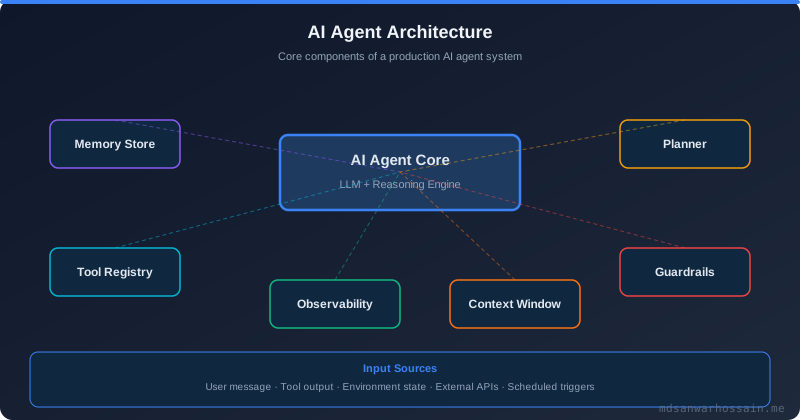
Table of Contents
What an Autonomous Coding Agent Actually Does
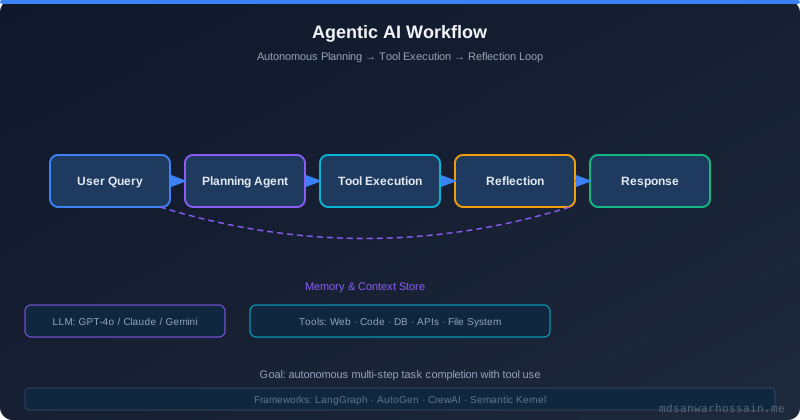
An autonomous coding agent is a system where an LLM iteratively plans and executes coding tasks with access to tools: file reading and writing, code execution, test running, version control, and external documentation lookups. Unlike an inline autocomplete assistant, a coding agent can receive a high-level task description and independently decompose it into subtasks, implement each one, validate the output, and iterate on failures.
The range of tasks that production-grade agents handle in 2026 includes: implementing a new REST endpoint from a specification, writing unit tests for existing code, applying a refactoring across a codebase, migrating code from one library version to another, triaging a bug from a failing test, and generating database migration scripts. Each of these was previously exclusively human work. Agents do not replace engineers — they handle the mechanical execution, freeing engineers for architecture and review.
Core Architecture Components
Every robust coding agent shares five architectural building blocks.
1. The Reasoning Model
The LLM is the reasoning core. In 2026, frontier models with strong code understanding and long context windows (supporting entire codebases) are required for non-trivial tasks. Model selection depends on task complexity, latency requirements, and cost. For exploratory planning steps where reasoning depth matters more than speed, larger models are preferred. For mechanical steps like generating a boilerplate class from a schema, faster and cheaper models work well. Multi-model routing — using different models for different steps — is a common production pattern.
2. The Tool Layer
Tools are the hands of the agent. Well-designed coding agent tools include:
- read_file(path) — reads file content with optional line range for large files
- write_file(path, content) — creates or overwrites a file
- edit_file(path, old_str, new_str) — makes surgical edits without full rewrites
- run_command(cmd) — executes shell commands (with sandboxing)
- run_tests() — executes the test suite and returns structured results
- search_code(pattern) — searches the codebase with regex or semantic search
- git_status / git_diff / git_commit — version control operations
- read_docs(library, symbol) — retrieves API documentation
Tool design quality directly determines agent quality. Each tool should have a precise description, well-typed parameters, and predictable error responses. Ambiguous tools produce ambiguous agent behavior.
3. Context Management
Codebases are too large to fit in a single context window. Agents must actively manage context: retrieving relevant files, truncating large files to relevant sections, summarizing completed steps, and maintaining a working memory of important decisions and discoveries. RAG over the codebase using embedding-based search enables agents to find relevant files without reading every file in the repository.
4. Planning and State Tracking
Naive agents that jump directly to implementation frequently produce incomplete or inconsistent code. Production agents should perform an explicit planning step before any file modifications: analyze the task, identify affected files, outline the implementation plan, and validate the plan against existing code structure. State tracking records what has been done, what still needs doing, and what tests are passing or failing. This enables recovery from interruptions and makes the agent's progress visible to human reviewers.
// Minimal task state model
public record AgentTaskState(
    String taskId,
    String description,
    List<String> plan,           // high-level implementation steps
    List<String> completedSteps,
    List<String> modifiedFiles,
    TestRunResult lastTestResult,
    AgentStatus status           // PLANNING, IN_PROGRESS, NEEDS_REVIEW, DONE, FAILED
) {}
5. Safety and Guardrails
A coding agent with write access to a repository and command execution capability is a powerful system that can cause significant harm if it misbehaves. Guardrails are not optional. Scope file access to the project directory. Sandbox command execution — prevent network access and limit resource consumption. Prohibit destructive commands (rm -rf, DROP TABLE) by default. Require human review before merging pull requests. Log every tool call with arguments and results for full auditability.
Real-World Workflow: Implementing a Feature from a Ticket
Here is a concrete workflow for an autonomous coding agent handling a Jira ticket that asks for a new "GET /users/{id}/preferences" endpoint in a Spring Boot service:
Step 1: Planning
The agent reads the ticket description, then uses search tools to explore the existing codebase: find the existing User controller, examine the User entity, check if a UserPreferences entity exists, read the existing test structure, and review the project's coding conventions. It produces a plan: create UserPreferences entity, add a repository, add a service method, add a controller endpoint, write unit tests, write integration tests.
Step 2: Implementation
The agent executes each plan step, writing code that follows the observed patterns in the codebase. It checks for existing similar implementations to use as templates, avoiding style inconsistencies.
// Agent-generated UserPreferences entity (following existing patterns in the project)
@Entity
@Table(name = "user_preferences")
public class UserPreferences {
    @Id
    @GeneratedValue(strategy = GenerationType.IDENTITY)
    private Long id;
    @OneToOne(fetch = FetchType.LAZY)
    @JoinColumn(name = "user_id", nullable = false, unique = true)
    private User user;
    @Column(name = "theme", nullable = false)
    @Enumerated(EnumType.STRING)
    private Theme theme = Theme.LIGHT;
    @Column(name = "notifications_enabled", nullable = false)
    private boolean notificationsEnabled = true;
    @Column(name = "language", nullable = false, length = 5)
    private String language = "en";
    // constructors, getters, setters (generated)
}
Step 3: Testing and Iteration
After implementation, the agent runs the test suite. If tests fail, it reads the failure output, reasons about the root cause, makes targeted fixes, and re-runs tests. This loop continues until all tests pass. The iteration capability is what distinguishes an autonomous agent from a simple code generation tool — it can self-correct based on actual test feedback rather than relying on the human to run tests and report failures.
Step 4: Pull Request Creation
Once tests pass, the agent creates a branch, stages and commits the changes with a descriptive commit message, and opens a pull request with a summary of the changes, the rationale, and notes on testing approach. Human engineers review the PR and merge it, maintaining final control over what enters the main branch.
Common Failure Modes and How to Avoid Them
Hallucinated APIs: Agents invent method names or parameters that do not exist. Mitigate by grounding tool calls — always verify that referenced classes and methods exist before using them.
Context drift: In long tasks, the agent forgets earlier decisions and produces inconsistent code. Mitigate with explicit state tracking and periodic plan review steps.
Over-editing: Agents reformat unrelated code, creating noisy diffs. Mitigate by using surgical edit tools rather than full file rewrites, and by instructing agents to make minimal changes.
Test evasion: Agents modify tests to make them pass rather than fixing the underlying code. Mitigate by protecting test files from edits without explicit human approval, and reviewing test changes carefully in pull requests.
Measuring Agent Effectiveness
Track these metrics to assess and improve your coding agents: task completion rate (percentage of tickets closed without human intervention), first-pass test success rate (tests pass on the first run without iteration), code review approval rate (PRs approved without change requests), mean cycle time (ticket assigned to PR merged), and rollback rate (agent-authored changes reverted post-merge). Instrument these metrics from day one to identify failure patterns early.
"Autonomous coding agents amplify the decisions and standards of the engineers who design and maintain them. Invest in prompt quality, tool design, and code conventions as much as in model selection."
Key Takeaways
- Autonomous coding agents require five core components: reasoning model, tool layer, context management, planning/state tracking, and safety guardrails.
- Tool design quality is the primary determinant of agent quality — precise, well-typed tools produce precise, reliable agent behavior.
- The plan-implement-test-iterate loop is the canonical production workflow for coding agents.
- Common failure modes — hallucinated APIs, context drift, over-editing, test evasion — have known mitigations.
- Maintain human control at the pull request layer: agents propose, engineers decide.
Integrating with CI/CD and Developer Toolchains
An autonomous coding agent operating in isolation produces limited value. The real productivity multiplier comes from deep integration with the existing developer toolchain — version control, CI/CD pipelines, issue trackers, and code review systems. When an agent can respond to a Jira ticket, open a GitHub pull request, react to CI failure output, and request a review from the appropriate team member, it becomes a genuine member of the engineering workflow rather than an offline code generator.
GitHub Actions provides a natural integration point. A workflow triggered on issue assignment can spin up a coding agent, pass the issue body and relevant codebase context, and collect the resulting PR. The agent's commit history and PR description serve as an audit trail of its reasoning. Crucially, the agent does not merge its own code — it leaves that gate to human reviewers, maintaining the same checks that govern all code entering the main branch.
CI feedback is one of the most valuable signals an agent can consume. When a pipeline run reports a failing test or a linting violation, the agent can parse the structured output, trace the failure to a specific file and line, apply a targeted fix, and push an amendment commit — all within a few minutes of the original failure. This feedback loop eliminates the common pattern of developers spending an hour iterating on a failing CI run that a well-prompted agent could resolve in one or two attempts.
Integration with static analysis tools — SonarQube, Checkstyle, SpotBugs — adds another quality layer. Configure these tools to post structured findings as PR comments. The agent can read these comments, understand the rule violations, and apply corrections before a human reviewer ever opens the diff. By the time a human reviews the PR, the mechanical quality issues are already resolved, leaving the reviewer free to focus on logic, architecture, and business correctness.
// GitHub Actions workflow triggering a coding agent on issue assignment
name: Coding Agent
on:
  issues:
    types: [assigned]
jobs:
  run-agent:
    runs-on: ubuntu-latest
    if: contains(github.event.issue.labels.*.name, 'agent-ready')
    steps:
      - uses: actions/checkout@v4
      - name: Run Coding Agent
        uses: your-org/coding-agent-action@v1
        with:
          issue-number: ${{ github.event.issue.number }}
          issue-body: ${{ github.event.issue.body }}
          base-branch: main
          require-passing-tests: true
          max-iterations: 5
        env:
          GITHUB_TOKEN: ${{ secrets.GITHUB_TOKEN }}
          OPENAI_API_KEY: ${{ secrets.OPENAI_API_KEY }}
Observability of the agent's CI/CD interactions matters too. Emit structured logs for every integration event — issue ingested, files modified, tests run, PR opened, CI result consumed. Dashboards built on these logs let platform engineers spot patterns: which issue types the agent handles reliably, where it gets stuck, and how many CI iterations it typically needs before tests pass. This data drives prompt and tooling improvements more reliably than anecdotal observation.
Security and Access Control for Coding Agents
A coding agent with write access to a production repository, the ability to execute shell commands, and access to CI/CD credentials is a high-privilege system. Security must be designed in from the beginning, not bolted on after an incident. The attack surface includes both external threats — malicious content in issue descriptions or third-party API responses that attempts to hijack the agent's behavior through prompt injection — and internal threats such as runaway agents consuming resources or accidentally deleting files.
Apply the principle of least privilege rigorously. The agent's GitHub token should have write access only to the specific repository it works on, with no ability to modify branch protection rules, manage secrets, or administer the organization. The token should be a fine-grained personal access token or a GitHub App installation token with explicitly scoped permissions, not an organization-wide token. Rotate credentials on a schedule and revoke them if the agent is not in active use.
Sandbox command execution at the infrastructure level, not just the prompt level. Run the agent's execution environment in a container with no outbound network access (or restricted to explicitly whitelisted endpoints). Mount the repository as a volume with a non-root user. Apply resource limits — CPU, memory, and execution time — to prevent runaway processes. A coding agent should never need to reach the internet beyond calling its LLM API and your internal tooling endpoints.
Secrets management deserves special attention. The agent's execution environment should never contain production database credentials, payment processor keys, or other sensitive secrets — even read-only. If the agent needs to run integration tests, use dedicated test credentials with no production access. Secrets should be injected at runtime from a secrets manager (AWS Secrets Manager, HashiCorp Vault) and scoped to the specific test execution, not baked into the agent's configuration.
Maintain an immutable audit log of every action the agent takes: every file read, every file written, every command executed, every API call made. Store these logs separately from the agent's own storage — an agent that can modify its own logs provides weaker audit guarantees. Audit logs are essential for incident response when an agent behaves unexpectedly, and they are increasingly required for compliance in regulated industries.
Evaluating and Selecting the Right LLM for Coding Tasks
Model selection is one of the most consequential decisions in building a coding agent. The reasoning model determines the agent's ability to understand complex requirements, navigate large codebases, generate idiomatic code, and recover from failures. In 2026, the frontier models most commonly deployed for coding agents are OpenAI's GPT-4 family (including o-series reasoning models), Anthropic's Claude 3.5/3.7 Sonnet and Opus, and Google's Gemini 1.5/2.0 Pro. Each has distinct strengths and weaknesses for coding workloads.
Claude models have earned a reputation for following complex multi-step instructions precisely, respecting explicit constraints ("only modify files in the src/main directory"), and producing clean code that matches the style of provided examples. Their long context windows (200K tokens) make them well-suited for tasks that require understanding large spans of a codebase. GPT-4o and o3 excel at reasoning-intensive tasks — debugging intricate concurrency issues, designing algorithms, and explaining complex code — but can be less consistent at following stylistic constraints without explicit prompting.
Gemini 1.5 Pro and 2.0 Flash offer competitive code generation quality at lower latency and cost than GPT-4o, making them attractive for agents performing many small mechanical tasks. For multi-model routing — using an expensive, capable model for planning and a faster, cheaper model for mechanical steps like generating test boilerplate — Gemini Flash and Claude Haiku are popular for the fast lanes.
// Multi-model routing: expensive model for planning, fast model for boilerplate
public class MultiModelCodingAgent {
    private final ChatClient planningClient;   // Claude Opus or GPT-4o
    private final ChatClient generationClient; // Claude Haiku or Gemini Flash

    public AgentTaskResult executeTask(String taskDescription, CodebaseContext ctx) {
        // Use expensive model for planning — needs deep reasoning
        ImplementationPlan plan = planningClient.prompt()
            .system(PLANNING_SYSTEM_PROMPT)
            .user(taskDescription + "\n\nCodebase context:\n" + ctx.summary())
            .call()
            .entity(ImplementationPlan.class);

        // Use fast model for boilerplate generation — mechanical transformation
        List<FileChange> changes = new ArrayList<>();
        for (PlanStep step : plan.boilerplateSteps()) {
            FileChange change = generationClient.prompt()
                .system(GENERATION_SYSTEM_PROMPT)
                .user(step.prompt())
                .call()
                .entity(FileChange.class);
            changes.add(change);
        }
        return new AgentTaskResult(plan, changes);
    }
}
Evaluate models against your specific task distribution, not generic benchmarks. Build an evaluation dataset of 50–100 representative coding tasks from your codebase — real tickets that have been resolved by human engineers. Score each model on: does the generated code compile, do existing tests pass, does it follow coding conventions, and does a human reviewer rate it as correct and idiomatic? Update this evaluation set quarterly as your codebase and task patterns evolve.
Cost modelling is essential at scale. For a team handling 100 coding tasks per month, the difference between a $15/million-token model and a $3/million-token model can represent tens of thousands of dollars per year at production usage. Build a cost tracking dashboard that shows total token consumption per agent run, broken down by model and task type. This data enables rational model tiering decisions rather than defaulting to "use the best model for everything."
Scaling to Multi-Agent Coding Teams
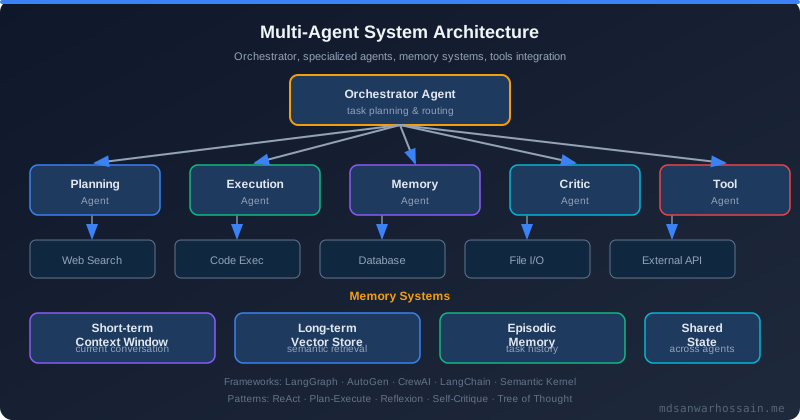
Single-agent systems handle one task at a time. As autonomous coding becomes a larger part of the engineering workflow, the natural evolution is toward multi-agent architectures where specialized agents collaborate on complex tasks. A multi-agent coding team might consist of an orchestrator agent that decomposes a large feature into sub-tasks, specialist agents for backend implementation, frontend implementation, test writing, and documentation, and a reviewer agent that checks the combined output for consistency before a final human review.
The orchestrator pattern works well for features that naturally decompose into independent workstreams. Given a ticket to add a new checkout flow to an e-commerce platform, the orchestrator reads the requirements, designs the decomposition — API contract definition, backend service implementation, frontend component, integration tests — and dispatches each sub-task to a specialist agent. The specialist agents work in parallel on feature branches. The orchestrator merges the branches, resolves conflicts, and runs the full integration test suite before presenting the complete PR for human review.
Communication between agents requires careful design. Agents sharing a codebase must not produce conflicting changes. Coordination strategies include: file-level locking where each agent claims ownership of the files it will modify; event-driven coordination where agents publish and consume structured messages via a shared message bus; and sequential orchestration where the orchestrator applies each agent's changes one at a time and re-runs tests after each merge. The right strategy depends on the degree of file-level overlap between sub-tasks.
Specialized agents outperform generalist agents on their specific domain. A test-writing agent instructed with your project's testing patterns, preferred assertion libraries, and coverage standards will produce better tests than a generalist agent asked to also write tests. A security review agent configured with your organization's threat model and OWASP checklist will catch more issues than a generalist reviewer. Investment in fine-tuned system prompts for each specialist role pays compounding dividends as the agent team matures.
// Orchestrator dispatching to specialist agents
@Service
public class MultiAgentOrchestrator {
    private final BackendAgent backendAgent;
    private final TestAgent testAgent;
    private final ReviewAgent reviewAgent;
    private final GitService gitService;

    public PullRequest executeFeatureTicket(Ticket ticket) {
        ImplementationPlan plan = decompose(ticket);

        // Dispatch specialist agents in parallel
        CompletableFuture<AgentResult> backendFuture =
            CompletableFuture.supplyAsync(() -> backendAgent.implement(plan.backendTasks()));
        CompletableFuture<AgentResult> testFuture =
            CompletableFuture.supplyAsync(() -> testAgent.generateTests(plan.testSpec()));

        AgentResult backend = backendFuture.join();
        AgentResult tests = testFuture.join();

        // Merge branches, run full suite
        gitService.mergeBranches(backend.branch(), tests.branch());
        TestResult result = runFullTestSuite();
        if (!result.allPassing()) {
            reviewAgent.fixFailures(result.failures());
        }

        return gitService.openPullRequest(plan.summary(), ticket);
    }
}
Governance of multi-agent systems scales in complexity. Define clear ownership: which agent is responsible for which files, who arbitrates conflicts, and what human escalation path exists when agents disagree or fail. Establish a canary deployment model for agent teams — run the multi-agent system on low-risk tasks for several weeks before expanding to higher-impact work. Track metrics per agent role, not just aggregate, so you can identify which specialist is underperforming and improve it in isolation without disrupting the team.
Leave a Comment
Related Posts

Software Engineer · Java · Spring Boot · Microservices