Backend vs Full-Stack in the AI Era: Career & Architecture Decisions for 2026
AI tools are eroding the friction that once kept frontend and backend development in separate silos. But specialization still pays — if you specialize in the right things. Here's a frank look at the career calculus for 2026.
For most of the last decade, the software industry organized itself into two camps: backend engineers who owned APIs, databases, and business logic, and frontend engineers who owned the user interface. Full-stack was the ambitious middle ground — aspirational, sometimes derided as "jack of all trades, master of none." AI is rewriting that calculus fast. Today, a backend engineer can generate a functional React component in minutes. A frontend engineer can scaffold a REST API before lunch. The specialization boundary hasn't disappeared, but it has moved — and understanding where it moved is critical for making smart career and architecture decisions.
Table of Contents
- How AI Is Blurring the Backend/Frontend Boundary
- What Backend Specialization Still Offers in 2026
- The Full-Stack Advantage in AI-Native Teams
- Java Spring Boot Backend — Still the Enterprise Choice
- Angular and React on the Frontend — Where AI Accelerates Most
- Microservices: Backend-First Thinking
- When to Specialize vs Generalize: A Decision Framework
- What Skills to Focus on for Each Path
- Conclusion
How AI Is Blurring the Backend/Frontend Boundary
The traditional justification for specialization was the steep learning curve of each domain. Frontend required deep CSS intuition, browser quirks knowledge, component lifecycle mastery, and accessibility expertise. Backend required distributed systems thinking, query optimization, concurrency models, and security depth. These took years to internalize — and few people had the time to build genuine expertise in both.
AI has dramatically lowered the entry cost for each domain. GitHub Copilot can generate a well-structured Angular component with reactive forms and HTTP interceptors in seconds. Claude Code can scaffold a Spring Boot microservice with persistence, validation, and OpenAPI documentation in minutes. This doesn't mean AI has mastered these domains — it means the boilerplate burden that used to enforce specialization has been lifted. What remains requires genuine expertise: performance debugging, security architecture, complex state management, distributed consistency, and system design decisions where trade-offs have real business consequences.
"AI levels the playing field on implementation. It doesn't level it on judgment, architecture, or domain mastery — those remain the differentiators."
What Backend Specialization Still Offers in 2026
Backend specialization remains highly valuable — but the definition of "backend" has evolved. Pure CRUD API engineering is increasingly automated. The backend skills that still command premium salaries and career longevity are those that require deep systems understanding:
- Distributed systems design: Consistency models, partition tolerance, saga orchestration, and event sourcing are not AI-generatable decisions. They require understanding your specific system's failure modes.
- Database performance engineering: Query plan analysis, index strategy, connection pool tuning, and schema migration patterns require contextual judgment that AI can only partially support.
- Security architecture: OAuth2 flows, JWT validation, RBAC design, and threat modeling require a depth of understanding where AI hallucinations can have catastrophic consequences.
- Platform engineering: Kubernetes operator design, custom admission controllers, multi-tenant resource isolation — this is backend work that is accelerating in demand and resists automation.
If you're a backend specialist, the strategic move is to deepen into these high-judgment, low-automation areas rather than defending pure API development turf that AI is encroaching upon.
The Full-Stack Advantage in AI-Native Teams
In AI-native engineering teams — those organized around small, autonomous units shipping features end-to-end — full-stack capability is increasingly a superpower. When each engineer can own a feature from database schema to UI component, team coordination overhead drops dramatically. Product iteration speed increases. On-call rotations become less specialized. Full-stack engineers in these environments are using AI to fill competency gaps in real time: an engineer with strong backend foundations can use Cursor to generate and iterate on the frontend of their feature without waiting for a frontend specialist.
The caveat: "full-stack" in AI-native teams doesn't mean equal depth in everything. It means enough frontend competence to ship features and enough backend depth to own production reliability. The T-shape model applies: broad competence, deep expertise in one dimension.
Java Spring Boot Backend — Still the Enterprise Choice
Despite years of predictions about its displacement, Java with Spring Boot remains the dominant enterprise backend stack in 2026. The reasons are structural, not sentimental:
- Ecosystem maturity: Spring's integration with security, messaging, persistence, and observability is unmatched. Spring Boot 3.x with virtual threads (Project Loom) has closed the reactive performance gap for most workloads.
- Operational tooling: Actuator endpoints, Micrometer metrics, OpenTelemetry integration, and Spring Boot's auto-configuration make production operations significantly more tractable than younger frameworks.
- Team scalability: Convention-over-configuration means large teams can onboard engineers who share a common mental model. This matters at scale in ways that bespoke architectures don't.
- GraalVM native images: Spring Boot's native compilation support addresses the startup-time objection that once favored Go and Node.js for certain workloads.
For backend-focused engineers, Java + Spring Boot + Kubernetes remains the combination that opens the most doors in enterprise contexts, financial services, and large-scale SaaS.
Angular and React on the Frontend — Where AI Accelerates Most
The frontend is the domain where AI has achieved the highest relative productivity gain. Component generation, styling, form validation, HTTP service wiring, and basic state management — all heavily formulaic — are now largely AI-generatable with high fidelity. This means that a backend-primary engineer adopting a T-shape model can credibly own frontend work for their features with AI assistance.
Angular remains dominant in enterprise environments, particularly those with Java backends, because of its strong typing, opinionated structure, and built-in tooling for large teams. React dominates in product-focused companies and startups where iteration speed and ecosystem flexibility are prioritized.
What AI doesn't accelerate well on the frontend: complex animation and interaction design, accessibility auditing, performance optimization (Core Web Vitals tuning, bundle splitting strategy), and cross-browser regression analysis. These remain areas where genuine frontend expertise creates differentiated value.
Microservices: Backend-First Thinking
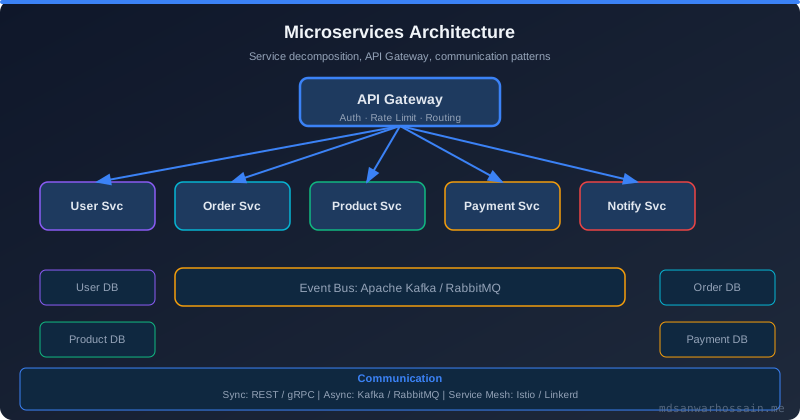
The microservices architectural pattern is inherently backend-centric. Service boundary design, API contract management, distributed data ownership, inter-service communication patterns, and operational concerns like service mesh configuration — all of these live in the backend domain and require deep expertise that AI tools can assist but not replace.
Full-stack engineers working in microservices architectures are most effective when their primary depth is in backend systems. Frontend responsibilities are typically smaller per service and more amenable to AI-assisted implementation. The architectural complexity accumulates on the backend side: consistency guarantees, failure propagation, schema evolution across service versions, and observability across distributed boundaries.
When to Specialize vs Generalize: A Decision Framework
Rather than dogma, use this framework to evaluate your own situation:
Specialize (Backend or Frontend) when:
- You're at a large company (500+ engineers) where team coordination is the limiting factor and deep expertise in one area creates clear leverage.
- Your target domain has high regulatory or security complexity (fintech, healthcare, government) where depth is non-negotiable.
- You want to move into a Staff or Principal Engineer track — these roles reward depth and architectural thinking in a specific domain.
- You work in a platform engineering or infrastructure role where the "product" is the engineering platform itself.
Go Full-Stack when:
- You're at a startup or scale-up (under 200 engineers) where shipping features fast is more important than deep specialization.
- You want to found or co-found a company — full-stack capability reduces co-founder dependencies in early stages.
- Your team uses AI-native workflows where feature ownership is end-to-end and the team is organized around outcomes rather than layers.
- You're building a side project or SaaS — owning the full stack gives you the fastest path from idea to shipped product.
What Skills to Focus on for Each Path
Backend Specialist (Java/Spring Boot focus)
- Deep JVM internals: GC tuning, thread models, memory management
- Distributed systems: consensus algorithms, consistency models, saga patterns
- Kubernetes: operators, admission controllers, resource management
- Security: OAuth2, mTLS, RBAC, threat modeling
- Observability: OpenTelemetry, distributed tracing, SLO engineering
Full-Stack Engineer (T-shaped)
- One backend framework deeply (Spring Boot or Node.js/Express)
- One frontend framework competently (Angular or React)
- Database fundamentals: SQL query optimization, indexing, schema design
- Infrastructure basics: Docker, basic Kubernetes, CI/CD pipelines
- AI-assisted development workflows: prompt engineering, Cursor, Copilot
Key Takeaways
- AI lowers the implementation barrier for both frontend and backend work, but does not eliminate the need for architectural and systems expertise.
- Backend specialization remains highly valuable — but must focus on high-judgment areas like distributed systems, security, and platform engineering.
- Full-stack capability is increasingly advantageous in AI-native teams where feature ownership is end-to-end.
- Java Spring Boot remains the dominant enterprise backend choice in 2026 for structural, not sentimental reasons.
- Your specialization decision should be driven by company size, role trajectory, and domain complexity — not industry fashion.
- The T-shape model is the practical optimum: broad enough to collaborate across layers, deep enough to lead in your primary domain.
Conclusion
The backend vs full-stack debate has been given a new dimension by AI. The tools that once enforced specialization through friction are now available to everyone. What they can't provide is judgment — the ability to make the right architecture decision for a specific system under specific constraints with specific business consequences. That judgment is what specialization builds, and it's what the market will continue to reward. Whether you go deep on backend systems or broad as a full-stack engineer, make sure you're investing in the high-judgment, low-automation skills that compound over time. Those are the career assets that AI makes more valuable, not less.
Frequently Asked Questions
How AI Is Blurring the Backend/Frontend Boundary?
The traditional justification for specialization was the steep learning curve of each domain. Frontend required deep CSS intuition, browser quirks knowledge, component lifecycle mastery, and accessibility expertise. Backend required distributed systems thinking, query optimization, concurrency models, and security depth. These took years to internalize — and few people had the time to build genuine expertise in both. AI has dramatically lowered the entry cost for each domain. GitHub Copilot can generate a well-structured Angular component with reactive forms and HTTP interceptors in seconds. Claude Code can scaffold a Spring Boot microservice with persistence, validation, and OpenAPI documentation in minutes. This doesn't mean AI has mastered these domains — it means the boilerplate burden that used to enforce specialization has been lifted.
What Backend Specialization Still Offers in 2026?
Backend specialization remains highly valuable — but the definition of "backend" has evolved. Pure CRUD API engineering is increasingly automated. The backend skills that still command premium salaries and career longevity are those that require deep systems understanding: If you're a backend specialist, the strategic move is to deepen into these high-judgment, low-automation areas rather than defending pure API development turf that AI is encroaching upon. Distributed systems design: Consistency models, partition tolerance, saga orchestration, and event sourcing are not AI-generatable decisions. They require understanding your specific system's failure modes. Database performance engineering: Query plan analysis, index strategy, connection pool tuning, and schema migration patterns require contextual judgment that AI can only partially support.
What is The Full-Stack Advantage in AI-Native Teams and how does it work?
In AI-native engineering teams — those organized around small, autonomous units shipping features end-to-end — full-stack capability is increasingly a superpower. When each engineer can own a feature from database schema to UI component, team coordination overhead drops dramatically. Product iteration speed increases. On-call rotations become less specialized. Full-stack engineers in these environments are using AI to fill competency gaps in real time: an engineer with strong backend foundations can use Cursor to generate and iterate on the frontend of their feature without waiting for a frontend specialist. The caveat: "full-stack" in AI-native teams doesn't mean equal depth in everything. It means enough frontend competence to ship features and enough backend depth to own production reliability. The T-shape model applies: broad competence, deep expertise in one dimension.
How do you implement Java Spring Boot Backend — Still the Enterprise Choice?
Despite years of predictions about its displacement, Java with Spring Boot remains the dominant enterprise backend stack in 2026. The reasons are structural, not sentimental: For backend-focused engineers, Java + Spring Boot + Kubernetes remains the combination that opens the most doors in enterprise contexts, financial services, and large-scale SaaS. Ecosystem maturity: Spring's integration with security, messaging, persistence, and observability is unmatched. Spring Boot 3.x with virtual threads (Project Loom) has closed the reactive performance gap for most workloads. Operational tooling: Actuator endpoints, Micrometer metrics, OpenTelemetry integration, and Spring Boot's auto-configuration make production operations significantly more tractable than younger frameworks. Team scalability: Convention-over-configuration means large teams can onboard engineers who share a common mental model. This matters at scale in ways that bespoke architectures don't.
What is Angular and React on the Frontend — Where AI Accelerates Most and how does it work?
The frontend is the domain where AI has achieved the highest relative productivity gain. Component generation, styling, form validation, HTTP service wiring, and basic state management — all heavily formulaic — are now largely AI-generatable with high fidelity. This means that a backend-primary engineer adopting a T-shape model can credibly own frontend work for their features with AI assistance. Angular remains dominant in enterprise environments, particularly those with Java backends, because of its strong typing, opinionated structure, and built-in tooling for large teams. React dominates in product-focused companies and startups where iteration speed and ecosystem flexibility are prioritized. What AI doesn't accelerate well on the frontend: complex animation and interaction design, accessibility auditing, performance optimization (Core Web Vitals tuning, bundle splitting strategy), and cross-browser regression analysis.
Leave a Comment
Related Posts

Software Engineer · Java · Spring Boot · Microservices