Engineering a High-Signal Code Review Culture: Automation, Etiquette, and Latency Reduction
Code review is the highest-leverage engineering practice most teams do wrong. Reviews devolve into style debates while architectural landmines pass unnoticed. PRs sit unreviewed for days, blocking downstream work and demoralising authors. In this deep dive, we build a systematic framework for high-signal reviews: automate everything a machine can check, establish explicit etiquette contracts between authors and reviewers, leverage AI as a first-pass filter, and design async workflows that cut review latency without cutting review depth.
Table of Contents
- The Code Review Problem: Low Signal, High Latency, Team Friction
- The Review Etiquette Contract: What Reviewers and Authors Owe Each Other
- Automating the Automatable: Linters, Formatters, and Static Analysis in CI
- AI-Assisted Reviews: GitHub Copilot, CodeRabbit, and Where AI Falls Short
- Structuring PRs for Fast, High-Quality Reviews
- Reducing Review Latency: Async Workflows and SLA Agreements
- Reviewing for Architecture vs Reviewing for Style
- Measuring Review Quality: Metrics That Matter
- Key Takeaways
- Conclusion
1. The Code Review Problem: Low Signal, High Latency, Team Friction
Picture a 12-engineer product team at a mid-sized SaaS company. They ship two-week sprints, have a reasonable test suite, and use GitHub for source control. Pull requests are required before merging to main. On paper, the process looks solid. In practice, it is quietly destroying velocity and morale.
PRs routinely sit unreviewed for two to three days after opening. When reviews do arrive, they consist overwhelmingly of nitpicks: missing Javadoc on a private helper, a variable named res instead of response, a constructor parameter ordering that the reviewer personally dislikes. Meanwhile, a PR that introduced a synchronous HTTP call inside a database transaction loop — a latency time bomb under load — was approved in twenty minutes with a single thumbs-up emoji. Nobody had the cognitive bandwidth left after the style debate on the previous three PRs to notice the architectural issue buried on page three of the diff.
The costs compound over time. Slow review turnaround directly impacts DORA's deployment frequency metric. Developer frustration from low-signal reviews correlates strongly with attrition — engineers who feel their work is not genuinely engaged with start looking elsewhere. Most importantly, bugs that a focused architectural review would have caught are shipped, causing incidents, customer impact, and the expensive rework cycle of fixing production problems instead of preventing them.
The solution is not to do fewer reviews or to review less carefully. It is to redirect human attention to what only humans can evaluate — correctness, design, security semantics, business logic — and automate everything else. That requires a deliberate, structured approach to the entire review workflow, from how PRs are written to how feedback is delivered to how review quality is measured.
2. The Review Etiquette Contract: What Reviewers and Authors Owe Each Other
A review etiquette contract is a team-agreed, written document (keep it in your engineering wiki, not in someone's memory) that defines explicit obligations on both sides of the review relationship. Without it, expectations are implicit, conflict is inevitable, and culture degrades to whoever complains loudest.
What authors owe:
- Small, focused PRs under 400 lines of logic change. This is not an arbitrary limit — research consistently shows that review effectiveness drops sharply above this threshold. Reviewers become fatigued, miss issues, and rubber-stamp. If a feature naturally requires more changes, decompose it into a stack of dependent PRs.
- A clear PR description explaining the WHY, not just the WHAT. The code diff shows what changed. The description must explain why this change is necessary, what alternatives were considered, and what trade-offs were made. A reviewer who understands the intent can evaluate whether the implementation achieves it.
- A self-review before requesting human review. Read your own diff with fresh eyes in the GitHub UI, not your editor. You will catch 20–30% of issues yourself. If you find yourself embarrassed by something you see in the diff, fix it before requesting review — do not waste a reviewer's attention on things you already know are wrong.
- A test coverage report attached or linked. Reviewers should not have to guess whether the changed code is tested. Include the coverage delta or link to the CI coverage report so reviewers can focus on test quality rather than test presence.
What reviewers owe:
- A first response within 24 business hours. Not necessarily a full review — an acknowledgement that you've seen the PR and will review by a specific time is sufficient. Silence is the most demoralising response an author can receive.
- Distinguishing blocking from non-blocking feedback. Use the
nit:prefix for non-blocking comments — style preferences, minor naming suggestions, optional refactoring ideas. A reviewer who mixes blocking correctness issues with non-blocking preferences forces authors to guess which must be addressed before merge. This ambiguity causes unnecessary delay and re-review cycles. - Not re-reviewing already-approved code. If you approved a section in round one and the author made unrelated changes in round two, do not re-litigate the approved section. Approve what is ready, block only on new issues introduced in the new round.
- Avoiding bike-shedding. If you have a preference about a naming convention, formatting rule, or code structure pattern that is not enforced by the team's linter, your options are to accept the author's approach or to add the rule to the linter. Expressing it as a review comment is a tax on the author's time for a preference that has no objective correctness.
The etiquette contract should be reviewed and updated quarterly. As the team's tooling evolves — new linter rules, new CI checks, new PR templates — the contract must reflect what is now automated and what therefore no longer warrants human review attention.
3. Automating the Automatable: Linters, Formatters, and Static Analysis in CI
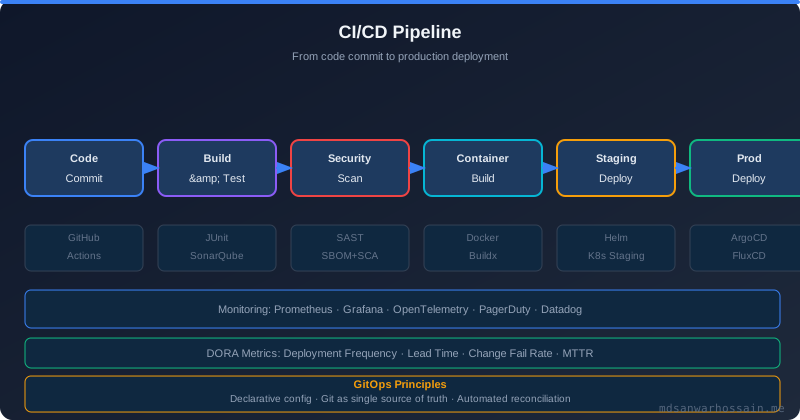
The cardinal rule: if a machine can check it, a human should not spend time on it. Every minute a reviewer spends commenting on code formatting is a minute not spent evaluating whether the algorithm is correct or the database query will cause a full table scan under production data volumes. CI must catch the following categories of issues as required status checks — PRs that fail any of these checks cannot be merged, regardless of how many approvals they have.
Code formatting: Use Checkstyle or Spotless for Java projects, ESLint and Prettier for JavaScript/TypeScript. Configure these tools to fail the build on any deviation from the agreed style. Run them in check-only mode in CI (not auto-fix — developers should run the formatter locally before pushing). Once formatting is fully automated, it disappears from code review conversations entirely.
Code style and complexity: PMD catches common Java anti-patterns — unnecessary null checks, overly complex methods, improper exception handling. SpotBugs identifies potential null pointer dereferences, resource leaks, and thread-safety violations at the bytecode level. Configure both with a project-specific ruleset that the team has agreed upon; the default rulesets contain rules that may not apply to your codebase.
Dead code and complexity metrics: SonarQube's quality gate can enforce cognitive complexity limits per method, flag unreachable code branches, and track code duplication percentage across the codebase. Set up a SonarQube quality gate as a required CI check with thresholds the team agrees are realistic for your codebase's current state, then tighten them incrementally each quarter.
Security hotspots: Semgrep and CodeQL both run effectively in CI pipelines and catch classes of security issues — SQL injection patterns, unsafe deserialization, hardcoded credentials, insecure cryptographic API usage — that reviewers would need specialist expertise to identify reliably on every PR. Treat security tool findings as blocking by default; triage false positives explicitly rather than suppressing tool categories broadly.
Test coverage threshold: Configure Jacoco (for Java) or Istanbul (for JavaScript) to fail the build if overall branch coverage drops below 70%, or if coverage on changed lines specifically drops below a higher threshold (85% is reasonable). The exact numbers are less important than the principle: coverage regressions are caught automatically before they accumulate into untested legacy code.
Here is a GitHub Actions workflow that implements all of these checks as required status checks:
name: PR Quality Gates
on: [pull_request]
jobs:
  quality:
    runs-on: ubuntu-latest
    steps:
      - uses: actions/checkout@v4
      - name: Run Checkstyle
        run: mvn checkstyle:check
      - name: Run SpotBugs
        run: mvn spotbugs:check
      - name: Run Tests with Coverage
        run: mvn test jacoco:report
      - name: Enforce Coverage Threshold
        run: |
          COVERAGE=$(python3 scripts/extract_coverage.py)
          if [ "$COVERAGE" -lt 70 ]; then
            echo "Coverage $COVERAGE% below 70% threshold"
            exit 1
          fi
In your GitHub repository settings, mark the quality job as a required status check on the main branch. Reviewers can then start from the assumption that any PR they receive has already passed all automated quality gates — allowing them to focus their cognitive energy entirely on the logic, design, and correctness questions that automation cannot answer.
4. AI-Assisted Reviews: GitHub Copilot, CodeRabbit, and Where AI Falls Short
The AI-assisted code review ecosystem has matured significantly in 2025–2026. Tools like CodeRabbit, GitHub Copilot pull request summaries, and Qodo Merge (formerly PR-Agent) now provide genuine pre-human-reviewer value when configured correctly. Understanding where they excel and where they fail is essential to integrating them without creating false confidence.
Where AI review tools add genuine value:
- PR summaries: CodeRabbit and Copilot can generate accurate, structured summaries of what a PR changes — which files were modified, what the primary intent appears to be, and what categories of change are present (new feature, refactor, bug fix, test addition). This primes human reviewers to focus their attention appropriately before reading a single line of code.
- Potential null pointer and exception handling issues: AI reviewers reliably flag missing null checks on method parameters, unchecked cast operations, and exception swallowing patterns in catch blocks. These are high-frequency, low-context issues that AI handles well.
- Missing edge case tests: Given a new method implementation, AI tools can suggest edge cases that are not covered by the existing tests — empty collections, negative integers, timezone boundary conditions, concurrent access scenarios. The suggestions are not always relevant, but the rate of useful suggestions is high enough to justify the noise.
- Security pattern identification: AI reviewers can flag string-concatenated SQL queries, unvalidated user input passed to file system operations, and missing authorization checks on new API endpoints. They are not a replacement for a dedicated security review, but they catch the obvious patterns reliably.
Where AI review tools fail:
- Business logic correctness: AI has no access to your product requirements, user stories, or domain model decisions. It cannot tell you whether the discount calculation logic is correct per your pricing contract, or whether the authorization rule matches your access control specification.
- Architectural alignment: AI cannot evaluate whether a new service dependency fits your team's target architecture, whether extracting this logic into a shared library is the right abstraction, or whether the approach chosen is consistent with decisions made in your architecture decision records.
- Performance at scale: AI tools can flag obvious N+1 query patterns, but they cannot reason about the performance profile of your specific data volumes, caching layer behaviour, or the interaction effects between this PR and three other concurrent changes on the same service.
- Team-specific conventions: Your team may have agreed that all external API calls go through a specific circuit-breaker wrapper, or that all events published to Kafka must include a specific correlation ID header. AI tools don't know these conventions unless they are explicitly documented in a format the tool ingests.
The correct integration model is to use AI as a first-pass pre-human reviewer: AI comments on the PR, the author addresses obvious issues, and only then does the PR enter the human review queue. This pattern reduces the number of trivial issues human reviewers must flag, letting them focus their limited attention on the judgment calls that require human context.
5. Structuring PRs for Fast, High-Quality Reviews
A PR's reviewability is largely determined before a reviewer opens it. The author's choices about scope, description quality, and PR decomposition strategy determine whether a reviewer can engage deeply or is forced to reverse-engineer intent from a diff.
The single-purpose rule: Each PR should have exactly one clear purpose — one feature, one bug fix, or one refactor. Never mix a feature implementation with an unrelated cleanup, even if the cleanup is small. Mixed-purpose PRs force reviewers to mentally context-switch mid-review, increasing cognitive load and the probability of missing issues in the less prominent change. If you notice a cleanup opportunity while implementing a feature, create a separate draft PR for the cleanup and link them.
The PR description template: Standardise on a template that answers the questions reviewers would otherwise have to infer from the code:
## What
[One sentence summary of what this PR changes]

## Why
[Business or technical reason this change is necessary.
 Link to the ticket, incident report, or architecture decision that drove it.]

## How
[Approach taken and why this approach was chosen over alternatives.
 Highlight any non-obvious implementation decisions.]

## Test Plan
[How to verify this change works correctly:
 - unit tests added / modified
 - integration tests that cover this path
 - manual verification steps if applicable]

## Rollout Risk
[low / medium / high]
[Reason: e.g., "low - purely additive change behind feature flag",
          "high - modifies the payment processing state machine"]
PR stacking: When a feature requires sequential changes — PR2 depends on PR1 being merged — use stacked PRs only when the dependency is genuinely unavoidable. Mark stacked PRs clearly with a dependency note in the description. The risk of stacking is that a blocking review on PR1 cascades into delays on PR2 and PR3. Keep stacks shallow (two or three levels maximum) and merge as quickly as possible once each base PR is approved.
Draft PRs for early architecture feedback: For significant changes — new service abstractions, data model changes, cross-cutting concerns — open a draft PR with only the skeleton implementation before writing the bulk of the code. Request an architecture-level review early, before you have invested days of implementation effort in an approach the team may not endorse. This is dramatically cheaper than discovering architectural disagreements at full-PR review time.
6. Reducing Review Latency: Async Workflows and SLA Agreements
Review latency is one of the most direct controllable levers on your team's deployment frequency — a key DORA metric. A PR that sits unreviewed for three days doesn't just delay that feature; it creates merge conflicts, forces rebases, blocks dependent work, and signals to engineers that their contributions are not valued. Treating review latency as an engineering metric — tracked, discussed in retrospectives, and improved systematically — is a prerequisite for a high-performing team.
Target SLAs to agree on as a team:
- First review response (acknowledgement or initial comments): within 4 business hours of PR opening
- Full review turnaround for PRs under 400 lines: within 1 business day
- Full review turnaround for PRs over 400 lines (which should be rare): within 2 business days
- Re-review after author addresses feedback: within 4 business hours
Dedicated review slots: Calendar-blocking is the most reliable mechanism for ensuring reviews actually happen. Block two 30-minute review slots in every engineer's calendar: one in the morning (9:00–9:30 AM) and one at end of day (4:00–4:30 PM). These slots are protected from meeting scheduling and are used exclusively for reviewing open PRs. The morning slot ensures authors receive feedback before noon; the end-of-day slot ensures PRs opened during the day don't go unreviewed until the next day.
PR assignment rotation: Relying on engineers to self-assign for reviews creates uneven load distribution — some engineers review everything, others are rarely assigned. Implement an automatic rotation policy using GitHub's CODEOWNERS file to ensure balanced assignment. For cross-cutting files (e.g., CI configuration, shared infrastructure code), use a team-level CODEOWNERS entry that round-robins assignment.
# .github/CODEOWNERS
# Require review from any member of the backend team for service code
src/main/java/com/company/service/   @company/backend-team

# Require a senior engineer for infrastructure and CI changes
.github/workflows/                   @company/senior-engineers
terraform/                           @company/senior-engineers

# Require the data team for schema migrations
src/main/resources/db/migration/     @company/data-team
Async timezone workflows: For teams distributed across multiple timezones, the most effective latency strategy is submission timing. Authors should submit PRs at the end of their local workday so that engineers in the next active timezone can pick them up at the start of their day. A Bangalore-based engineer submitting at 6 PM IST provides an entire London morning for review; a London engineer submitting at 5 PM GMT hands off to a US East Coast team for their afternoon. Explicit timezone handoff conventions, documented in the team wiki, eliminate the awkward "waiting for review" state that otherwise consumes an entire working day.
7. Reviewing for Architecture vs Reviewing for Style
Conflating tactical and strategic review modes is one of the root causes of both low-signal reviews and missed architectural issues. These are fundamentally different activities, require different mindsets, and should be treated as distinct phases of the review process.
Tactical review is what most engineers think of as code review. It covers: correctness of the implementation given the stated intent, edge case handling (empty inputs, concurrent access, error paths), error handling completeness and appropriateness, security considerations at the implementation level (input validation, output encoding, authentication enforcement), and test coverage quality — not just whether tests exist but whether they test meaningful behaviour rather than implementation details.
Tactical review happens at the line level. It is what junior and mid-level engineers should do on every PR they review. It is also the level at which automated tools (static analysis, AI reviewers) provide their most reliable value, which means that by the time a PR reaches a human tactical reviewer, AI and CI should have already cleared the lowest-level findings.
Strategic review is a distinct activity that happens at the design and architecture level, not the line level. The questions a strategic reviewer asks are categorically different:
- Does this design fit the system's long-term architectural trajectory, or does it create a new inconsistency we will have to unify later?
- Is this change solving the right problem, or is it solving a symptom while leaving the underlying cause in place?
- Would a new team member joining in six months be able to understand and safely modify this code without extensive tribal knowledge?
- Would you be comfortable owning and maintaining this implementation in two years, when the original author may have moved on?
- Does this introduce a new cross-service dependency, data model assumption, or shared state that the broader team has not explicitly accepted?
Strategic reviews are conducted primarily by senior and staff engineers. They operate at the level of the entire PR, not individual lines. The most important insight about strategic reviews is their timing: the right moment for a strategic review is before full implementation, not after. For any change of significant complexity — new service abstractions, data model modifications, cross-team API contracts — request an architecture review session (a 30-minute synchronous discussion) before the author writes the bulk of the code. This is exponentially cheaper than discovering fundamental design disagreements when reviewing a 600-line PR that took two weeks to build.
8. Measuring Review Quality: Metrics That Matter
You cannot improve what you don't measure. Most teams have zero visibility into the health of their review process beyond anecdotal frustrations. Instrumenting the review workflow with the right metrics — tracked weekly in a team dashboard, reviewed in retrospectives — converts an opaque cultural practice into a data-driven engineering process.
PR cycle time (time from first commit on the branch to merge into main) is the highest-level throughput metric. It captures everything: development time, review latency, rework cycles after review, and merge queue wait time. A rising PR cycle time is an early warning signal that something in the development or review process is degrading before it shows up as a velocity problem in sprint delivery.
Review turnaround time (time from PR opened to first review comment or approval) measures specifically the latency introduced by the review process itself, independently of development time. If this metric is rising, the issue is reviewer availability or workload, not the quality of PRs being submitted. Target: under 4 business hours for the first response.
Rework rate (percentage of PRs that require more than three review rounds, or are reopened after merging due to review-missed bugs) is the quality signal most teams ignore. A low rework rate can indicate either excellent first-pass review quality or rubber-stamping — you need to look at it alongside review depth to distinguish them. A high rework rate indicates that reviewers are not engaging with the full scope of issues, or that PRs are arriving too large and complex for a single review pass to cover.
Review depth (average number of substantive review comments per PR, measured over rolling 30-day windows) tracks engagement quality. Too few comments (below 2–3 per PR) suggests rubber-stamping — reviewers are approving without genuine engagement. Too many comments (above 15–20 per PR consistently) suggests either bike-shedding or that PRs are arriving too large. The target range is roughly 4–12 substantive comments per PR. Track comment-to-nit ratio separately to monitor whether reviewers are following the etiquette contract's nit-prefix convention.
Change failure rate (DORA metric: percentage of deployments that cause a production incident requiring a hotfix or rollback within 24 hours) is the ultimate downstream indicator of whether reviews are effective. If your CI automation, AI review layer, tactical human review, and strategic architecture review are functioning well, this metric should be low and improving. A rising change failure rate, in the absence of other explanations, is evidence that reviews are not catching the issues that matter most.
Collect these metrics via GitHub's built-in analytics (pull request cycle time is available in GitHub Insights for Teams) or with a lightweight script against the GitHub API. Present them in your engineering retrospectives not as individual performance metrics but as system health indicators — the goal is to improve the process, not to rank individual reviewers.
Key Takeaways
- Automate style and formatting completely: Checkstyle, Spotless, ESLint, PMD, SpotBugs, and SonarQube as required CI checks eliminate the most common source of low-value review noise before any human sees the code.
- Establish an explicit etiquette contract: Document what authors and reviewers owe each other — small PRs, clear descriptions, 24-hour first-response SLAs, and mandatory
nit:prefixes for non-blocking feedback — and treat violations as process failures, not personal failures. - Use AI as a pre-human-reviewer filter: CodeRabbit, GitHub Copilot PR summaries, and Qodo Merge provide real value on null safety, missing test cases, and security patterns; but they cannot replace human judgment on business logic, architecture alignment, and performance at scale.
- Separate tactical from strategic review: Line-level correctness and edge-case reviews are the domain of tactical review; architectural fit and long-term maintainability require a different mode of engagement — one that should happen before implementation, not after.
- Treat review latency as a DORA metric: Calendar-block review slots, implement CODEOWNERS rotation, and establish explicit timezone handoff conventions. First response within 4 hours and full turnaround within 1 business day are achievable targets for most teams.
- Measure what matters: PR cycle time, review turnaround time, rework rate, review depth, and DORA change failure rate together give a complete picture of review process health — instrument them, track them weekly, and improve them systematically.
Conclusion
A high-signal code review culture is not an accident of hiring talented engineers — it is the product of deliberate process design. The 12-engineer team spending three days waiting for reviews that consist mostly of Javadoc complaints is not suffering from a talent problem; it is suffering from a systems problem. The solution is to build a layered review system: automated tools catch everything they can catch reliably, AI tools provide a fast pre-human pass on common patterns, and human reviewers are given the context, time, and focus to engage with the questions that genuinely require human judgment.
The return on investment is significant and measurable. Teams that implement this framework typically see PR cycle times drop by 40–60%, rework rates fall, and — most importantly — a qualitative shift in the nature of review conversations toward substantive discussions about design, correctness, and maintainability. Engineers begin to look forward to reviews as collaborative design conversations rather than dreading them as bureaucratic gauntlets. That cultural shift, more than any individual tool or process, is the hallmark of an engineering team operating at a high level.
Leave a Comment
Related Posts

Software Engineer · Java · Spring Boot · Microservices