DORA Metrics in Practice: Measuring and Improving Engineering Delivery Performance
The DevOps Research and Assessment (DORA) program's four key metrics have become the industry standard for understanding software delivery capability. But knowing the metrics and actually implementing a data-driven improvement culture are very different things. This guide covers both — with real instrumentation, failure analysis, and team-level anti-patterns.
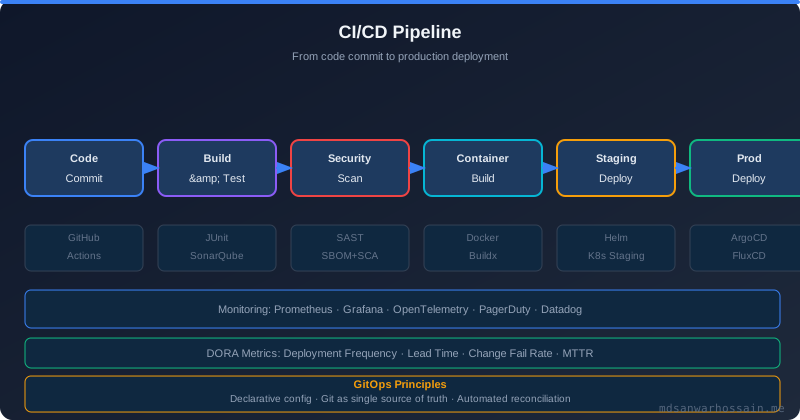
Table of Contents
- The DORA Research Foundation
- The Four Key Metrics Explained
- Instrumenting DORA Metrics in Your CI/CD Pipeline
- Performance Benchmarks: Elite vs. Low Performers
- Real-World Improvement Scenarios
- Failure Scenarios: When Metrics Lie
- The Fifth Metric: Reliability (Operational Health)
- Trade-offs and Pitfalls
- Key Takeaways
1. The DORA Research Foundation
The DORA (DevOps Research and Assessment) program, now part of Google Cloud, has tracked engineering team performance since 2014 across tens of thousands of professionals. Their annual "State of DevOps" reports represent the largest longitudinal study of software delivery practices in the industry.
The core finding: high-performing software teams deliver 208x more frequently than low performers, recover from incidents 2,604x faster, and have 7x lower change failure rates. This is not marginal improvement — it's a different order of magnitude. And the research shows these improvements directly correlate with organizational outcomes: profitability, market share, and employee satisfaction.
The four metrics aren't arbitrary — they were identified as the minimal predictive set after factor analysis of hundreds of engineering practices. They capture both throughput (how fast you deliver) and stability (how reliably you deliver).
2. The Four Key Metrics Explained
2.1 Deployment Frequency (DF)
Definition: How often your organization successfully deploys code to production (or releases to end users).
What it measures: Your ability to get small batches of changes into production quickly. High-frequency deployment is a forcing function for small, safe changes.
Common confusion: "Deployment" means production deployment to real users, not a deployment to staging. A release behind a feature flag counts only when the flag is enabled for real users.
2.2 Lead Time for Changes (LT)
Definition: The time from code commit to that commit running in production.
What it measures: The end-to-end speed of your delivery pipeline — build time, test time, approval gates, deployment time. Long lead times indicate pipeline bottlenecks or cultural approval friction.
Measurement start point: The first commit that's part of the change (not the PR open date). Use Git commit timestamps correlated with your deployment events.
2.3 Change Failure Rate (CFR)
Definition: The percentage of deployments that cause a degradation in service requiring a hotfix, rollback, or patch.
What it measures: Delivery quality. A high CFR indicates insufficient testing, poor change management, or lack of deployment safety practices (canary releases, feature flags).
Critical nuance: Not every production incident is a "change failure." A change failure requires a deployment to have occurred within the attribution window (typically 24–72 hours) and to be causally linked to the incident.
2.4 Mean Time to Restore (MTTR)
Definition: How long it takes to restore service after a production incident or degradation.
What it measures: Recovery capability — your incident response process, rollback tooling, observability quality, and team on-call effectiveness. High MTTR often signals poor observability (you don't know what's broken) or slow rollback pipelines.
3. Instrumenting DORA Metrics in Your CI/CD Pipeline
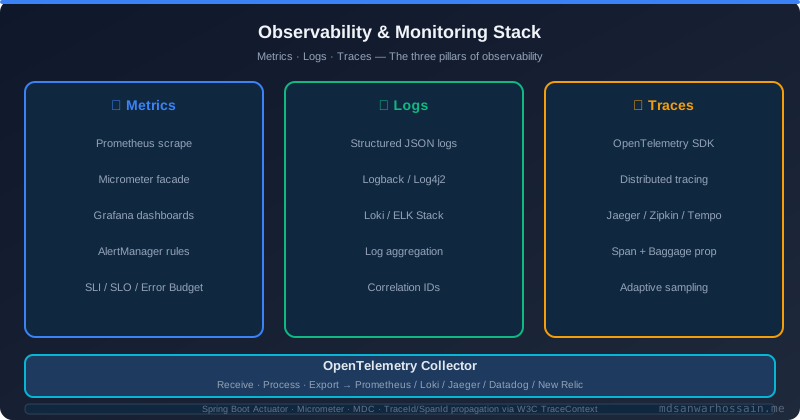
Accurate DORA measurement requires automated data collection from your toolchain — manual survey data is insufficient for operational decisions.
Data Sources Required:
- Deployment Frequency: Deployment events from CI/CD (GitHub Actions, ArgoCD, Spinnaker). Emit a webhook or write to a metrics store on every successful production deploy.
- Lead Time: Git commit timestamps (first commit SHA in the deployment set) + deployment timestamp. GitHub/GitLab APIs provide both; compute the delta per deploy.
- Change Failure Rate: Correlate deployment events with incident creation events (PagerDuty, OpsGenie, Jira). A deployment within the attribution window of an incident = potential change failure. Require engineers to manually confirm causation in post-mortem.
- MTTR: Incident start time (first alert) to incident resolved time from your incident management tool.
# Example: GitHub Actions step to record deployment event
- name: Record DORA deployment event
  if: github.ref == 'refs/heads/main' && success()
  run: |
    curl -X POST https://metrics.internal/dora/deployment \
      -H "Content-Type: application/json" \
      -d '{
        "service": "${{ github.repository }}",
        "environment": "production",
        "deployed_at": "'$(date -u +"%Y-%m-%dT%H:%M:%SZ")'",
        "commit_sha": "${{ github.sha }}",
        "first_commit_sha": "${{ env.FIRST_COMMIT_SHA }}",
        "first_commit_at": "${{ env.FIRST_COMMIT_AT }}"
      }'
Recommended Tooling:
- Four Keys (Google): Open-source BigQuery + Looker Studio pipeline for DORA metric calculation from GitHub/GitLab + PagerDuty events. Best for teams already on GCP.
- LinearB / Swarmia / Hatica: Commercial DORA platforms with Git + incident source integrations. Good for teams wanting out-of-box dashboards without infrastructure investment.
- Grafana + custom events: If you already use Grafana, push deployment and incident events to a Prometheus counter/gauge and build DORA panels. Most flexible for complex multi-team setups.
4. Performance Benchmarks: Elite vs. Low Performers
| Metric | Elite | High | Medium | Low |
|---|---|---|---|---|
| Deployment Frequency | Multiple/day | Weekly–daily | Monthly | <6 months |
| Lead Time for Changes | <1 hour | 1 day–1 week | 1 week–1 month | >6 months |
| Change Failure Rate | 0–15% | 16–30% | 16–30% | 16–30% |
| MTTR | <1 hour | <1 day | 1 day–1 week | >1 week |
Source: DORA State of DevOps Report 2023 benchmark clusters.
5. Real-World Improvement Scenarios
Scenario: Reducing Lead Time from 5 Days to 4 Hours
A logistics company's backend team had a 5-day average lead time. Investigation using actual data showed:
- Build + test time: 25 minutes (good)
- Wait for QA approval: 2.5 days (bottleneck)
- Wait for release manager approval: 1.5 days (bottleneck)
- Deployment + verification: 30 minutes (good)
Solutions applied: (1) Shifted QA left — automated contract tests eliminated manual QA for routine changes. (2) Introduced continuous deployment with automated rollback gates instead of manual release manager approval. (3) Used feature flags to decouple deployment from release. Result: lead time dropped to 4.2 hours average.
Scenario: Improving MTTR from 4 Hours to 18 Minutes
An e-commerce platform averaged 4-hour MTTR for production incidents. Root cause analysis of 6 months of incidents revealed: 70% of time was spent in diagnosis (figuring out what was broken), not in recovery. The fix wasn't faster rollbacks — it was better observability. After adding structured logging, distributed tracing, and service-level dashboards, MTTR dropped to 18 minutes because engineers could identify the root cause in minutes rather than hours.
6. Failure Scenarios: When Metrics Lie
Gaming Deployment Frequency
Teams under pressure to hit DF targets split large PRs into meaningless micro-commits or deploy trivial config changes to game the metric. This is Goodhart's Law: when a measure becomes a target, it ceases to be a good measure. Solution: measure DF alongside CFR — gaming DF without quality will show up immediately in the change failure rate.
Underreporting Change Failures
Teams reluctant to admit failures classify incidents as "infrastructure issues" or "external dependencies" to keep CFR artificially low. Require mandatory post-mortems for all P1/P2 incidents with explicit change-causation fields. Psychological safety is a prerequisite for honest metric collection.
MTTR Stops at "Mitigated" Not "Resolved"
Teams that close incidents when the immediate user impact is mitigated (e.g., by rolling back) but before the root cause is fixed report artificially low MTTR. Track both "time to mitigate" and "time to resolve root cause" separately.
7. The Fifth Metric: Reliability (Operational Health)
DORA added a fifth metric in 2021: Reliability (meeting availability/performance SLOs). This was added because teams that optimized the four metrics while running services at 90% availability were improving delivery but not customer experience.
Reliability is measured as the percentage of time you meet your defined SLOs (error rate, latency, availability). Track error budget burn rate alongside your DORA metrics to prevent delivery throughput from sacrificing service reliability.
8. Trade-offs and Pitfalls
- DORA is throughput-biased: Elite throughput is only valuable if reliability is maintained. Don't deploy 50 times a day if each deploy has a 20% chance of causing a user-impacting incident.
- Not all teams can be elite: Teams maintaining legacy systems, regulated software (FDA, financial), or non-web software have inherent deployment frequency constraints. Benchmark within your category.
- Cross-team dependency overhead: In monolithic or tightly coupled architectures, a single team can't improve lead time without other teams' cooperation. DORA metrics expose org-level constraints that require leadership intervention.
- Survey vs. toolchain measurement: DORA recommends starting with surveys for benchmarking context; use toolchain measurement for operational monitoring. Surveys give context; automated metrics give precision.
9. Key Takeaways
- DORA's four metrics (DF, LT, CFR, MTTR) are research-validated predictors of organizational performance — not vanity metrics.
- Automate metric collection from CI/CD + incident toolchain; manual tracking introduces selection bias.
- Lead time bottlenecks are usually in approval gates, not build time. Data reveals the truth.
- MTTR improvements come primarily from better observability, not faster rollback pipelines.
- Guard against Goodhart's Law by tracking pairs: DF + CFR, and LT + Reliability.
- Add reliability (SLO compliance) as the fifth metric to prevent throughput-reliability trade-offs going unnoticed.
Conclusion
DORA metrics work not because they're sophisticated, but because they're honest. They measure outcomes of your delivery system, not activities within it. A team with perfect PR review turnaround but a 5-day lead time has a systematic bottleneck — DORA data tells you where to look.
Start measuring today. Even imperfect data from toolchain instrumentation is vastly more useful than no data. Within one quarter, you'll have enough signal to identify your single biggest delivery bottleneck — and the data to make the case for fixing it.
Frequently Asked Questions
What is The DORA Research Foundation and how does it work?
The DORA (DevOps Research and Assessment) program, now part of Google Cloud, has tracked engineering team performance since 2014 across tens of thousands of professionals. Their annual "State of DevOps" reports represent the largest longitudinal study of software delivery practices in the industry. The core finding: high-performing software teams deliver 208x more frequently than low performers, recover from incidents 2,604x faster , and have 7x lower change failure rates . This is not marginal improvement — it's a different order of magnitude. And the research shows these improvements directly correlate with organizational outcomes: profitability, market share, and employee satisfaction. The four metrics aren't arbitrary — they were identified as the minimal predictive set after factor analysis of hundreds of engineering practices.
What is 1 Deployment Frequency (DF) and how does it work?
Definition: How often your organization successfully deploys code to production (or releases to end users). What it measures: Your ability to get small batches of changes into production quickly. High-frequency deployment is a forcing function for small, safe changes. Common confusion: "Deployment" means production deployment to real users, not a deployment to staging. A release behind a feature flag counts only when the flag is enabled for real users.
What is 2 Lead Time for Changes (LT) and how does it work?
Definition: The time from code commit to that commit running in production. What it measures: The end-to-end speed of your delivery pipeline — build time, test time, approval gates, deployment time. Long lead times indicate pipeline bottlenecks or cultural approval friction. Measurement start point: The first commit that's part of the change (not the PR open date). Use Git commit timestamps correlated with your deployment events.
What is 3 Change Failure Rate (CFR) and how does it work?
Definition: The percentage of deployments that cause a degradation in service requiring a hotfix, rollback, or patch. What it measures: Delivery quality. A high CFR indicates insufficient testing, poor change management, or lack of deployment safety practices (canary releases, feature flags). Critical nuance: Not every production incident is a "change failure." A change failure requires a deployment to have occurred within the attribution window (typically 24–72 hours) and to be causally linked to the incident.
What is 4 Mean Time to Restore (MTTR) and how does it work?
Definition: How long it takes to restore service after a production incident or degradation. What it measures: Recovery capability — your incident response process, rollback tooling, observability quality, and team on-call effectiveness. High MTTR often signals poor observability (you don't know what's broken) or slow rollback pipelines.
Leave a Comment
Related Posts

Software Engineer · Java · Spring Boot · Microservices