CompletableFuture Pitfalls in Production: Thread Pool Starvation, Exception Swallowing, and Debugging Strategies
CompletableFuture is one of the most powerful additions to the Java concurrency toolkit, enabling expressive, non-blocking async pipelines. But its subtlety is precisely what makes it dangerous in production. This article dissects the five most critical pitfalls that cause real-world outages — from ForkJoinPool thread starvation and silently swallowed exceptions to missing timeouts, blocking anti-patterns, and broken cancellation in composed futures. Each section pairs production war stories with actionable code fixes.
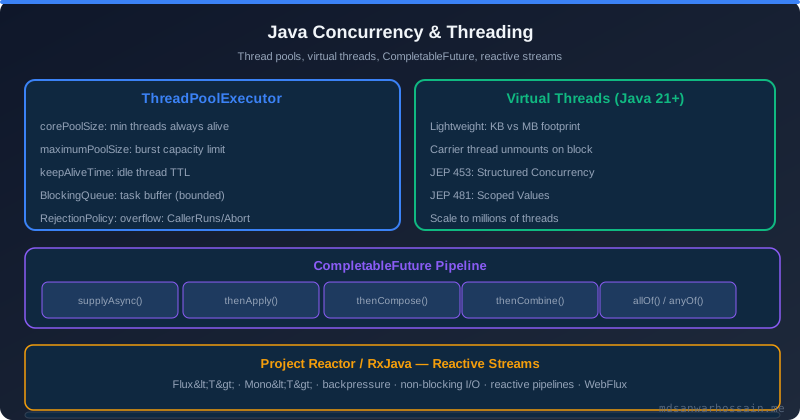
Table of Contents
- Introduction — The Async Code That Looked Fine But Wasn't
- Pitfall 1: The ForkJoinPool Default Executor Trap
- Pitfall 2: Silent Exception Swallowing
- Pitfall 3: Missing Timeouts and Orphaned Futures
- Pitfall 4: Blocking Inside Async Chains
- Pitfall 5: allOf() and anyOf() Failure Propagation
- Debugging CompletableFuture in Production
- Key Takeaways
- Conclusion
1. Introduction — The Async Code That Looked Fine But Wasn't
Picture a Spring Boot microservice under routine load review. The code is clean: three downstream service calls wrapped in CompletableFuture.supplyAsync(), composed with thenCombine(), and returned to the caller. Response times average 50 ms at normal traffic. Automated tests pass. Code review gives it a green tick. Six weeks later, the on-call pager fires at 2 AM. Response times have climbed to 30 seconds. The service is not down — it is just catastrophically slow.
Root cause: one of the three async tasks was performing a synchronous JDBC query inside the supplyAsync() lambda. Under high load, these blocking threads exhausted the default ForkJoinPool.commonPool(), which for an 8-core machine holds exactly 7 threads. Once the pool was saturated, every new async operation queued up, and the queue grew faster than it drained. The code looked correct; the architecture was silently broken.
This scenario captures the essence of CompletableFuture production failures: they rarely manifest during development or low-load testing, and they often produce confusing symptoms. The following five pitfalls represent the most dangerous patterns I have encountered across production Java services.
2. Pitfall 1: The ForkJoinPool Default Executor Trap
When you call CompletableFuture.supplyAsync(supplier) without specifying an executor, Java submits your task to ForkJoinPool.commonPool(). This pool was purpose-built for CPU-bound work-stealing algorithms — recursive tasks that can be subdivided and recombined efficiently. It is architecturally hostile to I/O-bound workloads.
The default pool size is Runtime.getRuntime().availableProcessors() - 1. On an 8-core container, that is 7 threads — shared across your entire JVM process, including libraries and frameworks also using supplyAsync() without a custom executor. A single blocking JDBC call taking 200 ms under load consumes one thread for 200 ms. At 40 RPS this saturates the pool almost instantly.
// DANGEROUS: uses ForkJoinPool.commonPool() — 7 threads on 8-core machine
CompletableFuture<User> userFuture = CompletableFuture.supplyAsync(() -> {
    return userRepository.findById(userId); // blocking JDBC — holds a ForkJoinPool thread!
});

// CORRECT: dedicated executor sized for I/O-bound work
ExecutorService ioExecutor = new ThreadPoolExecutor(
    20,                                  // corePoolSize
    100,                                 // maximumPoolSize
    60L, TimeUnit.SECONDS,               // keepAliveTime
    new LinkedBlockingQueue<>(500),      // bounded queue to prevent OOM
    new ThreadFactoryBuilder()
        .setNameFormat("async-io-%d")
        .setDaemon(true)
        .build(),
    new ThreadPoolExecutor.CallerRunsPolicy() // backpressure: caller thread executes on overflow
);

CompletableFuture<User> userFuture = CompletableFuture.supplyAsync(() -> {
    return userRepository.findById(userId);
}, ioExecutor); // always supply the executor explicitly
Maintain separate thread pools for I/O-bound and CPU-bound tasks. Expose pool metrics (active threads, queue depth, rejected tasks) to your observability platform. A growing queue depth is the earliest warning signal of pool starvation, giving you minutes to respond before response times degrade.
3. Pitfall 2: Silent Exception Swallowing
CompletableFuture captures exceptions internally and stores them in the future's completed-exceptionally state. If the future is never observed — no .get(), no .join(), no completion handler — the exception vanishes without trace. This is one of the most insidious failure modes in async Java code.
A real incident: a nightly batch job processed customer records asynchronously using runAsync(). An upstream schema change caused a DataAccessException on every record. Because no completion handler was attached, zero records were processed, zero exceptions were logged, zero alerts fired. The data corruption was discovered three days later during a reconciliation audit.
// DANGEROUS: exception silently captured, never observed
CompletableFuture.runAsync(() -> {
    processCustomerRecord(record); // throws DataAccessException — swallowed!
}, executor);

// CORRECT: use exceptionally() for recovery, handle() for unified success/failure handling
CompletableFuture.supplyAsync(() -> processCustomerRecord(record), executor)
    .exceptionally(ex -> {
        log.error("Failed to process record {}: {}", record.getId(), ex.getMessage(), ex);
        alertingService.sendAlert("batch-processing-failure", ex);
        return null; // or a fallback value
    });

// handle() gives access to both result and exception in one callback
CompletableFuture.supplyAsync(() -> callExternalService(request), executor)
    .handle((result, ex) -> {
        if (ex != null) {
            metrics.increment("external.call.failure");
            log.warn("External call failed, using cached result", ex);
            return cache.getLastKnownGood(request.getKey());
        }
        metrics.increment("external.call.success");
        return result;
    });

// whenComplete() for side-effects without altering the result/exception
future.whenComplete((result, ex) -> {
    if (ex != null) log.error("Async task failed", ex);
    else log.debug("Async task succeeded with result: {}", result);
});
The key distinction: exceptionally() only fires on failure and returns a recovery value; handle() fires on both success and failure, allowing unified transformation; whenComplete() fires on both but cannot transform the outcome. For production systems, always attach at least a whenComplete() to every fire-and-forget future to ensure exceptions reach your logging and alerting pipeline.
4. Pitfall 3: Missing Timeouts and Orphaned Futures
Calling future.get() without a timeout is a deadlock waiting to happen. If the async task never completes — due to a hung downstream service, an infinite loop in business logic, or a thread that is itself waiting on another blocked thread — the calling thread waits forever, eventually exhausting the HTTP thread pool and cascading to a full service outage.
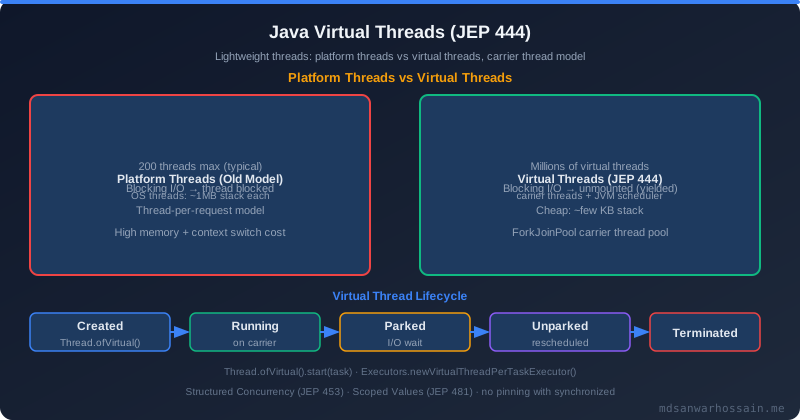
Orphaned futures are a related problem: when an API gateway or load balancer times out a request and drops the client connection, the internal CompletableFuture chain continues executing. These zombie tasks consume thread pool capacity and can cause downstream services to receive requests for work whose results will never be used.
// DANGEROUS: unbounded wait — potential deadlock
String result = future.get(); // blocks forever if future never completes

// CORRECT: always use timeout overload
String result = future.get(5, TimeUnit.SECONDS); // throws TimeoutException on breach

// Java 9+: orTimeout() integrates timeout into the pipeline
CompletableFuture<String> withTimeout = CompletableFuture
    .supplyAsync(() -> callSlowService(), executor)
    .orTimeout(5, TimeUnit.SECONDS); // completes exceptionally with TimeoutException

// completeOnTimeout() provides a fallback value instead of an exception (Java 9+)
CompletableFuture<String> withFallback = CompletableFuture
    .supplyAsync(() -> callSlowService(), executor)
    .completeOnTimeout("default-value", 3, TimeUnit.SECONDS);

// Combine timeout with graceful fallback
CompletableFuture<ProductInfo> productFuture = CompletableFuture
    .supplyAsync(() -> productService.fetchDetails(productId), ioExecutor)
    .orTimeout(2, TimeUnit.SECONDS)
    .exceptionally(ex -> {
        if (ex instanceof TimeoutException) {
            log.warn("Product service timed out for id {}, using cached data", productId);
            return productCache.get(productId);
        }
        throw new CompletionException(ex);
    });
With Java 21's StructuredTaskScope, timeout handling becomes even more elegant. StructuredTaskScope.ShutdownOnFailure and ShutdownOnSuccess scopes automatically cancel sibling tasks when one succeeds or fails, eliminating orphaned futures at the API level. For services on Java 21+, structured concurrency should be preferred over manual allOf() + orTimeout() chains.
5. Pitfall 4: Blocking Inside Async Chains
The subtlest pitfall is calling .get() or .join() inside a thenApplyAsync() or thenCompose() callback. This reintroduces blocking on the very thread pool thread you were trying to free, negating the benefit of the async pipeline and potentially causing deadlocks when the nested future is also submitted to the same pool.
// ANTI-PATTERN: blocking inside async chain — deadlock risk on small pools
CompletableFuture<OrderSummary> badChain = CompletableFuture
    .supplyAsync(() -> fetchOrder(orderId), executor)
    .thenApplyAsync(order -> {
        // Calling .join() on another future INSIDE the async callback!
        // If executor is saturated, this future may never execute -> deadlock
        User user = fetchUser(order.getUserId()).join(); // BLOCKS the pool thread
        return buildSummary(order, user);
    }, executor);

// CORRECT: use thenCompose() to flatten nested async calls into a single pipeline
CompletableFuture<OrderSummary> goodChain = CompletableFuture
    .supplyAsync(() -> fetchOrder(orderId), executor)
    .thenComposeAsync(order ->
        fetchUser(order.getUserId())                       // returns CompletableFuture<User>
            .thenApply(user -> buildSummary(order, user)), // non-blocking transformation
        executor
    );

// Spring @Async interop: returning CompletableFuture from @Async method
@Service
public class UserService {
    @Async("ioTaskExecutor") // named executor defined in AsyncConfig
    public CompletableFuture<User> fetchUserAsync(String userId) {
        return CompletableFuture.completedFuture(userRepository.findById(userId));
        // Do NOT: return CompletableFuture.supplyAsync(...) inside @Async — double-submits!
    }
}
To identify blocking in production, capture a thread dump with jstack <PID> or via JFR. Threads named ForkJoinPool.commonPool-worker-N or your custom pool threads that show java.util.concurrent.ForkJoinTask.get() or CompletableFuture.join() in their stack trace are blocked inside an async chain — a smoking gun for this anti-pattern.
6. Pitfall 5: allOf() and anyOf() Failure Propagation
CompletableFuture.allOf() returns a future that completes when all constituent futures complete. Crucially, it does NOT short-circuit on failure. If one of five futures throws an exception at T+100ms, the remaining four continue running until they finish or time out. In a fan-out pattern calling five downstream services, a single fast failure wastes the resources of four ongoing requests.
// Cancellation-propagating allOf() pattern
public static <T> CompletableFuture<List<T>> allOfWithCancellation(
        List<CompletableFuture<T>> futures) {

    CompletableFuture<List<T>> aggregate = new CompletableFuture<>();

    for (CompletableFuture<T> future : futures) {
        future.exceptionally(ex -> {
            // Cancel all siblings when one fails
            futures.forEach(f -> f.cancel(true));
            aggregate.completeExceptionally(ex);
            return null;
        });
    }

    CompletableFuture.allOf(futures.toArray(new CompletableFuture[0]))
        .thenRun(() -> {
            List<T> results = futures.stream()
                .map(CompletableFuture::join)
                .collect(Collectors.toList());
            aggregate.complete(results);
        });

    return aggregate;
}

// anyOf() zombie future problem: completed future is returned but others keep running
CompletableFuture<?> first = CompletableFuture.anyOf(
    fetchFromRegion("us-east"),
    fetchFromRegion("eu-west"),
    fetchFromRegion("ap-south")
); // The two slower futures continue consuming threads even after fastest returns!

// Fix: cancel remaining futures after anyOf completes
List<CompletableFuture<String>> futures = List.of(
    fetchFromRegion("us-east"),
    fetchFromRegion("eu-west"),
    fetchFromRegion("ap-south")
);
CompletableFuture.anyOf(futures.toArray(new CompletableFuture[0]))
    .thenRun(() -> futures.forEach(f -> f.cancel(true)));
Note that cancel(true) on a CompletableFuture only marks the future as cancelled — it does not interrupt the underlying thread. To achieve true cooperative cancellation, check Thread.currentThread().isInterrupted() inside your async lambdas at logical checkpoints, and use the cancellation signal to exit early.
7. Debugging CompletableFuture in Production
When a CompletableFuture-heavy service degrades in production, the first step is a thread dump. Look for threads with waiting on condition and java.util.concurrent.locks.AbstractQueuedSynchronizer in the stack — these indicate threads waiting for a future to complete. A high count of such threads relative to pool size confirms starvation.
One of the hardest debugging challenges is MDC (Mapped Diagnostic Context) loss across async boundaries. When you submit a lambda to a thread pool, the new thread does not inherit the caller's MDC context — correlation IDs and request context disappear from log lines. The fix is to capture and restore MDC explicitly:
// MDC propagation across async boundary
Map<String, String> mdcContext = MDC.getCopyOfContextMap();

CompletableFuture.supplyAsync(() -> {
    if (mdcContext != null) MDC.setContextMap(mdcContext); // restore context
    try {
        return callDownstreamService();
    } finally {
        MDC.clear(); // prevent context leak to next task on this thread
    }
}, executor);

// OpenTelemetry context propagation
Context otelContext = Context.current(); // capture current trace context
CompletableFuture.supplyAsync(() ->
    otelContext.wrap(() -> callInstrumentedService()).call(), // run inside captured context
    executor
);

// whenComplete() for per-task latency metrics
long startNs = System.nanoTime();
CompletableFuture.supplyAsync(() -> fetchProductDetails(id), executor)
    .whenComplete((result, ex) -> {
        long durationMs = (System.nanoTime() - startNs) / 1_000_000;
        meterRegistry.timer("async.fetch.product", "status", ex == null ? "ok" : "error")
                     .record(durationMs, TimeUnit.MILLISECONDS);
    });
Enable JFR (Java Flight Recorder) to capture thread pool statistics without significant overhead: jcmd <PID> JFR.start duration=60s filename=async-profile.jfr. The resulting recording exposes thread park/unpark events, helping you pinpoint exactly which async stages are blocking.
8. Key Takeaways
- Never use ForkJoinPool.commonPool() for I/O-bound tasks. Always provide a dedicated, properly sized
ThreadPoolExecutorwith a bounded queue and a rejection policy. - Attach completion handlers to every future. At minimum, use
whenComplete()to log exceptions. Silent failure in async code is indistinguishable from success at the caller level. - Always specify timeouts. Use
orTimeout()andcompleteOnTimeout()(Java 9+) rather than bare.get(). Unbounded waits cascade into full-service outages. - Never call
.get()or.join()inside a callback. UsethenCompose()to chain dependent async calls. Blocking inside a pool thread leads to deadlocks under load. - Implement cancellation in
allOf()fan-outs. DefaultallOf()does not cancel sibling futures on failure; wrap it with explicit cancellation propagation to avoid resource waste. - Propagate MDC and trace context explicitly. Capture context before submission and restore it inside the lambda. Without this, distributed traces and structured logs break across async boundaries.
9. Conclusion
CompletableFuture raises the ceiling for Java concurrency expressiveness — but it lowers the floor for how badly things can go wrong without discipline. The pitfalls covered here share a common thread: they are invisible during development, they manifest only under production load or specific failure conditions, and they produce symptoms (slowness, silent data loss, cascading timeouts) that are difficult to attribute without knowing where to look.
The remedies are not complex. Explicit thread pools, mandatory completion handlers, timeouts on every blocking call, thenCompose() for chaining, and proper MDC propagation — these patterns are the difference between async code that performs and async code that merely appears to perform. Apply them consistently, instrument your thread pools, and your CompletableFuture pipelines will be both fast and debuggable.
For services targeting Java 21+, evaluate StructuredTaskScope as a higher-level replacement for many allOf() / anyOf() patterns. Structured concurrency enforces lifetime scoping and cancellation semantics that eliminate entire classes of the pitfalls described here — the future of safe Java concurrency.
Leave a Comment
Related Posts

Software Engineer · Java · Spring Boot · Microservices