Core Java 2026: Performance, Concurrency, and AI-Ready Backends
Core Java fundamentals still decide whether a backend survives traffic spikes, incidents, and fast-moving feature work. This 1000+ word guide collects the 2026-ready practices every Java backend engineer should know, including how agentic AI fits the toolkit.
1) Virtual threads and structured concurrency as defaults
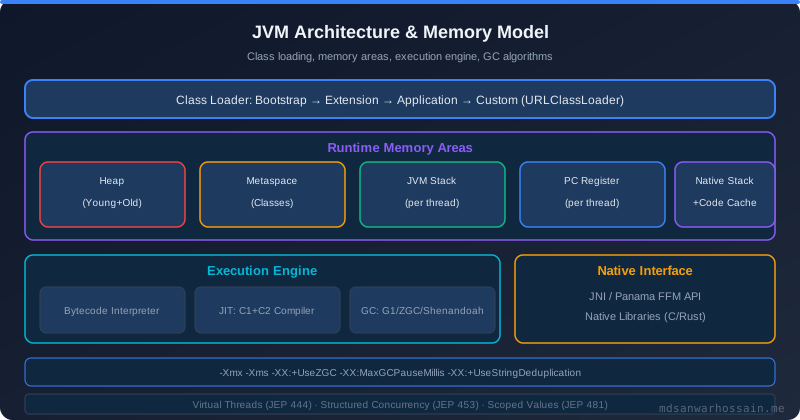
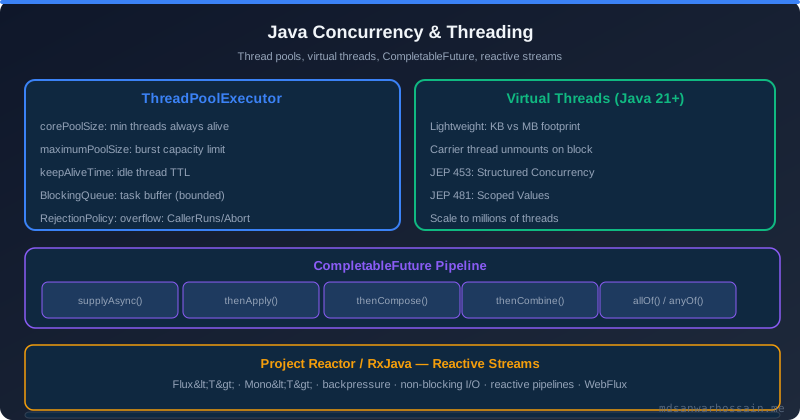
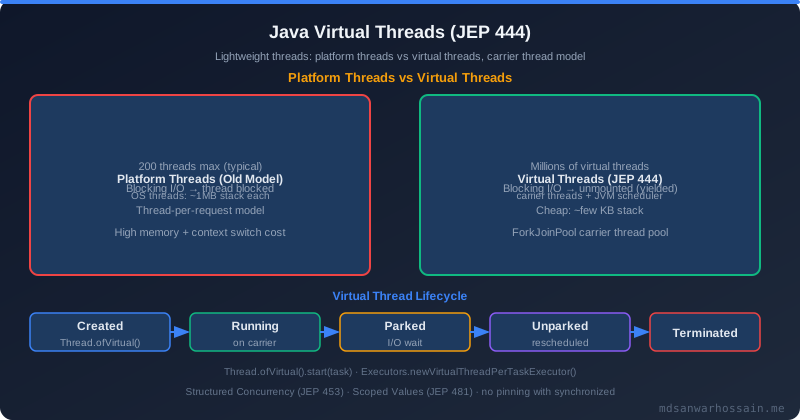
Java 21 virtual threads remove the classic “one thread per request” tax. Use virtual threads for I/O-heavy work so you keep threads cheap while protecting CPU. Pair them with structured concurrency (still a preview in Java 21, enable with --enable-preview or upgrade when it is final) to group related tasks, propagate cancellation, and capture errors cleanly. Keep thread pools bounded; a small carrier pool plus virtual threads usually beats giant fixed pools.
2) Choose I/O models intentionally
Virtual threads make imperative code viable again, but reactive stacks remain great for extremely chatty, latency-sensitive traffic. Avoid mixing paradigms unnecessarily; pick the model that matches traffic shape. If you are on Netty or WebFlux, isolate blocking calls behind dedicated schedulers. If you adopt Spring MVC with virtual threads, verify JDBC drivers and clients are truly non-blocking or sized appropriately.
3) Modern language features for clearer domain models
Records, sealed classes, and pattern matching reduce boilerplate and create safer domain models. Use records for DTOs and configuration snapshots to get immutability by default. Use sealed hierarchies for business states (e.g., PaymentAuthorized, PaymentDeclined) so the compiler enforces exhaustiveness in switch expressions. These features tighten API contracts and reduce runtime surprises.
4) Memory discipline that survives real traffic
Garbage collectors are powerful but not magic. Profile allocations with JFR or async-profiler to see where transient objects explode under load. Reuse buffers for hot paths, prefer primitive collections for telemetry-heavy data, and avoid unnecessary boxing. Use G1 defaults for most services and evaluate ZGC for large heaps or latency-sensitive APIs. Always benchmark changes against realistic load before promoting to production.
5) GC tuning paired with observability
GC tuning without telemetry is guesswork. Emit GC pause histograms, heap utilization, and allocation rates to your observability stack. Set SLO-aligned alerts on long pauses and promotion failures. Validate pause goals after each JDK upgrade because default behaviors evolve. If you adopt containerized workloads, pin max heap (e.g., -XX:MaxRAMPercentage) to avoid memory contention with sidecars and native images.
6) API contracts that are explicit and resilient
Use clear method signatures, non-null annotations, and typed errors for predictable behavior. Prefer checked business exceptions only when callers can recover; otherwise surface domain failures as problem-detail JSON with actionable error codes. Validate inputs at the edge using Bean Validation or lightweight guards. Define idempotency and timeouts in API contracts so downstream teams can design for retries safely.
7) Data layer choices with cost awareness
Pick JDBC for strong consistency paths and R2DBC or async drivers for high-concurrency read flows. Keep connection pools right-sized; a smaller pool with backpressure is safer than an oversized pool that starves the database. Introduce caching intentionally: read-through for catalog-style data, cache-aside for tolerant staleness, and request coalescing for thundering herd protection. Document TTL strategy and cache invalidation triggers to avoid invisible correctness drift.
8) Resilience primitives baked in
Timeouts, retries with jitter, circuit breakers, and bulkheads should be defaults, not optional helpers. Choose small default timeouts that align to user-facing latency budgets (for example, 60–80ms per downstream call if the page budget is 300ms). Combine retries with idempotency keys and poison-queue handling to prevent duplicate side effects. Simulate dependency failures in staging to prove your safeguards work.
9) Observability you can debug under pressure
Adopt OpenTelemetry for traces, metrics, and logs with consistent service, route, and tenant attributes. Add business context (orderId, tenant, feature flag state) to spans so on-call engineers can correlate symptoms quickly. Track RED metrics (rate, errors, duration) per endpoint and dependency. Link alerts directly to runbooks that include sample queries, known failure modes, and quick rollback steps.
10) Security and supply chain hygiene
Use dependency scanning and SBOM generation in CI. Pin container base images, enable certificate validation everywhere, and rotate secrets via your platform vault. Validate deserialization inputs to avoid gadget-based exploits, and favor JSON-B/Jackson with strict schemas over permissive parsers. Sign artifacts and use provenance (SLSA-style) for critical services so deployments remain auditable.
11) Build pipelines optimized for feedback speed
Fast, deterministic CI keeps teams shipping. Parallelize unit tests, cache Maven dependencies, and fail early on formatting and static analysis. Add smoke tests that boot the service with production-like config to catch missing environment variables. Publish JFR profiles or flamegraphs from performance test runs so developers see the impact of code changes before release.
12) Agentic AI as a productivity layer—not a crutch
Agentic AI copilots are now part of the Java toolkit. Use them to draft DTOs, REST clients, and test scaffolds, but review outputs with the same rigor as human code. Teach your copilot about house standards: logging format, error envelopes, and null-handling conventions. Combine AI-generated load-test scenarios with real traffic patterns to explore edge cases. Keep prompts and AI-generated code in version control for traceability.
13) Designing for operability in microservices and monoliths
Whether you run a modular monolith or a fleet of services, make operability a first-class design goal. Emit version metadata, support graceful shutdown, and keep health endpoints meaningful (dependency checks, not just “UP”). Prefer feature flags over long-lived branches for safer rollouts. Capture structured audit events for user-facing actions; they are priceless during incident investigations.
14) Continuous learning with JDK upgrades
Plan regular JDK upgrades to benefit from GC improvements, security patches, and library updates. Run canary environments on the new JDK with synthetic and replayed production traffic. Track CPU, allocation, and latency deltas before flipping all services. Keep a rollback path (container tag or deployment strategy) in case regressions appear.
Core Java excellence in 2026 is about disciplined fundamentals plus pragmatic adoption of modern features and AI assistance. If your team standardizes on the practices above—virtual threads where they fit, explicit contracts, observability you can trust, and agentic AI with guardrails—you will build backends that stay fast, safe, and maintainable even as your product and traffic scale.
Table of Contents
Real-World Problem: Latency Spikes Under Load
A high-traffic Java e-commerce platform serving 50,000 concurrent users during a flash sale experienced cascading latency spikes that weren't visible in normal load. The root cause was a combination of three issues: a fixed-size thread pool of 200 threads, connection pool exhaustion to PostgreSQL during bursts, and a GC configuration that hadn't been revisited since Java 8. Under peak load, threads piled up waiting for database connections, GC pauses spiked to 800ms due to heap pressure from transient order objects, and the circuit breakers, configured with a static threshold, opened prematurely.
The fix required three coordinated changes: migrating to virtual threads with Spring Boot 3.2 (eliminating the fixed pool constraint), profiling allocation hot spots with JFR and switching to object pooling for the most-allocated types, and switching from G1GC to ZGC with a reduced pause target. The result was p99 latency dropping from 2.1 seconds to 180ms under identical load, with no code changes to business logic.
Architecture: Structuring AI-Ready Java Services
Modern Java services that integrate agentic AI pipelines require careful architectural layering to keep latency budgets intact. The pattern that works best is asynchronous delegation: the HTTP request layer accepts the task, validates input, and returns an accepted status immediately. A virtual thread pool or CompletableFuture pipeline processes the AI calls asynchronously against upstream LLM APIs. Results are streamed back via Server-Sent Events or written to a message broker for downstream consumption. This decoupling prevents slow AI inference times (often 2–10 seconds) from blocking the web server's ability to accept new connections.
For synchronous AI-enhanced APIs where latency is acceptable, wrap all LLM calls with explicit timeout budgets using CompletableFuture.orTimeout() and degrade gracefully — return a cached result, a partial answer, or a fallback message — rather than propagating timeouts to the user as 500 errors.
Optimization: Reducing Allocation Pressure
Java's GC handles most allocation automatically, but for high-throughput backends, allocation pressure in hot paths directly determines GC frequency and pause duration. The most impactful optimization is identifying and eliminating unnecessary object creation on the critical path. Common culprits include string concatenation in loops (use StringBuilder or formatted string templates), boxing of primitives in generic collections (use Eclipse Collections or Koloboke primitive maps for telemetry data), and repeated deserialization of configuration objects that could be cached.
JFR allocation profiling makes this analysis straightforward: run the service under representative load, capture a 60-second JFR recording, and open it in JDK Mission Control. The Allocation by Thread view reveals which call stacks are allocating the most memory, pointing directly to the highest-ROI optimization targets.
Common Pitfalls in 2026 Java Backends
- Using synchronized on virtual-thread-heavy code: Synchronized blocks that perform I/O pin virtual threads to carrier threads and negate scalability gains. Audit existing code for synchronized I/O patterns before enabling virtual threads globally.
- Ignoring thread-local state with virtual threads: Thread-local variables work with virtual threads but can hold large objects in memory longer than expected when millions of virtual threads exist. Prefer scoped values (Java 21 preview) over ThreadLocal for request-scoped context.
- Connecting to non-virtual-thread-aware JDBC drivers: Not all JDBC drivers support non-blocking semantics. Verify your driver version before enabling virtual threads in a database-heavy service.
- Over-relying on AI-generated code without performance review: AI copilots generate functionally correct code but rarely generate performance-optimized code. Review AI output for unnecessary copies, unintended boxing, and missing null checks before merging.
Key Takeaways
- Virtual threads eliminate the fixed thread pool constraint for I/O-heavy services — enable them in Spring Boot 3.2+ with a single property.
- Profile allocations with JFR before tuning GC — reduce allocation pressure first, then tune GC parameters.
- ZGC targets sub-millisecond pauses for large heaps; G1GC remains the safe default for most services.
- Avoid synchronized blocks that hold locks during I/O in virtual-thread-enabled services; use ReentrantLock instead.
- Agentic AI integration requires async delegation patterns with explicit timeout budgets and graceful degradation.
Conclusion
The Java platform in 2026 offers more performance headroom than any previous generation, but that headroom requires deliberate engineering to unlock. Virtual threads, ZGC, modern language features, and AI-assisted development are powerful tools — but only when applied with a clear understanding of the underlying concurrency model, memory behavior, and operational realities. Teams that combine profiling-driven optimization with disciplined architectural boundaries and robust observability will build Java backends that remain competitive in performance and agility for years to come.
Leave a Comment

Software Engineer · Java · Spring Boot · Microservices